
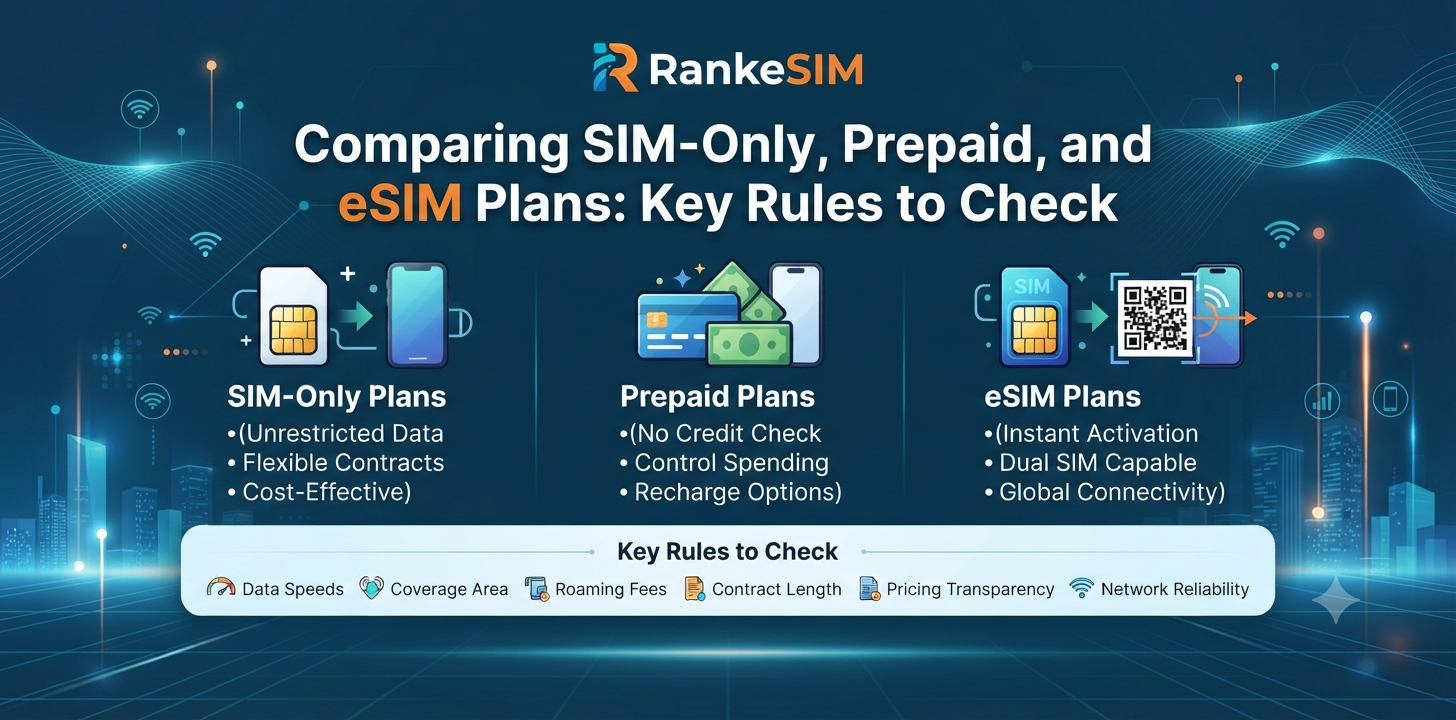
Picking a phone plan can look easy at first glance. Most phone companies show a big monthly price, a large data number, and a 5G logo right on their main page. Yet when you read the small print, that low price might only last for two or three months, lock you into a long contract, or block you from sharing data with your laptop.
To find a good mobile deal, you have to look past the ads. Things like how long a recharge lasts, whether speeds drop after a data cap, if your phone works on that network, and how strong the local signal is all shape what you really pay and get. A plan that looks cheap today can cost much more later if the rules do not fit how you use your phone.
Independent comparison sites like RankeSIM help people check these details side by side. By putting data limits, true monthly costs, and source check dates in one clear place, tools like this let you judge plans based on real facts instead of sales pitches.
Understanding the Main Types of Mobile Plans
Before you look at prices or data amounts, it helps to know how phone plans are built. Across most countries, mobile companies group their plans into six common types. Each one works best for different budgets and habits.
Prepaid Mobile Plans
With a prepaid plan, you pay upfront for a set pack of data, calls, and texts that lasts for a fixed time, such as 7, 28, or 30 days. When your data runs out or the time ends, you top up again by hand or set up auto-pay. Prepaid plans have no long contracts and rarely ask for a credit check, which makes them great for students, newcomers, and anyone watching their spending.
Postpaid Mobile Plans
Postpaid plans send you a bill at the end of each month for your base plan plus any extra charges outside your pack. They often give you larger data buckets, roaming perks, and the choice to pay off a new phone each month. On the flip side, postpaid plans usually require a local credit check, proof of address, and a fixed contract length.
SIM-Only Plans
A SIM-only plan gives you calls, texts, and data without a phone bundled in. You can find SIM-only deals on prepaid terms, rolling 30-day plans, or 12-month contracts. Because you are not paying off a new handset inside your bill, SIM-only plans usually cost much less if you already own an unlocked phone.
Pay-As-You-Go Plans
Pay-as-you-go plans charge you only for each megabyte of data, call minute, or text message you use, taking money from a balance you add ahead of time. There is no set monthly fee, though many networks ask you to make a paid call, send a text, or top up every few months to keep your number active. Light phone users and people who spend almost all day on Wi-Fi often save money with this setup.
Data-Only Plans
Data-only plans give you mobile internet without normal phone call minutes or SMS texts. They are made for tablets, laptops with SIM slots, portable Wi-Fi hotspots, and dual-SIM phones where you make calls through internet apps. Travelers and remote workers often use a data-only eSIM alongside their main number.
Bundled Mobile Plans
Bundled plans group mobile service with a financed smartphone or home services like fiber internet and TV. Multi-service deals can trim your total household bill, but they also make it harder and pricier to switch to another provider later.
Key Details to Check Before You Pick a Plan
Checking a phone plan means looking at all of its rules together. Focusing on just one number—like the starting price—often hides extra costs or limits elsewhere in the offer.
- Monthly or upfront price: Check the normal price you will pay after any short-term welcome discount ends.
- True cost over time: Add up every dollar or pound you will spend over 6 or 12 months—including setup fees, SIM card delivery costs, and price jumps after a promo period—then divide by the number of months.
- Data allowance: Look at how much fast data you get and what happens when it runs out. Some plans cut off data completely, some charge extra per gigabyte, and others slow your connection down to basic speeds.
- Plan length and renewal rules: See if the plan covers a full calendar month or a 28-day cycle. Over a full year, a 28-day plan means paying 13 times instead of 12.
- Call and text limits: Check if local calls and texts are unlimited, capped at a set number, or left out completely, and look up rates for calling other countries.
- 4G and 5G access: Make sure the plan includes 5G access if your phone supports it, and check whether the provider caps top download speeds on cheaper tiers.
- Hotspot and tethering rules: Confirm whether you can share your mobile data with a laptop or tablet, and check if hotspot data comes out of your main data pool or a smaller separate cap.
- Roaming rules: Find out if using your phone in another country adds daily roaming fees, pay-per-use rates, or strict fair-use data caps.
- SIM and eSIM support: Make sure your phone is unlocked and works with either a physical plastic SIM or a built-in eSIM from that company.
- Leaving and switching rules: Check how much notice you must give to cancel, whether early exit fees apply, and if you lose unused prepaid credit when moving your number.
Navigating Mobile Plan Choices in the United Kingdom
The UK mobile market runs on four main networks—EE, O2, Three, and Vodafone—along with many smaller brands such as giffgaff, Lebara, SMARTY, Tesco Mobile, and VOXI. Because people in Britain often buy their phones separately from their airtime, many shoppers keep their current handset and compare SIM-only deals UK providers offer on 30-day rolling or 12-month plans.
When looking at British options, it helps to separate rolling monthly bundles from classic credit-based plans. Many UK brands call their 30-day prepaid packs "rolling plans" that renew automatically from a bank card each month, whereas true pay as you go SIM deals UK operators offer deduct standard pence-per-minute, per-text, and per-megabyte rates from a top-up balance with no set monthly charge.
People who stream a lot of video often look at unlimited data SIM only deals UK companies advertise, yet "unlimited" rarely means zero rules. Most providers set fair-use limits that can cap hotspot sharing, limit free data roaming in Europe, or slow traffic during busy evening hours. Some lower-priced unlimited plans also cap download speeds at 2 Mbps or 10 Mbps, which can make large downloads sluggish. Reading the provider's fair-use page and checking local postcode signal maps helps you avoid surprises after signing up.
Evaluating Prepaid and 5G Plans in the United States
In the United States, three major carriers own nationwide cell towers—AT&T, T-Mobile, and Verizon—while dozens of carrier-owned and independent brands such as Cricket Wireless, Metro by T-Mobile, Mint Mobile, US Mobile, and Visible sell plans on those same networks. Because standard US postpaid bills can add up quickly once taxes and extra fees are included, many people compare prepaid phone plans USA brands offer to keep monthly costs predictable.
US prepaid options range from small single-line data packs to multi-line family discounts and bulk plans where paying for 3, 6, or 12 months upfront lowers your monthly rate. Still, US buyers should check how each plan handles network priority and hotspot use. Lower-cost prepaid plans often face data deprioritization, meaning your speeds temporarily slow down when a local tower gets crowded while higher-paying postpaid customers on the same network get faster access.
When shoppers compare 5G mobile plans, USA carriers promote, local coverage and phone hardware both matter. A plan with 5G access might mostly connect to low-band 5G, which reaches far into suburbs and rural towns at speeds close to 4G LTE, rather than mid-band 5G, which delivers much faster speeds in cities. Checking that your unlocked phone supports the carrier's specific 5G bands—and looking up real coverage at your home and office—is smart before you switch.
Exploring Mobile Connectivity Options in Australia
Australia has three physical mobile networks: Telstra, Optus, and Vodafone. Alongside those three carriers, many smaller providers—including Amaysim, Belong, Boost Mobile, Felix, and Moose Mobile—sell plans that run on parts or all of those networks. When locals and new arrivals compare mobile plans Australia wide, coverage outside major cities is often the biggest factor, especially for anyone who drives or works in regional towns.
Recharge length is another important detail in Australia. While some plans last a full calendar month or 30 days, many Australian prepaid recharges run on 28-day cycles, while others offer 7-day, 180-day, or 365-day expiry periods for light users. Checking whether unused gigabytes roll over to your next recharge—and whether you must keep auto-recharge turned on to save that banked data—can make a big difference in value.
Digital setup has also become much easier across the country, prompting many shoppers to check prepaid eSIM plans Australia providers now offer for newer phones. An eSIM lets you download your plan online in minutes without waiting for a plastic card in the mail, which is helpful for arriving students and travelers. Even so, not every Australian provider supports eSIM on prepaid plans, and some only allow certain phone models, so always check your device on the provider's site first.
Understanding Prepaid SIM Rules in Germany
Germany's mobile network relies on three main operators—Telekom Deutschland, Vodafone Germany, and O2 Telefónica—plus a newer fourth network being built by 1&1 and many budget brands like Aldi Talk, Congstar, fraenk, and Lidl Connect. Since traditional German postpaid contracts often lock you in for 24 months, flexible prepaid SIM plans Germany networks and discount brands sell are a popular choice for students, expats, and anyone who wants simple, no-contract pricing.
Most German prepaid packs run for four weeks (28 days) instead of a full calendar month, which adds up to 13 billing cycles per year. You can pick small starter data bundles or larger 5G packs, and your SIM balance usually stays active as long as you follow the provider's top-up schedule. Thanks to European Union roaming rules, most German prepaid plans also let you use your domestic data, calls, and texts while traveling in other EU countries at no extra charge, within standard fair-use limits.
One key legal rule in Germany is mandatory ID verification before a prepaid SIM or eSIM can be turned on. Under German law, mobile providers must verify your identity using a valid passport or national ID card—usually via a quick video call, an automated photo-ID check in an app, or in person at a post office or partner shop. Checking which ID documents a provider accepts before buying helps avoid activation delays, especially for newcomers with non-EU passports.
Key Factors for Comparing Mobile Plans in Canada
Canada's wireless market is led by three national carriers—Bell, Rogers, and Telus—along with regional providers such as Freedom Mobile, SaskTel, and Videotron, and flanker brands including Chatr, Fido, Koodo, Lucky Mobile, Public Mobile, and Virgin Plus. When people compare mobile phone plans Canada providers offer, location matters a great deal because prices, bonus data offers, and network choices change noticeably from one province or territory to another.
Provinces with active regional carriers often have lower monthly prices or larger data allowances than areas served mainly by the big three national networks. Canadian buyers should also check speed caps carefully: many flanker and prepaid brands limit connections to 4G LTE speeds or cap 5G speeds at a set ceiling, while higher-priced plans unlock full-speed 5G access and larger data pools.
Extra fees and payment rules can also change your final bill. In Canada, many providers charge a one-time setup or connection fee when you sign up in a store or by phone, though they often waive that fee if you activate online yourself. In addition, many advertised postpaid prices include a monthly discount for signing up for automatic bank payments, meaning the price goes up if you pay manually by credit card. Checking the regular rate, data overage rules, and provincial sales taxes helps you see the true monthly total.
Physical SIM Cards vs. eSIM Technology Explained
Deciding between a removable plastic card and a built-in digital chip is now a normal step when picking a phone plan. Knowing how SIM vs eSIM plans work in daily life helps you avoid setup headaches and pick the option that matches your device.
A physical SIM card is a small removable chip—usually a tiny nano-SIM—that holds your subscriber details and links your phone to a mobile network. You slide it into a tray on the side of your phone using a small pin tool. An eSIM (embedded SIM) is a tiny reprogrammable chip built directly into your phone's circuit board at the factory. Instead of inserting plastic, you load your mobile plan digitally by scanning a QR code or tapping a button in your carrier's app.
Both options have clear pros and cons depending on your phone and habits:
- Phone support: Almost every mobile phone takes a physical SIM card, while eSIM works mostly on mid-range and flagship phones made in recent years. Hardware also varies by country; for example, newer iPhones sold in the US have no physical SIM tray at all, while models sold in other regions still include one.
- Fast setup: You can turn on an eSIM online in a few minutes without waiting for postal delivery or visiting a shop, as long as you have Wi-Fi during setup.
- Easy switching and dual lines: Digital profiles make switching providers simple, and most modern eSIM phones let you save several profiles and keep two phone numbers active at once.
- Travel convenience: With an eSIM, you can keep your main home SIM active to receive bank security texts while using a local data plan on a second profile abroad.
- When a physical SIM is handier: If your phone breaks or runs out of power, moving a physical SIM card into a spare phone takes seconds. Moving an eSIM to another phone sometimes requires carrier app verification, a text code, or a fresh QR code from support.
Mobile Network Operators (MNOs) vs. MVNOs
As you shop around, you will notice that many mobile brands do not own cell towers. Learning the difference between Mobile Network Operators (MNOs) and Mobile Virtual Network Operators (MVNOs) explains why two plans using the same radio towers can have different prices and rules.
An MNO is a telecom company that owns and runs its own cell towers, licensed radio frequencies, core network gear, and billing systems. Well-known examples include EE in the UK, T-Mobile in the US, Telstra in Australia, Telekom in Germany, and Rogers in Canada. Because MNOs spend huge sums building and maintaining physical towers, their direct plans often cost more, though they usually come with full 5G access, higher data priority in busy areas, physical retail stores, and extra perks.
An MVNO does not own cell towers. Instead, it buys wholesale network access from one or more MNOs and sells mobile plans under its own brand name. Because MVNOs do not pay to build towers or run big store chains, they often pass those savings to customers through lower prices, simple no-contract plans, and easy online account tools.
Still, running on the same towers does not always mean identical service. Wholesale deals differ: an MVNO might get lower data priority when a local cell tower is crowded, miss out on certain high-speed 5G bands, or offer different roaming rules and support channels. Checking both the host network and the MVNO's own plan terms helps you balance lower prices against expected performance.
A Practical 10-Step Process for Comparing Mobile Plans
Using a simple checklist keeps catchy promotions from distracting you from what you actually need. Walk through these ten steps whenever you compare mobile plans:
- Check how much data you really use: Open your phone's cellular settings or look at your last three bills to see your average monthly gigabytes instead of paying for huge data packs you never finish.
- Pick prepaid or postpaid: Go with prepaid for strict budget control and zero contracts, or choose postpaid if you want larger data caps, family line bundles, or monthly phone payments.
- Verify phone and SIM support: Make sure your phone is unlocked, supports the provider's 4G and 5G bands, and works with a physical SIM or an eSIM.
- Work out the true cost: Add up all payments across the time you plan to keep the plan, including activation fees, SIM shipping, and standard prices after welcome promos end.
- Check cycle length and renewal rules: See if the plan lasts 28 days, 30 days, or a full calendar month, and check how auto-renewal or unused data rollover works.
- Check signal and 5G coverage: Look at the provider's official coverage map for your home, commute, and workplace, and check if 5G speeds are capped.
- Read hotspot, roaming, and fair-use rules: Confirm if tethering is allowed, what roaming abroad costs, and what speed caps apply on unlimited plans.
- Read the key plan summary: Check the official plan summary for cancellation notice rules, yearly price-rise clauses, and required payment methods.
- Check when the plan info was updated: Make sure the prices and data limits you are reading come from recent official sources rather than old blog posts.
- Pick the best match for your habits: Choose the plan that gives you reliable coverage and enough data at the lowest true cost for how you actually use your phone.
Why Fresh and Verified Plan Information Matters
Phone plan prices and rules change all the time. Mobile providers regularly update promo discounts, adjust data caps, add speed limits, and change fair-use policies without making big announcements. Relying on outdated comparison lists or rankings sorted only by the cheapest headline price can lead you to expired deals or hidden fees.
Good comparison tools solve this by treating plan records as live data that needs regular checking rather than static ads. Trustworthy plan comparisons rely on several clear habits:
- Links to official provider pages: Pointing back to the operator's official plan summary lets you confirm every detail directly before buying.
- Last-checked dates: Showing the exact date a plan's price, data cap, and validity were last reviewed tells you how fresh the information is.
- Clear verification labels: Separating confirmed operator facts from unverified details prevents guesses from looking like promises.
- Outdated-data alerts: Flagging older records reminds you to double-check current terms on the carrier's website before signing up.
- Honest "unknown" labels: When a provider does not publish a detail—like exact 5G speed caps or network priority—marking it as unknown is much more helpful than guessing.
- User-submitted updates: Letting everyday users and providers flag price changes or wrong details helps keep comparison tables accurate over time.
How RankeSIM Helps Consumers Compare Mobile Plans
RankeSIM follows this evidence-based approach to mobile plan comparisons. The platform is not a mobile network operator and does not sell phone subscriptions; instead, it organizes public plan details so you can compare choices clearly across several countries.
Inside its comparison tool, you can filter and review plans using practical details such as:
- Personalized plan-fit scores: A match score built from the preferences you select—like data needs, budget, contract flexibility, and 5G support—to help you spot strong candidates quickly. Keep in mind that a plan-fit score shows how well a plan matches your chosen filters under RankeSIM's rules; it is not a live signal test or a guarantee that one plan is best for everyone.
- Effective monthly costs: Cost figures that factor in plan duration and ongoing rates rather than showing only short-term intro prices.
- Data caps and cycle lengths: Clear side-by-side details on fast data limits, 28-day versus monthly renewals, and plan types across prepaid, postpaid, SIM-only, data-only, bundled, and pay-as-you-go options.
- 5G and hotspot details: Quick indicators showing whether 5G access and mobile hotspot sharing are included, capped, or not confirmed.
RankeSIM currently covers nine active markets: Australia, Canada, France, Germany, India, Ireland, New Zealand, the United Kingdom, and the United States. Because mobile markets differ in size and how openly providers publish plan sheets, the number of listed plans and verified details varies by country. Each country section also notes whether a provider is an MNO or an MVNO, along with source links, last-checked dates, and ageing-data warnings where needed. (A separate travel eSIM comparison mode is also being introduced, so check the site directly for its current status.)
Common Mistakes to Avoid When Picking a Phone Plan
Even savvy phone shoppers can miss small contract details when switching providers. Steering clear of these common mistakes saves money and hassle:
- Picking solely by the lowest intro price: A cheap first-month promo rate can jump sharply once the discount period ends, costing more over a year than a steady flat-rate plan.
- Forgetting about 28-day billing cycles: Comparing a 28-day recharge directly against a calendar-month plan without counting the extra 13th payment each year hides the true annual cost.
- Missing speed or hotspot caps: Buying a big data bundle only to find out tethering is blocked or speeds are capped at slow browsing levels cuts down the real value of those gigabytes.
- Thinking all unlimited plans are the same: Unlimited plans differ a lot in top download speeds, hotspot data limits, roaming rules, and busy-hour slowdowns.
- Skipping device checks: Ordering a SIM or eSIM before checking if your phone is unlocked or supports the network's frequency bands can leave you without service.
- Mixing up strong signal with the right plan: Great 5G coverage in your neighborhood does not make an expensive unlimited plan worthwhile if you stay on Wi-Fi all day and use 4 GB a month.
- Ignoring auto-renewal and exit rules: Overlooking auto-pay settings or cancellation notice windows can lead to extra charges after you planned to switch.
- Trusting old comparison articles: Mobile promos change fast; always check when a listing was last verified and confirm final terms on the provider's checkout page.
- Assuming every brand offers eSIM: Many smaller MVNOs and prepaid brands still only send physical SIM cards or limit eSIMs to postpaid plans.
Frequently Asked Questions
What is the difference between a prepaid and a postpaid phone plan?
A prepaid plan lets you pay upfront for a set pack of data, calls, and texts for a fixed number of days, with no long-term contract or credit check. A postpaid plan bills you at the end of each month, often includes higher data caps or phone payments, and usually requires a credit check.
Is a SIM-only plan cheaper than a phone-and-plan bundle?
Yes, in almost every case. Because a SIM-only plan pays only for network service and does not include monthly installments for a new smartphone, your bill is much lower. Once you finish paying off your current phone, moving to a SIM-only plan is an easy way to cut monthly costs.
Does an unlimited data plan always give full-speed internet?
No. Many unlimited plans include fair-use rules that cap top download speeds, limit how much data you can share via mobile hotspot, or slow your connection during busy hours after you pass a high-speed threshold. Always check the fair-use terms before buying an unlimited tier.
Can every smartphone use an eSIM?
No. Your phone needs built-in eSIM hardware, unlocked carrier status, and compatible software. While most mid-range and flagship smartphones released in recent years support eSIM, many older or budget phones still require a physical SIM card, and not every provider supports eSIM on every plan.
How can smaller MVNO brands charge less than major networks?
Mobile Virtual Network Operators (MVNOs) rent wholesale network space from big network operators instead of building and maintaining their own cell towers and large retail stores. Lower overhead costs let them offer cheaper monthly rates, though they may get lower data priority when local towers are crowded.
Why does 5G access not guarantee fast speeds everywhere?
5G runs on different radio bands. Low-band 5G covers wide areas at speeds close to 4G LTE, while mid-band and high-band 5G deliver much faster speeds over shorter distances. Some providers also cap 5G download speeds on budget plans, so both local coverage and plan tier matter.
How do I figure out the true monthly cost of a plan?
Add up all costs over the time you plan to keep the service—including intro promo prices, regular ongoing rates, activation or SIM fees, and extra payments if the plan renews every 28 days—then divide that sum by the number of months.
Why does a 28-day recharge cost more over a year than a monthly plan?
A year has 365 days, which equals thirteen 28-day periods rather than twelve calendar months. Staying on a 28-day prepaid plan all year means making 13 payments instead of 12, which raises your yearly spend by roughly 8 percent compared to a monthly plan at the same price.
Can a phone use a physical SIM and an eSIM at the same time?
Yes, most modern eSIM phones support dual-SIM mode. This lets you run one physical SIM card and one eSIM—or two active eSIM profiles—together, making it easy to keep work and personal lines separate or use a local data plan while traveling abroad.
Conclusion: Making a Smarter Mobile Plan Choice
Choosing the right mobile plan comes down to matching how you actually use your phone with clear, up-to-date plan rules. Instead of getting pulled in by flashy discount banners or massive data headlines, take a moment to check your real monthly data use, make sure your phone supports the right SIM type and 5G bands, and add up the true cost over the full time you plan to keep the plan.
It also pays to separate basic network coverage from how well a specific plan fits your daily life. Knowing whether a brand is an MNO or an MVNO, checking local coverage maps, and reading the fair-use rules on speed and hotspot sharing will tell you far more than an ad ever could. When you are ready to review country-specific plans, provider types, and verified tariff details in one place, checking an independent tool like RankeSIM can help you compare your choices clearly before confirming the final terms with your chosen provider.



Top comments (0)