
Introduction
Generating a static QR code takes less than a second, yet building a dependable system that delivers accurate, location-specific guidance when a user scans a sign at a physical venue is a genuine software engineering challenge. Once a QR plaque is printed on anodized aluminum or mounted beside a parking barrier, its encoded payload becomes effectively immutable. If the underlying destination URL breaks, serves stale room numbers, or stalls on a weak cellular connection inside an underground garage, the physical sign becomes a source of friction rather than clarity.
Designing a robust QR-driven information system—whether for last-mile visitor wayfinding, equipment documentation, or facility directories—requires decoupling the physical token from mutable business state while optimizing for mobile latency, offline resilience, and operational maintainability.
The Engineering Problem: Immutable Physical Tokens vs. Mutable Context
At its core, a QR-based location system solves a binding problem between a static physical artifact and dynamic operational data:
- Physical Immutability: Reprinting and reinstalling physical signs across multi-wing campuses, parking structures, or event halls is expensive and slow. Encoding raw text or deep, unrouted asset paths directly into a QR code creates tight coupling that breaks whenever a gate closes or a reception desk relocates.
- Environmental Constraints: Users typically scan location QR codes outdoors in bright glare, while walking, or inside concrete basements where cellular reception drops to intermittent 3G/4G signals.
- Contextual Granularity: A single property often needs distinct instructions depending on where the code is placed—a sign at the north parking barrier requires different guidance than a standee inside the main atrium lobby.
System Architecture
A maintainable architecture separates identifier resolution from content rendering using four distinct layers:
[Physical QR Sign]
       │  (Encodes stable short URL: https://go.example.org/l/9f8a2c)
       ▼
[Edge CDN & Routing Layer] ──► Cache Hit? ──► [Serve Cached Mobile HTML/JSON]
       │ (Cache Miss / Revalidate)
       ▼
[Application Backend / Resolver Service]
       │  (Resolves location_id, checks active notices & status)
       ▼
[Relational / Document Data Store] ──► [Media Storage (WebP/SVG Diagrams)]
1. Indirection via Stable Short URLs
Instead of encoding human-readable slugs that might change after a corporate rebrand or tenant move (e.g., /acme-corp/building-a/floor-4), encode an opaque, collision-resistant identifier such as [https://go.example.org/l/k7m9p2](https://go.example.org/l/k7m9p2). The routing layer resolves this short identifier to the current canonical location record.
2. Edge Routing and Lightweight Frontend
When a smartphone camera scans the code, the browser issues an HTTP GET request. An edge CDN terminates TLS, inspects cache headers, and serves a lightweight, server-rendered mobile web page. Keeping the initial payload minimal—avoiding heavy client-side JavaScript frameworks—ensures near-instant rendering on mid-range mobile devices.
Information Management and Data Modeling
Location data is inherently hierarchical and time-sensitive. A clean schema separates permanent structural attributes from temporary operational overrides so non-technical facility managers can update notices safely without touching core layout data.
{
  "location_id": "loc_9f8a2c",
  "organization_id": "org_4410",
  "title": "Northgate Campus — Building B",
  "status": "active",
  "temporary_notice": {
    "active": true,
    "severity": "warning",
    "message": "Main North Driveway closed for paving until Friday. Enter via Elm Street Gate.",
    "expires_at": "2026-11-27T18:00:00Z"
  },
  "coordinates": {
    "visitor_gate": { "lat": 23.6693, "lng": 86.1511 },
    "dropoff_bay": { "lat": 23.6696, "lng": 86.1508 }
  },
  "instructions": [
    {
      "step": 1,
      "modes": ["driving"],
      "heading": "Visitor Parking P1",
      "body": "Enter Gate 2 on Elm Street, collect a barrier token, and park in rows A–C.",
      "landmark": "Green Visitor Parking overhead sign"
    },
    {
      "step": 2,
      "modes": ["driving", "walking", "rideshare"],
      "heading": "Building Entrance & Check-In",
      "body": "Enter through the Glass Atrium behind the courtyard fountain and check in at Ground Floor Security.",
      "step_free": true
    }
  ],
  "updated_at": "2026-11-21T09:15:00Z"
}
Design Trade-Off — Relational vs. Document Storage: A relational database (such as PostgreSQL) works well for managing organizations, access permissions, and audit logs, while storing the nested instructions array as a validated JSONB column allows flexible step structures without frequent schema migrations.
Reliability, Caching, and Content Freshness
Balancing fast load times with immediate updates requires deliberate HTTP caching strategies:
-
Stale-While-Revalidate (
SWR): ConfiguringCache-Control: public, max-age=60, stale-while-revalidate=300allows the CDN edge to serve cached responses immediately while asynchronously fetching updated content in the background. -
Active Cache Invalidation: When an administrator publishes an urgent notice (such as an elevator outage), the backend should trigger a targeted CDN purge for that
location_idso the next visitor sees the alert immediately. -
Graceful Degradation for Retired Locations: Never return a raw
404 Not Foundif a physical plaque remains mounted after a tenant moves. Instead, transition the record to anarchivedorredirectedstate that informs the visitor and points them to the main reception directory.
Security and Privacy Considerations
Public-facing location endpoints must balance frictionless access with strict protection against abuse:
- Zero-Auth Read Access vs. Authenticated Writes: Visitors scanning a sign should never face login walls or invasive tracking cookies. Conversely, administrative endpoints for editing location records require strong authentication, role-based access control (RBAC), and audit logging.
- Transport Security and HSTS: Enforce HTTPS with HTTP Strict Transport Security (HSTS) across all short-link domains to prevent man-in-the-middle tampering on public Wi-Fi networks.
-
Input Sanitization and URL Validation: Because facility managers may input external map links or contact numbers, sanitize all text fields to prevent stored Cross-Site Scripting (XSS) and restrict outbound links to allowlisted schemes (
https:,tel:,geo:). - Data Minimization: Avoid logging personally identifiable information (PII) such as raw IP addresses or device fingerprints on public scan endpoints; aggregate anonymous scan counts at the edge if basic operational metrics are needed.
Offline and Low-Connectivity Resilience
Underground parking levels and steel-framed lobbies frequently degrade mobile connectivity. Two lightweight web techniques improve resilience without requiring a native app:
- Inline Critical CSS and Compact Assets: Keeping the entire HTML document and critical styling under 15–20 KB allows the core text instructions to render within a single TCP round-trip, even before secondary diagrams finish downloading.
- Service Worker Caching: Registering a minimal Service Worker on first load caches the visited location's HTML and JSON payload locally. If a visitor scans a sign outside a building and loses signal while descending into a basement corridor or elevator, refreshing or reopening the tab still displays the cached instructions.
Scalability Across Multi-Tenant Organizations
Supporting hundreds of businesses and thousands of physical touchpoints requires clean tenant isolation and predictable routing:
-
Hierarchical Namespaces: Partition data by
organization_idandsite_idin the backend while keeping the public QR URL short and flat. - Template Inheritance: Allow large campuses to define shared building-level rules (such as main gate hours or campus parking policies) that automatically cascade to individual suite or room QR codes, eliminating duplicate data entry.
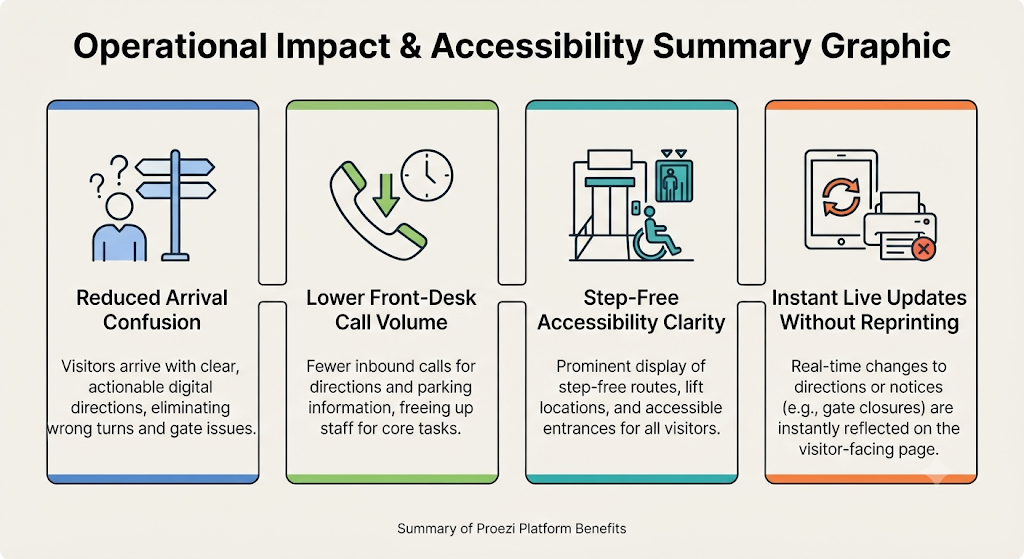
- Platforms in Practice: Purpose-built tools such as Proezi demonstrate how this model works for everyday operations—allowing organizations to publish structured visitor arrival instructions, parking notes, and supporting business reference pages behind reusable links and scannable QR codes without building custom infrastructure from scratch.
Practical Walkthrough: Scanning at a Parking Gate
Consider a visitor arriving at a multi-tower commercial complex:
-
Scan: At the vehicle entry barrier, the driver scans a weatherproof plaque encoding
[https://go.example.org/l/9f8a2c](https://go.example.org/l/9f8a2c). - Resolve: The edge CDN serves the pre-rendered mobile page in under 100 milliseconds. An amber banner at the top immediately warns that the North Driveway is closed, directing the driver to Gate 2.
- Filter: The visitor taps the Driving mode toggle (pure CSS/lightweight state toggle with zero network round-trip) to hide pedestrian-only transit steps.
- Navigate: After parking in Basement P1, cellular signal drops—yet the browser tab retains the loaded DOM and step-free elevator instructions, guiding the visitor smoothly to Tower B, Level 4.
Conclusion
Reliable QR-based information systems depend far more on sound web architecture than on the QR code itself. By separating immutable physical identifiers from mutable location records, optimizing payloads for constrained mobile networks, enforcing strict security boundaries on administrative updates, and planning for offline continuity, developers can build physical-to-digital interfaces that remain dependable long after the signage is installed.






Top comments (0)