
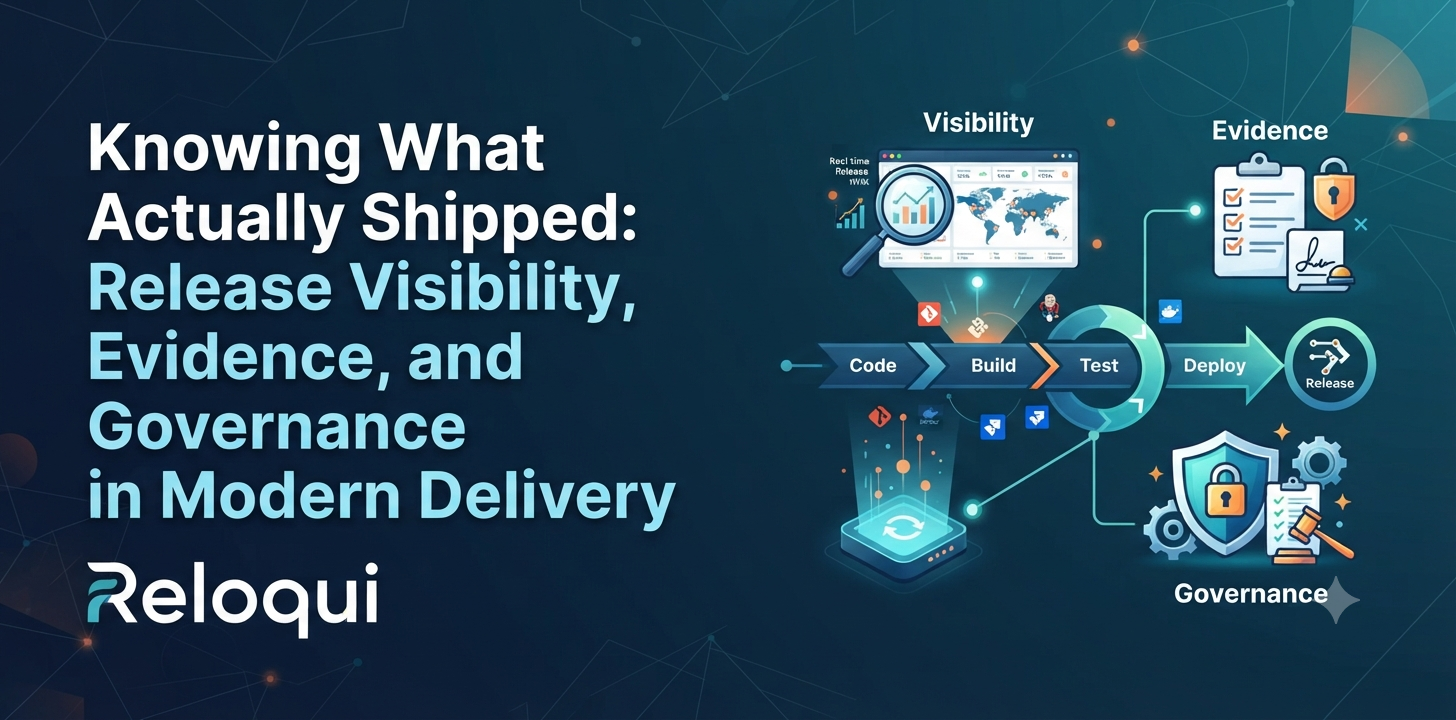
A deployment pipeline turns green. The container image is running in production. Yet twenty minutes later, someone asks a simple question: Which pull requests, Jira tickets, and infrastructure changes went into this release, and can we prove it?
Too often, the answer lives across browser tabs, chat threads, and memory. A successful deployment tells you code reached a target environment. It does not automatically prove what changed, whether every build and artifact lines up, or who approved the release under current policy.
Engineering teams need a clear, verifiable release record. When software delivery moves fast across microservices, shared libraries, and cloud environments, guesswork creates risk for engineers, operators, and release leaders alike.
Why Traditional Release Tracking Breaks Down
Most engineering organizations already have capable tools for writing code, tracking work, running pipelines, and deploying services. The trouble starts when those tools operate in silos rather than sharing one connected release view.
Fragmented Tooling and Manual Reporting
Code lives in Git repositories, tickets sit in issue trackers, builds run in CI/CD (Continuous Integration and Continuous Delivery) tools, and deployments show up in cluster dashboards or chat alerts. Without a shared record tying those events together, teams often rely on spreadsheets, release checklists, or manual status updates before a launch window.
Manual tracking slows teams down and drifts out of date. Someone may forget to paste a commit hash or miss a late hotfix merged right before a release tag.
Unlinked Changes, Builds, and Deployments
A commit or pull request does not always reference a ticket ID. A hotfix may land on a release branch outside the normal flow, or a force-push may rewrite commit history after a build starts.
Build success and deployment success are also different events. A pipeline can compile an artifact cleanly while a deployment fails, rolls back, or targets only one environment. If teams confuse a green build or a finished deployment with a complete release record, gaps slip past unnoticed.
Missing Artifacts and Cross-Team Blind Spots
Sometimes a container image or build artifact is pruned, overwritten, or not recorded alongside the environment where it ran. Infrastructure changes made via code or manual scripts may also happen on a separate track from application code.
When engineering, operations, product, and compliance teams look at different slices of data, alignment suffers. Engineers focus on commits and pull requests, operations looks at environment state and incidents, and leadership asks whether a release is safe to ship.
What Evidence-Based Release Intelligence Means
Release intelligence focuses on gathering, connecting, and reconciling technical signals from across the software delivery lifecycle to build an accurate picture of each release. Rather than treating a version number or deployment event as the whole story, it treats a release as a set of linked facts and verifiable evidence.
Basic version tracking tells you a tag or release name exists. Deployment monitoring tells you whether a rollout succeeded, failed, or triggered alerts in an environment. Evidence-based release intelligence connects those signals back to the underlying code changes, work items, builds, artifacts, infrastructure context, and approval actions.
Reloqui positions itself in this space as a release intelligence and evidence-reconciliation platform designed to sit alongside existing engineering tools. According to Reloqui's published product details, it reconciles signals from source control, issue tracking, builds, artifacts, deployments, and other connected systems into an explainable release record rather than replacing the tools where work happens.
How Release Evidence Connects Across Engineering Systems
A trustworthy release record depends on linking events across the systems engineers already use every day:
- Source-control repositories: Record branches, commits, tags, pull or merge requests, and history events such as force-pushes.
- Issue-tracking systems: Capture planned features, bug reports, hotfixes, and status transitions tied to engineering work.
- CI/CD pipelines and build records: Show which code revision produced a build, whether tests and build steps passed, and when runs occurred.
- Artifact registries: Identify the concrete packages, container images, or binaries produced and whether those artifacts exist when needed.
- Deployment environments and infrastructure changes: Show where a version was deployed, across which environments, and alongside what infrastructure updates.
- Incident records: Link post-release alerts or incidents back to the versions and services involved.
Consider a typical payment service update, checkout-api v2.3.0. A developer opens a pull request to fix an address validation check and links it to a Jira issue. After code review and merge, the CI pipeline builds an artifact and pushes it to the registry, and a deployment job rolls v2.3.0 to staging and production.
With GitHub Jira release tracking connected into a broader evidence model, teams can see whether the merged pull requests align with tracked Jira issues, whether every change has a matching build and artifact, and whether a last-minute hotfix entered the release without a linked issue. That connection turns scattered tool events into one traceable timeline.
Release Reconciliation and Confidence Scoring
Collecting raw events is only the first step. Raw data from separate tools often contains gaps, delays, duplicates, or conflicting timestamps.
How Reconciliation Works
Evidence reconciliation is the process of matching, classifying, and validating signals from multiple systems so each change and deployment belongs to the right release record. Reloqui advertises an 11-stage reconciliation engine that collects and classifies engineering evidence—such as Git tags, pull requests, issues, builds, artifacts, deployments, orphaned changes, and force-pushes—to associate changes with releases.
Because Reloqui's detailed stage-by-stage technical specification is not fully published on its public overview pages, teams evaluating any reconciliation engine should focus on the core outcomes it aims to deliver:
- Evidence collection and association: Gathering signals from connected tools and tying commits, pull requests, issues, builds, and artifacts to a release candidate or version.
- Change classification and gap detection: Distinguishing standard changes from hotfixes, identifying orphaned or unlinked changes, and flagging missing artifacts or deployment records.
- History and state verification: Detecting anomalies such as force-pushes or late changes that can alter what a release actually contains.
Transparent Confidence Scoring and Visible Uncertainty
A release confidence score summarizes how complete and consistent the supporting evidence is for a given release. Reloqui describes its scoring approach as deterministic-first and heuristic-second, showing which signals raised or lowered trust in the release record.
Just as important, a confidence score is not a guarantee that code is bug-free, secure, or immune to production incidents. A release can have high evidence completeness and still contain a logic defect, while a valid hotfix might temporarily lower a score because a ticket or check ran out of order.
Hiding missing evidence or conflicting records behind a single green label creates false certainty. Keeping gaps, orphaned changes, and uncertainty visible lets engineers inspect what is missing and decide whether to investigate further or proceed with a documented exception.
Release Readiness Before Production Deployment
Before promoting a release to production, teams usually check more than whether a pipeline finished. A thorough pre-release review looks at:
- Evidence completeness: Are expected pull requests, work items, builds, and artifacts present for the target version?
- Build and artifact status: Did required builds succeed, and are the corresponding artifacts available in the registry?
- Deployment history: Has the version been validated in prerequisite environments, or is it jumping straight to production?
- Unresolved or unlinked changes: Are there orphaned commits, force-pushes, or late additions that need explanation?
- Policy alignment and exceptions: Does the release satisfy team rules, or does it require a recorded exception?
Release readiness assessment software can organize these checks in one place and highlight missing signals before a release goes live. Even so, software cannot replace engineering judgment. A human engineer still needs to judge whether a missing non-blocking signal is harmless or a sign of a real operational risk.
Release Approval Workflows and Governance
As delivery volume grows, ad-hoc approvals in chat messages become hard to audit and easy to misapply. Clear governance gives teams predictable guardrails without turning every release into a slow bureaucracy.
Policies, Thresholds, and Freeze Windows
Effective release governance defines who can approve a release, what conditions must be met before publishing, and when changes should pause. Teams commonly use:
- Approval responsibilities: Clear sign-off roles for application owners, release managers, or operations leads based on risk or environment.
- Confidence thresholds: Rules that require extra review or block automated publishing when release evidence falls below a set confidence level.
- Publishing policies and freeze windows: Guardrails that restrict releases during high-risk periods, such as peak traffic windows or holidays, unless an approved exception applies.
With release approval workflow software, teams can enforce these rules consistently and record who approved what, when, and under which policy conditions. If new evidence arrives after an approval—such as a late change or a drop in confidence—workflows can also flag or suspend the prior sign-off so reviewers re-check the latest state.
Snapshots, Audit Trails, and Compliance Boundaries
A software release audit trail preserves the history of evidence, decisions, approvals, and exceptions tied to a release. Immutable release snapshots help teams inspect what was known at a point in time rather than watching history shift under their feet.
Keep a clear boundary in mind: a documented release approval record supports internal accountability and audit readiness, but it is not by itself a formal security certification, legal sign-off, or regulatory compliance guarantee. External audits still depend on broader organizational controls, access management, and policy enforcement.
Automated Release Notes and Audience-Specific Summaries
Writing release notes by hand is tedious and error-prone. Engineers often have to dig through merged pull requests, closed tickets, and deployment logs to figure out what actually shipped, while stakeholders ask for summaries tailored to very different needs.
An automated release notes generator can draft release summaries directly from reconciled engineering evidence. Because the underlying facts—changes, linked issues, builds, and deployments—are already connected, the same evidence base can support multiple audiences:
- Engineering teams: Technical details on merged changes, version boundaries, and linked work items.
- Operations and SRE (Site Reliability Engineering) teams: Deployed versions, affected services, environment rollouts, and notable anomalies.
- Product managers: User-facing changes and completed work items mapped to product context.
- Executives: High-level delivery summaries and release status without low-level noise.
- Compliance and governance reviewers: Traceable records linking changes, approvals, and exceptions to each release.
Reloqui advertises five audience-specific note views built from a shared evidence base. Automated drafts save time, but human review remains essential. Auto-generated text can miss subtle product nuance, overstate impact, or reflect incomplete upstream metadata until a human editor refines the wording.
Deployment Tracking, Change Traceability, and Impact Analysis
Tracking deployments across staging, canary, and production environments helps teams see where each version lives right now. A CI/CD deployment tracking dashboard gives engineers and operators a clearer view of rollout progress across environments than raw job logs alone.
It helps to separate three related concepts:
- Pipeline monitoring tracks whether CI/CD workflows and jobs run and succeed.
- Deployment tracking shows which versions were deployed to which environments and when.
- Release-level evidence reconciliation connects those deployments back to the underlying code changes, work items, artifacts, and approvals.
Once changes and services are connected, software release change traceability becomes much easier during investigations. When a service catalog and dependency graph map relationships between applications, services, infrastructure resources, and environments, teams can run release comparisons and impact analysis to see which upstream or downstream services might be affected by a change.
Impact analysis is a valuable investigative aid, not an oracle. Dependency graphs only reflect the relationships modeled and observed in connected systems, so dynamic runtime behavior or unmodeled dependencies can still surprise teams in production.
Self-Hosted vs. Managed Deployment Models
Choosing how to host a release intelligence platform depends on your team's infrastructure setup, security requirements, and operational capacity. Reloqui's pricing page advertises a free self-hosted option with the full feature set alongside a managed enterprise offering with dedicated or isolated infrastructure, uptime SLA (Service-Level Agreement) terms, backups and disaster recovery, operational support, and enterprise identity assistance.
| Factor | Self-Hosted Deployment | Managed Deployment |
|---|---|---|
| Infrastructure & data control | Runs on your own servers or cloud environment; data stays inside your infrastructure boundary | Hosted and operated by the vendor, typically with dedicated or isolated environment options |
| Setup, upgrades & maintenance | Your team installs, configures, patches, and upgrades the platform | Vendor handles ongoing platform operations, scaling, and routine maintenance |
| Backups & disaster recovery | Managed by your internal team according to your recovery goals | Handled as part of the managed service offering |
| Support & SLAs | Relies on documentation, community channels, and internal operations | Includes structured support channels, onboarding help, and contracted service commitments |
| Cost & resource trade-off | Free software licensing on Reloqui's self-hosted tier, but requires ongoing engineering time | Involves commercial agreement and vendor scope, while reducing internal operational overhead |
Organizations with strict data residency rules or experienced platform teams often prefer self-hosted release management software to keep release metadata inside their own network. Teams that prefer to offload maintenance, backups, and uptime operations often lean toward a managed option once their usage grows.
Where Reloqui Fits in an Existing DevOps Toolchain
Reloqui is built to complement your existing delivery stack rather than replace it. Your developers still write code in Git, track tasks in issue trackers, run pipelines in CI/CD systems, store artifacts in registries, and manage infrastructure with tools like Terraform.
Where Reloqui fits is the coordination and verification layer across those systems. Reloqui advertises twelve connector types—covering platforms such as GitHub, GitLab, Bitbucket, Azure DevOps, Jira, Linear, CI/CD systems, artifact registries, Terraform, and incident tools—along with webhooks and polling, a service catalog and dependency graph, confidence scoring, approval policies, audience-specific notes, and a REST API with an OpenAPI explorer.
As a release intelligence platform, it turns signals from those existing tools into one reconciled record per release. Before adopting any connector or plan tier, verify exact connector availability, plan scope, and API capabilities in the platform's current documentation and pricing details.
Evaluating a Release Intelligence Solution
If your organization is evaluating release intelligence tools, use a practical checklist to test fit before rolling anything out widely:
- Connector compatibility: Does the tool support your exact source control, issue tracker, CI/CD, artifact registry, infrastructure, and incident tools—and do those integrations capture the fields you need?
- Evidence completeness: How does it handle missing links, unreferenced commits, or partial data across pipelines?
- Accuracy and explainability: Can engineers see why a confidence score is high or low and inspect the underlying evidence?
- Deployment coverage: Does it track multi-environment rollouts, rollbacks, and infrastructure changes clearly?
- Release approval requirements: Does it support your approval roles, confidence thresholds, freeze windows, and exception tracking?
- Audit record retention: How are historical release records and snapshots preserved for later review?
- API and automation needs: Does it offer a REST API, webhooks, or automation hooks to fit existing workflows?
- Hosting preferences: Do you want self-hosted control or managed hosting with dedicated infrastructure and support?
- Security and access controls: Does it support SSO (Single Sign-On), SCIM (System for Cross-domain Identity Management), tokens, and role-based access that match your standards?
- Operational support: What documentation, community help, or managed support options are available when issues arise?
- Ease of adoption: Can a small team test it quickly—such as with a read-only demo, sample data, or a pilot repository—before broader rollout?
During evaluations, ask vendors concrete questions about data retention, webhook vs. polling behavior, how conflicting signals are resolved, and what happens when an external API is rate-limited or temporarily unreachable.
Frequently Asked Questions
What information should a reliable software release record contain?
A reliable release record should link the release version to its merged commits and pull requests, associated work items or tickets, CI/CD build results, produced artifacts, target deployment environments, relevant infrastructure changes, approval actions, and any noted gaps or exceptions. Together, those links show what changed, where it ran, and what evidence supports the release.
How is release tracking different from deployment monitoring?
Deployment monitoring focuses on runtime health and rollout status in an environment, such as whether pods started, health checks passed, or error rates spiked. Release tracking focuses on the version itself and the engineering evidence behind it, connecting code changes, builds, artifacts, approvals, and environment rollouts into one coherent record.
Why should engineering teams connect source control and issue tracking?
Connecting source control and issue tracking helps teams verify that code changes match planned work, bug fixes, or approved hotfixes. Without that link, teams can easily lose track of why a change was merged, miss scope drift before a release, or spend extra time reconstructing context during post-release reviews.
How can teams identify missing release evidence?
Teams can spot missing evidence by checking whether every release change has a corresponding build, artifact, deployment record, and issue link, and by watching for anomalies like orphaned changes or history rewrites. Highlighting missing links early prevents teams from assuming a release is complete when data is absent.
What is the purpose of release confidence scoring?
Release confidence scoring gives teams a quick, structured signal of how complete and consistent a release's supporting evidence is. A good score highlights gaps or conflicting signals that merit attention, while reminding reviewers that evidence completeness does not guarantee bug-free code, full security, or zero production incidents.
How can release approvals be documented?
Release approvals are best documented inside a system that records the approver, timestamp, release version, policy checks or confidence state at the time, and any approved exceptions or freeze overrides. Storing approvals alongside release evidence avoids scattered chat approvals and creates a clear history for later review.
What should organizations consider when choosing a self-hosted deployment?
Organizations considering self-hosted deployment should weigh full control over hosting and data boundaries against the ongoing effort required for installation, updates, backups, disaster recovery, monitoring, and troubleshooting. It is a strong fit when teams have internal operations capacity and strict environment or data-control requirements.
How can automated release documentation be reviewed?
Teams can treat automated release notes as a structured draft built from verified engineering evidence, then have a technical writer, product owner, or release lead review accuracy and tone. Checking drafts against actual changes and audience needs prevents misleading summaries caused by incomplete metadata or jargon.
How do dependency relationships help with release impact analysis?
Mapping relationships between services, shared components, infrastructure resources, and environments helps teams see which systems may be affected when a version changes. While dependency graphs cannot catch every runtime interaction, they narrow down blast radius and guide smarter testing, rollouts, and incident triage.
Can a release intelligence platform work with an existing DevOps toolchain?
Yes. A release intelligence platform is designed to integrate with existing source-control repositories, issue trackers, CI/CD pipelines, artifact registries, infrastructure tools, and incident systems via connectors, webhooks, and APIs, reconciling their signals without forcing teams to replace their core engineering tools.
Final Thoughts on More Reliable Software Releases
A green deployment notification only tells you a rollout finished. Reliable software delivery depends on connecting code changes, work items, builds, artifacts, deployments, and approvals into a record that engineers and stakeholders can actually trust.
When teams combine connected release evidence, transparent confidence assessments, clear governance, dependency visibility, and human review where context matters, release reviews shift from guesswork to informed decisions. For organizations exploring evidence-backed release visibility alongside their current DevOps stack, Reloqui offers a clear example of how release intelligence can bring those signals together.



Top comments (0)