
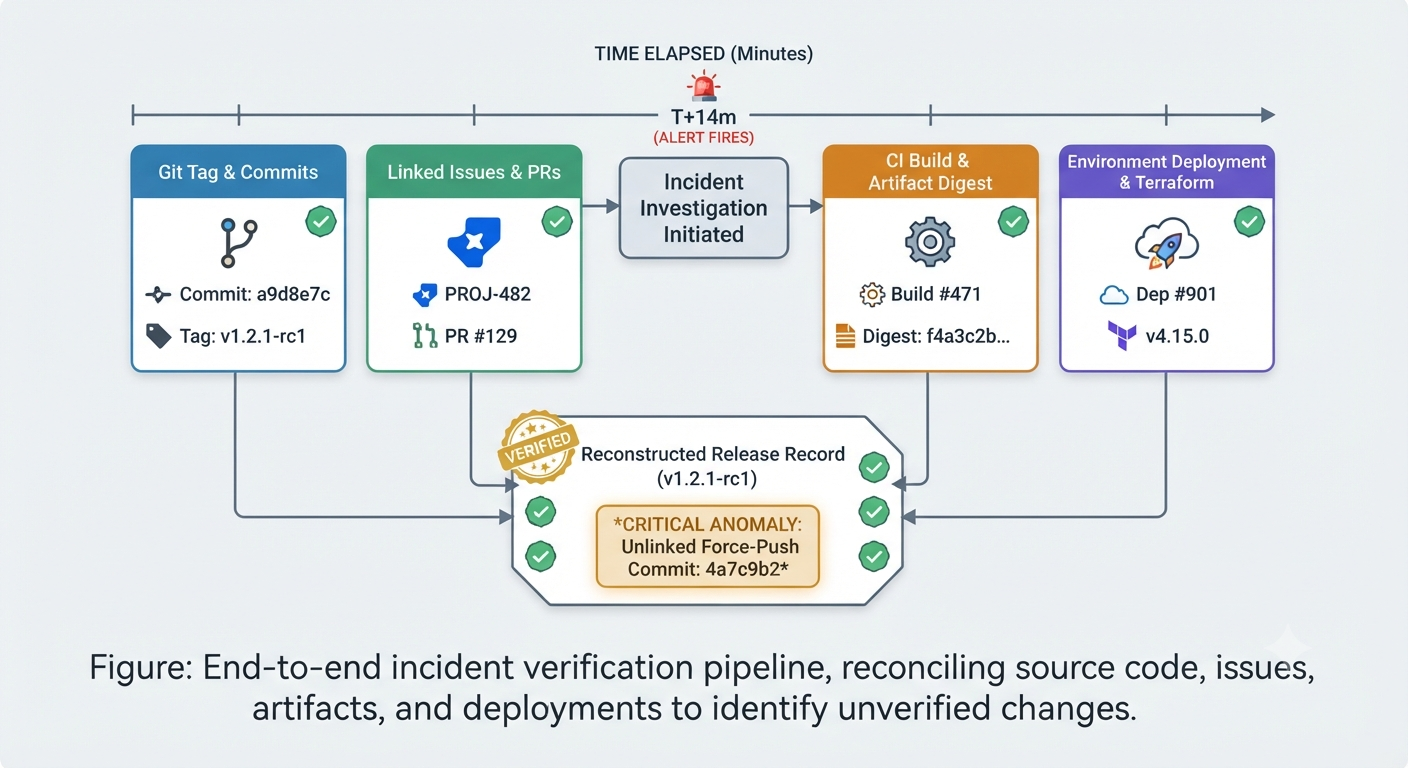
At 14:18 UTC, elevated HTTP 502 responses and queue retry spikes hit the production checkout service. Two minutes earlier, a deployment job finished with an exit code of zero, and a release tag v2.8.4 had been cut earlier that afternoon. On call, the primary SRE knows two things for certain: production traffic is degrading right after a release window, and no database schema migration was intentionally scheduled for today.
What remains uncertain is far more consequential. Did v2.8.4 actually introduce the change causing the 502s? Was a last-minute commit added to the release branch after the main integration test run? Did the staging artifact get re-tagged or rebuilt, or did an out-of-band infrastructure update land around the same timestamp?
During an active incident, guessing slows down mitigation and risks bad rollbacks. Reconstructing the exact release from verifiable engineering evidence gives responders a clear, factual baseline before they change production state.
Establish the Release Boundary
Before inspecting individual diffs or logs, anchor the investigation to concrete time, version, and environment boundaries so you examine the right release candidate.
- Identify the affected environment and active version: Check cluster state, workload manifests, or a CI/CD deployment tracking dashboard to see which version string or image digest is currently serving traffic in the impacted region or cell.
- Pinpoint the incident and deployment timestamps: Compare the first anomalous error or latency inflection against deployment start and completion times, plus any recent infrastructure runs.
- Define the release comparison window: Identify the prior known-good version running in that environment so you can compare the delta between "healthy before" and "failing after."
# Example: inspect active container image digest and tag in a Kubernetes deployment
kubectl -n payments get deployment checkout-api -o jsonpath='{.spec.template.spec.containers[*].image}{"\n"}'
kubectl -n payments rollout history deployment/checkout-api
Reconstruct the Change Set
Once the version boundary is clear, map the software version back to the source changes that produced it.
-
Inspect Git tags and commit ancestry: Verify whether
v2.8.4points to the expected commit on the release or main branch, and list the commits introduced since the previous production tag. - Trace pull requests and code reviews: Match commits to pull requests to see who authored and reviewed each change, when it merged, and whether any commits landed outside standard pull request flow.
- Cross-reference linked issues: Check ticket keys in branch names, PR titles, or commit messages. Consistent GitHub Jira release tracking (or equivalent Git and issue-tracker linkage) helps clarify the intended scope of each change—such as whether a commit was meant to adjust retry backoff limits or alter payload serialization.
Verify Build and Artifact Evidence
A Git commit list proves what was written in source control, not what was compiled and packaged into a shippable unit.
- Confirm CI build execution: Check the CI pipeline run tied to the tagged commit or release workflow. Verify test results, build parameters, and whether the job ran against the exact commit SHA recorded on the tag.
- Validate artifact availability and digest provenance: Confirm that the expected container image, package, or binary exists in the artifact registry and that its digest matches what CI published—rather than an older cached artifact or a manual rebuild.
# Example: verify that the deployed image digest matches the registry artifact digest
crane digest ghcr.io/acme/checkout-api:v2.8.4
Investigate Deployment Evidence
Even when code and build artifacts align, deployment mechanics can introduce discrepancies between the intended release and the live environment.
- Audit pipeline and rollout logs: Check when the deployment step started, which target nodes or clusters received the update, and whether canary or progressive rollout stages stalled or partially rolled back.
- Check infrastructure and configuration changes: Review Terraform runs, environment variable updates, feature flags, or Helm/manifest overrides applied near the release window. An infrastructure tweak executed separately from application code can shift runtime behavior without changing the application version tag.
Identify Evidence Gaps
Real-world incident investigations rarely find a neat, unbroken chain of records. Missing or conflicting signals are often where the real story hides.
- Orphaned changes: Commits present in the release history with no associated pull request or issue record.
- Missing issue associations: Pull requests merged without ticket links, or tickets marked "Done" whose code never made the tag.
- Force-push activity: History rewrites on release or feature branches that make commit SHAs, review trails, or build references ambiguous.
-
Incomplete or conflicting records: A Git tag pointing to commit
9f3a10c, a CI build reporting8e11b04, or an environment running an artifact digest not tied to that pipeline run.
Investigators must explicitly separate confirmed facts (for example, "image digest sha256:4d91... is running on 100% of checkout-api pods as of 14:16 UTC") from unverified assumptions ("PR #412 is definitely included in sha256:4d91..."). Treating a missing link as proof of safety—or assuming a commit is included without checking the tree and artifact digest—creates false confidence during triage.
| Evidence Source | What It Establishes | Investigation Limitation |
|---|---|---|
| Git Tags & Commits | Commit history, branch ancestry, force-pushes, authorship | Does not prove a commit was built or deployed to production |
| Pull Requests & Issues | Intended scope, code review context, ticket status | Can drift from reality via direct pushes, rewrites, or stale ticket states |
| CI Builds & Registries | Pipeline test/build outcomes, artifact digests, packaging metadata | Does not prove which environment or replica currently runs the artifact |
| Deployments & Infra (e.g., Terraform) | Rollout timestamps, target environments, infrastructure changes | Out-of-band changes or manual overrides may lack full release linkage |
Hypothetical Incident Reconstruction
To see how these pieces fit together, trace how the v2.8.4 incident on checkout-api is reconstructed:
-
Boundary: Deployment logs show
checkout-apiupdated tov2.8.4at14:15 UTC, one minute before 502 errors spiked at14:16 UTC. The previous stable version wasv2.8.3. -
Change Set: Comparing
v2.8.3..v2.8.4shows four merged PRs plus one direct commit (c71e902) pushed to the release branch at14:09 UTCwith no linked issue or PR. -
Build & Artifact: The CI build for
v2.8.4ran at14:11 UTConc71e902and pushedghcr.io/acme/checkout-api@sha256:7b04.... Cluster inspection confirmssha256:7b04...is live on all production pods. -
Deployment: No Terraform changes ran during the window; commit
c71e902changed timeout parsing from milliseconds to seconds in an upstream client call. -
Conclusion: The release reconstruction confirms
c71e902is live in production viasha256:7b04...and explains the exact code delta sincev2.8.3, giving the SRE team high-confidence grounds to roll back tov2.8.3or patch the timeout unit while tracking down the missing ticket context.
Connect Findings to Incident Response
A reconstructed release record directly supports responders across the incident lifecycle without replacing system telemetry or log analysis:
- Narrow investigation scope: Instead of suspecting every service in the architecture, responders can focus on the exact commits, linked issues, dependencies, and infrastructure changes introduced between the prior release and the active version.
- Improve handoffs: Passing a concise evidence summary—listing confirmed versions, artifact digests, and flagged anomalies—prevents incoming on-call shifts from repeating dead-end checks.
- Support post-incident reviews: During the post-incident review, a clear software release audit trail helps teams reconstruct timelines objectively, distinguish root causes from contributing gaps, and avoid blame-heavy guesswork.
How Reloqui Supports Evidence Reconciliation
Platforms built around release intelligence can reduce manual correlation overhead during investigations while complementing existing Git, issue-tracking, and deployment tools. Reloqui, for instance, uses an 11-stage release reconciliation engine across 12 connector types—including GitHub, GitLab, Bitbucket, Azure DevOps, Jira, Linear, CI/CD systems, artifact registries, Terraform, and incident-related integrations—to associate pull requests, issues, builds, artifacts, and deployments with software versions.
When investigating a release, Reloqui provides release comparisons, impact analysis, service catalogs, dependency graphs, and immutable release snapshots containing supporting evidence and approval history. Its explainable release confidence scores evaluate signals such as Git tags, linked pull requests, successful builds, artifact availability, deployment evidence, orphaned changes, and force-push activity, displaying exceptions and uncertainty alongside supporting evidence rather than hiding gaps. For organizations with strict data-residency or internal infrastructure policies, Reloqui offers self-hosted release management software as a free self-hosted platform with its complete feature set, alongside a managed enterprise option with dedicated infrastructure, service-level commitments, operational support, backups, and disaster recovery. (It reconciles and presents release evidence; incident detection and mitigation still rely on your observability and response tooling.)
Improve Future Investigations
Post-incident improvements are most effective when they make future reconstructions faster and surface gaps earlier in the delivery flow:
- Enforce commit-to-artifact provenance: Require build and deployment records to capture immutable artifact digests tied to exact Git commits and release tags.
- Surface anomalies early instead of hiding them: Use a software release tracking tool or release intelligence platform that highlights orphaned commits, force-pushes, and missing links visibly before and during releases.
- Pair readiness and approval gates with context: Combine release readiness assessment software (for confidence thresholds, publishing policies, and freeze windows) and release approval workflow software so reviewers see evidence and dependencies up front.
- Automate changelogs from verified records: Let an automated release notes generator build audience-specific summaries from reconciled release data rather than manual notes, and keep immutable snapshots at release time so audit and incident evidence stays intact.
During a production incident, speed comes from clarity. When your release records connect code, issues, builds, artifacts, and deployments—and keep missing evidence visible—responders spend less time guessing what shipped and more time restoring service health.



Top comments (0)