
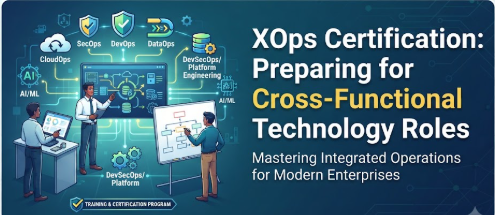
Modern technology environments have evolved far beyond traditional boundaries. Today, teams are tasked with managing software delivery, cloud infrastructure, massive data pipelines, machine learning models, artificial intelligence systems, security protocols, reliability targets, and cost management simultaneously. Because these domains often grew in isolation, organizations frequently encounter silos where development, infrastructure, data, and security teams work independently.
To bridge these gaps, the industry has embraced an umbrella approach known as XOps. By connecting multiple operational disciplines under a unified framework, organizations can streamline workflows, automate repetitive tasks, and improve overall system reliability. As technology professionals look for structured ways to master these connected practices, platforms like XOpsSchool have emerged to provide essential learning resources, guides, and educational materials tailored to modern IT operations.
What is XOps?
At its core, What is XOps is a question about modern operational integration. The letter "X" serves as a variable representing various operational disciplines, while "Ops" stands for operations. Rather than treating DevOps, DataOps, MLOps, and AIOps as completely separate technologies or team functions, XOps views them as interconnected parts of a larger operational ecosystem.
The Meaning of the "X"
In a modern technology enterprise, operations are no longer confined to keeping servers running. Different teams manage different lifecycle assets:
- Developers manage application code.
- Data engineers manage information pipelines.
- Machine learning engineers manage predictive models.
- Security teams manage risk and compliance.
XOps connects these areas by applying common principles such as automation, continuous integration, version control, observability, and feedback loops across all operational domains.
Why Connected Operations Matter
When organizations keep their operational practices isolated, bottlenecks occur. For example, a high-performing software deployment pipeline might fail if the underlying data pipeline cannot keep pace, or an AI application might experience downtime if its model monitoring is disconnected from standard infrastructure observability. XOps encourages teams to share tooling, standardize automation practices, and adopt a unified mindset toward reliability and governance.
Why XOps Matters in Modern IT
The complexity of modern cloud-native environments makes traditional, manual operational management unsustainable. Infrastructure spans multiple cloud providers, applications are broken down into microservices, and data volumes grow continuously.
Adopting an XOps mindset helps organizations address several key challenges:
- Breaking Down Silos: Encourages collaboration between software developers, data scientists, machine learning specialists, and system administrators.
- Standardizing Automation: Applies infrastructure-as-code and CI/CD principles beyond simple application code to data workflows and machine learning lifecycles.
- Improving Observability: Extends monitoring and telemetry across applications, infrastructure, data pipelines, and AI models to detect issues before they impact users.
- Enhancing Governance and Cost Control: Integrates security practices and cloud financial management directly into daily operational workflows.
Major XOps Disciplines
Understanding XOps requires examining the individual operational practices that feed into the broader framework. Each discipline addresses a specific technological lifecycle while sharing core automation and reliability principles.
DevOps
DevOps bridges the gap between software development and IT operations. It focuses on automated software delivery, continuous integration and continuous delivery (CI/CD), containerization, infrastructure automation, and fast feedback loops between writing code and running it in production.
DataOps
DataOps applies agile and automated practices to data engineering. It emphasizes reliable data pipelines, automated testing for data quality, orchestration, monitoring, and continuous data delivery to ensure that downstream applications and analytics teams receive clean, timely data.
MLOps
MLOps focuses on the machine learning lifecycle. It covers model development, automated training, model versioning, packaging, deployment, validation, and continuous monitoring to ensure that machine learning models perform reliably in production environments.
AIOps
AIOps leverages artificial intelligence and machine learning techniques to support IT operations. It helps teams analyze large volumes of operational data, perform anomaly detection, correlate events, automate alert management, and streamline incident troubleshooting.
SecOps
SecOps integrates security practices into every stage of the operational lifecycle. Instead of treating security as a final review step, SecOps embeds vulnerability scanning, compliance checks, and access controls directly into automated pipelines.
FinOps
FinOps brings financial accountability to cloud-native operations. It helps organizations track, analyze, and optimize cloud spending, ensuring that operational scaling aligns with business value and budget constraints.
Platform Engineering
Platform engineering focuses on building internal developer platforms that provide self-service capabilities, reusable infrastructure templates, and standardized workflows, reducing cognitive load for engineering teams.
| XOps Discipline | Main Focus | Common Learning Areas |
|---|---|---|
| DevOps | Software delivery and infrastructure automation | CI/CD, containers, infrastructure as code, version control |
| DataOps | Reliable data pipelines and data quality | Data orchestration, quality testing, observability, streaming |
| MLOps | Machine learning lifecycle and model deployment | Model versioning, experiment tracking, automated deployment |
| AIOps | Intelligent IT operations and anomaly detection | Log analysis, event correlation, predictive monitoring |
| SecOps | Security integration and vulnerability management | Compliance, automated security testing, identity management |
| FinOps | Cloud financial management and cost optimization | Cost allocation, resource sizing, budgeting, forecasting |
| Platform Engineering | Developer self-service and internal platforms | Internal developer portals, reusable templates, standardization |
XOps Training
As organizations adopt connected operational models, professionals seek structured XOps Training to understand how these diverse disciplines interact. A well-designed training path moves beyond single-tool mastery and focuses on operational principles that apply across multiple technical domains.
What to Expect from a Comprehensive Learning Path
Effective training programs typically cover foundational concepts before branching into specialized operational areas. Learners explore how infrastructure automation supports software delivery, how data pipelines require rigorous testing, and how monitoring principles apply equally to web applications and machine learning models. Resources provided by educational platforms like XOpsSchool help learners structure their study journey by breaking down complex operational theories into practical, digestible components.
XOps Certification
For many technology professionals, pursuing an XOps Certification serves as a way to validate structured learning and demonstrate a commitment to professional growth.
The Purpose of Certification
Preparing for a certification helps learners organize their knowledge, follow a logical syllabus, test their comprehension through practice exams, and identify knowledge gaps. It provides a structured benchmark for mastering complex topics such as cloud automation, container orchestration, and operational monitoring.
Note: Certification validates theoretical knowledge and familiarity with concepts, but it should be paired with hands-on practice, labs, and real-world problem-solving to build true operational expertise.
XOps Course
Choosing the right XOps Course is an important step for anyone looking to build professional competence in modern IT operations. A comprehensive course should follow a logical progression that mirrors real-world technology adoption.
Recommended Course Structure
- Introduction to XOps Fundamentals: Understanding the umbrella concept and how operational disciplines connect.
- DevOps Core Concepts: Mastering source control, CI/CD, and basic infrastructure automation.
- Cloud and Infrastructure: Exploring cloud platforms, networking, and infrastructure as code.
- Containerization and Orchestration: Working with Docker, Kubernetes, and GitOps principles.
- Observability and Reliability: Learning metrics, logs, traces, SLIs, and SLOs.
- Data Operations: Understanding data pipeline reliability and quality automation.
- MLOps and AIOps: Exploring machine learning lifecycles and AI-assisted monitoring.
- Security and Governance: Integrating SecOps and FinOps practices into everyday workflows.
XOps Tutorial
Practical learning often begins with a focused XOps Tutorial. Tutorials allow learners to experiment with specific configuration tasks, automation scripts, and monitoring setups in a controlled environment.
Bridging Theory and Practice
While reading conceptual articles explains why a practice matters, a good tutorial demonstrates how to configure a tool, set up a pipeline, or analyze operational metrics. Learners should use tutorials to build confidence with individual components before attempting to integrate multiple disciplines into a larger project.
XOps Tools
XOps is not a single proprietary software package; rather, it relies on a rich ecosystem of open-source and commercial technologies. These tools can be categorized by their operational functions:
- Source Control: Git, GitHub, GitLab, and Bitbucket for tracking code changes and collaboration.
- CI/CD: Jenkins, GitHub Actions, GitLab CI/CD, and Tekton for automating build and deployment pipelines.
- Containers and Orchestration: Docker for containerization, and Kubernetes for managing containerized workloads at scale.
- Infrastructure Automation: Terraform and Ansible for provisioning cloud resources and configuring servers.
- Observability: Prometheus, Grafana, and OpenTelemetry for monitoring performance and collecting telemetry data.
- GitOps: Argo CD and Flux for declarative, Git-driven infrastructure and application deployment.
- Data Operations: Apache Airflow, dbt, and Great Expectations for orchestrating data pipelines and testing data quality.
- MLOps: MLflow, Kubeflow, and Weights & Biases for tracking experiments and managing model deployment.
- AIOps: Specialized AI monitoring platforms that assist with log correlation and anomaly detection.
Tip: Tool selection should always depend on organizational architecture, team skills, security requirements, and scalability needs rather than mere popularity.
DevOps Training
Because DevOps forms the foundational bedrock of modern IT operations, rigorous DevOps Training is an essential stepping stone for anyone exploring XOps.
DevOps teaches the core principles of continuous delivery, automated testing, container management, and infrastructure as code. Mastering these fundamentals makes it much easier to transition into specialized areas like DataOps or MLOps, as many operational patterns remain consistent across domains.
AIOps Training
As IT environments generate unprecedented volumes of telemetry data, AIOps Training helps operations teams learn how artificial intelligence can assist with day-to-day management.
AIOps focuses on using machine learning algorithms to analyze logs, detect anomalies, correlate disparate alerts, and surface root causes during major outages. Proper training emphasizes that AIOps is designed to augment human judgment and streamline incident response, rather than replace experienced engineers.
MLOps Training
Deploying machine learning models into production introduces unique operational challenges that differ from traditional software development. MLOps Training addresses these complexities by focusing on model versioning, automated testing, data drift detection, and continuous monitoring.
Learners discover how to bridge the gap between data science experiments and reliable production systems, ensuring that models remain accurate and performant over time.
DataOps Training
Data is the lifeblood of modern decision-making, yet broken pipelines and poor data quality can cripple analytics and AI initiatives. DataOps Training teaches professionals how to apply agile principles, automated testing, and continuous monitoring to data workflows.
By treating data pipelines with the same operational rigor applied to software code, teams can guarantee reliable data delivery across the enterprise.
How XOps Connects DevOps, DataOps, MLOps, and AIOps
To fully appreciate the XOps framework, it helps to understand how its core disciplines complement one another:
- DevOps ensures that application code moves smoothly from development to production through automated CI/CD pipelines and robust infrastructure management.
- DataOps ensures that the data feeding those applications and analytics platforms is clean, tested, and delivered reliably through orchestrated pipelines.
- MLOps ensures that machine learning models built on top of that data are versioned, tested, and deployed with the same engineering discipline as standard software.
- AIOps applies AI techniques back into the operational layer, helping teams monitor application performance, data pipelines, and model health through intelligent automation and anomaly detection.
When combined, these disciplines share common underlying infrastructure, observability tooling, security protocols, and governance standards, creating a cohesive operational strategy.
Who Can Benefit from XOpsSchool?
1. DevOps and Cloud Engineers
Professionals already working in DevOps and cloud infrastructure can broaden their operational scope by learning how data pipelines, machine learning workflows, and AI-assisted operations integrate with their existing infrastructure expertise.
2. Data Engineers
Data professionals can leverage XOps concepts to improve pipeline reliability, implement automated testing for data quality, and adopt robust observability practices used in traditional software operations.
3. Machine Learning Professionals
Data scientists and ML engineers can use MLOps principles to transition experimental models into reliable, monitored production deployments that scale seamlessly.
4. IT Operations and SRE Professionals
Site Reliability Engineers and system administrators can enhance their skill sets by exploring AIOps tools, advanced observability frameworks, and platform engineering concepts to improve system uptime and developer self-service.
5. Developers and Technical Learners
Software developers who want to understand the broader operational lifecycle of modern applications can use structured educational resources to learn how code interacts with cloud infrastructure, data stores, and monitoring systems.
6. Technology Teams and Organizations
Engineering leaders and enterprise teams can use XOps knowledge to break down internal silos, standardize operational tooling, and foster a culture of shared responsibility across development, infrastructure, data, and security.
Common Mistakes When Learning XOps
- Treating XOps as a Single Tool: Assuming that purchasing one specific software platform solves all operational challenges.
- Skipping Fundamentals: Attempting to learn advanced MLOps or AIOps without first mastering basic Linux, networking, and DevOps principles.
- Learning Tools Over Concepts: Memorizing command-line arguments for a specific tool without understanding the underlying operational problem it solves.
- Ignoring Observability: Building complex automation pipelines without implementing proper logging, metrics, and tracing.
- Isolating Security and FinOps: Treating security audits and cost management as afterthoughts rather than core operational responsibilities.
Best Practices for Learning XOps
- Start with Foundations: Build a strong grasp of Linux, version control, and basic networking before diving into specialized operational areas.
- Practice Infrastructure as Code: Learn how to provision and manage cloud resources programmatically rather than through manual console clicks.
- Embrace Observability Early: Always configure monitoring and logging when building test pipelines or deploying applications.
- Build Integrated Projects: Instead of studying DevOps, DataOps, and MLOps in complete isolation, attempt small projects that combine two or more disciplines.
- Document Your Learning: Keep notes on configuration challenges, architectural decisions, and troubleshooting steps to reinforce your understanding.
Second Professional Table
| Learning Goal | Recommended XOps Area | Skills to Develop |
|---|---|---|
| Streamlining software releases | DevOps | CI/CD pipelines, containerization, infrastructure as code |
| Ensuring reliable data pipelines | DataOps | Data orchestration, quality testing, pipeline observability |
| Deploying predictive models | MLOps | Model versioning, experiment tracking, automated deployment |
| Automating incident detection | AIOps | Log analysis, anomaly detection, alert correlation |
| Improving developer velocity | Platform Engineering | Internal developer portals, reusable templates, self-service |
8-Step XOps Learning Guide
- Understand What XOps Means: Learn the basic philosophy of connected operational disciplines and why organizational silos hinder modern software delivery.
- Build DevOps Foundations: Master source control with Git, basic containerization with Docker, and fundamental CI/CD automation principles.
- Learn Cloud and Infrastructure: Study cloud provider basics, networking fundamentals, and infrastructure automation using tools like Terraform.
- Learn Observability and Reliability: Understand monitoring, metrics, logs, traces, alerting thresholds, and basic site reliability engineering principles.
- Explore DataOps: Learn how reliable data pipelines, automated testing for data quality, and data orchestration function in modern architectures.
- Explore MLOps and AIOps: Study the machine learning lifecycle, model deployment practices, and how AI techniques assist with operational monitoring.
- Learn Security and Cost Awareness: Integrate SecOps vulnerability checks and FinOps cloud cost optimization into your operational workflows.
- Build an Integrated Practical Project: Combine several relevant disciplines into a practical, end-to-end project that simulates real-world operational challenges.
Practical XOps Learning Approach
Transitioning from theoretical knowledge to practical ability requires hands-on experimentation. Learners should set up local development environments, build sample CI/CD pipelines, provision test infrastructure using code, configure monitoring dashboards, and simulate basic operational incidents.
Educational resources, tutorials, and structured guides found on platforms like XOpsSchool provide the foundational roadmap needed to navigate these practical exercises effectively without getting overwhelmed by the sheer breadth of the technology landscape.
How to Choose XOps Tools
Selecting the right technology stack requires careful evaluation of several factors:
- Business Requirements: Does the tool solve a specific operational pain point or business need?
- Team Skills: Does the engineering team already have experience with the tool, or will extensive training be required?
- Integration Capabilities: How well does the tool fit into your existing infrastructure and CI/CD pipelines?
- Security and Compliance: Does the technology meet your organization's security standards and data governance policies?
- Community and Support: Is the tool actively maintained, and is there robust documentation available for troubleshooting?
XOps Career and Skill Development
Acquiring knowledge across multiple XOps disciplines helps technical professionals become versatile contributors. Whether your primary role is in software development, cloud infrastructure, data engineering, or site reliability, understanding how different operational areas interconnect makes you better equipped to design robust, scalable, and secure systems.
Building practical ability, fostering strong communication skills, and maintaining curiosity about emerging technologies are the most reliable ways to advance your technical career.
Using XOpsSchool as a Learning Resource
Approaching a platform like XOpsSchool effectively involves structured navigation of its available educational materials. Learners can start by reviewing fundamental definitions of XOps, identifying the specific discipline that aligns closest with their current job role, and exploring targeted tutorials and guides.
By leveraging structured learning paths and conceptual resources, professionals can systematically expand their operational knowledge from basic DevOps foundations all the way to advanced multi-disciplinary integration.
Frequently Asked Questions
1. What is XOps in simple terms?
XOps is an umbrella approach that connects various IT operational disciplines—such as DevOps, DataOps, MLOps, and AIOps—under a unified framework of automation, observability, and shared workflows.
2. How is XOps different from DevOps?
While DevOps focuses primarily on software delivery and infrastructure automation, Xops extends those operational principles across multiple domains, including data pipelines, machine learning models, security, and AI-assisted operations.
3. What disciplines are included in XOps?
Common disciplines include DevOps, DataOps, MLOps, AIOps, SecOps, FinOps, and Platform Engineering.
4. Is XOps suitable for beginners?
Yes, beginners can start by learning foundational DevOps and cloud concepts before gradually exploring specialized areas like DataOps and MLOps.
5. What should an XOps training path include?
A robust training path should cover DevOps foundations, cloud infrastructure, containerization, observability, data operations, machine learning workflows, security, and governance.
6. What is the purpose of XOps certification?
Certification helps learners structure their study plans, validate theoretical knowledge, and benchmark their understanding of complex operational concepts.
7. What should learners look for in an XOps course?
An effective course should follow a logical progression from fundamentals to advanced integration, offering clear explanations and practical learning approaches.
8. Which tools are commonly associated with XOps?
Commonly used tools include Git, Docker, Kubernetes, Terraform, Prometheus, Grafana, Jenkins, GitHub Actions, and various data orchestration platforms.
9. How are DevOps, DataOps, MLOps, and AIOps connected?
They all share core engineering principles such as version control, automated testing, continuous delivery, and observability, while managing different types of technical assets.
10. How can someone start learning XOps?
Learners can start by understanding the basic definition of XOps, building strong DevOps and cloud foundations, exploring structured tutorials, and working on small, integrated practical projects.
Conclusion
Modern technology operations require a holistic approach that bridges the traditional gaps between software delivery, data engineering, machine learning, security, and system reliability. By treating these areas as interconnected components rather than isolated silos, organizations can achieve greater efficiency and resilience.
Understanding the XOps umbrella framework, mastering core tools, and following structured educational roadmaps provided by knowledge platforms like XOpsSchool allows technology professionals to build the practical skills needed to navigate today's complex operational landscape.



Top comments (0)