
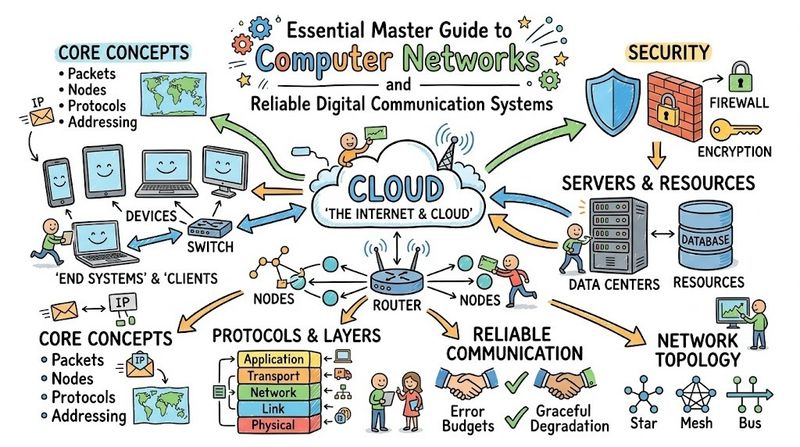
Mastering Core Data Pathways and Global System Interconnectivity
Computer networks function as the absolute core of all modern software ecosystems by connecting global servers together. At its most fundamental level, this topic encompasses the hardware, protocols, software configurations, and routing architectures that enable digital devices to share information. It defines how data splits into packets, travels across physical or virtual channels, and reassembles perfectly at its destination. Systems teams require robust communication architecture to scale their microservices and maintain high uptime across global zones. This comprehensive master guide explores data packets, protocols, architecture patterns, and the exact tools needed to build indestructible infrastructure.
Imagine a sudden enterprise database outage during peak holiday traffic that freezes thousands of customer transactions instantly. The primary application servers drop connection requests completely because the underlying packet delivery channels simply cannot route the packets to their destinations. Operational bottlenecks like these happen daily when organizations ignore the foundational paths that move critical data between distributed cloud environments.
[Local Host] ---> [Data Packets] ---> [Routers / Switches] ---> [Cloud Server]
     |                                                                 |
     +<------------------ Monitoring & Observability <-----------------+
You can easily gain full mastery over these complex communication channels by exploring the structured industry programs at Debug.school. This expert-led platform provides deep practical labs designed to transform your understanding of modern distributed system paths.
The Origin of Systems Infrastructure
The Early Industrial Bottlenecks
Traditional enterprise IT operations frequently suffered from severe technical fragmentation because engineering teams worked inside isolated silos. Software developers built application features quickly without understanding the underlying bare-metal server limitations or physical switch environments. Consequently, deploying a single application update required manual cable management, tedious firewall reconfigurations, and long hardware provisioning timelines.
These disconnected workflows created massive operational friction and frequent production outages during routine software releases. Software developers blamed the infrastructure staff for slow provisioning, while the network administrators blamed developers for writing unoptimized application code. This continuous operational stand-off made it nearly impossible for growing businesses to deploy software features at a competitive pace.
Moving Toward Unified Workflow Automation
Organizations gradually realized that breaking down these technical walls required a complete cultural shift toward unified automation frameworks. Infrastructure teams started treating physical hardware as software code by using automated scripts to configure global routing pathways. This structural transition unified application development priorities with infrastructure stability, ensuring both teams shared ownership of production uptime.
Automated pipelines completely replaced manual command-line entries, which drastically minimized human error during complex network configurations. This automated workflow evolution allowed businesses to spin up secure environments in minutes instead of waiting for weeks. As a result, companies achieved unprecedented operational velocity while establishing a highly resilient system baseline.
Global Expansion Across Commercial Ecosystems
This automation-first framework expanded rapidly across large-scale technology enterprises, financial institutions, and global cloud providers. Modern distributed platforms now demand continuous, real-time data replication across multiple geographical regions to serve billions of users. Consequently, unified operational methodologies evolved from a simple internal pipeline luxury into an absolute global business necessity.
Today, enterprise organizations run thousands of interconnected microservices that depend entirely on standardized communication paths to process transactions. Managing this vast scale requires deep, programmatic control over every single byte moving across the corporate ecosystem. Enterprises that master this automated architecture successfully dominate the global market by delivering flawless software performance.
Defining Strategic Operations Management
The Core Operational Structure
Strategic operations management coordinates software pipelines, infrastructure routing, and telemetry collection into one cohesive digital ecosystem. Information flows systematically from user devices through edge delivery nodes directly to the core application cluster. This unified structure ensures that every component remains visible, predictable, and highly adaptable to traffic changes.
+--------------------------------------------------------------+
|                Core Operational Architecture                 |
+--------------------------------------------------------------+
| User Request -> Edge Delivery -> Core Cluster -> Telemetry   |
+--------------------------------------------------------------+
Maintaining this structural integrity requires continuous configuration syncs across all public and private cloud environments. Advanced control planes automatically detect connection anomalies and rerun routing logic to bypass degraded underlying hardware components. This dynamic operational architecture keeps enterprise platforms stable even during intense global traffic spikes.
Daily Tasks of Systems Coordinators
Systems coordinators spend their daily shifts monitoring telemetry dashboards, optimizing data paths, and engineering automated deployment pipelines. These specialists build resilient configurations that dynamically balance application traffic across multiple cloud zones. Furthermore, they write automated scripts to identify resource leaks before those issues impact the end-user experience.
Coordinators also conduct deep architectural reviews to ensure new software features do not degrade overall system performance. They systematically run simulated failures to test how safely the existing platform isolates broken infrastructure components. Through continuous optimization, these engineers convert manual troubleshooting hours into automated, self-healing system routines.
Localized Control vs. Broad System Architecture
Granular component tracking focuses heavily on individual server metrics, local port statuses, and specific application process limits. Conversely, broad system architecture analyzes the complete multi-system environment to ensure overall business continuity. True operational excellence requires balancing these local metrics against the health of the entire global data path.
Managing an entire multi-system infrastructure means looking past a single broken server to evaluate total traffic throughput. For example, a single failing container matters very little if the global load balancers route users around it safely. Systems experts prioritize wide architectural resilience over individual component perfection to guarantee continuous service delivery.
The Efficiency Mindset
Achieving long-term system stability requires a fundamental cultural shift from reactive firefighting to proactive engineering design. Teams with an efficiency mindset view production failures as valuable data sources for improving the core automation stack. They actively avoid quick manual patches, choosing instead to write permanent software fixes that prevent repeat incidents.
This mindset encourages engineering groups to build simple, modular architectures that are inherently easy to monitor and troubleshoot. By prioritizing long-term structural reliability, organizations significantly reduce operational overhead and developer burnout. Ultimately, this sustainable engineering approach allows businesses to innovate rapidly without sacrificing system safety.
The 7 Core Principles of Networking Fundamentals Explained by Debug.school
1. Embracing Risk and Managing Variability
Complete perfection remains mathematically impossible in large distributed systems because physical hardware components will eventually fail. Operational teams must accept a calculated amount of systemic risk to deliver new software features to market. Instead of chasing impossible uptimes, engineers define acceptable failure limits to balance innovation speed with baseline platform safety.
Managing this variability involves designing software applications that degrade gracefully when underlying connection paths fail. Teams use smart retry patterns and circuit breakers to prevent a local failure from triggering a massive global outage. This realistic view of system risk helps organizations ship code faster while maintaining a highly dependable platform.
2. Establishing Service Level Objectives (SLOs)
Teams must establish measurable, data-driven targets to evaluate system success from the actual perspective of the user. These objectives define the precise percentage of requests that must succeed over a specific rolling time window. By using clear metrics, engineering groups remove emotional bias from operational discussions and align on real performance goals.
+---------------------------------------------------------+
|                  SLO Target Metrics                     |
+---------------------------------------------------------+
| Latency: 99% of requests < 200ms                        |
| Availability: 99.9% successful responses over 30 days   |
+---------------------------------------------------------+
These objective targets serve as the ultimate truth for determining whether a team should deploy features or fix bugs. When a system violates its agreed targets, feature deployments pause automatically to prioritize infrastructure stabilization work. This disciplined approach ensures that user satisfaction always takes priority over aggressive development deadlines.
3. Eliminating Toil and Manual Processes
Toil represents repetitive, manual, operational tasks that lack long-term strategic value and scale linearly with system growth. Examples include manually restarting stuck services, resetting user passwords, and running routine database cleanup scripts by hand. Left unchecked, toil completely drains engineering resources and stalls critical infrastructure development projects.
Modern operations groups track toil systematically and commit to engineering it away through robust automation scripts. If a manual task must occur more than twice, engineers write a permanent software solution to handle it automatically. Eliminating this manual burden frees up brilliant minds to focus on scaling the system architecture.
4. Monitoring & Observability Across the Pipeline
Comprehensive visibility across the entire data delivery pipeline prevents dangerous operational blind spots from hiding deep infrastructure flaws. Telemetry collection must capture metrics, distributed logs, and request traces from every single layer of the stack. This end-to-end observability allows engineers to track the exact path of a single transaction across dozens of microservices.
[User Request] -> [Metrics Caught] -> [Logs Written] -> [Traces Linked] -> [Dashboard View]
Advanced observability dashboards translate raw system data into clear, actionable insights regarding overall business health. Instead of searching through separate logs, engineers can view correlated data to pinpoint performance bugs instantly. This absolute visibility drastically reduces the time required to diagnose and resolve complex production incidents.
5. Automation Over Manual Coordination
Scaling modern enterprise workflows requires a strict engineering commitment to software-driven automation over manual human coordination. Manual configurations invite human error, create documentation gaps, and slow down critical system recovery efforts during outages. Software automation ensures that environment setups remain perfectly consistent, trackable, and repeatable across the entire organization.
Whether provisioning cloud load balancers or updating firewall rules, code must drive every single infrastructure change. This infrastructure-as-code strategy allows teams to version control their systems exactly like application source code. Consequently, recovering from a total regional data center disaster becomes as simple as running an automated deployment script.
6. Release Engineering and Deployment Stability
Predictable and safe software delivery depends entirely on standardized release engineering practices and automated testing frameworks. Teams utilize canary deployments to roll out new features to a tiny fraction of users before updates hit global production. This strategy allows engineers to monitor real-world performance metrics and catch bugs before they affect the wider user base.
Automated rollbacks act as a critical safety net by instantly reverting deployments if performance metrics drop. The release pipeline must run rigorous automated integration checks to catch breaking changes early in the development lifecycle. By enforcing these strict deployment guardrails, organizations maintain an uninterrupted, premium user experience.
7. Simplicity in Network Architecture
Keeping infrastructure environments clean, minimal, and highly standardized directly reduces the total failure surface of the enterprise. Complex routing schemes and undocumented custom configurations create hidden technical debt that complicates future troubleshooting efforts. Simple architectures are significantly easier to understand, automate, maintain, and defend against malicious security threats.
Engineers achieve this simplicity by using uniform design patterns and removing obsolete legacy software components. They deliberately limit unnecessary dependencies between microservices to prevent cascading failures across the distributed environment. Ultimately, a clean and simple architecture provides the most reliable foundation for long-term corporate growth.
Key Operational Concepts You Must Know
SLA vs. SLO vs. SLI — Explained Simply
Understanding systemic reliability requires mastering the distinct differences between service agreements, internal objectives, and live performance indicators.
- SLA (Service Level Agreement): The formal commitment made directly to customers, outlining major financial penalties if service drops below limits.
- SLO (Service Level Objective): The internal, stricter target that guides engineering teams to fix bugs before an SLA breach occurs.
- SLI (Service Level Indicator): The live, real-time measurement of current performance, showing the exact percentage of successful requests.
Error Budgets — The Game Changer for Operational Risk
An error budget represents the exact amount of downtime a system can legally afford before violating its internal SLO. Calculated simply as $100\% - \text{SLO}$, this metric serves as a dynamic budget for balancing speed and stability. For instance, an SLO of $99.9\%$ leaves an error budget of $0.1\%$ for innovation or unexpected outages.
Development teams can use this remaining budget freely to ship high-risk features and run experimental updates. However, if unexpected production incidents completely burn through the budget, all feature releases stop immediately. The entire engineering organization then pivots to focus exclusively on fixing infrastructure stability bugs.
Toil — The Silent Productivity Killer in Infrastructure
Toil slowly destroys engineering velocity by burying brilliant developers under a mountain of repetitive administrative chores. It requires no deep creative thinking, provides zero long-term system improvement, and grows larger with every new customer signup. Left unmanaged, toil burns out engineering talent and leaves organizations trapped in a reactive firefighting cycle.
Toil Calculation Matrix:
+-------------------------------------------------------------+
| Task Characteristics     | Toil Classification Status       |
+--------------------------+----------------------------------+
| Manual & Repetitive      | High Toil (Automate Immediately) |
| Creative Architecture    | Engineering Work (High Value)    |
+-------------------------------------------------------------+
Teams calculate toil by tracking time spent on administrative tasks versus true architectural engineering work. The explicit organizational goal is to keep daily toil levels below $50\%$ for every engineer. Companies achieve this by dedicating open engineering sprints to writing robust code that automates these manual tasks permanently.
Incident Management & Postmortems
When a major production outage occurs, a structured incident management framework guides the team to restore service quickly. Engineers step into pre-assigned operational roles to handle internal coordination, public communications, and active technical troubleshooting. This disciplined approach prevents chaos and ensures everyone works efficiently toward a rapid resolution.
[Outage Occurs] -> [Roles Assigned] -> [Fix Applied] -> [Blameless Postmortem]
Once the system stabilizes, the team conducts a blameless postmortem to discover what allowed the failure to happen. These sessions focus strictly on fixing systemic process flaws rather than pointing fingers at individual human mistakes. The resulting documentation outlines clear, actionable engineering items to ensure the same incident never happens again.
Capacity Planning
Capacity planning prevents performance degradation by forecasting infrastructure resource demands well ahead of organic user growth. Engineers analyze historical traffic data, marketing campaign schedules, and seasonal shopping trends to predict future resource needs. This proactive strategy ensures that the platform has enough computing power before traffic surges arrive.
Modern capacity management combines automated cloud auto-scaling algorithms with long-term financial budget optimization. Teams model extreme resource scenarios to understand exactly how their network architecture handles unexpected demand spikes. By planning ahead, organizations avoid expensive emergency hardware purchases and maintain steady system performance.
The Four Golden Signals of Pipeline Performance
Evaluating the baseline health of any distributed application requires monitoring four critical system metrics continuously.
- Latency: The precise time it takes for a data packet or service request to travel successfully across the system.
- Traffic: The overall volume of demand hitting the platform, measured in network requests per second or concurrent users.
- Errors: The rate of requests that fail completely, providing an immediate signal of systemic application bugs.
- Saturation: The total fraction of system resources currently utilized, highlighting impending hardware bottlenecks before they cause downtime.
Platform Implementation vs. Culture — What's the Real Difference?
The Philosophy Difference
Many organizations struggle to differentiate between high-level operational culture frameworks and concrete technical platform implementations. The cultural philosophy focuses entirely on breaking down team silos, embracing shared risk, and accepting human mistakes as learning opportunities. It sets the collaborative mindset required for separate engineering groups to work toward identical reliability goals.
Conversely, platform implementation translates this collaborative mindset into concrete software code, automated pipelines, and live telemetry dashboards. The implementation provides the tangible tools, like container clusters and automated scripts, that make the cultural philosophy possible. A truly elite organization understands that tools mean nothing without the right engineering culture supporting them.
Roles & Responsibilities Compared
The distinct engineering disciplines across modern infrastructure teams feature unique focuses and daily operational boundaries.
- Culture Champions: Focus heavily on cross-team collaboration, postmortem alignment, and improving organizational communication workflows.
- Platform Engineers: Build reusable infrastructure templates, manage central automation tools, and design self-service developer portals.
- Site Reliability Specialists: Write software code to optimize application uptime, manage error budgets, and resolve complex production incidents.
- Network Admins: Configure physical or virtual switches, manage enterprise routing protocols, and secure corporate data gateways.
Can You Have Both Disciplines?
Modern enterprise organizations do not choose between culture and implementation; they run both side-by-side to maximize efficiency. The cultural framework establishes the shared reliability metrics, while the platform team builds the automated tools to meet them. This harmonious relationship ensures that software developers can ship features safely without fighting rigid infrastructure guardrails.
When these engineering philosophies coexist, the platform team treats software developers as their primary internal customers. They deliver smooth, automated infrastructure pipelines that naturally enforce the organization's high reliability standards. This cross-pollination of culture and tools enables businesses to scale up without creating internal operational friction.
Which One Should Your Team Adopt?
Choosing where to focus your engineering resources depends heavily on your current organization size and software infrastructure maturity.
- Small Startups: Prioritize building a shared culture of reliability first before investing heavily in complex automation software.
- Mid-Sized Businesses: Focus on standardizing core infrastructure paths and automating repetitive manual task burdens.
- Large Enterprises: Build dedicated platform engineering teams to deliver centralized self-service infrastructure portals to developers.
- Global Corporations: Deploy specialized reliability squads to deeply optimize the efficiency of massively distributed microservices.
Real-World Use Cases of Modern Operations
How Tech Leaders Use Operational Metrics
Global software giants track millions of telemetry data points every second to keep their distributed architectures perfectly healthy. These companies use advanced correlation engines to watch how a latency spike in one service impacts checkout conversions. This real-time analysis allows operational teams to catch subtle software performance regressions before users notice them.
These tech leaders display their live system metrics on centralized dashboards across all engineering offices. This transparency ensures that every developer understands how their feature code performs under real-world traffic conditions. By making data visible, organizations build a strong engineering culture that naturally values high performance.
Chaos Engineering Approaches to Resilient Systems
Elite engineering groups do not wait for random infrastructure failures to test their system defenses during major traffic events. Instead, they practice chaos engineering by intentionally introducing controlled failures into their production environment. For example, automated software agents might randomly terminate server clusters or inject simulated latency into the network layer.
[Inject Failure Agent] ---> [Kill Server Cluster] ---> [Verify Auto-Recovery Stack]
These controlled experiments verify that the platform's automated self-healing mechanisms handle hardware failures flawlessly. If a chaos test causes a user-facing outage, the team fixes the underlying resilience bug immediately. This proactive testing gives organizations ultimate confidence that their infrastructure can survive unexpected real-world disasters.
Handling Reliability at Massive Scale
Managing distributed microservices that process millions of global transactions requires deep architectural isolation and smart routing designs. Top-tier platforms divide their computing infrastructure into isolated cells to prevent a single bug from crashing the global service. If a cell degrades, the global routing layer shifts traffic seamlessly to healthy clusters nearby.
+-----------------------------------------------------------+
|               Global Traffic Routing Control              |
+-----------------------------------------------------------+
| User Traffic -> Edge Router -> Cell A (Healthy)           |
|                             -> Cell B (Degraded -> Skip)  |
+-----------------------------------------------------------+
These large-scale architectures also utilize intelligent traffic shedding to save core services during intense unexpected demand spikes. The system prioritizes essential user transactions, like checkout requests, while dropping non-essential background tasks. This disciplined approach ensures the business continues generating revenue even when working under extreme infrastructure stress.
High-Availability in Fintech Operations
Financial technology platforms operate under strict regulatory compliance rules and have zero tolerance for data loss or system downtime. A single second of network latency can disrupt stock trading pipelines or cause duplicate payment transactions. Consequently, fintech infrastructure requires multi-region active-active database replication and immediate automated failover capabilities.
[Fintech Request] -> [Dual Regional Sync] -> [Consensus Engine] -> [Ledger Clear]
Fintech operations engineers run continuous validation scripts to ensure every ledger entry remains perfectly synced across regions. They deploy hardware-accelerated networking paths to minimize packet transit times down to the single-digit microsecond level. This extreme focus on reliability protects consumer capital and maintains institutional trust across global markets.
Scaled-Down but Essential Systems for Startups
Early-stage startups lack the massive budgets of global tech giants, but they still require highly dependable system foundations. Smart startup teams implement lean operational principles by utilizing managed cloud services to handle basic infrastructure heavy lifting. This strategy allows small engineering teams to gain high availability without managing complex physical hardware.
Startups focus their limited engineering hours on setting up simple, actionable alerts for critical user paths. They use basic error budgets to ensure fast feature development does not compromise early system stability. By adopting these core principles early, startups build a scalable architecture that supports fast business growth.
Common Mistakes in Operations Engineering
Mistake 1 — Confusing System Management with Just Being On-Call
Many traditional companies mistake modern operations engineering for a simple on-call rotation that reacts to infrastructure alerts. This misguided view treats engineers as simple firemen who spend their shifts fixing the same broken components manually. True system management focuses heavily on writing proactive software code to prevent those alerts from ever firing.
When an organization fails to treat operations as an engineering discipline, their production systems quickly degrade. Engineers spend all their time troubleshooting active incidents, leaving zero room for strategic architecture work. To fix this, leadership must allocate significant engineering time for teams to build permanent automated fixes.
Mistake 2 — Setting Unrealistic SLOs
Business executives often demand perfect $100\%$ uptime targets without understanding the extreme engineering costs involved. Chasing impossible uptimes requires massive infrastructure redundancy and stops software feature deployments completely. Furthermore, this unrealistic expectation burns out engineering talent and stains team relationships.
Smart organizations design realistic SLOs that reflect actual user satisfaction thresholds instead of abstract marketing goals. If a customer cannot tell the difference between $99.9\%$ and $99.99\%$ availability, the lower target is better. This practical approach preserves the team's error budget for rolling out innovative software features safely.
Mistake 3 — Ignoring Toil Until It's Too Late
Neglecting repetitive manual tasks creates a mountain of operational debt that can stall software development velocity. As the customer base expands, unchecked manual processes consume more engineering hours every single week. Eventually, the engineering team becomes completely trapped by routine maintenance work, blocking all strategic business progress.
Operational Debt Accumulation:
+---------------------------------------------------------+
| Time Period | Toil Hours Spent | True Engineering Time  |
+-------------+------------------+--------+
| Month 1     | 20 Hours         | 140 Hours (Productive) |
| Month 6     | 90 Hours         | 70 Hours (Stalled)     |
+---------------------------------------------------------+
Preventing this bottleneck requires managers to monitor daily toil levels across their engineering squads continuously. Teams must have the authority to pause feature development when manual work crosses acceptable boundaries. Prioritizing automation work pays huge dividends by keeping the development pipeline clean and fast.
Mistake 4 — Skipping Blameless Postmortems
When a major production incident happens, a toxic culture focuses on finding an individual person to blame. This defensive environment causes engineers to hide system mistakes, avoid risky projects, and minimize communication. Skipping a blameless postmortem guarantees that the underlying architectural flaw will remain in production to fail again.
[Outage] -> [Blame Culture: Hide Mistake] -> [Flaw Remains in Code] -> [Repeat Outage]
An elite organization embraces mistakes as critical data points for improving the system. They write detailed postmortems that focus exclusively on why the technical guardrails failed to prevent human error. This open learning environment turns every outage into a permanent improvement for the entire platform.
Mistake 5 — Monitoring Without Actionable Alerts
Setting up thousands of automated alerts for minor system fluctuations causes severe alert fatigue across engineering teams. When engineers receive constant non-actionable pages during off-hours, they start ignoring notifications completely. This dangerous desensitization leads to teams missing critical alerts during actual major system outages.
[Minor Spike] -> [Non-Actionable Page] -> [Alert Fatigue] -> [Real Outage Ignored]
Organizations must enforce a strict policy that every single alert must require clear, immediate human action. If a notification does not need an instant fix, it belongs in an email report, not a page. Clean alerting structures ensure that engineers remain focused, refreshed, and ready to handle genuine production incidents.
Mistake 6 — Not Involving Operational Engineers in the Design Phase
Software development groups often design complex application architectures without consulting infrastructure operations specialists. This disconnect results in features that run well locally but fail completely under real-world production traffic. Skipping operational input early creates massive integration bottlenecks and delays product release timelines significantly.
Bringing operational engineers into initial system design phases ensures the software is inherently reliable and easy to monitor. These specialists provide invaluable feedback on load balancing, caching strategies, and data replication paths from day one. This collaborative approach minimizes production bugs and guarantees a smooth rollout for new features.
Essential Infrastructure Tools & Technologies
Monitoring & Observability
Maintaining deep visibility into modern distributed environments requires a robust mix of metrics collection and log tracing tools. Industry leaders utilize Prometheus to gather real-time time-series metrics from cloud clusters using a pull-based architecture. This data pairs with Grafana to build highly intuitive dashboards that visualize system trends clearly.
For enterprise environments needing an all-in-one platform, solutions like Datadog and New Relic trace transactions across complex microservices. These observability platforms use machine learning algorithms to highlight performance anomalies before they impact users. Investing in a proper observability toolchain allows teams to spot root causes in seconds rather than hours.
Incident Management
When critical systems fail, specialized incident response platforms keep engineering teams organized and focused on mitigation. PagerDuty functions as the central nervous system for alert routing, automatically waking up the correct on-call engineer based on policy schedules. The platform integrates with communication tools to instantly create dedicated incident channels and video rooms.
These incident management tools help organize clear responder roles, track outage durations, and log timeline events automatically. This structured workflow minimizes administrative confusion and allows technical minds to focus completely on restoring services. Using centralized incident software ensures organizations handle high-pressure outages calmly and professionally.
CI/CD & Release Engineering
Automating the software delivery pipeline requires powerful continuous integration and deployment engines to ensure absolute environmental stability. Jenkins remains a widely adopted automation engine for building, testing, and verifying application code packages across enterprise environments. It pairs with modern tools like Spinnaker to manage complex deployment strategies across global cloud providers.
Cloud-native ecosystems frequently leverage Argo CD to achieve GitOps-driven deployment configurations inside Kubernetes environments. This tool monitors Git repositories continuously and automatically syncs the live cluster state with the version-controlled code. This automation removes human error from deployments and makes rolling back broken changes incredibly fast.
Chaos Engineering
Injecting controlled failures into live production infrastructure requires specialized chaos tools designed to run experiments safely. Chaos Monkey, originally built by Netflix, randomly terminates server instances in cloud environments to test system redundancy. This continuous disruption forces developers to design resilient applications that handle sudden hardware loss naturally.
Modern cloud teams also use advanced platforms to run multi-layered failure scenarios across networks, containers, and cloud configurations. These tools provide strict safety guardrails, allowing engineers to halt chaos experiments instantly if metrics cross unacceptable limits. Running regular chaos simulations helps companies discover hidden architectural bugs before real disasters strike.
SLO Management
Tracking customer reliability targets requires centralized software platforms that connect live metrics directly to business objectives. Nobl9 specializes in slinging data from multiple monitoring sources to calculate real-time error budgets and SLO trends. This centralized view helps engineering managers make data-driven decisions on whether to ship features or stabilize code.
+--------------------------------------------------------------+
|                    SLO Tracking Dashboard                    |
+--------------------------------------------------------------+
| Core Service: Availability SLO 99.5% -> Budget: 82% Remaining|
+--------------------------------------------------------------+
These platforms send automated warnings when an error budget burns down too quickly over a rolling window. This proactive signaling allows development squads to pivot their focus before violating formal customer service agreements. Using dedicated SLO management tools aligns business priorities with technical reality perfectly.
How to Become an Operations Expert — Career Roadmap
Skills Every Specialist Must Have
Starting a career in systems operations requires mastering foundational terminal navigation tools, shell scripting, and basic cloud concepts. You must feel completely comfortable using Linux command-line utilities to debug processes, check disk space, and analyze system network connections. Scripting proficiency in languages like Bash or Python allows you to automate repetitive server tasks efficiently.
+-----------------------------------------------------------+
|              Essential Technical Skill Stack              |
+-----------------------------------------------------------+
| Core: Linux Terminal, Bash/Python, Git                    |
| Cloud: AWS/Azure Networking, IAM, Compute Provisioning    |
+-----------------------------------------------------------+
Additionally, you need a strong understanding of fundamental internet communication concepts including DNS routing, load balancing, and firewall rules. Gaining familiarity with cloud provider computing environments and container basics forms the baseline for modern infrastructure roles. These core technical skills provide the essential toolkit needed to solve complex distributed system problems.
The Professional Learning Path
The professional educational journey starts with mastering standalone server administration before moving into multi-node cloud environments. Beginners should focus on deploying simple web applications manually to learn how web servers interact with databases. Once you understand the basic components, you can learn to write infrastructure-as-code scripts to automate that deployment.
[Single Server Linux] -> [Infrastructure-as-Code] -> [Kubernetes Clusters] -> [Global Systems Architect]
Next, progress into learning container orchestration systems like Kubernetes to manage large groups of dynamic application containers. Study how distributed telemetry systems gather metrics and logs to provide deep observability across cloud environments. Finally, refine your architectural design skills to build highly resilient, fault-tolerant platforms for global enterprises.
Certifications Worth Pursuing
Earning respected cloud and infrastructure credentials validates your technical expertise and accelerates your career growth significantly.
- Certified Kubernetes Application Developer (CKAD): Proves your hands-on ability to design, build, and configure cloud-native applications.
- Certified Kubernetes Administrator (CKA): Validates your professional skills in managing production container clusters and network infrastructure.
- AWS Certified DevOps Engineer — Professional: Shows your expertise in automating cloud deployments and managing complex architecture security.
- Microsoft Certified: Azure DevOps Engineer Expert: Confirms your proficiency in designing continuous delivery pipelines and infrastructure-as-code strategies.
Educational Resources with Debug.school
Mastering these advanced technological fields requires high-quality, practical training environments designed by real-world industry mentors. Debug.school offers comprehensive educational programs that feature structured step-by-step labs focused directly on networking foundations and system operations. These deep training courses combine fundamental theory with immersive terminal practices to prepare you for actual production engineering roles.
The carefully tailored curriculum ensures you learn the exact automation skills demanded by modern global tech enterprises. By studying under experienced engineering specialists, you avoid common self-learning traps and gain immediate clarity on complex topics. Explore the professional learning paths available on the platform today to elevate your engineering career to new heights.
The Future of Systems Management
AI and Automation in System Optimization
Artificial intelligence is rapidly shifting infrastructure management from a reactive practice to an autonomous, self-optimizing operation. Predictive machine learning models analyze massive streams of telemetry data to identify subtle anomaly patterns before failures occur. This advanced signaling allows the platform to adjust routing paths and allocate extra compute resources entirely without human intervention.
AI assistants also speed up root cause analysis during active outages by correlating historical logs with current metrics. Instead of searching through separate dashboards, engineers receive a summarized diagnosis and a recommended automation script fix. This intelligent automation drastically reduces system recovery times while freeing up teams to build new features.
Platform Engineering — The Evolution of Infrastructure
Platform engineering represents a major shift in how organizations deliver infrastructure resources to internal software development groups. Instead of filling out tickets for new servers, developers use internal self-service portals to spin up environments instantly. The platform team focuses entirely on building these automated, highly secure infrastructure templates.
[Developer Portal] ---> [Self-Service Click] ---> [Automated Environment Deploy]
This self-service model eliminates traditional operational friction and accelerates feature delivery timelines across the business. Software developers gain complete autonomy while the organization maintains strict security guardrails automatically. By treating infrastructure as an internal software product, businesses achieve immense operational efficiency.
Management in Cloud-Native & Kubernetes Environments
The rapid adoption of highly dynamic containerized applications creates complex orchestration challenges for traditional network architectures. Containers launch and terminate in seconds across global clusters, demanding instant DNS tracking and highly adaptable load balancing. Managing this fluid environment requires declarative configuration planes that continuous sync network states automatically.
Engineers deploy service meshes to secure and observe communication paths directly between hundreds of microservices. These systems provide advanced traffic management features like safe canary routing and automatic request retries. Mastering these cloud-native architectures remains an absolute requirement for managing modern enterprise platform scales.
Operational Skills That Will Matter Most
As infrastructure tech stacks continue to mature, the most valuable engineering priorities are shifting toward advanced cloud cost optimization. Engineers must build architectures that dynamically adjust sizes based on real-time traffic demands to eliminate waste. Mastering cloud financial operations allows specialists to deliver maximum platform performance while keeping budgets under tight control.
+-----------------------------------------------------------+
|                  Modern Priority Checklist                |
+-----------------------------------------------------------+
| 1. Dynamic Cloud Financial Optimization (FinOps)          |
| 2. Deep eBPF-Driven Linux Kernel Observability            |
+-----------------------------------------------------------+
Furthermore, gaining expertise in deep, kernel-level telemetry collection via modern Linux technologies provides unparalleled infrastructure insights. This low-overhead observability allows engineers to trace data packet pathways without modifying application source code. Developing these specialized skills ensures you remain highly competitive as systems management continues to evolve.
FAQ Section
- What is the typical salary trend for an infrastructure operations specialist? Salaries in this technical field remain highly lucrative due to the immense global demand for reliable cloud architecture management. Junior engineers start with excellent compensation packages, while experienced systems architects frequently earn top-tier enterprise engineering salaries. The continuous expansion of global digital platforms guarantees that these specialized skills command a premium premium across all major tech markets.
- How does site reliability engineering differ from traditional system administration? Traditional system administrators focus primarily on manually configuring physical hardware servers, managing software installations, and responding to alerts. Conversely, site reliability engineering treats infrastructure management as a software problem by applying software engineering principles directly to operations. Reliability specialists write automated code to replace repetitive manual administrative tasks, ensuring systems scale efficiently without scaling human labor.
- Can a software developer successfully transition into a systems operations role? Yes, software developers possess strong coding and logic skills that make them exceptionally well-suited for automation-focused infrastructure positions. A developer transitioning into operations simply needs to focus on learning Linux administration, cloud networking fundamentals, and telemetry collection pipelines. This strong programming background allows them to write highly efficient infrastructure scripts and design clean self-healing system architectures.
- Which cloud certification is best for absolute beginners entering this space? Beginners should start with foundational cloud credentials like the AWS Certified Cloud Practitioner or Microsoft Azure Fundamentals to learn core concepts. Once you understand the basic terminology, immediately pursue hands-on certifications such as the Certified Kubernetes Administrator (CKA). These practical, terminal-based exams hold immense value in the industry because they prove your actual ability to configure production infrastructure.
- Why are error budgets considered a game changer for modern engineering teams? Error budgets completely remove the traditional cultural conflict between fast feature developers and stability-focused operations teams. By converting reliability into a measurable shared budget, both groups align on a single data-driven goal for feature releases. It provides developers clear autonomy to take calculated risks when the budget is healthy, while protecting system uptime when the budget burns down.
- What are the four golden signals used to monitor application pipeline health? The four golden signals of monitoring are latency, traffic, errors, and saturation across your infrastructure stack. Latency tracks the time requests take to resolve, traffic measures overall system demand, and errors count failing requests. Saturation evaluates the remaining capacity of your computing hardware, warning you of impending performance bottlenecks before they cause downtime.
Final Summary
Maintaining optimal system health across distributed enterprise networks requires a continuous, disciplined commitment to automation, observability, and robust architectural simplicity. Modern organizations must look past outdated operational silos to embrace a shared culture that manages systemic risk through data-driven objectives. By automating repetitive manual toil and analyzing live performance telemetry, engineering groups ensure their platforms remain perfectly reliable under intense traffic. The future of global digital communications depends entirely on building self-healing, code-driven environments that support rapid feature innovation safely. Elevate your professional understanding of these cutting-edge infrastructure frameworks by exploring the expert-led courses at Debug.school today.



Top comments (0)