
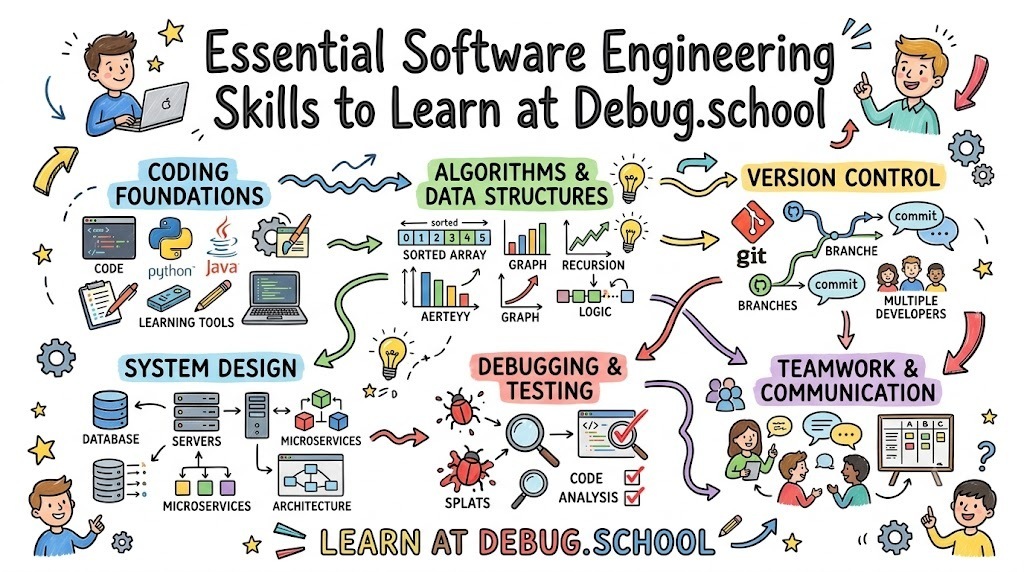
The field of software engineering changes rapidly, requiring developers to constantly upgrade their technical capabilities. Building applications is no longer just about writing functional code. Consequently, modern engineers must master system architecture, automation, and continuous delivery to build scalable systems. If you want to excel in this competitive landscape, focusing on core engineering competencies is completely essential. You can master all these fundamental practices and advanced methodologies by enrolling in specialized programs at Debug.school. This comprehensive guide breaks down the essential technical domains you need to study. Through practical training, you will bridge the gap between theoretical knowledge and real-world production environments.
Furthermore, mastering modern engineering means understanding how infrastructure and code interact seamlessly. Many developers focus entirely on syntax while neglecting the systems that run their software. As a result, they face massive challenges when deploying applications at scale. By focusing on production-grade systems, you learn to anticipate errors before they impact users. Therefore, selecting a structured learning path is the smartest decision for your career growth. Let us dive deep into the specific operational and development concepts you must acquire to become a world-class engineer.
Key Operational Concepts You Must Know
Continuous Integration and Continuous Delivery (CI/CD)
Automating the software delivery pipeline is a foundational pillar of modern engineering. Continuous Integration ensures that multiple developers can merge their code changes into a central repository frequently. Consequently, automated build and test processes run instantly to validate these changes. This immediate feedback loop prevents integration conflicts and catches bugs early in the lifecycle. Therefore, teams can maintain a highly stable codebase without manual verification headaches.
Continuous Delivery takes this automation further by preparing the validated code for deployment. It ensures that the main branch remains in a deployable state at all times. Moreover, Continuous Deployment automatically pushes these updates straight to production servers. Because this eliminates manual intervention, software updates reach users much faster and with significantly less risk.
Infrastructure as Code (IaC)
Managing infrastructure manually through cloud consoles is inefficient and highly prone to human error. Instead, Infrastructure as Code allows engineers to define and provision server setups using machine-readable definition files. This approach means you can manage networks, virtual machines, and load balancers just like application source code. Consequently, you can version control your entire infrastructure using Git repositories.
Furthermore, IaC guarantees that your development, staging, and production environments remain completely identical. If an environment drifts or changes unexpectedly, you can redeploy the exact configuration instantly. This consistency eliminates the classic problem where code works on a local machine but fails in production. Therefore, mastering IaC tools is absolutely non-negotiable for modern software engineers.
Containerization and Orchestration
Containerization packages an application together with all its dependencies, libraries, and configuration files into a single unit. This isolated package runs consistently across any computing environment, regardless of the underlying operating system. As a result, developers can eliminate environment-specific bugs entirely. It simplifies local development because the container behaves exactly the same way on a laptop as it does on a massive cloud server.
However, managing hundreds of isolated containers across multiple cloud servers requires powerful automation. This is where container orchestration platforms become vital for handling scaling, networking, and self-healing. Orchestration tools automatically replace failed containers, balance incoming user traffic, and scale up resources during peak hours. Understanding these ecosystems allows you to build highly resilient, distributed applications that handle massive traffic.
Observability and Monitoring
Building a system is only half the battle; you must also understand how it behaves in production. Observability relies on three main pillars, which are logs, metrics, and distributed traces. Logs provide a detailed chronological record of specific system events and errors. Meanwhile, metrics give you real-time statistical data about CPU usage, memory consumption, and network latency.
Distributed tracing tracks the exact path of a user request as it travels through various interconnected microservices. Together, these three elements give engineers deep visibility into complex system behaviors. When an application slows down, observability tools help you pinpoint the exact bottleneck immediately. Therefore, learning to configure comprehensive monitoring systems is essential for maintaining high application uptime.
Platform Implementation vs. Culture — What's the Real Difference?
Defining Platform Engineering
Platform Engineering focuses on building an internal developer platform that simplifies operations for software development teams. The platform team designs automated tools, reusable templates, and self-service portals. Consequently, product developers can provision databases or deploy code without waiting for operations teams to help them. This approach treats the internal infrastructure directly as a product designed to optimize developer productivity.
Furthermore, platform engineering reduces cognitive load by abstracting away the complex underlying cloud infrastructure. Developers do not need to become deep experts in networking or cloud security to ship code safely. Instead, they leverage pre-configured, secure blueprints provided by the platform. This structured automation accelerates feature delivery while ensuring the entire organization follows corporate compliance policies.
Understanding DevOps Culture
In contrast, DevOps is not a specific job title or a standalone tool, but rather an organizational culture. It breaks down the traditional silos that historically separated development teams from operational teams. This cultural framework emphasizes shared responsibility, continuous communication, and mutual feedback throughout the entire lifecycle. Therefore, developers care about operational stability, and operators care about development velocity.
Additionally, a strong DevOps culture encourages experimentation, calculated risk-taking, and continuous learning from production failures. Teams conduct blameless post-mortems to fix systemic issues rather than blaming individuals for software bugs. When combined with automated tooling, this mindset transforms how fast an organization innovates. Ultimately, culture provides the philosophical foundation, while platform engineering provides the tangible tools to execute it.
| Aspect | Platform Engineering | DevOps Culture |
|---|---|---|
| Primary Focus | Creating internal self-service products and automated tools. | Fostering collaboration, shared goals, and cultural mindsets. |
| Target Audience | Internal software developers and engineering teams. | The entire organization, including dev, ops, and QA. |
| Execution Method | Building software platforms and maintaining infrastructure. | Changing workflows, communication habits, and team structures. |
| Core Goal | Reducing developer friction and optimizing productivity. | Aligning development speed with operational stability. |
Real-World Use Cases of Modern Operations
High-Frequency E-Commerce Platforms
During massive seasonal holiday sales, e-commerce applications experience sudden, unpredictable surges in user traffic. Modern operational strategies utilize automated scaling to handle these massive traffic spikes smoothly. For instance, metric-driven triggers detect rising CPU utilization and instantly launch additional application containers. This dynamic adjustments ensure that the website remains fast and responsive for shoppers.
Moreover, microservices architecture prevents a failure in one section from crashing the entire retail store. If the payment gateway experiences a slowdown, customers can still browse products and add items to their carts. Database replication and caching mechanisms ensure that product listings load instantly under heavy strain. Implementing these robust operational practices keeps businesses profitable during peak commercial events.
Global Financial Services
Financial software requires absolute data accuracy, low latency, and compliance with strict security regulations. Operational engineering addresses these needs by enforcing automated compliance checks directly within the deployment pipeline. Every code change undergoes rigorous security scanning for vulnerabilities before moving to production. This process minimizes human oversight errors and blocks malicious code from entering live environments.
Additionally, financial systems deploy multi-region active-active architectures to prevent catastrophic data loss during outages. If a primary cloud data center goes offline unexpectedly, traffic routes to a secondary region instantly. Zero-downtime deployment strategies ensure that banking applications receive updates without interrupting customer transactions. Therefore, modern operations form the backbone of security and reliability in global finance.
Scalable Media Streaming Architecture
Media streaming platforms deliver massive video data files concurrently to millions of worldwide users. To avoid buffering, operational engineers leverage distributed Content Delivery Networks (CDNs) to cache media content close to users. They also build adaptive bitrate streaming algorithms that adjust video quality dynamically based on real-time internet speeds. This architecture requires complex backend coordination between media encoding servers and storage buckets.
Furthermore, streaming services utilize container orchestration to manage real-time user recommendations and analytics engines. When a popular show launches, the backend infrastructure scales dynamically to process millions of concurrent streams. Observability dashboards monitor global delivery paths to fix network issues before viewers experience lag. Thus, advanced operations enable smooth, uninterrupted digital entertainment experiences at an incredible scale.
Common Mistakes in Operations Engineering
- Ignoring Security in the CI/CD Pipeline: Many teams treat security as an afterthought, scanning code only right before a major release. This mistake allows security vulnerabilities and exposed API keys to slip deep into the production environment undetected. Moving security checks to the very beginning of the pipeline prevents these costly issues completely.
- Over-Engineering the Infrastructure: Developers often introduce overly complex microservices and distributed tools for applications that could run fine on simple setups. This unnecessary complexity increases cloud computing costs and makes debugging difficult. Engineers should always build the simplest architecture that successfully meets business requirements.
- Lack of Comprehensive Documentation: Teams frequently build automated pipelines but fail to document how the underlying systems interact. Consequently, when the primary architect leaves or goes on vacation, the remaining team cannot fix system failures. Maintaining clear, updated architectural diagrams prevents operational dead ends.
- Relying Exclusively on Manual Backups: Depending on human operators to trigger database backups manually inevitably leads to data loss during disasters. Automated, regularly tested backup routines are the only reliable way to protect critical enterprise data. Teams must simulate data restoration drills frequently to ensure backups actually work.
- Setting Up Poor Alerting Thresholds: Configuring overly sensitive monitoring alerts causes severe notification fatigue among on-call software engineers. When systems trigger alarms for minor issues, engineers begin ignoring notifications altogether. Alerts should only activate when immediate human intervention is required to fix a production problem. ## How to Become an Operations Expert — Career Roadmap ### Phase 1: Mastering Linux and Scripting Foundations Your engineering journey must begin with a rock-solid understanding of the Linux operating system. You must become comfortable navigating the command line interface, managing processes, and manipulating file permissions. Because automation is the core of operations, learning a scripting language like Bash or Python is absolutely essential. Scripting allows you to automate repetitive server management tasks and clean up logs easily. Additionally, you need to understand core networking concepts such as IP addressing, subnets, and DNS configurations. Knowing how data moves across routers and firewalls helps you diagnose connectivity issues between applications. This foundational phase builds the core technical troubleshooting mindset required for all advanced engineering roles. Skip this step, and you will struggle to understand complex cloud systems later. ### Phase 2: Adopting Version Control and CI/CD Tools Once you can manage single servers, you must learn how to collaborate effectively using Git version control. You need to master branching strategies, merge requests, and conflict resolution workflows. Next, transition into building automated continuous integration pipelines that run unit tests on every code commit. This step teaches you how to enforce quality standards automatically across software projects. After mastering test integration, focus on continuous delivery mechanisms that package software into deployable artifacts. You will learn to construct delivery pipelines that push applications to staging environments automatically. Understanding this automation loop reduces release anxieties and accelerates your deployment speed. This phase transforms you from a traditional developer into an automation-focused engineer. ### Phase 3: Specializing in Containers and Cloud Architecture The third phase requires you to move away from traditional virtual machines and adopt container technology. Learn how to write optimized configurations to package microservices efficiently with minimal resource overhead. Once you understand individual containers, study advanced orchestration platforms to manage large-scale multi-container applications. This knowledge teaches you how to handle rolling updates, service discovery, and automated application scaling. Simultaneously, dive deep into cloud computing platforms and learn to manage resources using Infrastructure as Code. Instead of clicking buttons in a cloud portal, you will write declarative files to spin up entire architectures. This step combines software development practices directly with systems infrastructure management. Mastering these skills qualifies you for high-paying platform and operations roles globally. ## FAQ Section
- What are the most critical skills to learn at Debug.school? Students at Debug.school focus deeply on mastering automation pipelines, container ecosystems, and infrastructure as code practices. Additionally, the curriculum emphasizes real-world troubleshooting, production system observability, and building scalable cloud architectures.
- Is learning Linux mandatory for a career in software operations? Yes, learning Linux is absolutely mandatory because the vast majority of production cloud environments run on Linux servers. Developing strong command-line and scripting skills allows you to automate infrastructure tasks efficiently and debug server errors quickly.
- How does Platform Engineering differ from traditional DevOps? Platform Engineering focuses on building internal self-service tools and platforms to improve the developer experience directly. DevOps, on the other hand, represents a broader cultural philosophy centered on collaboration and shared operational responsibilities.
- Why should I use Infrastructure as Code instead of manual configuration? Infrastructure as Code eliminates human configuration errors and ensures your deployment environments remain completely identical. It allows you to version control your infrastructure using Git, making deployments fast, repeatable, and easily auditable.
- How does containerization solve deployment environment issues? Containerization packages an application together with its exact dependencies, ensuring it runs identically on any computer. This isolation eliminates the common problem where software works locally on a laptop but fails in production environments. ## Final Summary To summarize, mastering software engineering requires a balanced combination of development knowledge and deep operational expertise. Aspiring engineers must look past basic coding syntax and embrace automation, container infrastructure, and robust observability. By learning to manage systems through code, you make yourself incredibly valuable to modern engineering organizations. Enrolling in structured, practical programs at Debug.school provides the exact hands-on experience needed to dominate this field. Furthermore, avoiding common industry mistakes like weak security integration and over-engineered architecture will accelerate your professional growth. Following a step-by-step career roadmap ensures you build a foundational understanding before tackling complex cloud systems. As industries continue to migrate toward distributed cloud architectures, the demand for highly skilled operations experts will rise. Dedicate yourself to continuous learning, practice daily on production-grade setups, and transform your engineering career today.



Top comments (0)