
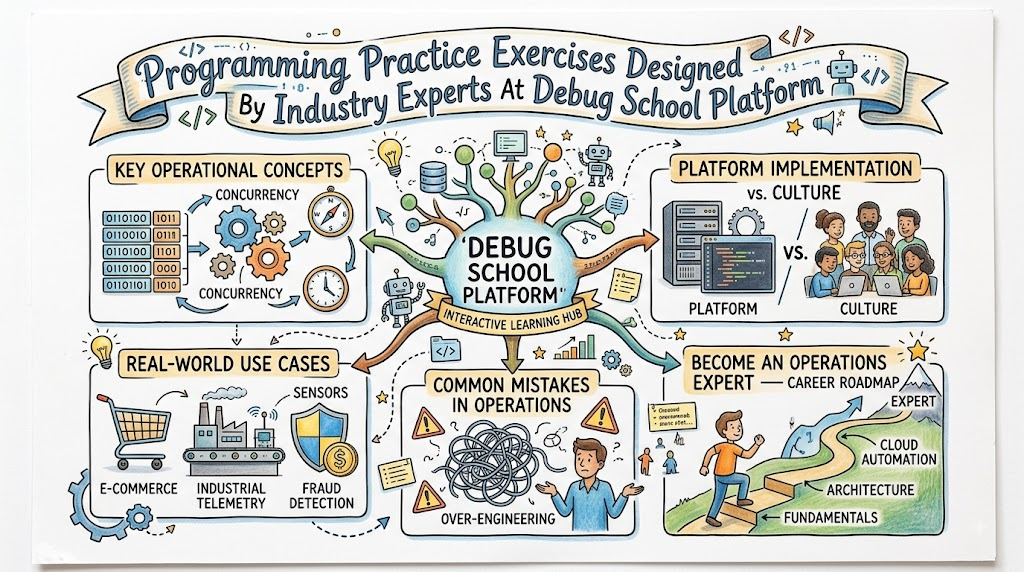
Mastering modern software engineering requires far more than passively reading syntax manuals or watching endless video tutorials. Real programming expertise develops through targeted problem-solving, deliberate failure analysis, and structured coding drills. Aspiring software engineers refine their analytical thinking and bridge the gap between syntax and production engineering by using debug.school. This comprehensive learning platform transforms abstract coding challenges into hands-on, mentor-crafted exercises that build genuine problem-solving intuition. Consequently, developers learn to design resilient software, trace complex runtime errors, and write performant code across diverse application ecosystems.
Foundational Coding Drills for Algorithmic Thinking
Algorithmic thinking allows developers to dissect complex software challenges into discrete, deterministic computing instructions. Foundational coding drills challenge engineers to organize raw data logically while selecting the most efficient mathematical routines. Instead of memorizing isolated code snippets, developers learn to evaluate trade-offs between memory footprint and computational speed.
Furthermore, recurring practice with core data structures establishes an intuitive mental map for runtime complexity. When software engineers understand how arrays, linked lists, hash tables, and trees behave under heavy loads, they write cleaner and faster solutions. This deep structural fluency prevents performance bottlenecks before code ever reaches a production environment.
Consequently, consistent practice with algorithmic drills turns daunting programming tasks into manageable, step-by-step logic chains. By internalizing these core patterns, engineers tackle unfamiliar frameworks with complete analytical confidence.
Incremental Debugging Workflows in Modern Development
Software development is fundamentally an iterative process of identifying, isolating, and fixing unexpected runtime defects. Structured debugging exercises train programmers to move beyond basic print statements and adopt professional inspection workflows. Through disciplined execution tracking, developers systematically trace state changes and variable mutations throughout the application lifecycle.
Additionally, mastering dedicated inspection utilities like interactive debuggers, memory profilers, and call-stack analyzers demystifies hidden execution layers. Engineers learn to pause running threads, set conditional breakpoints, and inspect memory allocation patterns in real time. This surgical visibility transforms debugging from random guessing into an exact, scientific investigation.
Therefore, dedicated debugging exercises cultivate technical resilience and sharp diagnostic instincts. Programmers learn to view software bugs as logical clues, allowing them to stabilize fragile applications swiftly.
Interactive Code Refactoring and Clean Architecture
Writing functional code is only the initial step in delivering high-quality, maintainable enterprise software. Expertly designed refactoring exercises guide developers through the art of transforming working yet messy code into clean, modular architectures. This process teaches programmers how to separate concerns, eliminate redundant loops, and establish clear class boundaries.
Moreover, practicing clean code conventions reinforces industry principles such as single responsibility, open-closed interfaces, and dependency inversion. As engineers refactor legacy scripts into decoupled modules, they significantly decrease technical debt across the codebase. Clean software structures make future feature expansions fast, safe, and easily testable.
As a result, regular refactoring practice helps programmers develop an eye for subtle code smells and architectural fragility. Teams that prioritize clean design patterns produce scalable software that stands up to rapid commercial growth.
Test-Driven Development Through Practical Code Challenges
Test-driven development fundamentally shifts how engineers conceptualize software requirements and design interfaces. By authoring unit tests before writing functional implementation code, programmers define precise success criteria upfront. This rigorous methodology forces developers to write decoupled, modular components that are inherently easy to isolate and verify.
Furthermore, automated test suites serve as living documentation that guards software against unexpected regressions. When developers practice building comprehensive test suites, they gain complete confidence during aggressive code refactoring phases. Automated test suites validate edge cases, handle unexpected null inputs gracefully, and verify data validation logic instantly.
Ultimately, integrating test-driven drills into routine programming practice produces robust codebases with near-zero defect rates. Engineers who adopt this habit consistently ship dependable, production-ready software systems.
Key Operational Concepts You Must Know
Distributed Memory and Concurrency Management
Modern enterprise software must handle concurrent requests without introducing race conditions or deadlocks into memory. In multi-threaded execution environments, multiple tasks access shared data structures simultaneously across various processing threads. Without robust synchronization mechanisms, concurrent write operations can silently corrupt data states and crash running applications.
Therefore, engineers must master atomic operations, thread pools, mutex locks, and non-blocking asynchronous event loops. Understanding how operating system threads interact with system hardware prevents costly resource starvation scenarios.
Additionally, modern high-throughput applications leverage distributed memory caches to reduce heavy query loads on core database clusters. Effective cache eviction policies, TTL strategies, and memory invalidation routines keep data fresh across distributed application tiers.
Algorithmic Complexity and Resource Profiling
Evaluating runtime efficiency through Big-O notation is a critical requirement for maintaining low-latency software operations. While a naive algorithm may function properly on small test datasets, it can completely stall when processing enterprise-scale workloads. Profiling resource utilization allows developers to uncover hidden quadratic loops and excessive heap allocations early.
Moreover, deep profiling uncovers memory leaks, thread contention, and slow garbage collection cycles within long-running virtual machines. Engineers use targeted CPU flame graphs to discover the exact lines of code consuming excessive processing cycles.
Consequently, optimizing algorithmic complexity directly slashes infrastructure operational costs and improves end-user response times. Continuous profiling ensures that software scales predictably without requiring constant, expensive hardware upgrades.
Network Input/Output and Asynchronous Systems
High-performance software relies extensively on non-blocking input and output mechanics to process thousands of simultaneous connections. Traditional blocking I/O models force threads to wait idly while reading files or querying remote network services. Conversely, non-blocking asynchronous architectures utilize event loops to handle incoming requests continuously without stalling threads.
Furthermore, engineers must account for network latency, TCP handshakes, packet serialization, and payload compression techniques. Optimizing these network communication layers dramatically improves system throughput across microservice boundaries.
As a result, understanding network sockets and streaming pipelines enables developers to build resilient distributed services. These modern communication patterns keep services responsive even during severe traffic spikes.
Continuous Integration and Automated Delivery Pipelines
Delivering software reliably requires an automated assembly line that tests, validates, and packages code changes continuously. Automated integration pipelines compile codebases, execute full test suites, and run static security scans on every pull request. This rapid feedback loop catches structural regressions and syntax flaws minutes after a developer pushes an update.
Additionally, automated delivery workflows package applications into lightweight, immutable container images for consistent multi-environment deployments. Standardized containerization ensures that software behaves identically across developer workstations, staging sandboxes, and live clusters.
Ultimately, robust delivery pipelines eliminate manual deployment errors and significantly accelerate release frequency. Development teams can ship critical security patches and innovative features to end users multiple times per day.
Platform Implementation vs. Culture — What's the Real Difference?
The Technology Trap in Engineering
Organizations frequently fall into the trap of believing that adopting new frameworks or buying specialized development platforms automatically fixes productivity issues. They deploy complex tooling environments without training their teams on core architectural design principles. Consequently, engineering teams struggle under the weight of complicated configurations rather than focusing on shipping clean, maintainable software.
In practice, a development platform is simply an instrument, not a replacement for strong engineering fundamentals. When developers lack solid debugging and design techniques, new platforms merely amplify existing operational bottlenecks.
Therefore, true engineering capability stems from mastering core logic, distributed computing models, and systematic problem-solving methods. Organizations must invest in sharpening their developers' algorithmic intuition before introducing heavy architectural platforms.
Fostering a Data-Driven Engineering Culture
A progressive engineering culture prioritizes continuous experimentation, peer code reviews, and transparent post-mortem analysis. In such environments, teams treat every software bug as an educational opportunity to strengthen automated test suites and refine shared standards. This collaborative approach removes the fear of failure and encourages engineers to tackle complex technical challenges boldly.
Moreover, a strong engineering culture values code clarity, documentation, and maintainability over clever, unreadable one-liners. Engineers actively collaborate across functional domains to ensure application architectures support overarching organizational goals.
When an organization successfully harmonizes modern tooling with an open, disciplined development culture, technical velocity increases dramatically. Teams consistently build durable software systems that adapt smoothly to changing business requirements.
| Operational Dimension | Tooling & Implementation Focus | Cultural & Mindset Foundation |
|---|---|---|
| Primary Focus | Installing IDE plugins, setting up CI/CD servers, and managing software licenses. | Cultivating deliberate practice, architectural clarity, and disciplined test-driven habits. |
| Longevity | Short-term horizon; tools and frameworks evolve or become obsolete rapidly. | Long-term asset; core problem-solving models remain valuable across all technologies. |
| Evaluation Metric | Tool adoption rates, deployment pipeline speed, and server uptime metrics. | Code maintainability, defect reduction rates, and cross-team knowledge sharing. |
| Value Proposition | Provides the execution environment and computational utilities for daily tasks. | Drives the engineering excellence, design consistency, and team-wide technical resilience. |
Real-World Use Cases of Modern Operations
Resilient Order Processing in Distributed E-Commerce
High-traffic online shopping platforms process millions of concurrent checkout requests during promotional campaigns and seasonal sales events. To maintain data consistency without dropping transactions, these platforms utilize event-driven messaging queues and transactional outbox patterns. This architectural design ensures that payment processing, inventory reservation, and email notifications execute reliably without database contention.
Simultaneously, distributed tracing systems track each purchase request as it traverses dozens of independent internal microservices. If an inventory service fails mid-transaction, automated compensation routines restore reserved stock and notify the customer gracefully.
- Core Challenge: Managing massive concurrent write operations while guaranteeing transactional consistency.
- System Characteristics: Event-driven microservices, decoupled message brokers, and idempotent database handlers.
- Operational Outcome: Prevents over-selling inventory and maintains responsive customer checkout experiences during traffic surges.
Real-Time Telemetry Processing in Automotive Fleets
Connected vehicles generate continuous streams of sensor data tracking battery temperature, motor RPM, tire pressure, and GPS coordinates. Fleet management platforms ingest this high-velocity telemetry data using distributed streaming pipelines for live diagnostic analysis. By processing these data streams immediately, systems trigger automated maintenance alerts before mechanical failures leave drivers stranded.
Furthermore, aggregated sensor records feed into deep analytical models to optimize battery lifespan and enhance vehicular energy efficiency. This dual-pipeline setup ensures immediate operational safety while providing valuable insights for future vehicle software updates.
- Core Challenge: Ingesting millions of high-frequency data points per second with minimal end-to-end latency.
- System Characteristics: Time-series streaming engines, edge data filtering, and automated anomaly detection alerts.
- Operational Outcome: Minimizes fleet downtime and extends component longevity through predictive maintenance alerts.
High-Throughput Fraud Detection in Payment Gateways
Global payment networks must evaluate transaction risk within milliseconds to intercept fraudulent charges without delaying genuine shoppers. Ingestion systems route incoming transaction payloads through distributed rule evaluation engines and real-time machine learning inference services. These systems cross-reference geolocation data, device fingerprints, and historical spending patterns before approving transactions.
Meanwhile, background worker clusters constantly aggregate behavioral profiles and retrain detection models based on newly discovered fraud vectors. This continuous feedback loop ensures that security measures dynamically adapt to emerging fraud techniques across global networks.
- Core Challenge: Executing complex multi-variable risk models within sub-second latency windows.
- System Characteristics: In-memory key-value stores, distributed inference microservices, and asynchronous event auditing.
- Operational Outcome: Protects consumer funds and drastically cuts chargeback costs for merchants worldwide.
Common Mistakes in Operations Engineering
Writing Monolithic Code Lacking Modular Boundaries
A common pitfall among developing engineers is writing massive, tightly coupled code files that blend business logic with network calls. These sprawling monoliths make isolating bugs nearly impossible and turn routine software updates into high-risk endeavors. When a developer changes a single variable in an unstructured script, unrelated application features frequently break without warning.
Consequently, development speed grinds to a halt because engineers spend excessive time deciphering convoluted dependency graphs. Software components must maintain clean separation of concerns and communicate exclusively through well-defined interfaces.
Therefore, engineers should practice breaking monolithic scripts into small, independently testable functions and classes. Clean modular boundaries drastically simplify debugging, streamline code reviews, and make team collaboration effortless.
Disregarding Boundary Validations and Error Handling
Relying entirely on optimistic code execution without handling unexpected input states is a recipe for catastrophic production failures. Beginners frequently assume external API calls will always return HTTP 200 responses and that input payloads will always match expected data types. When a service experiences network latency or receives malformed data, unhandled exceptions quickly crash running application processes.
To build reliable systems, developers must implement comprehensive input validation, defensive null-checking, and structured exception handling. Employing circuit breakers, exponential backoff retries, and fallback mechanisms ensures that services degrade gracefully during external outages.
Ultimately, resilient software anticipates runtime failures at every architectural layer and recovers automatically from network interruptions. Proactive error handling protects system availability and guarantees a consistent experience for end users.
Premature Optimization and Ignoring Measurement Tools
Engineers often spend valuable development time optimizing minor code routines before identifying the actual performance bottlenecks. Writing cryptic, low-level code in an attempt to save microsecond processing intervals often makes the codebase unreadable without delivering meaningful speed gains. In most real-world scenarios, the true bottlenecks stem from slow database queries, unnecessary network roundtrips, or inefficient file operations.
Instead of guessing where performance issues reside, developers must use objective profilers and tracing tools to measure system behavior. Profiling data highlights the exact functions consuming disproportionate memory or CPU time, directing engineering efforts where they matter most.
As a result, programmers should always prioritize clean, expressive code first, applying optimizations only when profiling data proves an operational necessity. Data-driven performance tuning yields maximum efficiency with minimal architectural complexity.
How to Become an Operations Expert — Career Roadmap
Step 1: Mastering Foundational Problem-Solving
Begin your engineering path by developing absolute mastery over foundational programming languages, control structures, and standard libraries. Dedicate significant time to solving algorithmic puzzles, manipulating strings, traversing arrays, and implementing custom data structures from scratch. Build fluency in writing modular code and master command-line utilities to navigate file systems and manage local processes smoothly.
- Primary Focus: Master core languages like Python, Java, or Go, and write clean, object-oriented or functional code.
- Learning Approach: Solve daily coding challenges, analyze time and space complexity, and build command-line automation tools.
- Milestone Goal: Gain the ability to translate complex conceptual logic into working code without relying on external assistance.
+-------------------------------------------------------------+
|               FOUNDATIONAL MASTERY                          |
|  - Core Data Structures (Trees, Graphs, Hash Maps)          |
|  - Time & Space Complexity Analysis (Big-O)                 |
|  - Command-Line Navigation & Scripting                      |
+-------------------------------------------------------------+
                              |
                              v
+-------------------------------------------------------------+
|               SYSTEM ARCHITECTURE & DESIGN                  |
|  - Asynchronous Programming & Concurrency                   |
|  - Test-Driven Development (TDD)                            |
|  - Clean Architecture & Design Patterns                     |
+-------------------------------------------------------------+
                              |
                              v
+-------------------------------------------------------------+
|               ENTERPRISE INFRASTRUCTURE                     |
|  - Containerization & Orchestration                         |
|  - CI/CD Automation & Static Analysis                       |
|  - Distributed Caching & Event Messaging                    |
+-------------------------------------------------------------+
                              |
                              v
+-------------------------------------------------------------+
|               OBSERVABILITY & OPTIMIZATION                  |
|  - Real-Time Telemetry & Distributed Tracing                |
|  - CPU Profiling & Memory Leak Mitigation                   |
|  - Production Resilience & Chaos Engineering                |
+-------------------------------------------------------------+
Step 2: Deepening Architecture and System Design
Once basic coding patterns become second nature, transition toward designing multi-tier systems, relational database models, and asynchronous workers. Study how to construct clean RESTful and gRPC APIs, implement authentication protocols, and design efficient database schemas. Practice writing comprehensive unit and integration test suites using modern test frameworks to ensure your services remain durable under stress.
- Primary Focus: Learn asynchronous programming, master SQL query optimization, and implement decoupled design patterns.
- Practical Projects: Build a full-featured web backend complete with automated unit tests, caching layers, and database migrations.
- Milestone Goal: Deliver decoupled, self-documenting applications that run reliably across multiple development environments.
Step 3: Mastering Containerization and Infrastructure Automation
Expand your technical reach by learning how to containerize applications, configure automated build pipelines, and manage cloud environments. Understand how container runtimes isolate processes, manage shared network interfaces, and bind persistent storage volumes. Gain practical experience authoring pipeline scripts that run automated tests, linting tools, and container builds on every code commit.
- Primary Focus: Master container tools, configure continuous integration pipelines, and practice infrastructure-as-code principles.
- Practical Projects: Create an automated deployment pipeline that packages microservices into lightweight container images.
- Milestone Goal: Automate the entire software delivery cycle from initial git commit to production cluster deployment.
Step 4: Observability, Profiling, and Enterprise Scaling
Achieve senior-level engineering status by mastering distributed system observability, memory profiling, and high-load traffic management. Learn how to instrument applications with distributed traces, aggregate structured log streams, and design informative health dashboards. Practice analyzing heap dumps and CPU flame graphs to resolve elusive memory leaks and concurrency bottlenecks under simulated heavy loads.
- Primary Focus: Master distributed tracing, instrument metrics, analyze thread dumps, and optimize high-throughput architectures.
- Leadership Role: Mentor junior developers, direct architectural design reviews, and establish company-wide engineering standards.
- Milestone Goal: Design, deploy, and maintain self-healing distributed platforms that support massive user bases with high availability.
FAQ Section
- Why is deliberate programming practice more effective than building random personal projects? Deliberate programming practice isolates specific conceptual weaknesses, such as concurrency bugs or recursive logic, through targeted, repeatable exercises. While building personal projects is valuable, deliberate drills force developers to confront challenging architectural problems they might otherwise avoid.
- How often should software developers practice dedicated coding and debugging exercises? Developers should ideally spend thirty to forty-five minutes every day practicing targeted coding exercises. Consistent daily practice reinforces algorithmic intuition, sharpens syntax recall, and builds the muscle memory needed to diagnose complex production bugs quickly.
- What is the best way to transition from writing code to debugging complex production issues? The most effective approach is learning to use professional debugging tools, such as interactive breakpoints, memory profilers, and stack trace analyzers. Instead of using print statements, developers should practice tracing execution flows step-by-step to understand how runtime state changes across threads.
- Why is test-driven development emphasized so heavily in enterprise environments? Test-driven development forces developers to clarify functional requirements and interface boundaries before writing implementation logic. This practice results in decoupled, modular code that is easy to maintain, refactor, and scale without introducing unexpected regressions.
- Which programming language should beginners master first for operational engineering? Beginners should start with an expressive, widely supported language like Python or Go before expanding into Java or C++. These languages offer clean syntax, extensive standard libraries, and widespread adoption across web services, cloud tools, and data pipelines.
Final Summary
Developing true software engineering expertise requires moving past superficial code tutorials and engaging in deliberate, structured problem-solving. By dissecting complex algorithmic patterns and practicing systematic debugging techniques, programmers build the skills necessary to develop enterprise-grade applications. Comprehensive learning platforms provide the clear roadmaps, practical exercises, and diagnostic challenges needed to bridge the gap between academic theory and real-world engineering.
Avoid the common pitfall of relying on new tools to solve fundamental design issues; instead, invest your time in mastering concurrency, clean architecture, and automated testing. Blending strong algorithmic fundamentals with a disciplined engineering culture empowers you to design resilient, high-performance systems that thrive in modern production environments.



Top comments (0)