
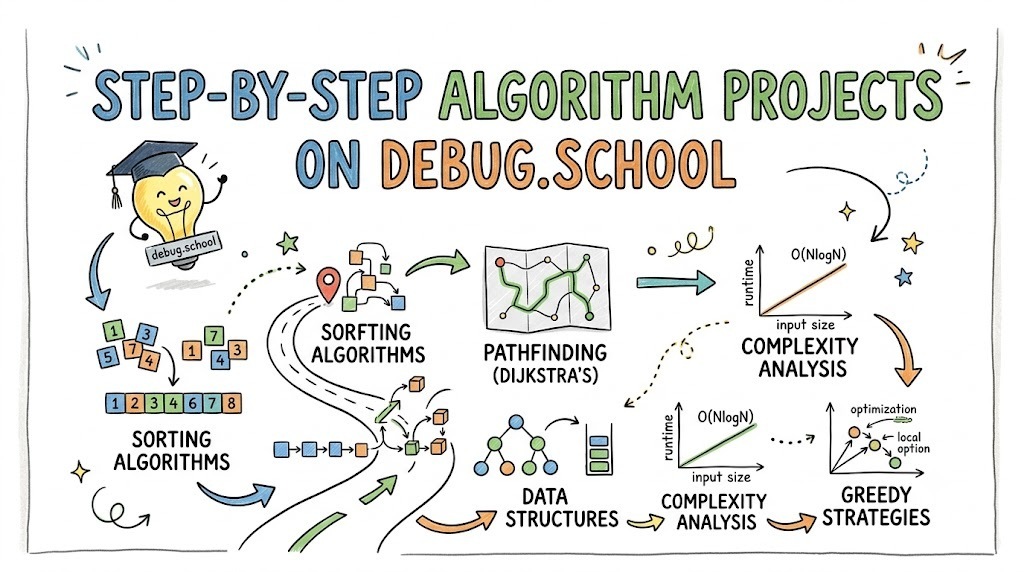
Learning algorithms often feels like trying to decipher a cryptic language filled with abstract mathematical symbols and confusing pseudo-code. However, breaking down complex data structures and optimization problems becomes incredibly natural when you can build them from scratch through hands-on practice. Aspiring developers can easily bridge the gap between theory and practical software engineering through the structured paths offered by debug.school. This interactive platform simplifies algorithmic thinking by turning complex computational logic into step-by-step project blueprints. Consequently, programmers can rapidly learn how to write efficient, optimized, and clean code that easily scales to handle real-world software challenges.
Key Operational Concepts You Must Know
Algorithm Time and Space Complexity
Complexity analysis forms the absolute foundation of evaluating how well an algorithm will perform under heavy production workloads. Instead of measuring performance in unreliable CPU seconds, developers use Big O notation to evaluate how resource consumption grows relative to input size. This mathematical framework ensures that your software remains stable and highly performant even when user traffic or data volumes scale exponentially over time.
Furthermore, engineers must constantly balance the delicate trade-offs between memory consumption and CPU execution speeds during application development. For instance, caching frequently used calculations drastically reduces processing time but requires dedicating significantly more system memory to the application.
Consequently, mastering time and space complexity analysis is essential for identifying performance bottlenecks before code ever hits production environments. When you inherently understand these mathematical limits, writing highly efficient code feels just as natural as writing a basic script.
Data Structure Fundamentals
Choosing the correct data structure fundamentally dictates how efficiently your code can store, access, and manipulate critical application data. Basic linear structures like dynamic arrays and linked lists offer simple data storage but vary wildly in search and insertion performance. Selecting the wrong container can accidentally introduce massive performance penalties that slow your entire application to an agonizing crawl.
Subsequently, advanced non-linear structures like trees and graphs allow developers to model complex, highly interconnected real-world information networks. These hierarchical frameworks enable rapid searching, sorting, and relationship mapping that traditional linear arrays simply cannot handle efficiently.
As a result, a deep familiarity with pointers, memory allocation, and data organization patterns is vital for every software engineer. Choosing the perfect structure early ensures your algorithms execute with maximum speed and minimal system overhead.
Divide and Conquer Paradigms
The divide-and-conquer paradigm is a powerful problem-solving strategy that breaks a massive, overwhelming computational problem into smaller, identical sub-problems. This design pattern works by recursively solving the miniature components and then combining their individual results to solve the original task. This structural approach frequently converts slow, inefficient algorithms into highly optimized processes that easily handle massive datasets.
Initially, developers often struggle with the recursive mindset required to implement these multi-step algorithms cleanly without causing stack overflows. However, mastering the exact base cases and division logic allows you to split workloads across multiple computing threads efficiently.
Ultimately, these principles form the structural backbone of modern sorting algorithms, fast Fourier transforms, and parallel computing architectures. Learning this paradigm enables you to tackle complex enterprise-level logic problems by systematically breaking them down into easily digestible pieces.
Greedy Strategies vs Dynamic Programming
Engineers must constantly decide whether to use a fast, short-sighted greedy approach or a thorough dynamic programming strategy. Greedy algorithms make the absolute best choice at each immediate step, hoping that these local optimal decisions lead to a global solution. While these algorithms are incredibly fast and easy to implement, they fail to solve complex optimization problems accurately.
Conversely, dynamic programming solves complex problems by systematically breaking them down into overlapping sub-problems and storing the results to avoid duplicate work. This memory-based approach guarantees an mathematically optimal solution by analyzing every historical decision pathway without wasting computational power.
Mastering both approaches allows you to confidently choose the right tool based on your specific performance requirements. This optimization expertise prevents you from wasting valuable development cycles on algorithms that yield incorrect or highly inefficient results.
Platform Implementation vs. Culture — What's the Real Difference?
The Syntax Trap in Algorithm Education
Many novice programmers mistakenly believe that memorizing specific language syntax or copying popular code snippets will automatically make them great problem solvers. This narrow focus on coding syntax creates a dangerous educational trap where individuals write code without understanding the underlying logical architecture. Consequently, developers struggle immensely the moment a real-world problem deviates slightly from the textbook examples they memorized.
In reality, a programming language is merely an implementation tool, not the core logic of the algorithm itself. When engineers focus solely on specific language quirks rather than universal algorithmic patterns, their problem-solving abilities become severely limited.
Therefore, true engineering mastery requires focusing deeply on core logical steps rather than the fleeting syntax of a specific language version. Learning how to design pure algorithms fundamentally prevents you from feeling helpless when switching between different software ecosystems.
Fostering an Algorithmic Engineering Culture
A robust engineering culture focuses heavily on code efficiency, rigorous peer reviews, and continuous architectural optimization across the development team. In this environment, teams treat algorithms as critical business assets that require automated testing, edge-case validation, and detailed performance documentation. This cultural mindset ensures that codebase quality remains exceptionally clean, readable, and maintainable as new features are added.
Additionally, an optimal engineering culture encourages developers to whiteboards solutions openly, debate architectural trade-offs, and learn from inefficient system designs. This collaborative atmosphere removes ego from the equation and accelerates the collective technical growth of the entire engineering department.
When a development team successfully balances clean platform implementation with a supportive problem-solving culture, software reliability skyrockets. Engineers stop guessing at optimization and start systematically building robust codebases that gracefully handle enterprise-scale workloads.
| Aspect | Platform Implementation | Culture & Mindset |
|---|---|---|
| Primary Focus | Writing lines of code, configuring compilers, and satisfying specific language syntax requirements. | Designing clean logic, optimizing execution paths, and validating edge cases systematically. |
| Longevity | Short-term focus that changes as programming languages evolve or introduce new framework versions. | Long-term foundational thinking that applies universally across any technology stack or language. |
| Success Metric | Code compiling successfully without errors and passing basic unit tests. | Minimal time complexity, optimal memory usage, and high architectural maintainability over time. |
| Core Value | Translates abstract logical designs into functional instructions that machines can physically execute. | Drives the underlying efficiency, scalability, and long-term viability of the entire software ecosystem. |
Real-World Use Cases of Modern Operations
Network Routing Protocols in Global Telecommunications
Modern networking hardware processes trillions of data packets every single second, requiring instantaneous routing paths across the global internet infrastructure. To achieve this speed, enterprise routers run highly optimized shortest-path algorithms to find the fastest data delivery routes dynamically. This real-time calculation allows networks to bypass congested data nodes and instantly redirect traffic around physical cable cuts.
Simultaneously, background processes continuously monitor network health metrics to update the underlying graph models that dictate global traffic flows. This continuous topological mapping guarantees that video streams, financial transactions, and communication data travel across the earth with minimal latency.
- Key Requirements: Ultra-low execution latency, high tolerance for dynamic topology changes, and absolute mathematical path accuracy.
- Core Benefit: Maximizes global network throughput while completely eliminating data packet loss during unexpected hardware failures.
- Data Scale: Manages massive routing matrices connecting billions of active internet devices simultaneously across the globe.
Resource Allocation in Cloud Computing Data Centers
Cloud computing data centers manage massive clusters of physical servers that host thousands of virtual machines for global business applications. To optimize operations, automated orchestration engines run complex bin-packing algorithms to fit workloads onto physical hardware efficiently. This automated placement prevents expensive servers from sitting completely idle while others are dangerously overwhelmed with user traffic.
Furthermore, these resource allocation algorithms must dynamically migrate running applications between servers when physical hardware components exhibit signs of degradation. This proactive movement keeps cloud systems running seamlessly without interrupting the digital services relied upon by millions of users.
- Data Types: Real-time CPU utilization metrics, memory consumption logs, and historical server performance data.
- Operational Goal: Minimize total energy consumption and hardware wear while honoring strict customer service level agreements.
- Analysis Method: Combines heuristic-based greedy scheduling with long-term dynamic forecasting models to balance server workloads.
Supply Chain Optimization in Global Logistics E-Commerce
Global e-commerce platforms rely heavily on algorithmic optimization to manage inventory distribution and delivery vehicle routes efficiently. As orders flood the system, routing algorithms instantly calculate the most cost-effective path from fulfillment centers to customer doorsteps. This complex processing accounts for live traffic patterns, delivery vehicle weight capacities, and promised shipping windows simultaneously.
Meanwhile, predictive algorithms analyze historical purchasing trends to strategically pre-position popular inventory items in warehouses closest to high-demand regions. This dual-layer planning ensures that companies can successfully achieve lightning-fast delivery times while keeping total transportation costs remarkably low.
- Target Outcomes: Drastically reduced fuel expenditures, faster order delivery times, and highly optimized warehouse spatial utilization.
- Pipeline Structure: Fast-moving real-time vehicle dispatch systems paired with deep historical inventory forecasting layers.
- Scale Challenge: Successfully managing millions of overlapping delivery coordinates during high-volume global holiday shopping seasons.
Common Mistakes in Operations Engineering
Implementing Premature Optimization Strategies
A frequent mistake among junior developers is optimizing code performance before verifying that the algorithm even functions correctly. Driven by a desire for perfect efficiency, programmers often implement complex, unreadable logic tweaks when simple code would work perfectly fine. This premature optimization introduces unnecessary technical debt, confusing bug vectors, and immense development friction for the engineering team.
Consequently, project delivery timelines slow to a crawl because the team spends more time debugging convoluted micro-optimizations than shipping features. Readability and correctness must always remain your primary objectives when first implementing a new algorithmic solution.
Therefore, you should only optimize your code after production profiling tools explicitly prove that a specific section is causing a bottleneck. Keeping your initial logic clean ensures rapid feature development, easy debugging cycles, and much higher overall code maintainability.
Ignoring Boundary Conditions and Edge Cases
Launching algorithm projects without comprehensively testing unusual input boundaries always leads to catastrophic application crashes down the road. When functions encounter unexpected null values, empty arrays, or negative numbers, unvalidated code will instantly throw fatal exceptions. Without automated input sanitization, these unhandled edge cases quietly break background pipelines, corrupting critical databases and disrupting user workflows.
To prevent this issue, developers must aggressively adopt test-driven development methodologies that deliberately target extreme minimum and maximum inputs. These automated test suites catch broken logic in isolated development environments long before the application goes live.
Ultimately, writing robust code requires a deep mindset of defensive programming, thorough input validation, and graceful error handling strategies. Prioritizing boundary condition verification early completely eliminates embarrassing production bugs and protects your system's operational integrity.
Blindly Copying Black-Box Algorithmic Solutions
It is incredibly easy to introduce severe security flaws and performance regressions by blindly copying algorithm blocks from internet forums. Beginners frequently paste complex code blocks into their applications without understanding how the underlying logic actually handles data internally. This lack of deep comprehension makes it nearly impossible to troubleshoot the application when hidden bugs inevitably surface.
Moreover, borrowed code often contains unoptimized loops that perform terribly when exposed to real-world, enterprise-sized production datasets. Failing to analyze the internal mechanics of your code leaves your software vulnerable to memory leaks and malicious exploit vectors.
As a result, engineers must make it a strict professional habit to thoroughly trace and understand every single line of code they implement. Building a deep, step-by-step understanding of your algorithms ensures that your software remains secure, highly performant, and completely within your control.
How to Become an Operations Expert — Career Roadmap
Step 1: Mastering Fundamentals
Begin your algorithmic journey by building an unshakeable foundation in core programming logic, variable management, and basic control structures. You must become completely fluent in tracing code execution line by line, understanding memory pointers, and using basic debugging tools. Additionally, focus heavily on learning how to read, write, and convert standard pseudo-code into fully functional computer programs.
- Core Focus: Master basic loop constructs, understand conditional logic paths, and practice manipulating simple linear data collections cleanly.
- Learning Resources: Interactive coding challenges, foundational logic puzzles, and beginner-friendly computer science learning paths.
- Estimated Time: Dedicate your opening weeks entirely to mastering these basic blocks before moving toward advanced structural concepts.
Step 2: Understanding Distributed Core
Once you master basic code syntax, advance immediately to studying universal data structures and their native search algorithms. Learn exactly how binary trees balance themselves, how hash tables resolve key collisions, and how graphs map internal nodes. Work on manually coding these structures from scratch to understand exactly how computers manage complex relationships in raw system memory.
- Core Focus: Implement linked lists, build custom binary search trees, and practice writing classic depth-first search traversal algorithms.
- Practical Projects: Create a visual simulator that demonstrates how different sorting algorithms rearrange data elements in real time.
- Key Concept: Focus intensely on calculating the precise Big O complexity differences between different data storage choices.
Step 3: Mastering Advanced Frameworks
Transition your problem-solving capabilities into complex algorithmic paradigms by studying dynamic programming, greedy strategies, and advanced heuristics. Learn how to identify overlapping sub-problems, construct efficient memoization tables, and optimize highly complex mathematical multi-step decision paths. Additionally, dive deep into string-matching mechanics, network flow optimization models, and advanced spatial indexing geometric structures.
- Core Focus: Solve multi-variable optimization problems and build intelligent pathfinding logic for complex virtual environments.
- Design Skills: Learn to instantly recognize which specific algorithmic paradigm perfectly matches a brand-new abstract problem statement.
- Optimization Goal: Focus heavily on reducing the execution footprint of your code from polynomial down to logarithmic runtime scales.
Step 4: Enterprise Orchestration and Cloud Deployment
Round out your professional expertise by applying your advanced algorithmic knowledge to large-scale enterprise software architectures and system designs. Master the art of designing distributed caching layers, optimizing database query execution plans, and load-balancing traffic across global servers. Finally, learn how to audit large enterprise codebases for algorithmic inefficiencies to dramatically reduce corporate cloud infrastructure costs.
- Core Focus: Scale backend architectures to gracefully handle millions of concurrent operations through highly optimized algorithmic logic.
- Career Growth: Advance from a standard application programmer into a high-level software architect who designs core engineering platforms.
- Final Goal: Architect incredibly fast, stable, and highly optimized software systems that effortlessly handle global enterprise workloads.
FAQ Section
- Why should I learn to code algorithms from scratch when libraries already exist? Coding algorithms from scratch trains your brain to break down complex logical problems systematically into highly optimized steps. This deep problem-solving skill makes you a far more adaptable engineer who can easily build custom, high-performance solutions when standard external libraries fall short.
- What is the actual difference between time complexity and space complexity? Time complexity measures how the execution time of an algorithm scales as the input data size increases. Space complexity measures how much additional system memory the algorithm requires to store variables and internal structures during that execution.
- How do I know when to use dynamic programming instead of a greedy algorithm? You should use dynamic programming when a problem requires a mathematically perfect, optimal solution across multiple overlapping choices. Greedy algorithms should only be chosen when a fast, approximate solution is acceptable and local optimal choices consistently lead to correct outcomes.
- Do I need a strong advanced mathematics degree to master algorithms? No, you do not need an advanced math degree because algorithmic thinking relies far more on structured logic than complex calculus. Anyone can master these patterns through consistent, step-by-step hands-on coding practice and clear architectural guidance.
- Why do massive tech companies focus so heavily on algorithms during technical interviews? Tech companies use algorithmic questions to evaluate your core problem-solving methodologies, logical reasoning speed, and code optimization instincts under pressure. Mastering these patterns proves that you can write clean, efficient code that keeps their massive cloud infrastructure bills low.
Final Summary
Mastering advanced software algorithms does not require rare natural genius, but it absolutely demands a structured, step-by-step approach to practical learning. By breaking down daunting logical concepts into small, accessible coding milestones, programmers can easily learn to build incredibly fast applications. Interactive educational ecosystems like debug.school provide the precise project roadmaps, clear breakdowns, and hands-on coding environments required to conquer this discipline. Avoid the mistake of simply memorizing popular code blocks; instead, focus your energy on truly understanding universal data structures and optimization paradigms. Ultimately, pairing strong algorithmic logic with clean coding habits empowers you to build robust, production-ready software systems that easily stand the test of time.



Top comments (0)