
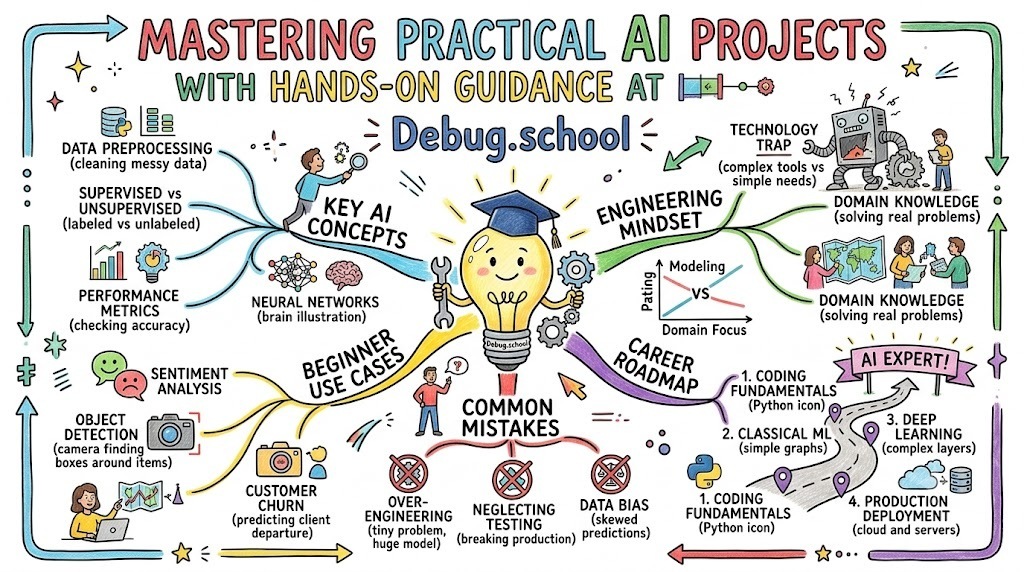
Artificial intelligence often appears to be a field reserved exclusively for advanced mathematicians and veteran software engineers. However, stepping into this domain becomes exceptionally straightforward when you focus on practical application rather than pure theoretical abstraction. Beginners can comfortably demystify these machine learning algorithms by building structured, real-world applications at debug.school. This interactive educational platform transforms overwhelming mathematical models into digestible, step-by-step engineering milestones. Consequently, aspiring creators quickly learn to prepare datasets, train predictive models, and deploy intelligent software applications without drowning in complex scholastic academic jargon.
Key AI Project Concepts You Must Know
Data Preprocessing and Cleaning Fundamentals
Data preprocessing forms the absolute bedrock of any successful artificial intelligence deployment. Real-world information is notoriously messy, filled with missing values, duplicate entries, and inconsistent formatting that can easily confuse an algorithm. Therefore, engineers must dedicate significant time to sanitizing data before passing it into a machine learning model.
Furthermore, this cleaning process involves identifying outliers that could skew predictive performance and translating text categories into numerical representations. When data is consistently formatted and normalized, algorithms can identify underlying patterns much more accurately.
Consequently, mastering operations like feature scaling, handling missing records, and splitting data into distinct sets is vital. When you handle your underlying data correctly, training an intelligent system becomes incredibly predictable and efficient.
Supervised vs Unsupervised Learning
Aspiring developers must grasp the fundamental distinction between training models with explicitly labeled examples or letting algorithms discover hidden structures independently. Supervised learning relies on historical datasets where the correct answers are already clearly marked for the system. This methodology is incredibly effective for classification and regression tasks, such as forecasting house prices or identifying spam emails.
Conversely, unsupervised learning handles completely unlabeled datasets where the system receives no explicit guidance or correct answers. The algorithm independently examines the input data to group similar items together or reduce dimensional complexity.
Ultimately, choosing the right paradigm depends entirely on your specific project goals and the nature of your available data resources. Understanding both methodologies allows you to tackle a massive variety of real-world automated challenges.
Model Evaluation and Performance Metrics
Building a predictive model is only half the battle; you must precisely measure how well it performs on unseen information. Relying solely on basic accuracy can be incredibly deceptive, especially when dealing with unbalanced datasets where one outcome is rare. Therefore, engineers use specialized metrics like precision, recall, and F1-score to evaluate system performance accurately.
Moreover, visualization tools like confusion matrices help developers pinpoint exactly where a machine learning model is making classification mistakes. These metrics guide iterative improvements, showing you whether to gather more data or adjust model parameters.
As a result, learning to interpret evaluation reports prevents you from deploying flawed systems into production environments. Proper validation ensures that your intelligent applications remain reliable when interacting with real human users.
Neural Network Architectures
Deep learning relies on structured layers of simulated neurons that process information in a manner inspired by biological brains. These neural architectures pass input features through multiple hidden layers to extract increasingly complex patterns automatically. While simple models struggle with unstructured data, deep neural networks excel at processing complex assets like images and natural speech.
Initially, early systems struggled with massive computational limitations and vanishing gradients during long training cycles. Subsequently, modern optimization techniques and specialized hardware acceleration transformed deep networks into the dominant force behind modern computer vision.
Consequently, understanding input layers, activation functions, and weights is essential for anyone wanting to build advanced recognition software. This structural knowledge allows you to customize deep learning models for highly specialized processing tasks.
Modeling Approach vs. Domain Knowledge — What's the Real Difference?
The Algorithm Obsession in Engineering
Many novice developers mistakenly believe that using the most complex, cutting-edge neural network will automatically guarantee project success. This narrow focus on algorithms creates a dangerous trap where teams implement massive models without understanding the data they process. Consequently, companies end up with fragile, slow systems that perform poorly because the underlying features are irrelevant.
In reality, an algorithm is merely a calculator that relies entirely on the quality of information you feed into it. When engineers prioritize model complexity over data relevance, system accuracy inevitably suffers.
Therefore, true engineering mastery requires a deep focus on data understanding rather than chasing fleeting algorithmic trends. Learning how data behaves fundamentally prevents you from wasting weeks fine-tuning a model that never had a chance to succeed.
Fostering a Domain-Driven Development Mindset
A robust engineering workflow focuses heavily on collaboration, operational context, and deep domain knowledge before a single line of code is written. In this environment, developers treat industry context as a vital feature that guides how models are shaped and evaluated. This contextual mindset ensures that your machine learning applications solve genuine human problems instead of existing as abstract tech experiments.
Additionally, understanding the domain helps engineers create highly relevant synthetic features that dramatically boost model performance. This collaborative approach removes guesswork and accelerates the creation of elegant, highly accurate automation software.
When an organization successfully balances mathematical modeling skills with practical domain insights, project success rates skyrocket. Engineers stop fighting abstract parameters and start delivering highly targeted solutions to real users.
| Aspect | Modeling Approach | Domain Knowledge |
|---|---|---|
| Primary Focus | Selecting algorithms, tuning hyperparameters, and optimizing network weights. | Understanding business rules, interpreting data context, and defining realistic goals. |
| Longevity | Short-term focus that shifts rapidly as new model architectures are invented. | Long-term foundation that remains stable across different technology shifts. |
| Success Metric | Minimal training error, high validation accuracy, and fast inference speeds. | Practical business value, user satisfaction, and accurate real-world problem-solving. |
| Core Value | Provides the computational mechanics and mathematical power to process data. | Drives feature engineering, contextual validation, and system safety standards. |
Real-World Use Cases of Beginner AI Projects
Intelligent Sentiment Analysis Systems
E-commerce businesses and media companies monitor thousands of user reviews daily to understand customer satisfaction levels. To handle this volume, automated text analysis applications ingest raw comments and instantly classify the emotional tone as positive, negative, or neutral. This immediate classification allows customer support teams to resolve complaints rapidly before they escalate online.
Simultaneously, marketing teams analyze monthly sentiment trends to evaluate how customers react to new product feature rollouts. These automated insights remove human bias from feedback loops, creating a highly accurate representation of public perception.
- Key Requirements: Robust text processing, high processing speed, and accurate handling of slang terms.
- Core Benefit: Highlights critical customer issues instantly while reducing manual review sorting hours.
- Data Scale: Handles thousands of incoming text strings across digital customer feedback channels.
Automated Object Detection Software
Modern security infrastructure and autonomous vehicles rely heavily on computer vision to interpret physical environments safely. Simple object detection models analyze video frames to identify and draw boundaries around pedestrians, vehicles, and potential hazards. By running these models locally, smart systems can trigger immediate alerts when safety boundaries are crossed.
Furthermore, integrating object detection into retail store cameras allows inventory management systems to track product stock levels on shelves automatically. This automation streamlines supply chains and completely eliminates manual counting tasks for floor employees.
- Data Types: High-definition video streams, static digital images, and spatial boundary coordinates.
- Operational Goal: Provide instantaneous visual recognition to automate safety monitoring and tracking.
- Analysis Method: Utilizes convolutional operations to detect edge patterns and identify shapes in real time.
Predictive Customer Churn Applications
Subscription services depend heavily on retaining existing users to maintain steady financial health over time. Predictive churn applications analyze user activity logs, payment histories, and usage frequencies to spot customers who might cancel their accounts. This early identification allows retention teams to offer targeted discounts or support to at-risk users before they leave.
Meanwhile, background analytical systems process historical user journeys to discover the root causes behind customer dissatisfaction. This proactive approach ensures companies can optimize their core product experience and systematically improve long-term user retention rates.
- Target Outcomes: Reduced cancellation rates, higher customer lifetime value, and optimized marketing spending.
- Pipeline Structure: Historical user activity analysis combined with automated early-warning notification systems.
- Scale Challenge: Handling varied user behavior patterns without generating excessive false churn alerts.
Common Mistakes in Beginner AI Projects
Over-Engineering Solutions for Basic Problems
A frequent mistake among beginner developers is deploying massive deep learning frameworks for simple tasks that require basic logic. Drawn by artificial intelligence hype, creators often build complex neural networks when a straightforward conditional statement works perfectly. This over-engineering introduces massive computational latency, high server costs, and unnecessary maintenance burdens for the creator.
Concurrently, development velocity slows to a crawl because the developer spends more time debugging complex network structures than solving the problem. Simplicity should always remain your primary objective when building your first automation applications.
Therefore, you should only introduce complex machine learning models when traditional programming techniques genuinely fail to handle the problem's complexity. Keeping your software architecture lean ensures easy debugging and fast execution speeds.
Neglecting Rigorous Validation and Testing
Launching machine learning applications without strict validation splits and separate testing datasets always leads to catastrophic failure in production. When a model trains on your entire data pool, it simply memorizes the answers instead of learning true underlying concepts. Consequently, the application appears highly accurate during development but fails completely when encountering real-world user data.
To prevent this issue, developers must implement strict separation between training, validation, and testing datasets from day one. This practice forces the model to prove its predictive capability on completely unfamiliar information.
Ultimately, maintaining reliable software requires continuous validation checks, diverse test sets, and realistic evaluation scenarios. Prioritizing strict testing early saves you from the embarrassment of deploying non-functional software to your clients.
Misunderstanding Data Bias and Underfitting
It is incredibly easy to build a biased system if your initial training data does not represent real-world diversity accurately. Beginners often train models on highly limited datasets, resulting in applications that fail completely when encountering varied user inputs. Additionally, selecting overly simplistic models can lead to underfitting, where the system fails to learn any meaningful patterns at all.
Moreover, failing to monitor your training loss curves can cause you to miss clear signs of model stagnation. This lack of architectural awareness leads to frustrating development cycles where models waste processing energy without improving.
As a result, creators must learn to audit their datasets for balance and evaluate learning curves meticulously. Writing data-conscious applications guarantees that your intelligent systems perform equitably and accurately across all user groups.
How to Become an AI Expert — Career Roadmap
Step 1: Mastering Foundational Coding
Begin your educational journey by establishing an incredibly strong foundation in fundamental programming concepts and data manipulation syntax. You must become completely comfortable with variables, loop structures, and object-oriented programming patterns within a clean development environment. Additionally, focus heavily on mastering data structures like dictionaries and matrices, alongside basic mathematical principles like linear algebra.
- Core Focus: Learn clean programming syntax, master matrix manipulation, and understand basic statistical distributions.
- Learning Resources: Interactive coding environments, foundational software books, and structured beginner programming courses.
- Estimated Time: Dedicated initial months focused entirely on programming fundamentals before writing any machine learning code.
Step 2: Exploring Classical Machine Learning
Once you master basic programming, move on to learning the mechanics behind classical machine learning algorithms and regression techniques. Study how decision trees split data, how linear models draw boundary lines, and how clustering algorithms group information. Work on small, clean datasets to observe how changing hyperparameters directly influences your validation accuracy scores.
- Core Focus: Master classification algorithms, understand regression analysis, and practice cleaning real-world datasets manually.
- Practical Projects: Build a housing price predictor or an email spam classifier using classical statistical libraries.
- Key Concept: Focus entirely on understanding how mathematical algorithms extract patterns from tabular text files.
Step 3: Advancing to Deep Learning
Transition your skills into advanced territory by exploring neural network architectures and deep learning frameworks for unstructured data. Learn how to construct multi-layered systems, manage gradient optimization steps, and prevent overfitting using regularization techniques. Additionally, dive deep into specialized visual and sequential networks, understanding how filters extract features from complex inputs.
- Core Focus: Construct deep neural networks and build automated computer vision classification pipelines.
- Design Skills: Learn to select appropriate loss functions and optimization algorithms for custom tasks.
- Optimization Goal: Focus heavily on maximizing computational efficiency while avoiding exploding gradient errors during training.
Step 4: Production Deployment and Monitoring
Round out your expertise by learning how to package, deploy, and monitor your intelligent applications inside cloud production environments. Master containerization tools, automated application programming interfaces, and continuous integration workflows to make your models accessible to users. Finally, learn how to monitor performance drift over time to keep your production applications accurate and reliable.
- Core Focus: Convert raw model files into operational web services that respond to remote user requests.
- Career Growth: Transition from a hobbyist script writer into a capable production engineer leading deployment pipelines.
- Final Goal: Build completely automated development cycles where models retrain and update seamlessly without causing system downtime.
FAQ Section
- Do I need a strong advanced mathematics degree to build AI projects? No, you do not need an advanced academic degree because modern development tools handle the complex calculus automatically under the hood. Focus instead on understanding logical data behavior, performance evaluation metrics, and practical system design patterns.
- What language should a complete beginner start with for AI projects? Beginners should start with Python because its clean, readable syntax mimics natural language and boasts the world's largest machine learning ecosystem. This extensive library support ensures you can implement complex features with minimal boilerplate code.
- How do I know if my machine learning model is overfitting? A model is overfitting when its accuracy score is perfect on training data but drops catastrophically on validation data. This divergence indicates that the algorithm has merely memorized your training examples instead of learning the actual concepts.
- Can I train deep learning models on a standard laptop computer? Yes, you can build and run introductory models on standard hardware or use free cloud-based development environments with hardware acceleration. These cloud platforms let you train complex architectures without investing in expensive physical graphic processors.
- Why is data preprocessing considered the most time-consuming step? Data preprocessing takes immense time because real-world information is collected from disparate sources and contains numerous formatting errors. Cleaning this data manually ensures that your algorithms receive pure, unpolluted inputs for training.
Final Summary
Building successful artificial intelligence applications does not require wizardry, but it absolutely demands a structured approach to data handling and algorithmic concepts. By breaking down complex neural networks into practical engineering milestones, any dedicated creator can build highly intelligent software. Educational platforms like debug.school offer the structured guidance, interactive environments, and clear roadmaps required to master these advanced technologies comfortably. Avoid the trap of over-complicating your initial architectures; instead, focus your energy on clean data preparation and thorough model validation. Ultimately, combining strong programming fundamentals with real-world project experience empowers you to design reliable automation tools that solve genuine human problems.



Top comments (0)