
Imagine a sudden ransomware attack paralyzing an entire hospital network, locking critical patient data, and halting emergency operations within seconds. This operational bottleneck highlights how vulnerable modern digital infrastructure becomes without foundational defense mechanisms.
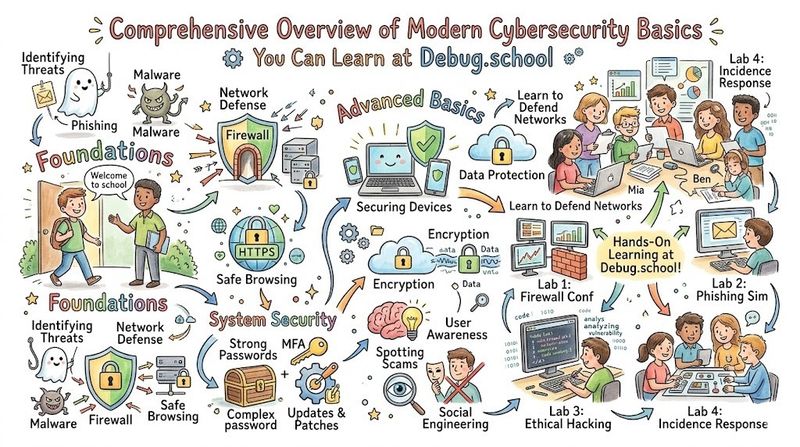
Cybersecurity Basics You Can Learn at Debug.school represents the foundational study and practice of protecting networks, devices, programs, and data from unauthorized digital attacks, damage, or unauthorized access. Modern technology teams need this structural discipline because digital environments scale rapidly, creating massive attack surfaces that malicious actors constantly exploit. By establishing robust security protocols, organizations protect their intellectual property, maintain consumer trust, and ensure uninterrupted system availability.
This comprehensive guide covers everything from the historical evolution of systems infrastructure to strategic operations management and core security principles. Readers will explore essential operational concepts, platform implementation strategies, real-world tech use cases, and career roadmaps for aspiring specialists.
To build a resilient career and safeguard modern infrastructure, students must master these fundamental protective concepts. Aspiring defensive specialists can discover deep technical insights and hands-on guidance by exploring the educational programs available at Debug.school.
The Origin of Systems Infrastructure
The Early Industrial Bottlenecks
Traditional enterprise operations suffered heavily from severe fragmentation, creating deep friction between software development and infrastructure management groups. Because separate departments worked in strict isolation, code deployments frequently crashed production environments due to environmental disparities. Consequently, manual configuration errors plagued deployment cycles, leading to prolonged system downtime and mutual finger-pointing between teams.
Moving Toward Unified Workflow Automation
Organizations eventually recognized that breaking down operational silos and unifying workflows radically transformed corporate infrastructure stability. By treating infrastructure as code, teams began integrating automated validation routines directly into their daily deployment pipelines. Therefore, this cultural shift allowed engineering groups to deploy software updates faster while maintaining a predictable, repeatable operational state.
Global Expansion Across Commercial Ecosystems
These modern operational frameworks expanded rapidly across large-scale tech enterprises, financial networks, and global e-commerce platforms. As distributed architectures grew more intricate, corporations required a standardized methodology to manage thousands of cloud instances simultaneously. Currently, global technology leaders implement these unified systems to guarantee continuous service delivery across diverse geographical regions.
Defining Strategic Operations Management
The Core Operational Structure
The foundational architecture of strategic operations relies on a continuous feedback loop between live system metrics and engineering workflows. Telemetry data flows from distributed applications into centralized aggregation platforms, allowing coordinators to analyze real-world performance indicators. Subsequently, this structured flow of information empowers engineering teams to detect anomalies before they impact end-users.
[System Components] ---> [Telemetry Aggregation] ---> [Operational Metrics] ---> [Engineering Feedback]
Daily Tasks of Systems Coordinators
Systems specialists execute a variety of practical, real-world tasks on a daily basis to keep infrastructure running smoothly:
- Triage automated alerts to differentiate between temporary performance spikes and genuine system emergencies.
- Conduct detailed root-cause investigations following unexpected platform disruptions to prevent recurrence.
- Optimize deployment scripts to streamline software delivery across staging and production environments.
- Review resource utilization metrics to eliminate wasted cloud expenditure and reallocate processing power.
Localized Control vs. Broad System Architecture
Granular component tracking focuses closely on individual server health, specific database queries, and isolated application microservices. In contrast, managing a multi-system infrastructure requires a macroscopic view of global traffic distribution, cross-region replication, and network dependencies. Balancing localized control with broad system architecture ensures that small component failures do not trigger catastrophic cascading outages across the enterprise.
The Efficiency Mindset
Prioritizing long-term stability requires a profound cultural shift away from reactive firefighting toward proactive systemic engineering. Teams possessing an efficiency mindset dedicate substantial engineering hours to building self-healing infrastructure components that automatically resolve common errors. Thus, this sustainable approach reduces operational fatigue, preserves engineering velocity, and establishes a highly reliable software ecosystem.
The 7 Core Principles of Cybersecurity Basics You Can Learn at Debug.school
1. Embracing Risk and Managing Variability
Absolute perfection remains impossible in complex digital environments, meaning every system will eventually encounter an operational failure. Engineers must therefore define and manage acceptable systemic risk rather than attempting to eliminate all possibilities of downtime. By acknowledging that components fail, teams design resilient, fault-tolerant architectures that degrade gracefully during unexpected underlying infrastructure disruptions.
2. Establishing Service Level Objectives (SLOs)
Teams must define precise, measurable targets for systemic success to balance operational velocity with platform reliability. These objectives guide business decisions by clearly outlining the minimum acceptable performance thresholds that users expect from a service. Consequently, when system metrics fall within these defined parameters, product teams proceed with high-risk feature deployments confidently.
3. Eliminating Toil and Manual Processes
Toil represents repetitive, manual, operational tasks that scale linearly with system size and provide no long-term strategic value. Engineering teams must actively identify these repetitive tasks and write automated software routines to eliminate them permanently. Reducing manual burdens frees up valuable engineering time, allowing specialists to focus on architecture improvements and security hardening.
4. Monitoring & Observability Across the Pipeline
Maintaining deep visibility across the entire operational environment prevents dangerous blind spots from hiding potential system bottlenecks. Comprehensive observability requires collecting logs, metrics, and distributed traces from every active application layer. Through this continuous data collection, engineers quickly isolate the exact source of performance degradation within highly complex microservice networks.
5. Automation Over Manual Coordination
Scaling modern enterprise workflows requires a dedicated engineering approach that replaces human intervention with smart software solutions. Automated systems manage infrastructure provisioning, user access control, and software deployments with minimal manual coordination. This strategic reliance on automation eliminates human error, accelerates delivery timelines, and ensures absolute consistency across all environments.
6. Release Engineering and Deployment Stability
Consistent, predictable, and safe application delivery strategies protect live production environments from sudden code regression issues. Release engineers utilize automated testing frameworks, canary deployments, and progressive rollouts to minimize the blast radius of new code. Accordingly, these structured deployment practices allow organizations to ship features frequently without sacrificing system availability.
7. Simplicity in Network Architecture
Keeping infrastructure environments clean, modular, and minimal directly reduces the overall failure surface of an enterprise. Complex architectures introduce hidden dependencies, making it incredibly difficult for engineers to troubleshoot issues during a critical live outage. By championing simplicity, teams create highly maintainable systems that new engineers comprehend quickly and secure effectively.
Key Operational Concepts You Must Know
SLA vs. SLO vs. SLI — Explained Simply
Understanding the distinction between these three metrics is critical for managing system reliability effectively. The following breakdown defines their practical roles in modern infrastructure management:
- Service Level Agreement (SLA): A formal, legally binding contract between a service provider and end-users specifying the financial penalties incurred if system reliability drops below a certain threshold.
- Service Level Objective (SLO): An internal target metric that engineering teams aim to achieve to keep users satisfied while maintaining operational velocity.
- Service Level Indicator (SLI): A precise, quantitative measurement of a system's performance at a specific point in time, such as request latency or error rate.
Error Budgets — The Game Changer for Operational Risk
An error budget represents the total permissible downtime that a system can experience over a predefined window of time. For instance, if an SLO requires 99.9% uptime, the remaining 0.1% constitutes the active error budget for innovation. Feature developers spend this budget by deploying updates, while operational engineers claw it back when stability boundaries face imminent threats.
| Operational State | Permissible Downtime (Per Month) | Allowed Engineering Actions |
|---|---|---|
| High Error Budget | 43.2 Minutes | Rapid feature deployment, experimental architecture changes, aggressive updates. |
| Depleted Error Budget | 0.0 Minutes | Feature freeze, priority bug fixing, infrastructure hardening, stability testing. |
Toil — The Silent Productivity Killer in Infrastructure
Toil manifests as manual administrative tasks like resetting passwords, generating recurring compliance reports, or manually restarting crashed servers. Organizations must calculate the percentage of time spent on these activities and capped it strictly at 50% of engineering hours. The remaining time must focus on project-driven engineering work that permanently automates away these repetitive administrative burdens.
Incident Management & Postmortems
When severe outages occur, teams must cultivate a blameless culture that focuses entirely on systemic flaws rather than human mistakes. Blameless postmortems analyze the timeline of events, identify root causes, and establish actionable engineering remediation items. This transparent approach encourages engineers to report vulnerabilities honestly, turning operational failures into valuable learning experiences for the whole company.
Capacity Planning
Predictive capacity planning allows organizations to forecast future infrastructure growth and prepare systems long before consumer demand spikes. Teams analyze historical traffic trends, seasonal purchase behaviors, and business growth projections to calculate future compute requirements. As a result, this proactive provisioning prevents catastrophic performance degradation during high-traffic events like global product launches.
The Four Golden Signals of Pipeline Performance
Monitoring infrastructure health effectively requires focusing heavily on four critical metrics that reflect overall system stability:
- Latency: The exact time it takes for a system to process a specific request and return a response to the user.
- Traffic: A quantitative measure of the total demand being placed on the network, such as HTTP requests per second.
- Errors: The rate of requests that fail explicitly, return unexpected status codes, or timeout during execution.
- Saturation: A measurement of how close system resources, such as memory or CPU utilization, are to reaching their maximum operating capacity.
Platform Implementation vs. Culture — What's the Real Difference?
The Philosophy Difference
Platform implementation focuses squarely on the concrete technical tools, software configurations, and automated architectures used to build systems. Cultural frameworks, conversely, focus on the human mindsets, communication patterns, and shared organizational responsibilities across engineering teams. While tools provide the technical capability to automate workloads, culture dictates how effectively humans collaborate to solve complex infrastructure problems.
Roles & Responsibilities Compared
Understanding how day-to-day duties differ between technical platform implementation and cultural alignment helps optimize team structures:
- Technical Implementation Focus: Writing automated configuration scripts, building deployment pipelines, and configuring live observability dashboards.
- Cultural Alignment Focus: Facilitating blameless postmortems, aligning business goals with engineering budgets, and breaking down communication barriers between departments.
- System Optimization Focus: Tuning database queries, managing cloud cluster auto-scaling rules, and refactoring legacy infrastructure code for better efficiency.
Can You Have Both Disciplines?
Modern enterprises successfully combine these distinct engineering philosophies to create highly resilient, fast-moving development organizations. Technical tools become far more effective when backed by a collaborative culture that encourages experimentation and accepts calculated risks. Conversely, a healthy engineering culture requires robust automated platforms to execute its reliability goals without burning out human workers.
Which One Should Your Team Adopt?
Choosing an operational focus depends heavily on organizational size, existing technical debt, and overall engineering maturity levels. Small startups usually focus on building a collaborative culture first, utilizing basic managed cloud services to minimize technical overhead. Large enterprises, however, must implement highly structured platform automation to manage massive distributed systems across global environments safely.
| Organization Size | Primary Operational Focus | Recommended Tool Strategy |
|---|---|---|
| Startup / Early Stage | Cultural Alignment & Core Principles | Managed cloud services, open-source basic monitoring, minimal custom tooling. |
| Large Enterprise | Structured Platform Automation | Dedicated observability platforms, custom CI/CD pipelines, multi-region architecture. |
Real-World Use Cases of Modern Operations
How Tech Leaders Use Operational Metrics
Major software enterprises utilize sophisticated telemetry networks to track user behavior and application performance in real time. These metrics feed directly into automated traffic routers that dynamically shift user workloads away from degraded cloud data centers. Consequently, global users experience seamless application availability even when underlying physical hardware suffers catastrophic failures.
Chaos Engineering Approaches to Resilient Systems
Resilient organizations intentionally inject controlled failures into production environments to uncover hidden architectural weaknesses before they cause outages. Teams utilize automated tools to randomly shut down microservices, simulate network latency, and block database access patterns during business hours. This proactive testing ensures that automated self-healing systems respond correctly and recover infrastructure state without human intervention.
Handling Reliability at Massive Scale
Distributed microservices architectures handle millions of concurrent financial transactions safely by utilizing decoupled data pipelines and rate-limiting queues. When traffic surges exponentially, systems drop non-essential background processes automatically to preserve core transaction functionality for consumers. Therefore, this strategic degradation protects primary business operations and ensures continuous data processing across global clusters.
High-Availability in Fintech Operations
Transaction and payment platforms operate under a strict zero-tolerance policy for data loss and system downtime. Fintech infrastructure engineers deploy multi-region database clusters that sync transactions synchronously across multiple physical geographic availability zones. This architecture guarantees that even if an entire city loses power, banking operations failover instantly to a secondary facility without losing a single cent.
Scaled-Down but Essential Systems for Startups
Early-stage companies apply core operational principles efficiently by leveraging serverless computing and automated infrastructure blueprints. By restricting human production access and deploying changes entirely through automated pipelines, small teams eliminate configuration drift effortlessly. This lean approach allows startup founders to focus heavily on product innovation while maintaining enterprise-grade system stability.
Common Mistakes in Operations Engineering
Mistake 1 — Confusing System Management with Just Being On-Call
Many organizations mistakenly view operations engineering as a reactionary pager-answering role rather than a proactive software discipline. When engineers spend all their time responding to live outages, they cannot write code to fix the underlying system flaws. True operations work requires dedicated engineering time focused on building automated systems that prevent incidents from occurring in the first place.
Mistake 2 — Setting Unrealistic SLOs
Demanding absolute 100% uptime represents an unrealistic goal that slows down feature development and rapidly burns out engineering talent. Perfect reliability is economically unviable because the cost of securing the final fraction of a percent outweighs the business benefit. Reasonable teams negotiate realistic reliability targets, allowing feature developers to utilize the remaining error budget for innovative deployments.
Mistake 3 — Ignoring Toil Until It's Too Late
Accumulating substantial operational debt happens when teams repeatedly defer automation tasks to prioritize short-term business features. As systems grow, manual tasks expand exponentially until they consume the entire engineering team's daily capacity. Organizations must systematically eliminate this creeping burden by capping manual toil and enforcing strict automation development sprints.
Mistake 4 — Skipping Blameless Postmortems
Punishing human mistakes during post-incident reviews creates an anxious culture where engineers actively hide system vulnerabilities. If teams fail to analyze root systemic flaws openly, the same technical failures will inevitably recur over time. Embracing a blameless mindset allows engineering groups to identify fragile architectures clearly and construct permanent technical solutions.
Mistake 5 — Monitoring Without Actionable Alerts
Flooding engineering chat channels with non-critical notifications causes severe alert fatigue, leading humans to ignore genuine system emergencies. Every automated alert must indicate a real, user-facing problem that requires immediate, specific human intervention to resolve. If an alert does not require urgent action, it belongs in a non-intrusive metric dashboard rather than an emergency pager.
Mistake 6 — Not Involving Operational Engineers in the Design Phase
Excluding infrastructure specialists from early software architectural discussions leads to the creation of brittle, unscalable application environments. Developers often focus solely on feature functionality, overlooking critical production requirements like observability, horizontal scaling, and secure data storage. Bringing operational insight into the design room early ensures systems are built from day one to handle real-world production stress.
Essential Infrastructure Tools & Technologies
Monitoring & Observability
Engineers rely heavily on advanced telemetry suites to gather deep insights into application behavior and underlying server metrics. Tools like Prometheus collect time-series numerical data, while Grafana visualizes these metrics through highly customizable enterprise dashboards. Additionally, commercial platforms such as Datadog and New Relic provide end-to-end distributed tracing across complex microservice architectures.
Incident Management
When critical production incidents occur unexpectedly, teams utilize specialized coordination platforms to mobilize response engineers immediately. PagerDuty manages on-call rotation schedules and routes urgent alerts to the correct engineering specialists based on system ownership records. These central hubs log incident timelines, aggregate alert data, and facilitate real-time communication during high-pressure system recovery operations.
CI/CD & Release Engineering
Automating the software delivery pipeline requires reliable compilation engines and container orchestration platforms to deploy updates smoothly. Jenkins automates the initial code testing and building phases, ensuring all software updates meet foundational quality baselines. Following validation, Spinnaker and Argo CD manage progressive deployment rollouts, safely distributing new application versions across live server infrastructure.
Chaos Engineering
Validating system resilience requires injecting controlled real-world failures directly into active testing environments using specialized automation tools. Chaos Monkey systematically disables production container instances, forcing infrastructure networks to demonstrate their automated self-healing capabilities. These controlled experiments expose hidden dependencies and validate that failover routing mechanisms perform correctly under duress.
SLO Management
Tracking system performance against long-term reliability commitments requires dedicated dashboard solutions that monitor active error budgets continuously. Nobl9 aggregates service level indicators from multiple monitoring sources and computes real-time compliance trends against specified target thresholds. This data empowers engineering management to make informed choices regarding feature deployment speeds and infrastructure stability tasks.
How to Become an Operations Expert — Career Roadmap
Skills Every Specialist Must Have
Aspiring infrastructure specialists must develop a strong technical foundation across several core engineering domains:
- Terminal Proficiency: Mastering command-line operations, shell scripting, and deep Linux system administration techniques.
- Programming Languages: Writing clean, readable automation scripts using modern programming languages like Python and Go.
- Cloud Infrastructure: Understanding virtual networking, cloud storage patterns, and compute resource provisioning across major providers.
- Containerization: Mastering container management using Docker and learning cluster orchestration principles via Kubernetes.
The Professional Learning Path
The professional journey begins with configuring local web servers, writing basic automation scripts, and managing small open-source databases. Next, engineers advance by studying distributed systems architecture, learning how to decouple applications, and building automated deployment pipelines. Finally, senior architects master corporate risk management, financial cloud optimization, and global multi-region infrastructure design.
Certifications Worth Pursuing
Industry-recognized credentials validate an engineer's technical capabilities and accelerate career progression within the infrastructure domain. Earning certifications such as the Certified Kubernetes Administrator (CKA) demonstrates deep, practical knowledge of modern container orchestration systems. Furthermore, cloud provider credentials like the AWS Certified DevOps Engineer validate a specialist's ability to automate large-scale enterprise deployments.
Educational Resources with Debug.school
Acquiring these advanced technical skills requires access to structured, hands-on learning curricula designed by seasoned industry professionals. Students discover comprehensive instructional courses covering modern system architecture, network defense, and deployment automation directly through Debug.school. These interactive programs provide the practical engineering experience necessary to build resilient digital systems and excel in modern technical environments.
The Future of Systems Management
AI and Automation in System Optimization
Machine learning models are rapidly transforming infrastructure operations by automating complex root-cause analysis and identifying subtle performance anomalies. These intelligent systems analyze massive streams of historical telemetry data to predict impending hardware failures long before they disrupt users. Consequently, automation shifts from reactive human scripting toward proactive, self-optimizing networks that adjust configurations dynamically.
Platform Engineering — The Evolution of Infrastructure
Platform engineering focuses heavily on building internal self-service portals that enable software developers to provision resources independently. Instead of filing tickets with infrastructure teams, developers utilize standardized automated templates to launch secure development environments instantly. This evolution eliminates organizational friction, enforces corporate security compliance automatically, and accelerates product delivery timelines across the enterprise.
Management in Cloud-Native & Kubernetes Environments
As organizations migrate completely toward ephemeral container clusters, managing dynamic network micro-topologies introduces unique operational challenges. Engineers utilize service meshes to secure, observe, and route communication traffic between thousands of rapidly shifting container instances. Therefore, mastering cloud-native orchestration patterns remains an absolute necessity for managing scale across modern distributed environments.
Operational Skills That Will Matter Most
The next generation of infrastructure specialists must focus deeply on financial cloud optimization and advanced data observability techniques. As global computing networks grow larger, managing the cost of data storage and processing becomes a critical architectural priority. Engineers who couple technical automation skills with strategic business alignment will lead the future of enterprise operations engineering.
FAQ Section
- What is the entry-level salary expectation for an operations specialist? Entry-level infrastructure and operations specialists generally command highly competitive salaries, typically ranging from eighty thousand to one hundred thousand dollars annually depending on regional market demands. As engineers acquire deeper scripting automation expertise and master cloud-native orchestration tools, compensation packages scale upwards rapidly across the technology sector.
- How does this discipline differ from traditional IT network administration? Traditional IT network administration focused heavily on manually configuring physical hardware, managing local office setups, and troubleshooting local desktop environments. Modern operations engineering treats infrastructure as software code, emphasizing system automation, programmatic scalability, and deep application observability across vast cloud environments.
- Can I transition into this technical field from a non-technical background? Yes, individuals transition into this field by systematically mastering fundamental command-line operations, learning basic programming languages, and building small cloud projects. Dedication to hands-on practical learning through structured educational platforms allows non-technical students to build strong infrastructure engineering Portfolios.
- Which programming language should I learn first for infrastructure automation? Python remains the highly recommended introductory programming language for infrastructure automation due to its clean readability and massive ecosystem of libraries. Once engineers feel comfortable with scripting basics, learning Go becomes beneficial for managing modern cloud-native tools like Kubernetes.
- How do error budgets prevent friction between developers and operations teams? Error budgets establish a shared mathematical boundary that removes emotional conflict regarding feature deployment speeds between separate engineering groups. When the budget is abundant, developers ship software features rapidly; when it depletes, priorities automatically shift toward systemic stabilization.
- Why is a blameless postmortem culture critical for enterprise system safety? A blameless culture ensures that engineers feel safe reporting technical mistakes and identifying fragile architecture components without fear of professional retaliation. This transparency allows organizations to locate true root causes quickly and implement permanent engineering solutions that protect systems long-term.
Final Summary
Maintaining optimal system health requires a continuous commitment to observability, programmatic automation, and the systematic elimination of manual toil. By grounding infrastructure management in clear service level objectives and embracing blameless operational cultures, modern tech organizations protect their digital pipelines against unexpected catastrophic failures. Ultimately, the long-term resilience of any distributed network depends entirely on building automated frameworks that prioritize stability while enabling rapid engineering innovation. Organizations aiming to master these performance frameworks and build resilient modern infrastructure should explore the professional learning pathways provided by Debug.school.



Top comments (0)