
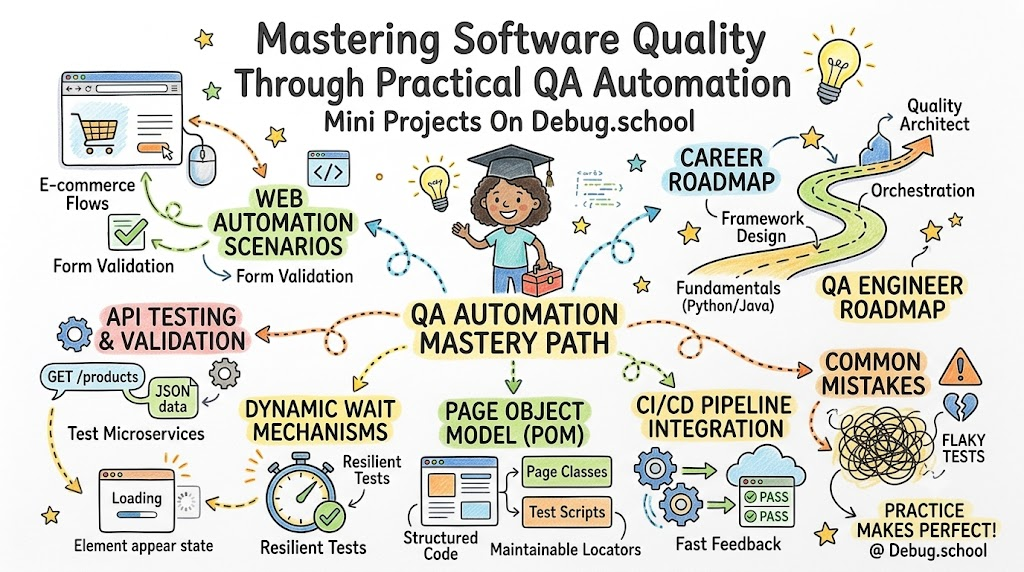
Software quality assurance has shifted from manual verification routines toward fully automated test execution pipelines. However, transitioning from theoretical coding concepts to reliable test framework design often creates significant hurdles for emerging engineers. Aspiring testers can rapidly accelerate their technical capabilities by completing structured, hands-on assignments through debug.school. This interactive learning ecosystem breaks down complex testing strategies into manageable exercises, allowing professionals to write robust test suites, inspect dynamic web elements, and validate backend endpoints with complete confidence.
Interactive Test Scripting Fundamentals
Writing reliable automated scripts requires a crystal-clear understanding of browser interactions and programmatic assertions. Instead of merely writing passive test scripts, engineers must learn how to handle asynchronous element rendering, dynamic page locators, and custom user events. These foundational exercises teach developers how to structure clean test code that accurately simulates realistic user workflows without producing random script failures.
Furthermore, modular script design ensures that test suites remain clean, reusable, and easy to maintain as applications evolve. By learning how to isolate page locators from assertion logic, testers prevent code duplication across extensive suites. This structural discipline saves countless engineering hours whenever front-end layouts undergo substantial revisions.
End-to-End Web Automation Scenarios
Real-world web applications feature multi-step transactions, authentication barriers, and complex form submissions that require resilient testing flows. Hands-on mini projects simulate complete user journeys, such as searching an e-commerce catalog, modifying a shopping cart, and navigating secure checkout steps. Completing these end-to-end scenarios teaches engineers how to manage state, cookies, and local session storage effectively.
Additionally, learners discover how to handle unpredictable web popups, nested frame elements, and file upload dialogues within automated workflows. Mastering these intricate UI interactions gives testers the confidence to build comprehensive test coverage for enterprise-scale platforms.
REST API Testing and Validation
Modern web architectures rely heavily on decoupled microservices, making backend API testing an indispensable operational skill. Mini projects focused on API testing guide engineers through sending HTTP requests, validating response status codes, and parsing complex JSON payloads. Consequently, testers learn to detect data discrepancies and server errors long before visual UI layers are even rendered.
Moreover, chaining dynamic API responses across multiple subsequent requests enables engineers to test complex business workflows rapidly. Validating endpoint performance, header configurations, and data contracts at the API layer creates a robust safety net that accelerates overall software release cycles.
Continuous Integration and Reporting Pipelines
Automated tests provide little value if they run only on a single local computer without standardized visibility. Integrating test suites into continuous execution pipelines ensures that tests trigger automatically whenever developers push new code commits. These pipeline projects teach testers how to containerize test environments, manage concurrent executions, and publish intuitive visual reports.
As a result, engineering teams gain instant feedback on code quality, allowing them to catch regressions before deployments reach production. Clear execution dashboards and detailed stack traces ensure that debugging failed builds remains fast, systematic, and collaborative.
Key Operational Concepts You Must Know
Dynamic Wait Mechanisms vs. Hardcoded Delays
One of the most critical principles in test automation is eliminating arbitrary pauses in favor of explicit, dynamic wait conditions. Hardcoded pauses unnecessarily slow down test runs and frequently fail when server response times fluctuate under load. Dynamic waits, on the other hand, pause execution only until a specific element becomes visible, clickable, or present in the DOM.
Consequently, dynamic synchronization drastically reduces overall suite runtime while virtually eliminating flaky test outcomes. Learning to implement robust expected conditions ensures that your test framework adapts seamlessly to varying network conditions and backend latencies.
The Page Object Model Pattern
Maintaining test locators across hundreds of individual test cases quickly becomes an operational nightmare without a structured design pattern. The Page Object Model architecture addresses this challenge by encapsulating page elements and user interactions inside dedicated class modules. Under this model, test scripts focus purely on assertions while page classes handle technical element locators and low-level clicks.
Therefore, when a developer changes a button locator in the user interface, you only need to update a single central page class. This strict separation of concerns keeps test repositories clean, highly readable, and easily maintainable across large software development teams.
Data-Driven Test Parameterization
Hardcoding test data directly into test scripts limits test coverage and forces repetitive scripting for varied input conditions. Data-driven testing separates execution logic from test parameters by externalizing test cases into external data sources like JSON files or database tables. This architectural pattern allows a single test script to run across hundreds of input combinations automatically.
Furthermore, parameterization allows testers to evaluate boundary values, invalid inputs, and security edge cases systematically without rewriting code. This scalability ensures comprehensive functional coverage while keeping the test codebase compact and efficient.
Test Isolation and Environment Idempotency
Automated test cases must remain completely independent of one another to guarantee consistent and deterministic results. If a test case depends on data generated by a previous test, an unexpected failure early in the run creates a cascading chain of false positives. Achieving test isolation requires building clean setup and teardown fixtures that generate and clean up dedicated test data for every execution.
As a result, isolated tests can run in parallel across distributed cluster nodes without causing data collisions or deadlocks. Ensuring environment idempotency guarantees that running a test suite ten times produces the exact same reliable outcome every single time.
Platform Implementation vs. Culture — What's the Real Difference?
The Pitfall of Tool-Centric Automation
Many engineering organizations believe that acquiring expensive automation tools or modern frameworks will instantly solve their software delivery bottlenecks. This narrow perspective often leads teams into a tool-centric trap, where engineers write fragile test scripts without understanding fundamental design principles. Consequently, organizations accumulate massive backlogs of unreliable tests that teams eventually ignore during release cycles.
In reality, an automation platform is merely an operational vehicle, not a replacement for thoughtful testing strategies. When teams focus solely on framework features rather than software architecture, test maintenance costs quickly exceed manual testing efforts.
Therefore, successful quality engineering requires mastering core design patterns, clean coding standards, and disciplined assertion strategies. Focusing on engineering principles ensures that your automated frameworks remain valuable, regardless of which specific tool or library you utilize.
Building a Quality-First Engineering Mindset
A genuine quality culture integrates automated verification directly into every stage of the software development lifecycle. In this environment, software developers, test engineers, and product managers share collective responsibility for application reliability and stability. This shared mindset encourages developers to write testable code and design modular components that simplify automated validation.
Additionally, a healthy engineering culture values fast feedback loops, open post-mortem reviews, and continuous pipeline optimization. Teams celebrate identifying defects early in the staging process rather than assigning blame for pipeline failures.
When an organization successfully unites structured platform implementation with a proactive quality culture, software delivery speed increases dramatically. Teams deploy new features frequently with complete confidence, knowing that robust automated safety nets protect production environments.
| Strategic Dimension | Platform Implementation | Quality-First Culture |
|---|---|---|
| Primary Objective | Deploying testing frameworks, configuring runners, and running scripts. | Establishing shared ownership, proactive defect prevention, and fast feedback. |
| Operational Scope | Focuses on technical execution, libraries, assertions, and test scripts. | Shapes team communication, coding standards, and collaborative release practices. |
| Maintenance Horizon | Requires regular updates to element locators, driver binaries, and packages. | Builds sustainable engineering habits that persist across changing technologies. |
| Success Metric | Number of automated tests executed and percentage of test coverage achieved. | Production stability, rapid release velocity, and low mean time to resolution. |
Real-World Use Cases of Modern Operations
Continuous Regression Testing in Fintech Applications
Financial service applications process critical money transfers, balance checks, and security validations that demand flawless operational precision. Automated regression suites execute across every pull request to verify that new code additions do not disrupt existing banking operations. These pipelines simulate user authentication, multi-factor verification, and inter-account transactions within containerized staging environments.
Simultaneously, mock servers simulate downstream payment processing gateways to validate error-handling routines without incurring transaction fees. This automated precision ensures that financial platforms maintain strict regulatory compliance while deploying daily platform enhancements safely.
- Critical Requirements: Deterministic test data, complete data encryption, and instant notification alerts for failed assertions.
- Primary Advantage: Eliminates human verification oversights during critical payment and ledger calculations.
- Implementation Focus: Combines end-to-end browser journeys with rapid API-level data contract validations.
Cross-Browser Compatibility for Retail Platforms
Online retail platforms must deliver consistent, frictionless shopping experiences across dozens of browser versions, operating systems, and device viewports. Modern automation operations run parallel test grids that execute the same checkout journey across multiple browser instances simultaneously. This parallel execution identifies subtle layout shifts, broken JavaScript triggers, and CSS styling bugs across distinct rendering engines.
Furthermore, automated visual testing compares live screen renders against approved baseline snapshots to catch unintended visual alterations. This automated visual inspection prevents broken user interfaces from damaging conversion rates during peak shopping seasons.
- Key Deliverables: Comprehensive cross-browser test reports, visual diff images, and execution speed optimizations.
- Operational Benefit: Guarantees uniform brand experiences for shoppers across diverse consumer hardware.
- Core Strategy: Leverages cloud execution grids to run hundreds of browser configurations concurrently within minutes.
API Contract Testing in Microservices Ecosystems
Modern enterprise platforms rely on distributed microservices that interact via well-defined REST and messaging interfaces. Automated contract testing suites verify that individual services adhere strictly to published API schemas and data structures. By validating contracts automatically, teams detect breaking changes in upstream services before downstream applications consume them.
Additionally, lightweight contract tests run in milliseconds, providing instant feedback to developers during local builds. This preventative validation eliminates integration bottlenecks and ensures smooth communication across independent engineering squads.
- Operational Target: Early detection of schema mismatches, missing payload parameters, and breaking status codes.
- Pipeline Integration: Automated execution during build stages prior to deploying microservice containers.
- System Benefit: Decouples team dependencies and accelerates continuous delivery across distributed architectures.
Common Mistakes in Operations Engineering
Overlooking Test Flakiness and False Positives
Tolerating intermittent test failures is one of the most destructive habits an engineering team can develop. When tests fail unpredictably due to race conditions or unstable environments, developers quickly lose confidence in the automation suite. Eventually, teams begin ignoring pipeline warnings altogether, allowing critical production bugs to slip past undetected.
To prevent this decay, teams must aggressively quarantine, investigate, and repair flaky tests the moment inconsistent behavior appears. Replacing static delays with resilient event listeners and stabilizing test data environments resolves the vast majority of timing-related failures.
Ultimately, maintaining a small suite of completely reliable tests provides far more engineering value than maintaining hundreds of erratic scripts. Prioritizing stability over pure test volume protects pipeline integrity and maintains team trust in automation results.
Ineffective Locator Selection Strategies
Relying on fragile, auto-generated element locators like absolute XPath strings or dynamic CSS classes inevitably leads to broken test suites. Whenever user interface developers refactor layout containers or update styling frameworks, brittle locators fail immediately. These unnecessary maintenance interruptions drain developer productivity and slow down delivery pipelines.
Instead, automation engineers must utilize stable locator strategies, such as dedicated test attributes, element IDs, or semantic accessibility labels. Designing resilient element locators ensures that test scripts remain functional even when underlying styling classes change completely.
Therefore, establishing clear locator conventions between front-end developers and automation testers creates long-term framework durability. Clean locator strategies minimize maintenance overhead and keep automation suites running smoothly through major UI redesigns.
Neglecting Pipeline Execution Speed
As test repositories expand over time, monolithic test execution times can easily balloon from minutes to several hours. Lengthy test runs create significant development friction, forcing software engineers to wait excessive periods for pull request validations. When feedback loops become too slow, developers naturally bypass testing steps, undermining overall software stability.
To combat execution bloat, engineers must design modular suites that support parallel test execution across distributed test nodes. Furthermore, running targeted test subsets based on modified code files ensures rapid feedback for localized code changes.
As a result, optimizing test runners, stripping unnecessary setup routines, and executing tests in parallel keeps pipelines fast and efficient. Maintaining short execution cycles encourages frequent code integration and keeps developer productivity high.
How to Become an Operations Expert — Career Roadmap
Step 1: Programming and Version Control Foundations
Begin your career journey by mastering a foundational programming language such as Python, Java, or JavaScript alongside core version control workflows. Focus deeply on object-oriented programming principles, control structures, and error-handling techniques to write clean, maintainable automation code. Simultaneously, learn how to manage code repositories using Git, practice branching strategies, and resolve merge conflicts cleanly.
- Core Focus: Master object-oriented concepts, understand data structures, and practice regular Git collaboration workflows.
- Practical Projects: Build small command-line utilities and automate local file-handling tasks using clean programming patterns.
- Milestone Goal: Write clean, modular code that passes standard static analysis and linting checks effortlessly.
Step 2: UI and API Automation Framework Design
Advance your capabilities by designing robust browser automation frameworks and backend API validation suites from scratch. Implement structural design patterns like the Page Object Model while learning to interact with dynamic web elements and REST endpoints. Focus on writing robust assertions, extracting reusable helper functions, and managing external test configuration files cleanly.
- Core Focus: Master locator strategies, dynamic wait conditions, HTTP methods, and JSON schema validation techniques.
- Practical Projects: Build a complete automated testing framework covering both web UI flows and backend REST services.
- Milestone Goal: Construct an end-to-end test framework that runs locally, generates clean test logs, and manages test state independently.
Step 3: CI/CD Pipeline Integration and Cloud Grids
Connect your automation suites directly into automated delivery pipelines using modern continuous integration platforms. Learn to containerize your testing environments using Docker to ensure consistent execution behavior across development, staging, and cloud environments. Additionally, configure parallel test execution across remote cloud grids to optimize overall execution duration.
- Core Focus: Write pipeline configuration files, containerize test runners, and configure parallel execution on cloud grids.
- Practical Projects: Set up a continuous integration pipeline that automatically executes tests on code commits and publishes visual reports.
- Milestone Goal: Achieve automated pipeline execution that runs full regression suites in under fifteen minutes with zero flaky failures.
Step 4: Strategic Quality Architecture and Governance
Elevate your expertise into strategic quality leadership by designing comprehensive testing architectures and governing enterprise quality standards. Establish quality metrics, implement automated performance and security checks, and guide cross-functional teams on testability best practices. Drive initiatives that shift testing left into initial architectural design phases to prevent defects before coding begins.
- Core Focus: Design enterprise test architecture, implement quality gates, and optimize infrastructure cost efficiency.
- Strategic Role: Mentor engineering squads, define organizational test policies, and analyze production telemetry for quality improvements.
- Milestone Goal: Lead platform-wide quality engineering strategies that reduce production incident rates while accelerating release frequency.
FAQ Section
- What makes mini projects more effective than reading theoretical testing tutorials? Mini projects force you to solve real-world testing challenges, such as handling asynchronous page loads, debugging failed assertions, and parsing dynamic responses. This hands-on problem-solving builds practical muscle memory and prepares you directly for enterprise engineering demands.
- How do dynamic waits improve the reliability of automated test suites? Dynamic waits pause script execution only until specific conditions are met in the application, such as an element becoming clickable. This approach eliminates unnecessary waiting time and prevents unexpected test failures caused by temporary network latency.
- Why should test cases remain completely isolated from one another? Isolated test cases prevent cascading failures where one broken test causes subsequent tests to fail due to shared data changes. Independent tests can also run in parallel across distributed nodes, drastically speeding up total execution time.
- Which programming language should a beginner choose for test automation? Python and JavaScript are excellent starting choices due to their readable syntax, extensive community support, and rich testing ecosystems. Selecting a language that aligns with your team's development stack further streamlines collaboration and code reviews.
- When should a team prioritize API testing over UI testing? Teams should prioritize API testing early because backend tests execute significantly faster, consume fewer resources, and pinpoint root-cause logic errors directly. UI testing should complement API tests by verifying visual presentation and critical end-to-end user journeys.
Final Summary
Developing expertise in automated quality assurance requires moving past passive reading and actively engaging with hands-on framework construction. Building modular mini projects provides the practical experience necessary to conquer dynamic locators, asynchronous rendering, and complex backend validation. Educational platforms like debug.school deliver the structured guidance, interactive environments, and real-world project scenarios needed to master modern testing methodologies. Avoid the common pitfall of chasing fleeting tools; instead, dedicate your energy to mastering resilient design patterns, dynamic synchronization, and pipeline integration. Combining solid programming fundamentals with a culture of shared quality ownership allows you to construct dependable automation systems that accelerate software delivery and protect user experiences.



Top comments (0)