
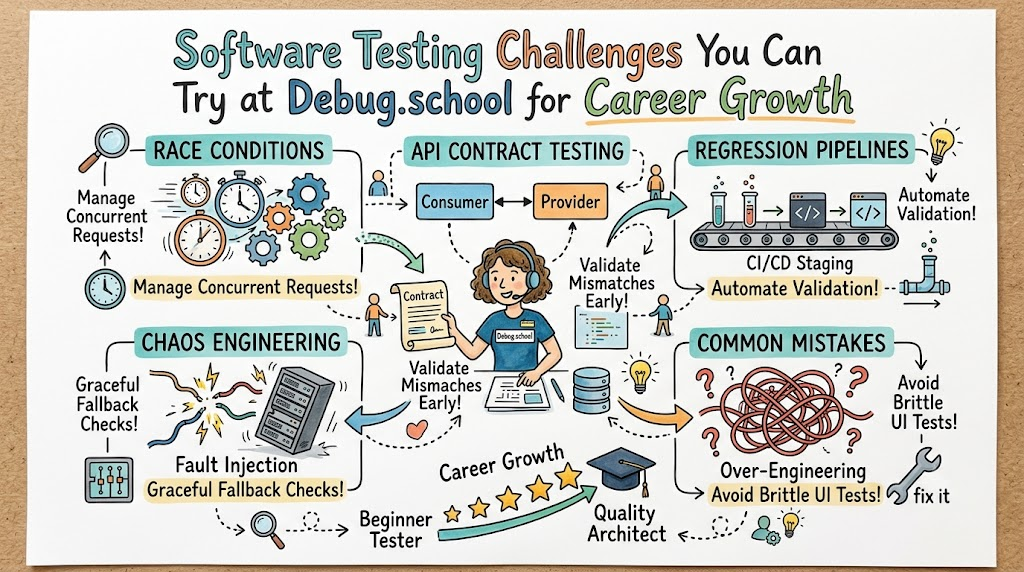
Software testing has evolved from simple manual verification into an intricate engineering discipline that demands deep problem-solving skills, architectural understanding, and robust automation capabilities. Because traditional classroom theory rarely prepares engineers for messy production bugs, practical hands-on exercises have become essential for real skill development. You can significantly sharpen your diagnostic and automation capabilities by tackling practical scenarios on debug.school. This specialized platform presents realistic software testing challenges that expose engineers to edge cases, race conditions, and performance bottlenecks, enabling you to build resilient applications with total confidence.
Key Operational Concepts You Must Know
Automated Regression Testing Pipelines
Modern continuous delivery models demand automated regression pipelines that rapidly validate every single code commit before deployment. Instead of manually running test scripts for hours, automated suites execute hundreds of validation checks across isolated staging environments within minutes. Consequently, software teams catch integration regressions immediately, preventing critical bugs from creeping into production environments.
Furthermore, engineers must design these test suites with modularity and test independence in mind. When test cases share state or depend on fixed execution order, automated pipelines produce erratic false positives that waste valuable developer time.
Therefore, mastering parallel test runners, headless browser configurations, and isolated database fixtures is fundamental to creating reliable pipelines. Once you master these operational mechanics, maintaining continuous test execution becomes second nature across large software teams.
Dynamic API Contract Testing
Modern software architectures rely heavily on distributed microservices that communicate constantly through dynamic API endpoints. Because separate teams build and deploy these services independently, even minor changes to request payloads or response headers can quietly break critical downstream systems. API contract testing solves this dilemma by enforcing strict structural agreements between consumers and service providers before code ever merges.
Initially, testing teams relied on slow end-to-end integration tests to catch these interface mismatches. However, this outdated approach delayed feedback loops and made root-cause analysis frustratingly slow and imprecise.
Subsequently, modern quality engineers embraced schema registries and consumer-driven contract tests to automate interface validation. By running lightweight contract tests during pull request reviews, engineers catch breaking API changes instantly without needing to boot up the entire microservice ecosystem.
Race Condition and Concurrency Testing
Multi-threaded applications and asynchronous event processors often hide dangerous race conditions that standard unit tests fail to catch. These elusive defects manifest only when multiple concurrent requests attempt to read and write shared system memory at the exact same millisecond. As a result, users might experience intermittent transaction failures, corrupted records, or double-spending glitches during peak traffic hours.
To expose these concurrency flaws, testers must simulate heavy parallel traffic and inject controlled network delays between operational threads. In addition, engineers use stress testing frameworks that repeatedly fire simultaneous requests against shared memory locks.
Ultimately, diagnosing these issues requires a solid grasp of database transaction isolation levels, atomic operations, and memory barriers. Mastering concurrency testing challenges guarantees that your backend services remain rock-solid under volatile production loads.
Chaos Engineering and Fault Injection
Testing applications only under ideal operating conditions creates a dangerous illusion of system stability. Chaos engineering actively injects controlled hardware failures, artificial latency, and sudden network dropouts directly into running systems to observe their recovery behavior. This aggressive testing methodology verifies whether your software can fail gracefully without taking down entire business platforms.
Moreover, these fault injection experiments reveal whether auto-scaling policies, fallback caches, and circuit breakers actually trigger as designed during an outage. When a dependent service fails, your application should degrade gracefully rather than displaying catastrophic error screens to end users.
Consequently, practicing fault injection challenges trains engineers to write defensive, self-healing code. Mastering these chaos principles ensures that your operational systems stay online even when critical underlying infrastructure components fail.
Platform Implementation vs. Culture — What's the Real Difference?
The Technology Trap in Quality Engineering
Many development organizations fall into the costly trap of believing that buying expensive enterprise testing suites will automatically eliminate software bugs. This narrow fixation on tooling leads teams to generate thousands of fragile, poorly written automated scripts that break with every minor user interface update. Consequently, quality assurance teams spend all their working hours fixing broken test maintenance scripts rather than uncovering critical business flaws.
In reality, an advanced testing framework is simply an execution vehicle, not a replacement for thoughtful quality strategy. When engineers prioritize flashy tool adoption over fundamental testing logic, overall software reliability steadily declines.
Therefore, true engineering excellence requires focusing on solid test design principles, boundary analysis, and code testability before introducing complex automation frameworks. Mastering core testing mechanics protects your team from the frustration of managing bloated, brittle test suites.
Fostering a Quality-First Engineering Culture
A thriving quality culture distributes testing responsibility across the entire software development lifecycle rather than dumping it onto a single QA department. In this environment, developers, product managers, and site reliability engineers collaborate closely to define acceptance criteria before writing a single line of code. This collaborative mindset shifts testing left, catching architectural oversights and functional gaps during the early design phase.
Additionally, a healthy culture encourages teams to view production incidents as valuable learning opportunities rather than occasions for blame. Engineers conduct blameless post-mortems to identify process gaps and design automated challenge scenarios that prevent similar bugs from recurring.
When an organization successfully balances cutting-edge testing tools with an empathetic engineering culture, software delivery velocity accelerates dramatically. Development teams release new features rapidly because they trust their automated validation safety nets completely.
| Aspect | Platform Implementation | Culture & Mindset |
|---|---|---|
| Primary Focus | Deploying test automation frameworks, CI/CD runners, and test management tools. | Establishing shared quality ownership, preventative test design, and continuous learning. |
| Longevity | Tactical and short-term; evolves as specific testing frameworks and libraries change. | Strategic and long-term; persists across shifting technology stacks and tools. |
| Success Metric | Number of automated tests executed and overall pipeline run time. | Reduction in production bugs, fast recovery time, and high team deployment confidence. |
| Core Value | Provides the computational execution engine to run repetitive verification checks. | Guides architectural decisions, code quality standards, and defensive development habits. |
Real-World Use Cases of Modern Operations
High-Volume Payment Gateway Verification
Financial technology platforms handle high-stakes transactions that demand zero-tolerance for calculation errors or checkout timeouts. To thoroughly validate payment systems, quality engineers construct dynamic challenge environments that simulate intermittent banking API drops, expired tokens, and currency conversion mismatches. This comprehensive validation ensures that transactions either process seamlessly or roll back cleanly without leaving user balances in an inconsistent state.
Simultaneously, automated performance suites simulate flash-sale traffic spikes to verify that payment microservices throttle requests gracefully without dropping database connections.
- Key Requirements: Exact mathematical precision, idempotency validation, and secure handling of sensitive authentication tokens.
- Core Benefit: Protects financial transactions from double charges and prevents revenue leakage during unexpected banking outages.
- Operational Scale: Validates thousands of concurrent payment requests against strict regulatory compliance standards.
Real-Time Healthcare Telemetry Systems
Healthcare platforms monitor real-time vital signs from medical sensors, requiring immediate data processing and unwavering communication reliability. Quality engineers test these systems by intentionally corrupting telemetry data packets and simulating sudden network disconnects across remote hospital wards. This rigorous testing verifies that alert dispatchers trigger emergency notifications instantly when patient metrics cross critical thresholds.
Furthermore, engineers validate that offline data caches store patient vitals locally during network outages and synchronize cleanly once connectivity returns.
- Data Types: High-frequency biometric data streams, alert event logs, and patient records.
- Operational Goal: Guarantee instantaneous alert delivery and prevent data loss during mission-critical medical emergencies.
- Testing Method: Combines dynamic packet manipulation with real-time stream simulation across mock distributed networks.
Media Streaming and Content Delivery Networks
Global streaming platforms deliver video streams to millions of diverse client devices operating on unpredictable wireless networks. Testers challenge these video pipelines by simulating variable bandwidth fluctuations, geographic content restrictions, and rapid video stream switching. This validation ensures that video players adapt their playback resolution dynamically without buffering or crashing user sessions.
Meanwhile, automated security suites continuously scan user authentication pipelines to block unauthorized stream piracy and credential stuffing attacks.
- Target Outcomes: Minimal video playback buffer rates, seamless bit-rate switching, and robust digital rights enforcement.
- Pipeline Structure: Distributed load generators paired with automated multi-device emulator grids.
- Scale Challenge: Simulating millions of simultaneous viewer logins during major global live-streaming sports events.
Common Mistakes in Operations Engineering
Constructing Inverted Test Automation Pyramids
A widespread anti-pattern in software testing is building an inverted automation pyramid loaded with hundreds of slow, brittle UI tests and almost no unit tests. Because end-to-end browser tests run slowly and break whenever minor visual changes occur, development pipelines quickly become sluggish bottlenecks. Teams waste countless hours investigating failed builds caused by browser rendering timing issues rather than genuine application bugs.
Consequently, developers begin to distrust the automated build pipeline, often ignoring failing tests and deploying risky code directly to production.
To prevent this problem, engineering teams must anchor their test strategy on a broad foundation of fast, reliable unit and integration tests. Reserving high-level UI tests strictly for critical user journeys keeps validation cycles lightning-fast and highly dependable.
Hardcoding Test Data and Environmental Dependencies
Another severe mistake is hardcoding sensitive credentials, database IDs, and static timestamps directly into automated test scripts. When test suites rely on static test records, running test cases in parallel becomes impossible because tests overwrite each other's data mid-execution. Moreover, these fragile tests inevitably fail the moment you execute them in a fresh environment or a clean container.
Instead, quality engineers should use dynamic factory patterns and synthetic data generators to provision clean, isolated data for every test run.
Ultimately, decoupling your testing suites from specific environments ensures that your challenges can run anywhere, from a developer's laptop to an enterprise CI/CD pipeline. Building independent test fixtures guarantees consistent, predictable results across every execution.
Overlooking Non-Functional Performance Boundaries
Teams frequently focus all their testing efforts on verifying functional requirements while completely ignoring non-functional performance, memory, and security boundaries. An application might pass every functional test with flying colors, yet completely crash when subjected to fifty concurrent users in production. Overlooking memory leaks, unindexed database queries, and slow garbage collection cycles introduces massive risks to software stability.
Therefore, engineers must incorporate performance benchmarking and load testing challenges into their regular validation cycles.
Proactively measuring response times, memory consumption trends, and CPU utilization under simulated loads reveals hidden bottlenecks long before they impact users. Treating performance as a fundamental requirement rather than an afterthought protects your application's reliability.
How to Become an Operations Expert — Career Roadmap
Step 1: Mastering Fundamental Test Design
Begin your educational journey by thoroughly understanding foundational testing theories, black-box techniques, and white-box test design methodologies. Master equivalence partitioning, boundary value analysis, and state transition testing to write airtight manual test scenarios. Additionally, develop a strong command of basic programming languages, relational database queries, and web protocols to inspect application internals.
- Core Focus: Learn a versatile language like Python or JavaScript, understand HTTP status codes, and master SQL data verification.
- Learning Resources: Interactive coding challenges, foundational software engineering textbooks, and hands-on testing platforms.
- Estimated Time: Dedicate the first few months to building this solid analytical baseline before diving into complex automation tools.
Step 2: Building Robust Automation Frameworks
Once you understand core test design, move on to building modular, maintainable automation frameworks from the ground up. Learn how to implement industry-standard design patterns like Page Object Models to keep your test automation code clean and readable. Practice writing automated API test suites that validate data contracts, response codes, and authorization headers across mock services.
- Core Focus: Build custom test automation frameworks using modern libraries, create robust assertion libraries, and handle dynamic web elements.
- Practical Projects: Build a complete automated testing suite for an open-source web application, incorporating both UI and API validations.
- Key Concept: Focus entirely on writing clean, readable, and reusable test code that requires minimal maintenance when interfaces change.
Step 3: Mastering Non-Functional and Distributed Testing
Elevate your skillset by mastering performance engineering, security vulnerability scanning, and distributed testing patterns. Learn how to design realistic load testing profiles that simulate complex user interactions across cloud infrastructure. Furthermore, dive deep into security testing basics, practicing how to identify common vulnerabilities like SQL injection and cross-site scripting.
- Core Focus: Master load generation tools, inspect system resource usage metrics, and automate basic security vulnerability scans.
- Design Skills: Learn to analyze system telemetry and identify database deadlocks, network latency spikes, and server memory leaks.
- Optimization Goal: Focus on diagnosing why systems slow down under stress and provide concrete remediation steps to developers.
Step 4: Enterprise Pipeline Integration and Quality Leadership
Complete your transition into a top-tier quality engineering expert by integrating your automated test suites into enterprise continuous integration systems. Learn how to configure containerized test runners, implement automated quality gates, and manage dynamic test environments with infrastructure-as-code tools. Finally, develop leadership skills to advocate for quality standards, mentor junior engineers, and architect organizational testing strategies.
- Core Focus: Build self-healing CI/CD pipelines, orchestrate parallel test execution in cloud containers, and implement actionable quality dashboards.
- Career Growth: Advance from a dedicated automation developer into a quality architect guiding system reliability across multiple teams.
- Final Goal: Architect comprehensive, autonomous quality ecosystems that accelerate deployment speed while ensuring zero defects in production.
FAQ Section
- What is the most effective way to start practicing software testing challenges? The most effective approach is to engage with hands-on challenge platforms that simulate broken web applications, unstable APIs, and messy edge cases. Practicing on realistic buggy environments forces you to apply diagnostic thinking, write targeted automation scripts, and fix actual engineering defects.
- Why are API tests generally preferred over UI automation tests in CI/CD pipelines? API tests execute significantly faster than UI tests because they do not require spinning up heavy web browsers or rendering graphical interfaces. Additionally, API tests are far less brittle, making them ideal for rapid validation gates during continuous integration builds.
- How do I prevent flaky tests from ruining automated build pipelines? Prevent flaky tests by ensuring complete test isolation, eliminating hardcoded time delays in favor of dynamic explicit waits, and generating clean synthetic test data for every execution. Removing shared database dependencies between parallel tests drastically stabilizes your automation suites.
- What role does chaos engineering play in modern software quality assurance? Chaos engineering actively tests how well a system withstands unexpected infrastructure failures, such as server crashes or network partitions. Injecting controlled faults verifies that your applications degrade gracefully and recover automatically without losing critical data.
- Is learning programming strictly necessary for a modern software testing career? Yes, learning programming is vital because modern quality engineering relies heavily on test automation, API validation, and performance benchmarking. Writing clean code allows you to build custom testing utilities, integrate automated checks into pipelines, and collaborate effectively with development teams.
Final Summary
Achieving true mastery in software testing requires stepping beyond static theoretical manuals and actively tackling unpredictable, real-world engineering bugs. By immersing yourself in practical problem-solving exercises, you quickly develop the instincts required to anticipate failures, spot concurrency issues, and secure critical data workflows. Interactive educational environments provide the safe, hands-on arena you need to experiment boldly, break running services, and build resilient automation frameworks from scratch. Rather than simply chasing trendy testing libraries, invest your effort into understanding core test design, system architecture, and collaborative engineering practices. Embracing this holistic quality mindset empowers you to build robust, fault-tolerant software systems that thrive effortlessly in demanding production environments.



Top comments (0)