
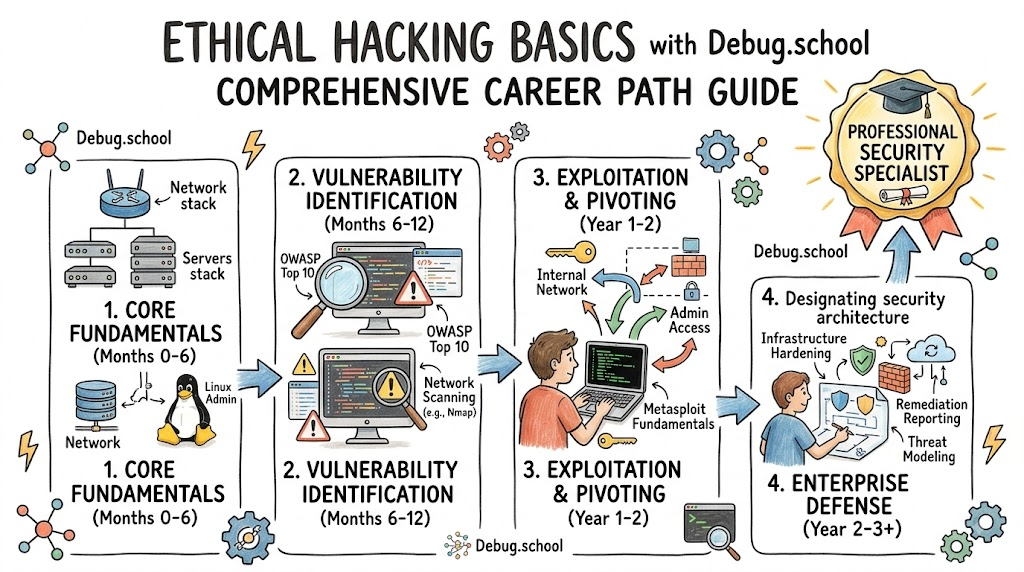
Modern digital infrastructure faces persistent threats from malicious actors who constantly hunt for system vulnerabilities and weak access points. Because of these escalating risks, organizations actively hire offensive security professionals to test, break, and reinforce their internal defenses before attackers strike. Learning these foundational security skills becomes straightforward and practical through the structured tutorials at debug.school. This specialized platform simplifies complex cyber defense concepts by offering hands-on technical labs and clear, mentor-led roadmaps. As a result, aspiring security specialists can build genuine ethical hacking skills without feeling overwhelmed by technical jargon.
Key Operational Concepts You Must Know
Network Discovery and Target Reconnaissance
Reconnaissance forms the initial and most vital phase of any security assessment. Security professionals systematically map out an organization's digital footprint by identifying active hosts, reachable IP subnets, and accessible network devices. This thorough discovery phase ensures that security testers uncover every possible entry route into a corporate network environment.
Furthermore, engineers perform passive information gathering to collect public metadata, domain details, and employee records without sending direct alerts to target firewalls. By combining this public data with active scanning tools, testers discover outdated network services and exposed communication ports across the infrastructure.
Consequently, mastering network mapping tools and packet routing mechanics is fundamental for establishing an accurate attack perimeter. When you thoroughly document an attack surface, identifying underlying weaknesses becomes a structured, predictable process.
Vulnerability Analysis and Attack Surface Mapping
Once security testers discover active hosts across the network, they immediately assess those systems for known architectural flaws and software misconfigurations. Security analysts inspect version banners, protocol implementations, and software builds against public vulnerability registries to locate unpatched weaknesses. This methodical scanning process reveals whether a target runs insecure legacy software that an attacker could exploit.
Additionally, analysts differentiate between minor configuration discrepancies and high-severity weaknesses that allow remote code execution. Because automated vulnerability scanners produce extensive noise, practitioners manually verify each alert to eliminate misleading false-positive reports.
Therefore, building a deep understanding of network protocol vulnerabilities, patch levels, and risk classification matrices is essential. This rigorous analysis provides organizations with actionable intelligence to remediate critical security holes before malicious intrusions happen.
Exploitation Mechanics and Privilege Escalation
Exploitation involves safely executing controlled attack vectors against verified vulnerabilities to validate the risk of an unauthorized breach. Ethical hackers craft specific payloads to bypass authentication barriers and trigger unexpected behaviors inside vulnerable applications. This step demonstrates exactly how a malicious adversary could compromise critical business systems.
Moreover, obtaining an initial user shell is rarely the final objective in an enterprise penetration test. Testers immediately search the compromised operating system for insecure file permissions, running services, and cached administrator credentials to elevate their access rights.
As a result, mastering privilege escalation techniques across both Linux and Windows environments allows testers to uncover deep administrative vulnerabilities. This practical validation highlights the importance of zero-trust architecture and strict internal permission boundaries.
Post-Exploitation and Remediation Reporting
After gaining privileged access, ethical hackers carefully document their entire lateral movement path across the target network. They identify accessible internal databases, sensitive intellectual property, and secondary network segments that lacked proper segmentation controls. This exploration proves the true business impact of an initial network breach without causing operational downtime.
Subsequently, the assessment process concludes with a clear, actionable remediation report written for both technical teams and executive leadership. Security professionals translate technical vulnerability data into prioritized engineering tasks that development teams can implement immediately.
Ultimately, clear reporting bridges the gap between offensive security testing and long-term organizational defense. Providing detailed remediation steps ensures that engineering teams close dangerous security gaps permanently.
Platform Implementation vs. Culture — What's the Real Difference?
The Technology Trap in Cyber Defense
Many organizations invest heavily in expensive security platforms, automated scanning software, and enterprise firewalls while completely ignoring security fundamentals. This heavy reliance on software tools creates a dangerous illusion of safety where teams mistakenly assume automated software handles all threat management. Consequently, organizations maintain misconfigured defenses that fail to detect subtle, manual infiltration techniques.
In reality, commercial security software only monitors known patterns and predefined threat rules across standard network environments. When defenders rely solely on automated dashboards, they miss novel lateral movement strategies and custom exploitation payloads.
Therefore, technical tooling must always accompany deep architectural comprehension and continuous manual validation. Relying purely on security software without understanding low-level computing mechanics leaves enterprise networks vulnerable to sophisticated attacks.
Fostering a Proactive Security Culture
A mature security culture promotes continuous security awareness, collaborative engineering reviews, and shared ownership of software safety. In this proactive environment, software engineers integrate security reviews directly into their daily development workflows rather than treating compliance as a late roadblock. This mindset ensures that development teams build secure software from the initial design phase onward.
Additionally, an open security culture encourages employees across all business departments to report suspicious communications and phishing attempts without fear of reprimand. This active participation turns every employee into a dynamic defensive layer for the organization.
When technical platform implementations align with a supportive, educated security culture, organizational resilience increases exponentially. Teams rapidly identify internal vulnerabilities and remediate emerging security risks before malicious actors discover them.
| Operational Dimension | Tool Implementation | Security Culture & Mindset |
|---|---|---|
| Primary Focus | Deploying security software, firewalls, and automated vulnerability scanners. | Establishing secure code habits, security ownership, and continuous education. |
| Lifecycle Impact | Short-term tactical defense that requires constant updates and license renewals. | Long-term organizational posture that strengthens system resilience over time. |
| Success Metric | Number of blocked intrusion attempts and successful scanner deployments. | Speed of vulnerability remediation and total reduction in security incidents. |
| Core Advantage | Automates repetitive threat scanning tasks across massive corporate networks. | Encourages human vigilance and eliminates dangerous architectural design flaws. |
Real-World Use Cases of Modern Operations
Securing Enterprise Web Applications
Modern web applications process massive amounts of sensitive customer data, making them primary targets for cybercriminals. Ethical hackers regularly perform web application assessments to identify critical security flaws such as SQL injection, cross-site scripting, and broken access controls. By actively attacking web interfaces, testers verify whether user input validation systems properly sanitize incoming requests.
Furthermore, ethical hackers evaluate API endpoints to prevent unauthorized data access between different user accounts. Finding and patching these logic flaws ensures that proprietary customer databases remain secure from data exfiltration attacks.
- Target Risks: Broken object-level authorization, data leakages, and injection vulnerabilities.
- Testing Methods: Automated input fuzzing, manual parameter tampering, and logic analysis.
- Core Benefit: Protects customer records and maintains regulatory compliance across commercial web services.
Cloud Infrastructure Hardening
Enterprise environments depend heavily on distributed cloud networks to host their production services and databases. Offensive security teams analyze cloud environments to locate publicly accessible storage buckets, overly permissive identity permissions, and unencrypted transmission routes. Identifying these misconfigurations allows cloud architects to reinforce their infrastructure before external scans detect them.
Simultaneously, testers simulate compromised access keys to examine whether attackers can move freely between cloud instances. This security validation ensures that internal network controls effectively isolate critical cloud applications.
- Key Focus Areas: Identity and Access Management policies, open storage repositories, and container security.
- Defensive Objective: Implement strict least-privilege access rules across all cloud assets.
- Testing Scale: Auditing complex multi-region cloud infrastructures and dynamic container networks.
Internal Red Teaming and Phishing Assessments
Red team operations simulate real-world cyberattacks to measure an organization's overall detection and incident response capabilities. Security specialists use controlled phishing simulations, social engineering techniques, and covert network infiltration methods to test physical and digital defenses. This practical testing proves whether corporate security teams can detect and isolate stealthy threats in real time.
Moreover, these exercises provide defensive teams with valuable operational insights into current detection blind spots. Security analysts use this information to tune internal monitoring systems and refine incident handling procedures.
- Core Exercises: Simulated credential harvesting, payload execution, and covert lateral movement.
- Expected Outcome: Validates internal alarm systems and accelerates blue team reaction times.
- Strategic Value: Uncovers subtle human and operational vulnerabilities across the entire organization.
Common Mistakes in Operations Engineering
Over-Reliance on Automated Scanning Tools
A frequent error among beginner security professionals is assuming that automated vulnerability scanners complete the entire security testing process. Automated tools often miss complex business logic vulnerabilities, multi-step authorization flaws, and intricate privilege escalation paths. Relying entirely on automated scanners produces shallow security audits that leave dangerous application loopholes wide open.
Furthermore, automated scanners flood security teams with hundreds of low-severity notifications and false alarms. Sifting through this uncurated output consumes valuable engineering hours that teams should dedicate to fixing critical system vulnerabilities.
Therefore, ethical hackers must treat automated tools merely as preliminary discovery helpers rather than comprehensive security solutions. Supplementing automated scans with rigorous manual testing ensures that complex application vulnerabilities never go unnoticed.
Neglecting Safe Testing Boundaries and Rules of Engagement
Executing security tests without strict rules of engagement and defined testing boundaries can cause severe system outages. Inexperienced testers sometimes run aggressive exploit scripts on live production databases, resulting in data corruption or extended business downtime. Unplanned service disruptions undermine executive trust and create serious legal and operational liabilities for the testing team.
To prevent accidental outages, ethical hackers must clearly establish target scopes, operational time windows, and communication channels before testing begins. Sticking strictly to agreed test parameters protects production systems from unpredictable application crashes.
Ultimately, professional security assessments demand extreme technical precision, clear stakeholder communication, and continuous risk management. Respecting testing boundaries guarantees that offensive evaluations deliver valuable security insights without harming operational workflows.
Inadequate Documentation and Vague Remediation Advice
Delivering a security report filled with raw tool outputs and vague remediation advice severely limits the value of a security assessment. Software developers need exact replication steps, code examples, and clear remediation guidance to fix discovered vulnerabilities effectively. When a security report lacks actionable advice, engineering teams struggle to implement the necessary software patches.
Additionally, failing to explain the actual business impact of a vulnerability makes it difficult for management to prioritize engineering resources. Security professionals must clearly communicate why a specific vulnerability poses a genuine operational risk to the company.
As a result, writing concise, clear, and actionable vulnerability documentation is a non-negotiable skill for every ethical hacker. Excellent documentation ensures rapid software patching and strengthens the working relationship between security and development teams.
How to Become an Operations Expert — Career Roadmap
Step 1: Core Fundamentals
Start your cybersecurity career by building an unshakeable foundation in computer networking, operating systems, and foundational scripting. You must understand how the TCP/IP model operates, how packets navigate local networks, and how operating systems handle user privileges. Additionally, spend time writing Python and Bash scripts to automate simple system administration and data parsing tasks.
- Foundational Skills: Network architecture, Linux system administration, and basic scripting fundamentals.
- Learning Method: Hands-on command-line practice, local networking experiments, and foundational documentation studies.
- Core Goal: Master how computers communicate and process system commands before attempting advanced security testing.
Step 2: Vulnerability Identification and Tool Mastery
After mastering computing fundamentals, learn how to inspect network services and analyze common software vulnerability patterns. Practice setting up isolated lab environments where you can run port scanners, web proxies, and protocol analyzers safely. Learn to identify common software misconfigurations, outdated application versions, and standard web application weaknesses.
- Core Competencies: Manual vulnerability analysis, web proxy configuration, and network traffic inspection.
- Practical Application: Build vulnerable virtual machines locally to practice identifying and cataloging system weaknesses safely.
- Primary Focus: Understand the exact mechanism that makes a system vulnerable to unauthorized access attempts.
Step 3: Exploitation and Lateral Movement
Advance your offensive capabilities by studying exploitation frameworks, payload delivery mechanics, and privilege escalation techniques. Learn how to identify misconfigured service permissions on target machines to elevate standard user privileges to administrator levels. Additionally, practice pivoting through segmented virtual networks to understand how attackers traverse internal corporate environments.
- Key Focus Areas: Privilege escalation scripts, credential dump analysis, and internal network pivoting.
- Practical Training: Complete hands-on capture-the-flag challenges and structured offensive lab scenarios.
- Defensive Alignment: Learn how each offensive action generates system logs and triggers security alerts on defensive monitors.
Step 4: Enterprise Defense and Security Specialization
Complete your professional transition by mastering enterprise security architectures, cloud defense strategies, and remediation engineering. Learn how to integrate automated security checks into modern continuous deployment pipelines to catch coding flaws early. Finally, refine your ability to communicate technical risks to executive leadership and design comprehensive threat models for enterprise software.
- Advanced Topics: Cloud infrastructure hardening, container security, and collaborative red teaming.
- Career Direction: Transition into specialized roles such as senior penetration tester, security architect, or security consultant.
- Professional Goal: Design, test, and protect resilient enterprise environments capable of defending against advanced cyber threats.
FAQ Section
- What is the primary difference between ethical hacking and malicious hacking? Ethical hackers operate with explicit legal authorization from system owners to discover and remediate security vulnerabilities before attackers exploit them. Malicious hackers breach computer systems without permission to steal confidential data, extort organizations, or cause operational disruption.
- Do I need advanced coding skills to start learning ethical hacking? You can begin learning basic security concepts with basic computer literacy, but mastering the discipline requires programming skills. Writing scripts in Python or Bash helps you understand application logic, automate repetitive testing tasks, and build custom security assessment tools.
- What is the difference between vulnerability scanning and penetration testing? Vulnerability scanning is an automated process that identifies known software flaws and outdated packages across a network. Penetration testing is a comprehensive manual assessment where ethical hackers actively exploit vulnerabilities to measure real-world security risks and business impacts.
- Is it safe to practice ethical hacking on my home network? You should only practice ethical hacking techniques within isolated virtual machines, dedicated local lab environments, or authorized educational sandboxes. Testing tools against live networks or websites without explicit written permission is illegal and can disrupt critical internet services.
- How does network segmentation improve overall corporate security? Network segmentation divides a large computer network into smaller, isolated zones with strict communication controls between them. This structural separation prevents an attacker who compromises an edge machine from easily moving laterally to sensitive corporate databases.
Final Summary
Mastering the fundamentals of ethical hacking requires a dedicated commitment to understanding computer networking, operating systems, and offensive security methodologies. By breaking down complex security concepts into structured, hands-on lessons, aspiring practitioners can methodically build practical cybersecurity skills. Educational platforms like debug.school provide the guided technical roadmaps and practical environments necessary to learn offensive security responsibly. Avoid relying purely on automated testing tools; instead, focus on mastering manual vulnerability analysis, safe testing practices, and clear remediation reporting. Ultimately, combining strong offensive technical capabilities with a deep commitment to ethical standards empowers you to protect critical digital systems effectively.



Top comments (0)