
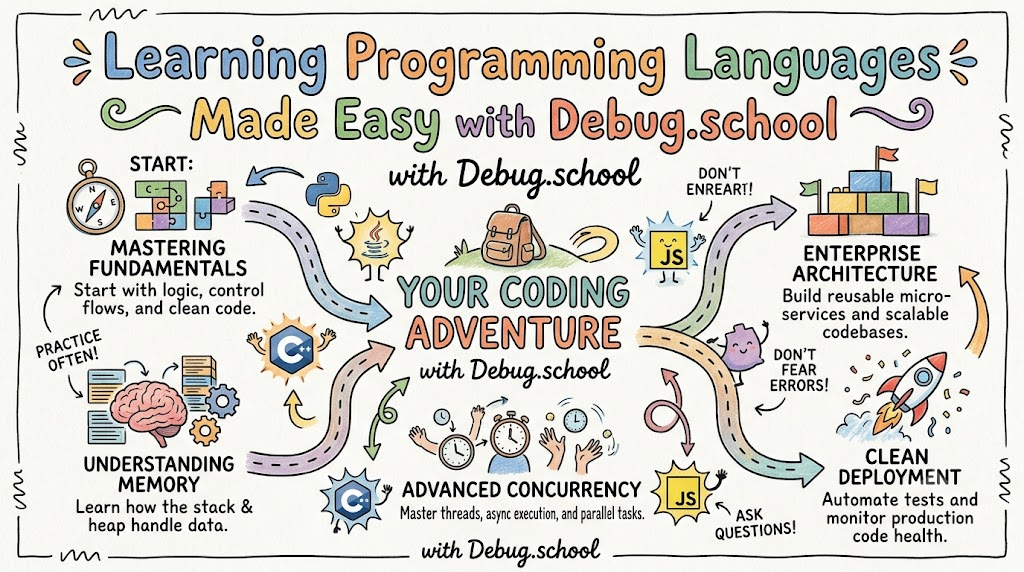
Choosing the right programming language often feels like standing before an endless maze of syntax, paradigms, and execution environments. However, evaluating these development options becomes remarkably straightforward when you have access to structured, hands-on guidance. Aspiring engineers can easily break down these complex software concepts through the comprehensive curriculum offered by debug.school. This educational platform simplifies software engineering by turning abstract coding theories into practical, bite-sized engineering lessons. Consequently, data professionals and developers can rapidly learn how to write, compile, and optimize enterprise-grade source code without getting lost in overwhelming technical jargon.
Key Operational Concepts You Must Know
Compilation vs. Interpretation Mechanics
Understanding how a computer translates human-readable source code into machine execution forms the absolute bedrock of any software infrastructure. Static compilation processes convert the entire codebase into native machine instructions before execution begins, creating highly optimized, standalone binary files. This strategy ensures that your application runs at maximum hardware efficiency since the computer executes the code directly without intermediate translation layers.
Furthermore, these systems enforce strict type checking during the compilation phase to catch developer syntax mistakes before the software ever goes live. Because the compiler checks every data assignment beforehand, runtime environment failures decrease dramatically across production systems.
Conversely, interpreted environments translate and execute source code line by line at runtime using an active runtime engine. While this approach introduces slight performance overhead, it provides incredible platform flexibility and allows developers to test code changes instantly without waiting for lengthy build cycles.
Memory Allocation and Management
Managing system resources requires a fundamental shift between manual memory handling and automated runtime garbage collection frameworks. Explicit memory management requires developers to allocate and free system random access memory manually within their application logic. This methodology ensures that production applications remain incredibly lean and fast because the engineer retains complete control over hardware utilization.
Initially, early system languages relied entirely on this manual strategy, which allowed developers to optimize performance for constrained hardware. While this approach was incredibly reliable for low-level systems, it introduced significant memory leaks and pointer vulnerabilities when developers forgot to clear unused data objects.
Subsequently, modern language runtimes shifted memory tracking entirely to automated background managers, which periodically scan the application heap to reclaim unused objects. By keeping memory management running as an internal background process, these modern frameworks prevent common application crashes and significantly accelerate the feature development lifecycle.
Concurrency and Threading Models
Engineers must constantly choose between multi-threaded execution patterns or single-threaded event loops when handling asynchronous application logic. Multi-threaded processing spreads computation tasks across multiple CPU cores simultaneously, making it ideal for CPU-intensive mathematical operations and heavy computational processing. Because threads share the same process memory space, applications can pass massive chunks of data quickly across the system architecture.
Conversely, asynchronous event loops process multiple concurrent input and output requests within a single execution thread. This non-blocking approach is crucial for high-traffic web applications, live microservices, and chat applications that handle thousands of simultaneous network connections.
Ultimately, modern software architectures frequently combine both approaches into a unified hybrid layout to achieve optimal system throughput. This combination allows organizations to manage fast concurrent network connections while still executing heavy background mathematical calculations efficiently.
Type Systems and Safety
A programming language requires a robust type system to define how data variables interact across large application codebases. Static typing binds data types explicitly at compile time, forcing developers to declare clear structures for every single variable and function return. Without this strict upfront structure, long-running production software can easily suffer unexpected type mismatch failures during live user transactions.
Moreover, dynamic type systems offer unparalleled flexibility by determining variable types on the fly during application execution. This flexibility allows developers to build rapid prototypes and write highly adaptable code blocks that handle changing data structures effortlessly.
As a result, mastering type checking, explicit casting, and structural safety patterns is vital for maintaining scalable codebase performance. Selecting the appropriate type system guarantees that your software architecture stays maintainable as your engineering team expands.
Platform Implementation vs. Culture — What's the Real Difference?
The Technology Trap in Engineering
Many development teams mistakenly believe that adopting the latest programming language trend will automatically solve their software delivery challenges. This narrow focus on specific syntax creates a dangerous technology trap where teams implement trendy frameworks without understanding their underlying architectural trade-offs. Consequently, companies end up with fragile, over-engineered codebases that are incredibly difficult to modify, test, and debug.
In reality, a programming language is merely an implementation tool, not a complete fix for poor system design. When engineers focus solely on syntax tricks rather than structural design patterns, application performance and maintainability inevitably suffer.
Therefore, true engineering mastery requires a deep focus on foundational software patterns rather than the specific syntax of a fleeting framework trend. Learning how systems function fundamentally prevents you from falling into the trap of writing convoluted code blocks instead of clean, maintainable systems.
Fostering a Data-Driven Engineering Culture
A robust software culture focuses heavily on clean code standards, rigorous testing, and shared architecture ownership across engineering squads. In this environment, teams treat code repositories as living products that require continuous refactoring, automated linting, and clear inline documentation. This cultural mindset ensures that application components remain reliable, reusable, and easy to modify as business requirements pivot.
Additionally, a healthy engineering culture encourages developers to conduct constructive peer reviews, share technical failures openly, and learn from production bugs. This collaborative approach removes individual ego from the code repository and accelerates the adoption of resilient development practices.
When an organization successfully balances language feature utilization with a supportive engineering culture, overall software quality increases dramatically. Engineers stop fighting over syntax preferences and start focusing on delivering stable, testable code to the production environment.
| Aspect | Language Implementation | Culture & Mindset |
|---|---|---|
| Primary Focus | Writing syntax, optimizing compilation, and configuring runtime tools. | Establishing design patterns, standardizing reviews, and fostering clean code habits. |
| Longevity | Short-term focus that changes as new runtime engines and frameworks emerge. | Long-term foundation that remains stable across different language migrations. |
| Success Metric | Application performance, build speed, and test coverage percentages. | Code maintainability, onboarding speed, and cross-team collaboration efficiency. |
| Core Value | Provides the specific syntax and execution rules for software tasks. | Drives the architectural standards, code reliability, and innovative design choices. |
Real-World Use Cases of Modern Operations
High-Frequency Trading Systems
Modern financial institutions process millions of trade orders every second, requiring sub-millisecond execution speeds to capture market opportunities. To achieve this speed, engineering teams use low-level compiled languages to bypass automatic memory management delays completely. This direct hardware control allows trading applications to calculate complex mathematical positions and execute market orders with zero runtime pauses.
Simultaneously, adjacent data systems ingest these trade logs into massive historical storage pools to audit execution compliance. These historical insights are then used to fine-tune the low-level trading algorithms, creating a continuously optimizing financial loop.
- Key Requirements: Ultra-low latency, predictable execution paths, and explicit memory layout control.
- Core Benefit: Maximizes transaction speed while minimizing exposure to volatile market shifts.
- Data Scale: Processes gigabytes of financial market ticks every second across highly optimized infrastructure.
Enterprise Web Microservices
Large e-commerce platforms rely on distributed microservices to handle millions of user requests during peak shopping events. Developers utilize highly concurrent web frameworks to build isolated, modular services that manage authentication, inventory checkout, and payment processing independently. This modular design ensures that a failure in the review section never takes down the critical purchase funnel.
Furthermore, deploying these services inside lightweight container units allows infrastructure teams to scale individual components instantly as web traffic surges. This flexible scaling keeps operational costs low while maintaining a responsive user experience under heavy load.
- Data Types: Structured payloads, application state tokens, and real-time user session logs.
- Operational Goal: Maintain high application availability and seamless horizontal scaling across cloud nodes.
- Analysis Method: Routes network traffic dynamically through load balancers to isolated service instances.
Machine Learning and Data Pipelines
Data engineering platforms require efficient scripting options to ingest, clean, and transform massive pools of unstructured information. Engineers use expressive, data-centric languages to build rapid data manipulation scripts and connect complex deep learning frameworks effortlessly. This clean syntax allows data teams to iterate quickly on mathematical models without worrying about low-level memory allocation details.
Meanwhile, the underlying execution engines run highly optimized native code under the hood to handle heavy matrix multiplications. This dual-layer approach provides developers with an easy-to-use scripting interface while retaining maximum hardware acceleration during model training phases.
- Target Outcomes: Fast prototyping speeds, extensive library availability, and smooth integration with data warehouses.
- Pipeline Structure: Expressive high-level orchestration layers backed by high-performance native math libraries.
- Scale Challenge: Processing petabytes of raw behavioral data without creating massive computational bottlenecks.
Common Mistakes in Operations Engineering
Picking Languages Based on Trend Hype
A frequent mistake among engineers is selecting a programming language based purely on internet popularity rather than project requirements. Driven by community hype, teams often rewrite perfectly stable services in a new language without considering ecosystem maturity or team expertise. This trend-chasing introduces unnecessary runtime bugs, missing third-party libraries, and immense hiring overhead for the engineering organization.
Information velocity slows to a crawl because the team spends more time fighting unfamiliar tooling quirks than building actual business features. Practical utility should always be the primary driver when selecting a software development stack.
Therefore, you should only migrate to a new language when your current stack reaches genuine performance or architectural limitations. Keeping your technology footprint minimal ensures easy team onboarding, lower training costs, and higher long-term code maintainability.
Ignoring Proper Error Handling Protocols
Launching production applications with lazy error catching or completely ignored exceptions always leads to catastrophic system failures. When unexpected database timeouts or malformed user inputs occur, poorly written error routines can crash the entire execution process instantly. Without explicit error propagation and logging, identifying the root cause of a silent system failure becomes nearly impossible.
To prevent this issue, engineering teams must implement strict error handling frameworks and automated global exception catchers across the codebase. These tools automatically log application state context and gracefully degrade user features instead of letting the program crash.
Ultimately, maintaining software resilience requires proactive boundary checks, comprehensive trace logging, and clear fallback mechanisms. Prioritizing robust error handling early prevents late-night production outages and keeps your systems running reliably.
Writing Monolithic Unoptimized Code Blocks
It is incredibly easy to degrade application performance when writing long, unoptimized loops that duplicate data objects in system memory unnecessarily. Amateurs often pass massive objects by value instead of using references, resulting in high memory usage and slow processing speeds. Common culprits include querying databases inside repetitive loops and performing heavy string operations inefficiently.
Moreover, failing to configure proper execution timeouts allows stuck processes to consume web server threads indefinitely. This lack of resource boundaries can easily freeze an entire microservice or severely disrupt neighboring application components.
As a result, developers must learn to analyze memory profilers, read execution stacks, and utilize efficient data structures. Writing resource-conscious code keeps hardware usage low and guarantees that your applications run smoothly on minimal server configurations.
How to Become an Operations Expert — Career Roadmap
Step 1: Mastering Fundamentals
Begin your educational journey by establishing a strong foundation in core programming logic, variable controls, and foundational algorithms. You must become completely comfortable with writing clean loops, managing conditions, and using basic collections like arrays and maps. Additionally, focus heavily on mastering object-oriented design patterns, functional concepts, and clear code organization strategies.
- Core Focus: Learn a highly readable language like Python, understand basic control flows, and practice algorithm writing.
- Learning Resources: Interactive coding challenges, foundational computer science textbooks, and structured programming courses.
- Estimated Time: Spend your first few months building this baseline before touching complex architecture paradigms.
Step 2: Understanding Memory and Systems
Once you master basic logic, move on to learning how programming languages interact directly with system memory and processor execution. Study how the application stack handles local variables while the heap manages dynamic object data allocations over time. Work on writing code in languages that require manual memory pointers to observe how memory leaks occur firsthand.
- Core Focus: Master pointer mechanics, understand stack and heap divisions, and practice debugging memory usage.
- Practical Projects: Build simple command-line tools that manipulate file data bytes directly to observe hardware interaction.
- Key Concept: Focus entirely on understanding how data lives in system memory during application execution cycles.
Step 3: Mastering Advanced Concurrency
Transition your skills into modern software environments by mastering asynchronous execution styles, threading models, and non-blocking inputs. Learn how to prevent race conditions, manage shared state variables safely, and implement thread-safe data collections. Additionally, dive deep into event-driven design, understanding promise states, execution loops, and message channels.
- Core Focus: Write highly responsive web APIs and build robust asynchronous background task workers.
- Design Skills: Learn to select the correct concurrency model based on specific CPU or input-output limits.
- Optimization Goal: Focus heavily on avoiding deadlocks and minimizing context-switching overhead in production code.
Step 4: Enterprise Architecture and Clean Deployment
Round out your expertise by learning how to structure, test, and deploy enterprise applications inside modular microservice frameworks. Master automated testing suites, continuous integration workflows, and modern container packaging to build repeatable application deployments. Finally, learn how to configure application performance monitoring tools to watch runtime health and track memory trends.
- Core Focus: Use design patterns to build decoupled codebases and monitor production application error rates.
- Career Growth: Transition from a basic script writer into a software architect capable of designing large distributed codebases.
- Final Goal: Build completely automated, test-driven application architectures that scale seamlessly across cloud production environments.
FAQ Section
- Which programming language should a beginner learn first? Beginners should start with an expressive, highly readable language like Python to master foundational programming logic without fighting complex syntax layout rules. Once you understand core logic, transitioning to strict type systems becomes much easier.
- What is the main difference between static and dynamic typing? Static typing checks and enforces variable data types during the compilation phase before the program runs. Dynamic typing determines data structures on the fly at runtime, offering faster initial prototyping but higher chances of hidden type errors.
- Why do some languages use garbage collection while others do not? Garbage collection automates memory cleanup, reducing development time and preventing memory management bugs. System languages skip this automated process to eliminate background execution pauses, giving developers direct control over performance.
- Can I learn enterprise software design patterns entirely online? Yes, you can absolutely master these architectural patterns through guided coding sandboxes and structured engineering tracks. Structured educational platforms provide clear code walkthroughs that connect abstract design patterns to real production scenarios.
- What causes an application memory leak to happen? A memory leak occurs when an application allocates space on the heap but fails to release it after the data object is no longer needed. Over time, these unreleased objects accumulate, consume available system memory, and cause the software to crash.
Final Summary
Mastering modern programming languages does not require raw genius, but it absolutely demands a structured approach to learning foundational software patterns. By breaking down compilation mechanics, memory behaviors, and concurrency models into manageable steps, developers can confidently build systems that scale. Educational platforms like debug.school provide the hands-on practice, clear system walkthroughs, and guided roadmaps needed to navigate the development landscape successfully. Avoid the trap of chasing every temporary language trend; instead, focus your energy on clean code principles, robust error patterns, and architectural design. Ultimately, blending solid coding fundamentals with a collaborative engineering culture allows you to build reliable, high-performance software applications that deliver lasting value.



Top comments (0)