
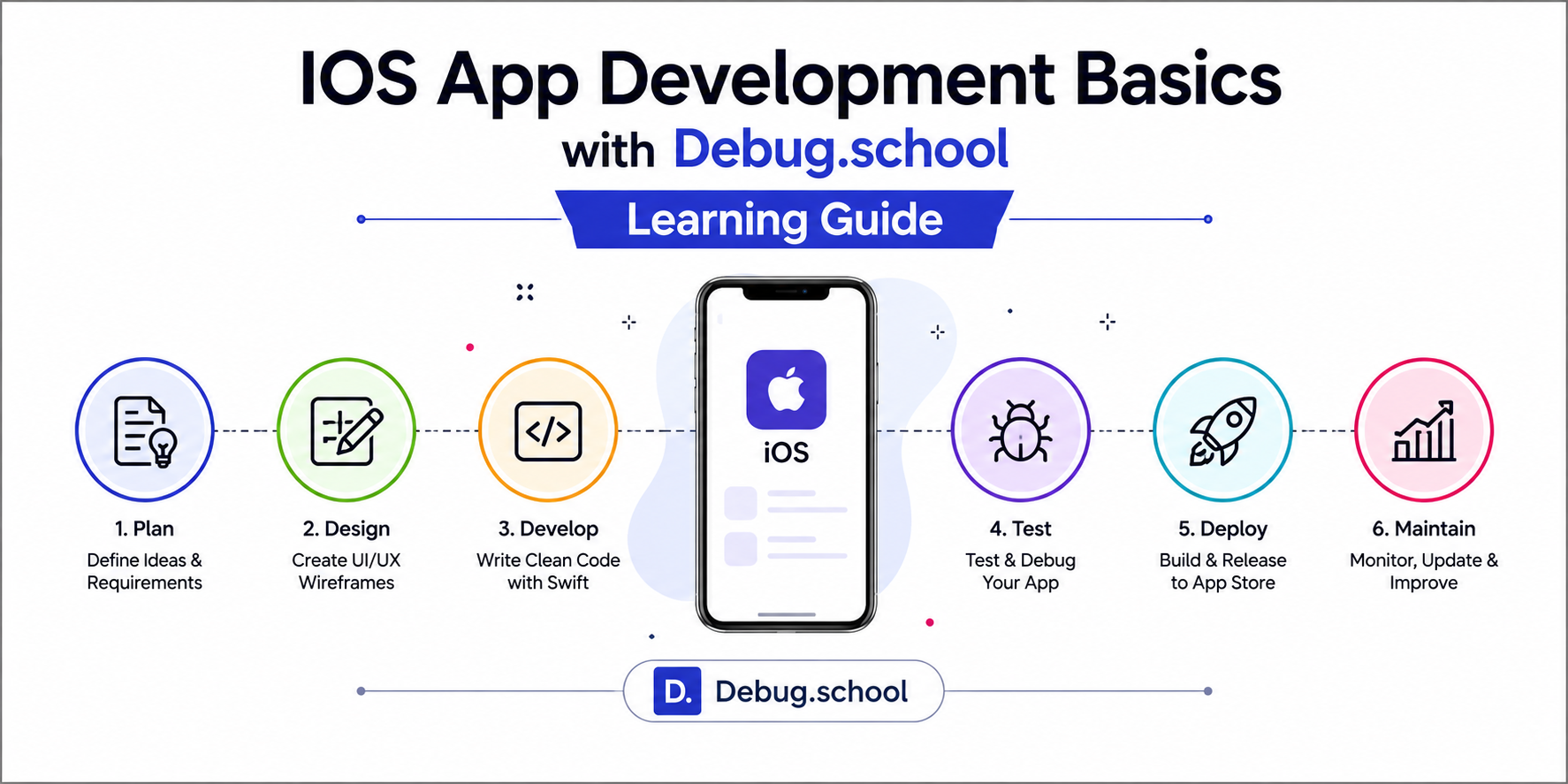
Understanding iOS app development is one of the most valuable skills for anyone interested in creating mobile applications for Apple devices. Whether you want to build business applications, educational platforms, social networking tools, productivity software, or gaming experiences, learning iOS development provides a strong foundation for creating high-quality mobile products. Modern iOS applications combine user-friendly interfaces, responsive performance, security-focused architecture, and seamless device integration. As organizations continue to invest in mobile-first strategies, developers who understand iOS fundamentals become highly valuable contributors to software teams. Learning through debug.school helps beginners understand essential concepts, development workflows, coding standards, and practical implementation techniques required for building reliable and scalable iOS applications.
Understanding iOS App Development Fundamentals
iOS app development involves designing, coding, testing, deploying, and maintaining applications that run on Apple's ecosystem of devices. These applications power smartphones, tablets, wearable devices, smart televisions, and various connected products. Developers use specialized programming languages, frameworks, and tools to create applications that provide seamless experiences while maintaining performance and security standards.
The development process starts with identifying user requirements and designing application workflows. Developers then create user interfaces, write business logic, integrate data storage systems, implement networking capabilities, and perform extensive testing. Additionally, successful iOS applications require attention to performance optimization, accessibility standards, privacy regulations, and user experience principles. Understanding these fundamentals helps developers create applications that meet both technical and business requirements while providing value to end users.
Why iOS Development Skills Matter in Modern Technology
Mobile applications have transformed how businesses interact with customers, employees, and partners. Consequently, organizations increasingly depend on mobile platforms to deliver services, manage operations, and generate revenue. iOS applications often serve high-value customer segments, making quality development practices particularly important.
Furthermore, iOS developers work on diverse projects ranging from healthcare applications and financial platforms to educational tools and entertainment services. These opportunities create strong career prospects and continuous learning possibilities. Since Apple maintains strict quality standards, developers who master iOS development often develop strong software engineering habits that benefit their entire careers. Therefore, investing time in learning iOS development provides both immediate technical skills and long-term professional advantages.
Core Components of the iOS Development Ecosystem
The iOS ecosystem includes multiple technologies that work together to support application development. Developers must understand how these components interact to create effective software solutions. The ecosystem includes development environments, programming languages, frameworks, testing tools, deployment systems, and monitoring platforms.
Additionally, developers need familiarity with application architecture patterns, design principles, version control systems, and collaborative development workflows. These components collectively support the entire software lifecycle from initial planning through ongoing maintenance. Understanding how each element contributes to application success enables developers to make informed technical decisions and build more reliable products. Consequently, a strong grasp of the ecosystem significantly improves development efficiency and software quality.
Essential Programming Concepts for iOS Beginners
Programming fundamentals form the foundation of successful iOS development. Developers must understand variables, data types, conditional statements, loops, functions, classes, objects, and error handling mechanisms. These concepts appear throughout every application regardless of complexity or purpose.
Moreover, object-oriented programming plays a significant role in iOS development because it promotes code organization, reusability, and maintainability. Developers learn how to model real-world entities through classes and objects while implementing inheritance, encapsulation, and polymorphism principles. At the same time, understanding memory management, data structures, and algorithm fundamentals helps developers write efficient code. As projects grow larger, these foundational skills become increasingly important for maintaining application performance and scalability.
User Interface Design Principles for iOS Applications
User interface design significantly influences application success because users interact directly with visual components. Effective interfaces prioritize clarity, consistency, accessibility, and intuitive navigation. Developers must understand layout systems, typography, spacing, color usage, and interaction patterns that align with platform expectations.
Additionally, responsive design ensures applications function properly across different screen sizes and device orientations. Developers should create interfaces that adapt gracefully while maintaining usability and visual appeal. Accessibility considerations also play a crucial role because applications should support users with varying abilities and preferences. Therefore, learning user interface principles enables developers to create experiences that satisfy both functional requirements and user expectations, ultimately contributing to greater application adoption and retention.
Application Architecture and Project Organization
Strong application architecture provides structure that supports development, maintenance, and future enhancements. Without proper organization, projects become difficult to understand, modify, and scale. Therefore, developers must learn architectural approaches that separate responsibilities and promote clean code practices.
A well-structured application typically separates user interface components, business logic, data management, and networking functionality into distinct layers. This separation improves maintainability while reducing dependencies between different parts of the system. Furthermore, organized project structures facilitate teamwork because developers can work on separate components without creating conflicts. As applications become more sophisticated, architectural discipline becomes increasingly valuable for ensuring long-term project success and development efficiency.
Key Operational Concepts You Must Know
Operations concepts are essential because software development extends beyond writing code. Modern applications require monitoring, maintenance, deployment management, performance optimization, and continuous improvement throughout their lifecycle. Understanding operational principles helps developers create applications that remain reliable in production environments.
Key operational concepts include system observability, performance measurement, incident response, resource utilization, scalability planning, and service reliability management. Developers should understand how applications behave under varying workloads and how operational metrics reveal potential issues before they impact users. Furthermore, logging and monitoring practices provide visibility into application performance and user behavior. These operational insights support informed decision-making while enabling teams to maintain high-quality user experiences across changing business requirements and technical environments.
Monitoring and Observability Fundamentals
Monitoring provides visibility into application health and performance through metrics, logs, and diagnostic information. Effective monitoring helps teams identify issues quickly and understand application behavior under different conditions. Consequently, developers can resolve problems before they significantly affect users.
Observability extends beyond basic monitoring by enabling deeper investigation into system behavior. Through comprehensive logging and performance tracking, teams gain insights into application interactions, resource consumption, and user activity patterns. Additionally, observability supports proactive maintenance by highlighting emerging trends and potential bottlenecks. Therefore, understanding these practices prepares developers to contribute effectively to production environments where reliability and performance directly influence business outcomes.
Performance Optimization Strategies
Application performance affects user satisfaction, retention, and overall product success. Slow applications frustrate users and often result in decreased engagement. Therefore, developers must understand techniques for improving responsiveness, reducing resource consumption, and optimizing user experiences.
Performance optimization includes efficient memory management, minimizing unnecessary computations, reducing network requests, and improving data processing workflows. Additionally, developers should analyze application metrics regularly to identify opportunities for improvement. Continuous performance monitoring ensures applications remain responsive as features evolve and user bases grow. Consequently, performance optimization becomes an ongoing responsibility rather than a one-time development activity.
Platform Implementation vs. Culture — What's the Real Difference?
Many organizations focus heavily on implementing tools and technologies while overlooking the cultural factors that determine long-term success. Platform implementation refers to deploying development environments, automation systems, testing frameworks, and operational tools. These technologies provide capabilities that support software delivery and maintenance.
However, culture represents how teams collaborate, communicate, learn, and solve problems. Even the most advanced platform cannot compensate for poor communication, lack of accountability, or resistance to continuous improvement. Successful organizations combine strong technical platforms with collaborative cultures that encourage experimentation, knowledge sharing, and continuous learning. Therefore, developers should recognize that technical excellence and organizational culture work together to produce sustainable results. Understanding this distinction helps professionals contribute effectively to both technical and team-oriented aspects of software development.
Technology Without Culture
Organizations sometimes invest heavily in development tools while expecting immediate improvements. However, without proper training, communication, and adoption strategies, these investments often fail to deliver expected benefits. Team members may continue using old processes despite having access to modern technologies.
Furthermore, technology alone cannot resolve collaboration challenges or improve decision-making processes. Successful implementation requires leadership support, knowledge sharing, and ongoing commitment to improvement. Consequently, organizations should view technology as an enabler rather than a complete solution. Developers who understand this relationship can help bridge gaps between technical capabilities and organizational practices.
Culture Supporting Technical Excellence
Strong engineering cultures encourage experimentation, learning, and continuous improvement. Team members openly share knowledge, discuss challenges, and collaborate on solutions. As a result, organizations adapt more effectively to changing requirements and emerging technologies.
Additionally, supportive cultures promote quality-focused development practices such as code reviews, automated testing, and performance monitoring. These behaviors improve software reliability while strengthening team capabilities. Therefore, cultivating positive engineering cultures creates environments where both individuals and organizations can thrive. Developers benefit significantly when they understand how cultural factors influence technical outcomes.
Real-World Use Cases of Modern Operations
Modern operations practices support applications across virtually every industry. These practices ensure systems remain available, secure, and responsive while supporting evolving business requirements. Understanding real-world applications helps developers appreciate the broader impact of operational excellence.
Organizations use operational practices to manage application deployments, monitor user experiences, optimize infrastructure usage, and maintain service reliability. These activities directly affect customer satisfaction and business performance. Consequently, developers who understand operational use cases become more effective contributors to software teams and organizational objectives.
E-Commerce Mobile Applications
E-commerce platforms depend heavily on operational excellence because downtime directly impacts revenue generation. Mobile applications must handle fluctuating traffic patterns, process transactions securely, and provide consistent user experiences during promotional events and seasonal demand increases.
Operational teams monitor system performance continuously while responding quickly to emerging issues. Additionally, automated deployment processes enable rapid feature releases without compromising stability. These practices help organizations maintain competitive advantages while delivering reliable shopping experiences. Therefore, e-commerce environments demonstrate the critical relationship between development quality and operational effectiveness.
Healthcare Mobile Solutions
Healthcare applications require exceptional reliability because users depend on them for important medical information and services. Operational practices ensure patient data remains secure while maintaining application availability and regulatory compliance.
Furthermore, healthcare organizations implement comprehensive monitoring systems to track application performance and identify potential issues. Incident response procedures help teams address problems quickly while minimizing service disruptions. Consequently, operational excellence becomes essential for supporting healthcare outcomes and maintaining user trust.
Financial Technology Applications
Financial applications process sensitive transactions and manage critical financial information. Therefore, operational practices emphasize security, reliability, and regulatory compliance. Teams implement extensive monitoring and testing procedures to maintain system integrity.
Additionally, financial organizations rely on automated processes to reduce human error while ensuring consistent operational execution. Performance monitoring helps identify unusual activity patterns and potential security concerns. These practices demonstrate how operational excellence supports both business objectives and customer confidence in highly regulated industries.
Common Mistakes in Operations Engineering
Operations engineering involves complex responsibilities that require careful planning and execution. However, many teams encounter recurring challenges that reduce effectiveness and increase operational risks. Understanding these common mistakes helps professionals avoid costly problems and improve overall performance.
Learning from industry experiences enables developers and operations teams to implement better practices from the beginning. Consequently, awareness of common pitfalls contributes to more reliable systems and smoother operational processes.
Ignoring Monitoring Requirements
Many teams prioritize feature development while postponing monitoring implementation. Unfortunately, this approach creates visibility gaps that make troubleshooting difficult when problems occur. Without proper monitoring, teams struggle to understand application behavior and identify performance issues.
Additionally, delayed monitoring implementation often results in incomplete observability coverage. Therefore, organizations should integrate monitoring considerations throughout the development lifecycle rather than treating them as optional additions. Early investment in monitoring capabilities provides significant long-term benefits.
Overcomplicating Architecture
Complex architectures often appear impressive but create maintenance challenges and operational risks. Excessive complexity increases learning requirements while making troubleshooting more difficult. Furthermore, complicated systems typically require additional resources and expertise to manage effectively.
Instead, teams should prioritize simplicity whenever possible while ensuring solutions meet functional requirements. Simple architectures generally improve reliability, maintainability, and operational efficiency. Consequently, thoughtful design decisions help organizations balance capability and complexity appropriately.
Neglecting Documentation
Documentation supports knowledge sharing, onboarding, troubleshooting, and operational consistency. However, many teams underestimate its importance and allow documentation to become outdated or incomplete. This oversight creates challenges when team members change roles or leave organizations.
Comprehensive documentation helps teams respond effectively during incidents while supporting ongoing maintenance activities. Additionally, clear documentation improves collaboration and reduces dependency on individual knowledge holders. Therefore, maintaining accurate documentation should remain an ongoing organizational priority.
Failing to Automate Repetitive Tasks
Manual processes increase the likelihood of errors while consuming valuable time and resources. Repetitive operational tasks often benefit significantly from automation because automated workflows provide consistency and efficiency.
Furthermore, automation enables teams to focus on higher-value activities such as optimization, innovation, and strategic planning. Organizations that embrace automation typically experience improved reliability and reduced operational overhead. Consequently, identifying automation opportunities represents an important operational responsibility.
How to Become an Operations Expert — Career Roadmap
Building expertise in operations requires continuous learning, practical experience, and exposure to real-world challenges. While technical skills provide essential foundations, successful professionals also develop communication, collaboration, and problem-solving capabilities. A structured roadmap helps individuals navigate this journey effectively.
The path toward operations expertise involves mastering fundamental concepts before progressing to advanced topics. Additionally, hands-on experience plays a critical role because operational knowledge develops through practical application rather than theoretical study alone.
Stage 1: Learn Development Fundamentals
Begin by mastering programming concepts, application architecture, version control systems, and software development practices. These skills provide context for understanding operational requirements and system behavior.
Focus on building applications while learning debugging techniques, testing strategies, and code quality principles. Additionally, study how software moves from development environments into production systems. This foundation supports future operational learning and professional growth.
Stage 2: Understand Infrastructure Basics
Infrastructure knowledge helps developers understand where applications run and how supporting systems function. Learn about servers, networking, databases, cloud platforms, and security fundamentals.
Additionally, explore containerization, virtualization, and resource management concepts. Understanding infrastructure components improves troubleshooting capabilities while enabling more informed architectural decisions. Consequently, infrastructure knowledge significantly enhances operational effectiveness.
Stage 3: Develop Monitoring Skills
Monitoring expertise enables professionals to assess system health and identify performance issues. Learn how to collect, analyze, and interpret operational metrics from various sources.
Practice creating dashboards, configuring alerts, and investigating system behavior through logs and performance data. Furthermore, study observability principles that support deeper operational insights. These capabilities become increasingly valuable as systems grow more complex.
Stage 4: Master Automation Techniques
Automation represents a core operational competency because it improves consistency and reduces manual effort. Learn scripting languages, workflow automation tools, and deployment automation practices.
Additionally, explore infrastructure management approaches that support scalable operational processes. Automation expertise enables professionals to manage larger environments while maintaining reliability and efficiency. Therefore, continuous automation learning contributes significantly to career advancement.
Stage 5: Build Leadership and Strategic Skills
Senior operational roles require leadership capabilities alongside technical expertise. Develop communication skills, project management abilities, and strategic thinking competencies. Learn how to align technical initiatives with organizational objectives.
Additionally, mentor junior team members and contribute to process improvement efforts. These experiences prepare professionals for leadership responsibilities while expanding organizational impact. Consequently, balanced development across technical and interpersonal domains supports long-term career success.
FAQ Section
What is iOS app development?
iOS app development is the process of creating applications for Apple devices using specialized tools, frameworks, and programming languages.
Do I need programming experience to learn iOS development?
No. Beginners can start with basic programming concepts and gradually build more advanced development skills through consistent practice.
Why is understanding operations important for developers?
Operations knowledge helps developers build reliable applications, improve performance, troubleshoot issues, and support production environments effectively.
What skills should an aspiring iOS developer focus on first?
Focus on programming fundamentals, user interface design, application architecture, debugging techniques, and version control systems.
How long does it take to become proficient in iOS development?
The timeline varies depending on learning consistency, practical experience, and prior technical knowledge. Regular hands-on practice accelerates progress significantly.
Is automation important in modern operations?
Yes. Automation improves consistency, reduces human error, increases efficiency, and allows teams to focus on higher-value activities.
Can iOS developers work in multiple industries?
Yes. iOS developers contribute to healthcare, finance, education, retail, entertainment, logistics, and many other industries.
What makes a successful operations professional?
Successful professionals combine technical expertise, problem-solving abilities, communication skills, continuous learning habits, and strong collaboration practices.
Final Summary
iOS app development provides an exciting pathway into modern software engineering while offering opportunities to create impactful mobile experiences. Through structured learning, developers gain expertise in programming, user interface design, application architecture, testing, deployment, and maintenance practices. Additionally, understanding operational concepts helps professionals build reliable applications that perform effectively in production environments.
Success in iOS development requires more than coding knowledge alone. Developers must understand monitoring, automation, performance optimization, collaboration, and continuous improvement principles. Furthermore, recognizing the relationship between technology platforms and organizational culture enables more effective contributions within professional environments. By following a structured learning roadmap, practicing consistently, and embracing both technical and operational excellence, aspiring developers can build rewarding careers while creating valuable software solutions that serve users across diverse industries.



Top comments (0)