
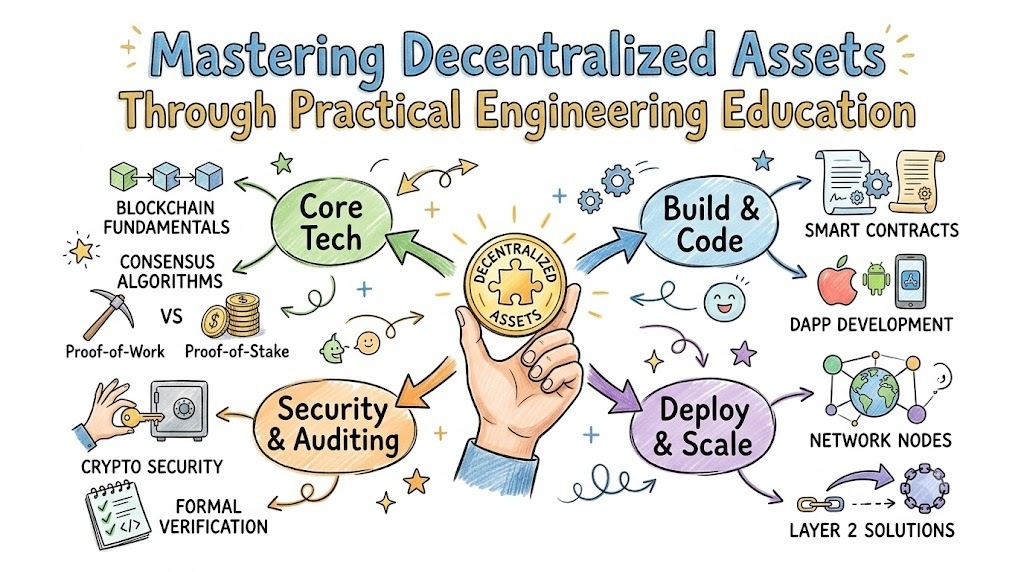
Cryptocurrency has evolved from an experimental digital payment experiment into a multi-trillion-dollar financial infrastructure powered by complex cryptographic mechanics. However, grasping decentralized technologies requires looking past online hype and taking time to understand the underlying peer-to-peer protocols. Aspiring blockchain developers and tech enthusiasts can quickly demystify these distributed ledger principles by learning directly through structured educational platforms like debug.school. This specialized platform simplifies complex cryptographic algorithms and ledger distribution concepts into practical, clear engineering modules. Consequently, tech professionals can comfortably build, secure, and deploy decentralized applications without getting lost in confusing market noise.
Key Operational Concepts You Must Know
Cryptographic Hashing and Ledger Integrity
Cryptographic hashing functions act as the immutable backbone of every secure distributed ledger. These mathematical algorithms transform arbitrary data inputs into fixed-length strings of characters, creating a digital fingerprint for every transaction block. Because even a tiny change in the underlying data dramatically alters the resulting hash value, tampering with historical records becomes instantly detectable across the entire network.
Furthermore, distributed ledgers chain these individual blocks together by embedding the hash of the previous block directly into the header of the next one. This sequential linking structure builds an uninterrupted linear timeline where modifying a single historical record breaks every subsequent cryptographic link.
Consequently, understanding cryptographic hashing, public-private key pairs, and digital signatures is essential for building robust Web3 systems. When you master these core cryptographic primitives, verifying network state integrity and auditing decentralized transactions becomes second nature.
Distributed Consensus Mechanics
Maintaining a single, universally agreed-upon transaction history across thousands of independent global computers requires specialized consensus mechanisms. Without a central administrator to settle disputes, consensus protocols dictate exactly how network participants validate incoming transaction batches. These mechanisms ensure that double-spending is physically impossible while preventing malicious actors from taking over the network state.
Initially, early networks relied heavily on computational proof-of-work mechanisms where participants solved complex cryptographic puzzles to earn block publishing rights. While this strategy achieved unprecedented network security, it required massive amounts of electrical energy to run specialized hardware continuously.
Subsequently, modern distributed networks transitioned to proof-of-stake mechanisms that rely on financial validation deposits rather than raw computational power. By requiring validators to lock up native digital assets, these newer networks achieve consensus significantly faster while consuming a fraction of the operational energy.
Smart Contracts and Decentralized Logic
Smart contracts extend the core utility of distributed ledgers from simple value transfers into fully programmable digital agreements. These self-executing programs run directly on top of decentralized virtual machines, executing automatically whenever predefined trigger conditions are met. Because smart contracts operate deterministically, they eliminate the need for traditional intermediaries like banks, brokers, or escrow agents.
Conversely, programming smart contracts introduces unique technical challenges because deployed code is completely immutable and public by default. A minor software bug in a smart contract can lead to irreversible financial drain before developers can intervene.
Ultimately, mastering smart contract development requires writing secure, resource-efficient code and conducting thorough formal verification testing. Learning how to structure decentralized logic allows software engineers to build transparent financial instruments, governance systems, and automated digital agreements.
Node Architecture and Peer-to-Peer Networking
A resilient decentralized network relies on thousands of globally distributed nodes communicating over an unstructured peer-to-peer network layer. Every full node maintains a local copy of the entire ledger, independently validating incoming blocks and relaying verified transactions to neighboring peers. This gossip protocol guarantees that network state updates propagate rapidly across the globe without relying on central routing servers.
Moreover, different node configurations serve specialized operational roles ranging from light clients with minimal storage footprints to heavy archiving validator nodes. Managing these node instances effectively ensures that decentralized networks remain resilient against targeted distributed denial-of-service attacks.
As a result, understanding peer-to-peer networking, node syncing mechanisms, and RPC gateway routing is vital for engineering reliable infrastructure. Proper node orchestration guarantees that client applications maintain steady connectivity to the underlying blockchain network.
Platform Implementation vs. Culture — What's the Real Difference?
The Technology Trap in Engineering
Many engineering teams mistakenly believe that deploying smart contracts or issuing custom crypto tokens will automatically modernize their digital business models. This shallow focus on protocol tools creates a technical trap where teams implement complex decentralized infrastructure without identifying genuine decentralized utility. Consequently, organizations spend massive capital maintaining expensive blockchain deployments when a traditional relational database would serve their operational needs better.
In reality, decentralized technology is simply an architectural pattern designed to solve specific trust and coordination problems, not a silver bullet. When developers focus exclusively on syntax or marketing hype rather than distributed network fundamentals, system security inevitably breaks down.
Therefore, true Web3 engineering mastery requires focusing deeply on core architectural trade-offs rather than chasing volatile asset trends. Understanding consensus mechanics, cryptographic primitives, and state storage prevents software teams from over-engineering solutions to straightforward software problems.
Fostering a Data-Driven Engineering Culture
Building production-ready decentralized systems demands a rigorous engineering culture centered on security, transparency, and continuous auditing. In a domain where deployed software code handles immutable financial value directly, traditional fast-and-loose deployment strategies become dangerous liabilities. An effective Web3 culture prioritizes formal security reviews, comprehensive unit test coverage, and open-source peer verification above fast feature releases.
Additionally, a strong Web3 culture encourages software developers to study protocol specifications deeply and share technical findings openly with the global community. This collaborative approach accelerates collective learning and helps teams identify systemic protocol vulnerabilities long before malicious actors exploit them.
When an organization successfully combines sound decentralized platform choices with a security-first engineering culture, system resilience increases dramatically. Developers build reliable, transparent applications that earn long-term user trust without sacrificing operational stability.
| Aspect | Platform Implementation | Culture & Mindset |
|---|---|---|
| Primary Focus | Deploying smart contracts, setting up node RPC gateways, and managing cryptographic wallets. | Prioritizing rigorous code auditing, open-source transparency, and security-first engineering. |
| Longevity | Short-term focus that shifts rapidly as new token standards and Layer-2 frameworks emerge. | Long-term foundation rooted in cryptographic principles and distributed consensus security. |
| Success Metric | Successful transaction throughput, low gas consumption, and network uptime. | System security, audit quality, community trust, and protocol resilience against exploits. |
| Core Value | Delivers the physical software layer and decentralized execution environment for applications. | Drives strict development standards, threat modeling practices, and sustainable design patterns. |
Real-World Use Cases of Modern Operations
Cross-Border Settlement in Financial Ecosystems
Traditional international money transfers rely on complex networks of correspondent banks, introducing high transaction fees and multi-day settlement delays. Decentralized asset networks solve this problem by enabling direct peer-to-peer value transfers across global borders within seconds. By removing intermediate clearinghouses, financial institutions can settle cross-border transactions at a tiny fraction of conventional costs.
Simultaneously, programmable asset protocols allow compliance rules, automated currency conversions, and transaction limits to be embedded directly into digital tokens. This built-in compliance ensures that international settlements remain fully auditable while maintaining maximum settlement velocity.
- Key Requirements: Sub-second transaction finality, high network availability, and robust cryptographic wallet key management.
- Core Benefit: Eliminates expensive correspondent banking fees and reduces settlement windows from days to seconds.
- Data Scale: Processes millions of global value transfers daily across public and private distributed ledgers.
Supply Chain Transparency and Provenance
Modern manufacturing supply chains involve hundreds of independent vendors, making it extremely difficult to verify product authenticity and ethical sourcing. Distributed ledgers solve this tracking problem by providing a single, tamper-proof record of every manufacturing step from raw materials to store shelves. Each supply chain partner logs location data and quality certifications directly onto the shared ledger using cryptographic signatures.
Furthermore, attaching internet-of-things sensors to shipments allows environmental conditions like temperature and humidity to be logged continuously onto the ledger. If a sensitive batch of medicine overheats during transit, smart contracts instantly flag the shipment and prevent compromised goods from entering retail markets.
- Data Types: High-frequency tracking events, digital ownership certificates, and environmental sensor logs.
- Operational Goal: Eliminate counterfeit goods, verify ethical sourcing, and automate inventory quality tracking.
- Analysis Method: Merges real-time sensor streams with historical ledger records to verify product provenance.
Decentralized Identity and Access Management
Conventional identity systems store sensitive user credentials inside centralized corporate databases, creating massive targets for malicious database breaches. Decentralized identity standards allow individuals to create self-sovereign digital identities anchored directly to a cryptographic ledger. Users hold their private credentials inside encrypted personal wallets and present zero-knowledge proofs to verify their identity without revealing underlying personal details.
Meanwhile, online services can verify credential authenticity instantly against the public ledger without storing sensitive user records on central servers. This architectural shift protects consumer privacy while completely removing user data liability for application developers.
- Target Outcomes: Elimination of centralized credential leaks, improved user privacy, and frictionless single-sign-on experiences.
- Pipeline Structure: Decentralized identity registries paired with zero-knowledge cryptographic verification circuits.
- Scale Challenge: Managing cryptographic key recovery safely for non-technical end users without introducing centralized backdoors.
Common Mistakes in Operations Engineering
Storing Unnecessary State Data On-Chain
A frequent architectural mistake made by junior developers is storing massive amounts of raw application data directly inside smart contract state storage. Because distributed network validators must store and replicate ledger state indefinitely, writing to on-chain storage carries extremely high execution costs. Storing large text files or raw media assets directly on-chain creates unsustainable gas fees and degrades contract efficiency.
Consequently, development teams should design hybrid architectures where heavy application data lives on decentralized storage networks or off-chain database systems. Smart contracts should only store small cryptographic hashes or state roots to verify off-chain data integrity when needed.
Therefore, keeping smart contract state minimal ensures that your decentralized applications remain cheap to interact with for end users. Lean state design lowers gas overhead, improves execution speed, and guarantees long-term smart contract viability.
Neglecting Reentrancy and Access Control Security
Launching smart contracts without rigorous access controls and security protections against common reentrancy attacks always leads to catastrophic asset losses. Reentrancy vulnerabilities occur when an external call allows a malicious recipient contract to call back into the main contract before state changes finish updating. Without proper state lock mechanisms, attackers can repeatedly withdraw funds in a loop until the contract wallet is completely empty.
To prevent these disasters, developers must implement strict coding standards, such as updating internal balances before executing any external transfers. Additionally, using automated static analysis security tools catches obvious logic flaws long before smart contracts go live on main networks.
Ultimately, maintaining safe decentralized applications requires continuous threat modeling, formal code verification, and external security audits. Prioritizing smart contract security early prevents fatal protocol exploits and protects user funds permanently.
Ignoring Network Congestion and Dynamic Gas Mechanics
Failing to account for variable network traffic spikes and fluctuating transaction gas fees causes client applications to fail silently in production environments. Beginners often hardcode static gas limits into their application interfaces, assuming that network execution costs will remain constant indefinitely. When network traffic surges, transactions written with static low gas fees get stuck in execution queues for hours or drop out entirely.
Moreover, failing to handle pending transaction queues properly creates confusing user interfaces where users submit multiple duplicate requests unnecessarily. This poor transaction handling leads to wasted user gas fees and extreme frustration with the underlying web application.
As a result, developers must build dynamic gas estimation algorithms and robust transaction monitoring services into their software client applications. Writing resilient network integration code ensures that your applications handle traffic spikes smoothly without failing end users.
How to Become an Operations Expert — Career Roadmap
Step 1: Mastering Fundamentals
Begin your educational journey by establishing a rock-solid foundation in fundamental computer science concepts, networking protocols, and basic cryptography concepts. Focus heavily on understanding how asymmetric key encryption works, including how public and private key pairs sign and verify digital messages. Additionally, become completely comfortable using Linux command-line tools, writing clean Python or JavaScript, and managing version control repositories.
- Core Focus: Master asymmetric cryptography basics, understand peer-to-peer networking, and learn foundational programming principles.
- Learning Resources: Interactive coding environments, foundational cryptography literature, and hands-on beginner Web3 courses.
- Estimated Time: Spend your first few months mastering this baseline technical foundation before writing any smart contract code.
Step 2: Understanding Distributed Ledgers
Once you master the cryptographic basics, move on to studying the architectural mechanics behind distributed consensus mechanisms and ledger structures. Learn how blocks are constructed, how transactions are ordered in memory pools, and how nodes resolve network chain forks. Work on running your own local test node to observe how transaction data propagates across peer-to-peer networks.
- Core Focus: Study proof-of-work versus proof-of-stake protocols, practice querying network RPC endpoints, and manage local test networks.
- Practical Projects: Set up a multi-node local blockchain test environment to simulate network latency, invalid transactions, and block reorgs.
- Key Concept: Focus on understanding how independent distributed nodes maintain a single source of truth across a global network.
Step 3: Mastering Advanced Frameworks
Transition your technical skills into building production-ready decentralized applications by mastering smart contract programming languages and client library frameworks. Focus heavily on learning secure design patterns, optimizing gas consumption, and connecting frontend interfaces seamlessly to smart contracts. Additionally, study Layer-2 scaling frameworks, understanding how rollups batch transactions off-chain to increase network capacity.
- Core Focus: Write highly secure smart contracts, build decentralized frontend applications, and optimize contract gas consumption patterns.
- Design Skills: Learn to design hybrid architectures that balance on-chain verification security with off-chain data processing efficiency.
- Optimization Goal: Focus heavily on eliminating security vulnerabilities and writing clean, gas-efficient smart contract logic.
Step 4: Enterprise Deployment and Auditing
Round out your expertise by mastering smart contract auditing, automated security testing, and deploying enterprise-grade decentralized infrastructure. Learn how to write comprehensive fuzzing tests, execute formal verification models, and run automated static analysis tools against complex contract suites. Finally, master cloud orchestration tools to deploy high-availability RPC gateways and blockchain indexing nodes.
- Core Focus: Conduct professional code security audits, deploy resilient infrastructure, and set up real-time monitoring tools for smart contracts.
- Career Growth: Transition from a junior smart contract developer into a senior Web3 architect leading enterprise protocol implementations.
- Final Goal: Build secure, self-sustaining decentralized protocols that execute flawlessly on public networks without requiring centralized oversight.
FAQ Section
- What is the fundamental difference between public and private blockchains? Public blockchains are permissionless networks where anyone can read data, send transactions, and participate in consensus validation. Private blockchains restrict access to verified participants, making them popular for internal corporate tracking systems.
- Why do smart contract transactions require gas fees? Gas fees compensate network node operators for dedicating CPU power, memory, and storage space to execute transaction code. These fees also prevent malicious actors from spamming the network with infinite computational loops.
- How do decentralized networks prevent double-spending without a central bank? Decentralized networks prevent double-spending by combining cryptographic signatures with consensus mechanisms that enforce a strict chronological order of transactions. Once a transaction block is finalized on the ledger, duplicate attempts to spend the same output are rejected by nodes.
- Can I learn Web3 development without prior blockchain experience? Yes, you can easily transition into Web3 development if you have basic programming knowledge and a willingness to master cryptographic fundamentals. Educational platforms provide guided learning paths that teach you decentralized concepts step by step.
- Why are Layer-2 scaling solutions necessary for major blockchain networks? Layer-2 solutions are necessary because base-layer public blockchains prioritize decentralization and security over massive transaction speed. Layer-2 frameworks process thousands of transactions off-chain before submitting compressed proofs back to the main ledger, drastically reducing user fees.
Final Summary
Mastering decentralized technology does not require elite mathematical expertise, but it demands a structured learning approach rooted in sound software engineering principles. By breaking down cryptographic hashing, consensus protocols, and smart contract design into clear building blocks, software developers can confidently build transparent decentralized systems. Educational platforms like debug.school offer the structured hands-on guidance, security frameworks, and clear roadmaps required to master this evolving technical landscape successfully. Avoid the temptation to focus on speculative market trends; instead, dedicate your energy to mastering core distributed concepts and secure smart contract programming practices. Ultimately, combining strong cryptographic foundations with a security-first engineering mindset enables you to create resilient, decentralized infrastructure that powers the future of digital trust.



Top comments (0)