
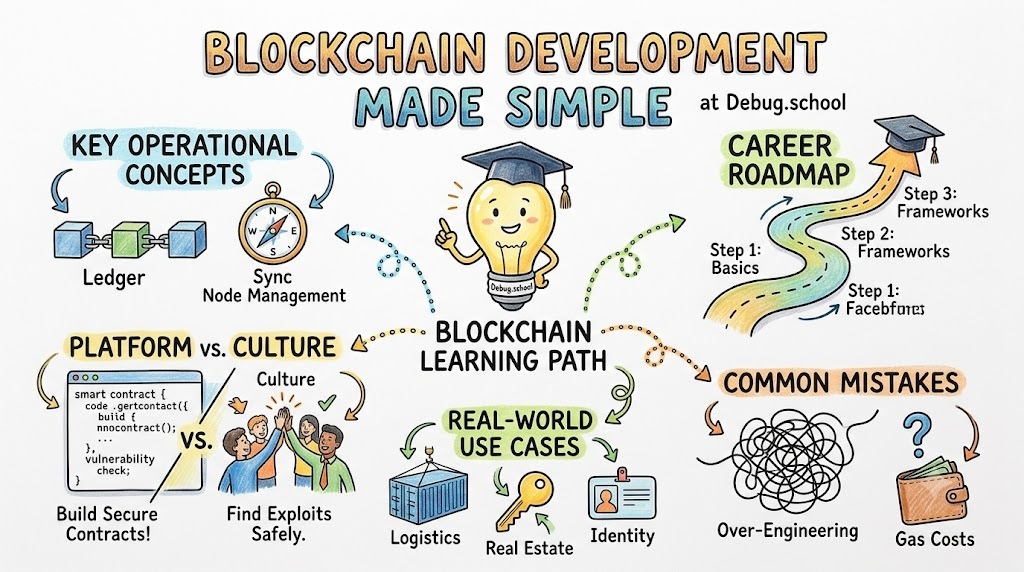
Blockchain technology often appears like an impenetrable fortress built of cryptographic puzzles, complex distributed algorithms, and confusing consensus mechanisms. However, mastering these decentralized frameworks becomes incredibly straightforward when you have access to structured, hands-on guidance. Aspiring developers can easily break down these complex architectural patterns through the comprehensive curriculum offered by debug.school. This specialized learning platform simplifies decentralized engineering by turning abstract cryptographic concepts into practical, bite-sized software lessons. Consequently, programming professionals can rapidly learn how to write smart contracts, build distributed applications, and establish highly secure ledger networks without getting lost in theoretical academic jargon.
Key Operational Concepts You Must Know
Cryptographic Ledger Architecture
Cryptographic ledgers form the absolute bedrock of any decentralized ecosystem, providing an immutable record of historical data entries across a distributed network. Instead of relying on a centralized database server, these networks use secure cryptographic hashing to link data blocks together sequentially. This strategy ensures that altering any past historical record requires rewriting every single block that follows it in the sequence.
Furthermore, these systems use public-key cryptography to verify the true identity of participants and secure transactional value transfers across the platform. Because every block contains a mathematical proof pointing directly to the previous block, verifying the complete history of data remains incredibly simple.
Consequently, understanding cryptographic hashing, digital signatures, and historical block validation is essential for building highly secure distributed applications. When you master these fundamental structural mechanics, managing immutable networks feels just as simple as manipulating standard local data arrays.
Distributed Consensus Engines
Maintaining a single, universally accepted version of truth across thousands of independent computers requires a robust distributed consensus engine. Consensus engines break down the process of system agreement into automated mathematical validations that run simultaneously across different cluster network nodes. This methodology ensures that the entire network stays perfectly synchronized even if multiple individual computers drop offline unexpectedly.
Initially, early networks used resource-heavy proof systems that required vast amounts of computational energy to validate transactional blocks. While this approach was incredibly reliable for security, it introduced significant throughput bottlenecks during high-volume operations.
Subsequently, modern systems shifted to consensus frameworks based on asset staking and cryptographic voting, which eliminated heavy computational energy requirements. By using resource-efficient voting patterns, these modern frameworks process transactions significantly faster than older distributed mining engines.
Smart Contract Execution Environments
Engineers must learn to write automated, self-executing code scripts that run predictably within a highly isolated virtual execution environment. Smart contracts handle the automated movement of digital assets based on pre-defined programming logic, removing the need for human intermediaries. Because the code runs identically on every machine in the network, the output of the execution remains completely tamper-proof.
Conversely, writing distributed code requires an entirely different mindset compared to traditional application development due to permanent deployment restrictions. Once you launch a smart contract onto the main network, modifying its underlying source code becomes nearly impossible.
Ultimately, modern architectures frequently combine off-chain processing layers with on-chain settlement contracts to achieve optimal transactional performance. This combination allows organizations to run complex application features quickly while still maintaining an unalterable audit trail for critical logic.
Decentralized Network Node Management
A distributed blockchain network requires a dedicated peering protocol to manage data synchronization and communications across hundreds of global nodes. Node management acts as the communication framework that routes transactions, distributes new blocks, and maintains network health across independent machines. Without this structured communication, independent servers would quickly fall out of sync, leading to dangerous network splits.
Moreover, modern node architectures isolate client traffic by separating consensus participants from read-only data indexing services. This structural isolation prevents public application programming interface queries from slowing down the core block production infrastructure during heavy use.
As a result, mastering node configuration, peer discovery, and block synchronization metrics is vital for maintaining production network environments. Efficient node operations guarantee that your distributed application remains continuously accessible without consuming excessive server storage or network bandwidth.
Platform Implementation vs. Culture — What's the Real Difference?
The Technology Trap in Engineering
Many organizations mistakenly believe that launching a private network cluster or adopting a popular programming language will automatically solve their trust challenges. This narrow focus on specific tools creates a dangerous technology trap where teams implement complex decentralized platforms without understanding their core architectural principles. Consequently, companies end up with fragile, over-engineered networks that are incredibly difficult to maintain and troubleshoot.
In reality, a blockchain platform is merely a tool, not a complete solution to complex business transparency problems. When engineers focus solely on tool syntax rather than distributed system patterns, application security and efficiency inevitably suffer.
Therefore, true engineering mastery requires a deep focus on foundational decentralized concepts rather than the fleeting features of specific software releases. Learning how data replication operates fundamentally prevents you from falling into the trap of fixing software symptoms instead of solving root architectural flaws.
Fostering a Data-Driven Engineering Culture
A robust decentralized culture focuses heavily on open-source collaboration, continuous cryptographic testing, and shared responsibility across different engineering teams. In this environment, teams treat smart contracts as high-stakes financial tools that require rigorous auditing, mathematical validation, and clear documentation. This cultural mindset ensures that deployed applications remain highly resilient, secure, and adaptable as user demands shift over time.
Additionally, a healthy culture encourages developers to experiment in safe test networks, share smart contract vulnerabilities openly, and learn from operational exploits. This collaborative approach removes the fear of the unknown and accelerates the development of innovative web solutions.
When an organization successfully balances technical platform implementation with a supportive engineering culture, overall software security increases dramatically. Engineers stop fighting their programming frameworks and start focusing on delivering secure, trustworthy user experiences to the global network.
| Aspect | Platform Implementation | Culture & Mindset |
|---|---|---|
| Primary Focus | Running full nodes, deploying smart contracts, and configuring test networks. | Establishing open-source standards, practicing rigorous security audits, and valuing immutability. |
| Longevity | Short-term focus that changes frequently as new software versions and protocols emerge. | Long-term foundation that remains stable across changing development landscapes. |
| Success Metric | Contract deployment speed, node uptime, and basic transaction throughput. | System trust, successful security audits, and efficient developer collaboration. |
| Core Value | Provides the raw infrastructure, execution environments, and cryptographic tools. | Drives the engineering safety standards, design patterns, and creative problem-solving. |
Real-World Use Cases of Modern Operations
Supply Chain Traceability in Global Logistics
Modern logistics enterprises handle complex global supply chains, requiring instant visibility to track the movement of physical goods across borders. To achieve this transparency, logistics platforms record every shipping milestone onto an immutable distributed ledger as the goods move. This real-time logging allows manufacturers, shipping lines, and end consumers to verify product authenticity and discover transit delays instantly.
Simultaneously, historical batch analysis systems review past supply chain data to optimize shipping routes and uncover systematic delay patterns. These structural insights are then used to improve future logistics planning, creating a highly efficient operational feedback loop.
- Key Requirements: High cryptographic security, seamless device integration, and accessible data visibility for multiple supply chain partners.
- Core Benefit: Eliminates counter-party disputes while preventing counterfeit products from entering the distribution pipeline.
- Data Scale: Manages millions of tracking events daily across highly distributed, multi-organizational corporate networks.
Automated Asset Tokenization in Real Estate
Real estate organizations use decentralized ledger systems to convert physical property values into digital cryptographic tokens. These property tokens stream transaction details and ownership updates directly into automated compliance networks for continuous verification. By digitizing these assets, investment platforms allow individuals to buy fractional shares of properties safely and transparently.
Furthermore, distributing rental dividends automatically through smart contract execution code saves companies immense administrative and legal overhead costs. This automated approach keeps investment platforms running smoothly and completely eliminates the traditional paperwork delays associated with asset management.
- Data Types: Digital ownership tokens, automated compliance logs, and historical property valuation records.
- Operational Goal: Reduce transaction friction and democratize access to high-value investment opportunities worldwide.
- Analysis Method: Combines automated token compliance checks with transparent public ledger tracking.
Decentralized Identity Management for Enterprise Systems
Corporate institutions rely heavily on secure identity management systems to protect user data privacy across different software applications. As a user authenticates, a decentralized identity system instantly verifies their cryptographic credentials without storing personal information on a central server. This immediate verification allows users to access multiple corporate services securely while retaining absolute control over their private data.
Meanwhile, background audit networks run continuously to check authorization compliance and flag suspicious credential usage patterns. This dual-layer security approach ensures that user access remains seamless while maintaining a fortress-like defensive posture against malicious actors.
- Target Outcomes: Reduced data breach risks, simplified compliance workflows, and enhanced user privacy controls.
- Pipeline Structure: Fast-moving cryptographic verification layers combined with transparent public key registries.
- Scale Challenge: Handling millions of continuous identity requests without impacting user login speeds.
Common Mistakes in Operations Engineering
Over-Engineering Simple Data Architectures
A frequent mistake among developers is building complex decentralized networks for basic data storage tasks that belong in a relational database. Driven by market hype, teams often deploy multi-node blockchain systems when a simple SQL server would work faster and cheaper. This over-engineering introduces massive computational latency, high transaction fees, and immense operational overhead for the development team.
Consequently, engineering velocity slows to a crawl because the team spends all their time managing network nodes instead of writing features. Simplicity should always remain the primary objective when designing enterprise data applications.
Therefore, you should only introduce distributed ledger systems when your application genuinely requires decentralized trust and multi-party verification. Keeping your software architecture lean ensures quick updates, lower operating expenses, and higher long-term stability.
Neglecting Data Quality and Schema Governance
Launching smart contracts without strict input validation rules always leads to catastrophic security vulnerabilities and loss of digital assets. When developers neglect to bound variables or fail to validate external function calls, malicious hackers can easily exploit the system. Without automated testing, vulnerable application code quietly enters the production environment, risking user funds and ruining the platform's reputation.
To prevent this issue, engineering teams must implement strict security scanning tools and comprehensive unit test suites at the development gate. These automated tools immediately flag vulnerable functions and isolate insecure code before it gets permanently written to the ledger.
Ultimately, maintaining software security requires continuous monitoring, independent code reviews, and automated vulnerability alerts. Prioritizing code quality early prevents devastating security exploits and keeps your production contracts running safely.
Ignoring Resource Optimization and Cost Controls
It is incredibly easy to overspend on gas fees when running unoptimized, poorly written smart contract code on a public network. Beginners often write overly complex storage loops that burn massive amounts of execution fees during transaction processing. Common culprits include storing large files directly on the ledger instead of using hash pointers, and making unnecessary execution steps.
Moreover, failing to optimize contract execution logic allows a single inefficient function to exhaust your operational development budget quickly. This lack of resource optimization can easily kill a promising project or severely disrupt your application's user adoption rates.
As a result, developers must learn to analyze execution costs, optimize state variable storage, and use efficient data structures. Writing resource-conscious smart contracts keeps transaction fees minimal and guarantees that your applications remain affordable for users.
How to Become an Operations Expert — Career Roadmap
Step 1: Mastering Fundamentals
Begin your educational journey by establishing a rock-solid understanding of standard programming concepts and web engineering architectures. You must become completely comfortable with Javascript execution patterns, command-line operations, and basic backend application development. Additionally, focus heavily on learning data encryption standards, asymmetric key mechanics, and traditional network security protocols.
- Core Focus: Learn a modern language like JavaScript or Python, master command-line tasks, and understand basic web server communication.
- Learning Resources: Interactive coding tutorials, foundational network security manuals, and structured web development programs.
- Estimated Time: Spend your first few months sharpening these baseline skills before diving into decentralized networks.
Step 2: Understanding Distributed Core
Once you master the basics, move on to learning the structural concepts behind distributed consensus and decentralized ledger storage. Study how peer-to-peer networks discover other nodes, distribute transactional blocks, and resolve data conflicts across a global system. Work on setting up small private networks locally on your development machine to watch how blocks form in real time.
- Core Focus: Master asymmetric cryptography concepts, understand public ledger architectures, and practice running local network configurations.
- Practical Projects: Set up a private multi-node network using container tools to study block production and network latency.
- Key Concept: Focus entirely on understanding how multiple independent machines reach agreement without a central authority.
Step 3: Mastering Advanced Frameworks
Transition your skills into the modern ecosystem by mastering smart contract programming languages and decentralized application frameworks. Learn how to write secure logic, manage execution costs explicitly, and connect user interfaces to backend network nodes. Additionally, dive deep into security patterns, learning how to prevent common programming exploits and vulnerabilities.
- Core Focus: Write highly secure smart contracts and build responsive frontend interfaces that interact with the network.
- Design Skills: Learn to design decentralized systems that protect user data privacy while maintaining high operational efficiency.
- Optimization Goal: Focus heavily on reducing transaction fees and eliminating security risks in production code.
Step 4: Enterprise Orchestration and Cloud Deployment
Round out your expertise by learning how to deploy and integrate decentralized applications within existing corporate cloud environments. Master containerization tools, automated testing workflows, and continuous integration pipelines to build repeatable deployment setups. Finally, learn how to configure contract monitoring services and alerting dashboards to track software performance and protect user interactions.
- Core Focus: Use deployment automation tools to manage multi-network release schedules and monitor node health parameters.
- Career Growth: Transition from a basic web developer into a blockchain architect capable of designing enterprise-grade decentralized systems.
- Final Goal: Build completely automated, heavily audited application pipelines that scale securely based on live user transaction volumes.
FAQ Section
- What is the difference between a public ledger and a private ledger? A public ledger allows anyone to join the network, read data, and validate transactional blocks without needing permission. A private ledger restricts network access to authorized participants, providing higher transaction speeds and tighter data privacy controls for corporations.
- Why are smart contracts considered immutable once they are deployed? Smart contracts are immutable because their compiled code is permanently stored inside cryptographic blocks across thousands of distributed machines. The consensus engine ensures that no single participant can alter that deployed code without breaking the network's cryptographic security.
- How do developers test smart contracts without spending real money? Developers use localized simulation networks and public test networks that replicate live system conditions using worthless test tokens. This setup allows engineers to find software bugs and measure transaction fees safely before releasing the code to production.
- Can I build decentralized applications using standard web development skills? Yes, you can absolutely leverage your existing HTML, CSS, and JavaScript skills to build user interfaces for decentralized applications. You simply need to learn how to connect those interfaces to network nodes using specialized JavaScript communication libraries.
- What is a gas fee and why does it change during the day? A gas fee is the computational cost required to process a transaction or execute code on a distributed network. These fees fluctuate based on live network congestion, rising when many users compete for limited block space simultaneously.
Final Summary
Mastering decentralized application development does not require genius intelligence, but it absolutely demands a structured approach to learning fundamental cryptographic patterns. By breaking down complex consensus mechanics into manageable pieces, engineers can confidently design distributed systems that operate securely. Educational platforms like debug.school provide the hands-on practice, clear code examples, and guided career roadmaps needed to navigate this shifting software landscape. Avoid the trap of chasing every new token trend; instead, focus your energy on understanding cryptographic ledgers, contract optimization, and security governance. Ultimately, blending strong coding skills with a security-focused development culture allows you to build clean, robust applications that deliver authentic decentralized value.



Top comments (0)