
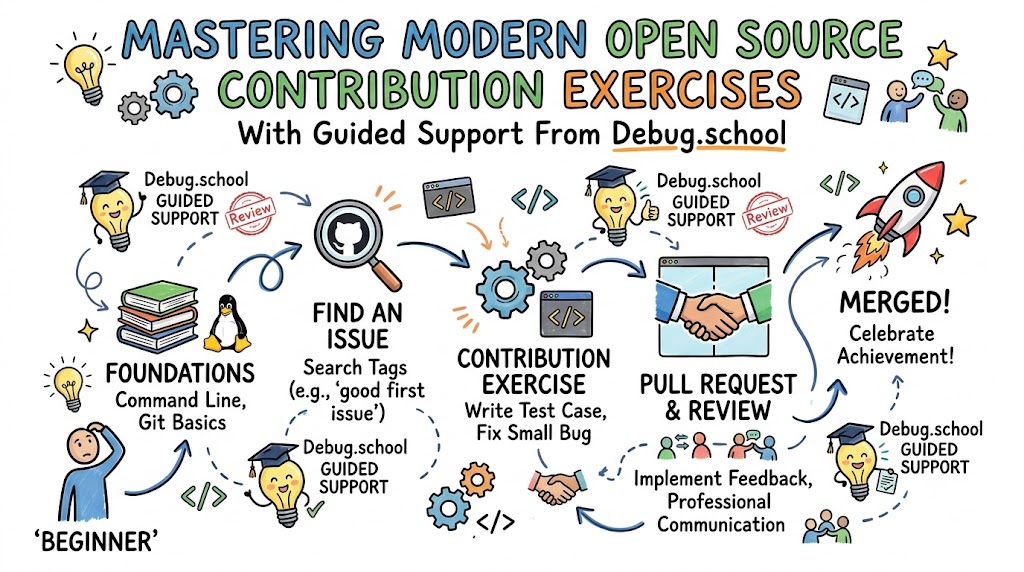
Entering the world of collaborative software development can feel intimidating when facing unfamiliar repositories, strict review guidelines, and complex automation workflows. Fortunately, structured practical tasks bridge this gap by providing safe, realistic environments where engineers can sharpen their skills without fear of breaking production code. Through purposeful open source contribution exercises curated by debug.school, learners systematically unravel the complexities of real-world codebases. This guided approach enables aspiring engineers to understand repository structures, master version control habits, collaborate with project maintainers, and write reliable code that meets modern production standards.
Understanding Collaborative Repository Architecture
Navigating a large open source project requires developers to comprehend repository anatomy before writing a single line of executable code. Typically, established projects organize files into modular directories containing source logic, test suites, automation configurations, and project documentation. Examining these directories systematically helps you understand where application boundaries lie and how components interact.
Moreover, every reputable repository includes standard files such as contribution guidelines, licenses, and architecture diagrams. Reading these documents teaches you project conventions, code style expectations, and branching protocols. Consequently, you can orient yourself within complex code structures smoothly while aligning your efforts with established team workflows.
Issue Triaging and Reproduction Techniques
Before attempting to fix an open source bug, an engineer must accurately reproduce the reported behavior in an isolated environment. Effective issue triaging involves reviewing the user's initial report, verifying the runtime environment, and confirming error outputs. By methodically stepping through reported steps, you isolate the exact conditions that triggered the unwanted behavior.
Furthermore, documenting your reproduction steps directly within the issue thread provides immense value to project maintainers. It confirms that the problem is authentic, active, and reproducible across different hardware configurations. As a result, triaging exercises sharpen your debugging acumen and build credibility within software engineering communities.
Pull Request Crafting and Peer Review Workflows
Submitting a clean pull request requires far more discipline than simply pushing a branch to an external server. You must craft small, focused commits that each perform an isolated logical change accompanied by clear, descriptive commit messages. Maintaining this discipline makes it simple for project maintainers to inspect changes and track developmental progress over time.
Additionally, participating in iterative code reviews teaches you how to receive technical feedback objectively and implement suggested improvements quickly. By treating every review comment as an opportunity to refine your code, you raise the overall software quality. Thus, learning how to present, discuss, and refine changes turns code reviews into an enjoyable collaborative exercise.
Automated Testing and Verification Workflows
Submitting contributions to open source repositories requires solid proof that your new modifications do not break existing features. Automated testing pipelines validate incoming changes by running unit tests, integration suites, and code linters against multiple system configurations. Learning how to run these test suites locally ensures your pull requests pass automated checks on the first attempt.
Additionally, writing new test cases to cover newly introduced features or fixed bugs is standard practice across top-tier projects. When you provide test cases that demonstrate both failure before your fix and success after it, maintainers can merge your work with complete confidence. In turn, mastering automated testing habits makes you an indispensable contributor to any engineering team.
Key Operational Concepts You Must Know
Distributed Version Control Architecture
Modern operational workflows depend entirely on distributed version control systems that track revisions across independent, decoupled environments. Unlike centralized version systems, every contributor possesses an entire local clone of the repository history, including all past revisions, tags, and branches. This architecture enables engineers to inspect logs, switch contexts, and make commits without needing a constant network connection.
Furthermore, distributed version control introduces sophisticated branch-merging and history-rewriting capabilities that maintain clean project logs. Understanding how branches diverge, merge, and rebase enables engineers to resolve complex file conflicts without corrupting production code histories. Mastering these mechanics ensures smooth collaboration across globally distributed developer teams.
+------------------+         Pull Request          +------------------+
|  Your Fork /     | ----------------------------> | Upstream Repo    |
|  Local Branch    | <---------------------------- | (Production Code)|
+------------------+         Sync / Rebase         +------------------+
         |                                                  |
         +---------------- Continuous Integration ----------+
                            (Tests & Linters)
Git Branching Strategies and Release Tracks
Organizations organize collaborative coding efforts by establishing strict branching workflows tailored to their deployment cadence. Popular patterns such as trunk-based development and feature branching outline how engineers isolate experiments from production-ready code. In trunk-based development, developers merge short-lived branches into the primary trunk daily to avoid painful, late-stage merge collisions.
Alternatively, scheduled release strategies maintain distinct stabilization branches alongside active development tracks to support multi-version maintenance. Choosing the right pattern depends heavily on your team's testing maturity, release frequency, and regulatory requirements. Adopting a structured branching strategy ensures predictable, low-risk software delivery across all operational environments.
Continuous Integration and Continuous Delivery Pipelines
Continuous Integration and Continuous Delivery frameworks form the operational spine of reliable software delivery. Whenever an engineer opens or updates a pull request, the automation engine spins up ephemeral build runners to compile code, execute tests, and analyze security posture. This fast feedback mechanism highlights syntax errors, test failures, and dependency conflicts minutes after code submission.
Similarly, Continuous Delivery automates the staging and packaging steps required to ship verified artifacts to production environments safely. Because automated delivery eliminates tedious manual deployment steps, software updates reach users faster and with fewer human errors. Developing comfort with continuous delivery configurations is essential for modern operational readiness.
Automated Dependency Management and Security Scans
Modern software stacks incorporate hundreds of third-party dependencies, libraries, and external tools that evolve constantly. If left unmonitored, outdated libraries introduce severe security vulnerabilities and performance regressions into production ecosystems. Modern operations engineering uses automated scanners to continuously check dependencies against known vulnerability databases and alert teams instantly.
Moreover, automated tools can submit automatic pull requests to bump vulnerable packages to safe, patched releases without human intervention. By integrating automated vulnerability scans into everyday workflows, engineering teams maintain strong security perimeters effortlessly. Proactive dependency management protects software supply chains from costly disruptions and security exploits.
Platform Implementation vs. Culture — What's the Real Difference?
The Pitfall of Tool-Centric Operations
Engineering teams frequently fall into the trap of assuming that adopting cutting-edge tools will instantly resolve operational friction. They spend massive budgets installing advanced deployment dashboards, container orchestrators, and monitoring suites while ignoring team habits. Yet, without clear communication and operational discipline, these expensive platforms merely automate flawed, chaotic development practices.
When organizations purchase platforms without addressing underlying team friction, operational complexity increases exponentially. Teams find themselves maintaining brittle automation scripts and managing unneeded infrastructure while delivery velocity stalls. True operational efficiency begins with clean development practices, open technical dialogue, and shared responsibility rather than an endless parade of software platforms.
Building an Open, Collaborative Mindset
A flourishing engineering culture values psychological safety, shared code ownership, and proactive mentorship across organizational boundaries. In such environments, developers feel empowered to propose architectural improvements, question legacy assumptions, and learn openly from production incidents. Treating failures as learning opportunities during post-incident reviews eliminates blame and fosters systemic resilience.
Furthermore, an open culture mirrors the collaborative dynamics of the broader open source ecosystem. Team members review each other's work with empathy, share domain knowledge generously, and maintain clear documentation for future teammates. Combining supportive team habits with robust technical platforms creates an unstoppable engineering organization capable of continuous innovation.
| Operational Dimension | Platform Implementation | Culture & Collaborative Mindset |
|---|---|---|
| Primary Focus | Installing automation tools, configuring servers, and wiring pipelines. | Building shared accountability, clear communication, and empathetic code reviews. |
| Adoption Velocity | Can be provisioned and configured in days or weeks using cloud automation. | Requires months of intentional practice, habit formation, and leadership modeling. |
| Response to Errors | Sends automated pipeline alerts, creates error logs, and restarts failed pods. | Conducts blameless retrospectives, identifies systemic flaws, and updates training. |
| Sustainability | Becomes obsolete as soon as technology trends and tooling evolve. | Endures across tools, languages, and structural business transitions. |
| Business Value | Provides execution infrastructure and computational capability. | Drives code quality, engineer retention, and continuous product innovation. |
Real-World Use Cases of Modern Operations
Streamlining Enterprise Contributions to Open Source
Global enterprises increasingly contribute upstream bug fixes and security improvements to the open source projects powering their core products. However, managing enterprise contributions requires balancing internal intellectual property protections with public collaboration standards. Operations teams establish dedicated automated screening gateways that sanitize internal code contributions before public release.
These contribution pipelines verify that internal secrets, proprietary keys, and private customer configurations never leak into public pull requests. Furthermore, automated legal scanners verify licensing compatibility to ensure compliance with corporate governance policies. Consequently, enterprise developers contribute confidently to community projects while keeping proprietary assets protected.
- Target Goal: Enable safe, compliant developer contributions to public open source software ecosystems.
- Security Controls: Automated credential detection, commit sanitization, and corporate licensing checks.
- Operational Benefit: Builds industry influence and speeds up internal bug fixes without compromising enterprise IP.
Managing High-Velocity Microservice Deployments
Modern digital platforms break monolithic software into dozens of independently deployable microservices maintained by distinct feature teams. Coordinating updates across these distributed services requires robust versioning controls and automated integration testing frameworks. Operations engineers design standardized pull request workflows that test inter-service communication contracts before deploying code changes.
By validating contracts in continuous integration pipelines, teams discover breaking interface changes before they impact end users. Additionally, automated canary deployment strategies route small percentages of user traffic to newly deployed microservices to verify real-world stability. This operational discipline enables organizations to ship hundreds of updates daily without unexpected service disruptions.
- Target Goal: Coordinate independent microservice updates safely across large distributed development teams.
- Release Methodology: Automated canary deployments, service mesh routing, and consumer-driven contract testing.
- Operational Benefit: Accelerates deployment velocity while drastically lowering the radius of potential service outages.
Automated Infrastructure Provisioning via Git Workflows
Modern infrastructure operations manage cloud resources exclusively through declared configuration files stored directly in version-controlled repositories. When a cloud engineer needs to provision new compute clusters or alter networking boundaries, they open a standard pull request. The team reviews the proposed infrastructure configuration using the same scrutiny applied to application source code.
Once the team approves the pull request, automated deployment runners apply the infrastructure adjustments directly to the target environment. This strategy creates an immutable, auditable trail of every infrastructure change made across the organization's history. Furthermore, recovering from catastrophic cloud failures becomes as simple as reapplying the declared infrastructure configurations stored within the repository.
- Target Goal: Automate cloud resource management through auditable, version-controlled review workflows.
- Core Practices: Infrastructure-as-code definitions, peer-reviewed configuration branches, and automated state drift detection.
- Operational Benefit: Eliminates manual server configuration errors and enables instant disaster recovery capabilities.
Common Mistakes in Operations Engineering
Submitting Massive, Monolithic Pull Requests
One of the most frequent mistakes made by developing engineers is bundling dozens of unrelated changes into a single colossal pull request. Reviewing a massive code update that changes hundreds of files is exhausting for maintainers and frequently delays review feedback. Moreover, huge pull requests often hide subtle logic bugs and regression errors that slip past tired reviewers.
Instead, developers should decompose complex tasks into small, bite-sized modifications that each achieve a single clear goal. Small pull requests are faster to review, simpler to test, and significantly easier to revert if unforeseen bugs appear in production. Embracing atomic, focused contributions accelerates approval cycles and earns praise from senior maintainers.
Neglecting Clear Documentation and Contextual Logs
Submitting code changes without detailing your intent creates friction for maintainers and future engineers trying to understand your work. Code alone rarely reveals why a particular workaround or performance compromise was chosen over alternative architectural options. Leaving future teammates without documentation turns routine debugging sessions into painful, time-consuming reverse-engineering projects.
To avoid this problem, supplement your pull requests with thorough descriptions, ticket references, and reproduction artifacts. Explain the business motivation behind the change and summarize the testing steps you performed to verify reliability. Clear communication demonstrates respect for your teammates' time and accelerates the overall code review process.
Poor Practice:
"Fixed the bug." -> No context, no ticket reference, no verification steps.

Best Practice:
"Resolve race condition in connection pool (Closes #412).
- Added synchronization lock around worker initialization.
- Added automated stress test simulating 500 concurrent connections.
- Verified zero deadlocks across 50 test iterations locally."
Skipping Local Pre-Flight Validations
Relying entirely on remote continuous integration servers to catch simple syntax errors and linting failures wastes expensive compute minutes and developer time. Pushing commit after commit to fix tiny formatting issues floods repository histories with noise and slows down shared testing queues. Furthermore, waiting on remote pipelines to catch basic syntax flaws interrupts your focus and breaks development momentum.
Engineers should configure local pre-commit hooks to run linters, formatters, and fast unit tests before pushing changes upstream. Running these sanity checks locally ensures that code arriving on the remote platform is already clean, readable, and properly formatted. Practicing local verification builds professional discipline and keeps shared continuous integration pipelines green.
How to Become an Operations Expert — Career Roadmap
Phase 1: Core Fundamentals and Shell Fluency
Begin your professional journey by developing absolute fluency in command-line environments, shell scripting, and core operating system concepts. Operations engineers spend significant time navigating remote servers, inspecting system performance, and writing administrative automation scripts. Understanding process execution, memory management, and file permissions provides the technical baseline required for advanced operational tasks.
- Operating Systems: Master Linux file hierarchy, system process monitoring, permissions, and terminal navigation.
- Scripting Automation: Learn Bash and Python to automate repetitive administrative tasks and parse operational log files.
- Version Control Basics: Understand branching, merging, rebasing, and tracking changes locally using Git.
- Foundational Networking: Study the basics of IP routing, DNS resolution, subnetting, and secure shell configuration.
Phase 2: Collaborative Development and Open Source Practice
After mastering foundational systems commands, transition your focus toward collaborative development workflows and community-driven coding standards. Practice cloning public repositories, triaging user issues, writing documentation updates, and submitting clean pull requests to active projects. This phase builds the communication skills and technical humility needed to thrive inside high-performing engineering teams.
- Repository Etiquette: Learn how to read contribution guidelines, follow code styling standards, and structure commit messages.
- Debugging Workflows: Practice isolating software defects using reproduction scripts, log tracing, and automated test runners.
- Peer Code Reviews: Engage actively in public review discussions, incorporating constructive feedback with professional poise.
- Continuous Integration Basics: Configure automated actions to lint code, check syntax, and run unit tests on every pull request.
Phase 3: Infrastructure Automation and Cloud Orchestration
Transition from code-level collaboration into managing distributed cloud infrastructure and automated container environments. Learn how to package applications into consistent, lightweight container images that run identically across development, staging, and production environments. Next, study infrastructure-as-code tools to declare cloud resources predictably without manual configuration consoles.
- Containerization: Master container packaging, layer caching optimization, and multi-stage build configurations.
- Infrastructure as Code: Write repeatable configuration files to provision cloud networks, compute instances, and storage buckets.
- Cluster Orchestration: Study container orchestration fundamentals, deployment controllers, and ingress routing mechanisms.
- Configuration Management: Implement secure secrets management and centralized configuration storage across environments.
Phase 4: Observability, Security, and Senior Leadership
Reach professional maturity by building reliable observability architectures, enforcing security standards, and mentoring junior engineers across the organization. Senior operations experts design automated monitoring systems that alert teams to emerging anomalies before users experience downtime. Furthermore, they champion blameless incident retrospectives and guide organizational strategy toward sustainable, resilient software delivery.
- Full-Stack Observability: Deploy metrics collectors, distributed tracing agents, and centralized log aggregation systems.
- Security Automation: Integrate static application security testing and container image vulnerability scanners into release gates.
- Site Reliability Practices: Define service level objectives, error budgets, and automated incident response runbooks.
- Technical Mentorship: Guide junior engineers through complex operational reviews and share systems architecture best practices.
FAQ Section
- How do open source contribution exercises help career advancement? Open source exercises provide verifiable proof of your technical abilities, collaborative maturity, and communication style. Unlike personal projects created in isolation, public contributions show potential employers that you can read existing codebases, accept feedback gracefully, and follow professional team conventions.
- What should a beginner do if their pull request receives critical review comments? Treat critical feedback as valuable professional mentorship rather than a personal critique. Carefully read the maintainer's suggestions, ask polite clarifying questions if needed, update your code accordingly, and thank the reviewer for dedicating their time to help you improve.
- Why is trunk-based development preferred by many modern operations teams? Trunk-based development encourages developers to merge small, frequent updates into the shared main branch. This practice eliminates painful merge conflicts, encourages continuous testing, and ensures that the entire engineering team works from the freshest version of the application.
- Can non-code contributions make a meaningful difference to open source projects? Non-code contributions are immensely valuable to open source ecosystems. Improving documentation, clarifying user guides, translating text, triaging reported issues, and writing reproduction test cases free up core maintainers to tackle complex architecture problems.
- How can organizations measure the health of their engineering culture? Organizations evaluate cultural health by measuring deployment frequency, change failure rates, mean time to recovery, and team psychological safety. High-performing cultures experience low employee turnover, run transparent blameless retrospectives, and maintain continuous delivery pipelines without heroics.
Final Summary
Developing modern operations expertise requires a balanced approach that pairs hands-on technical practice with an open, collaborative mindset. Navigating unfamiliar repositories, diagnosing tricky bugs, and interacting with seasoned maintainers transforms abstract operational theory into practical intuition. Engaging with guided open source contribution exercises provides the safe, structured sandbox necessary to build this muscle memory without unnecessary stress. Focus your energy on mastering distributed version control, writing clean and atomic pull requests, and automating test validations early. As you cultivate these technical and cultural habits, you will not only write better software but also become an invaluable, empathetic contributor to the global engineering community.



Top comments (0)