
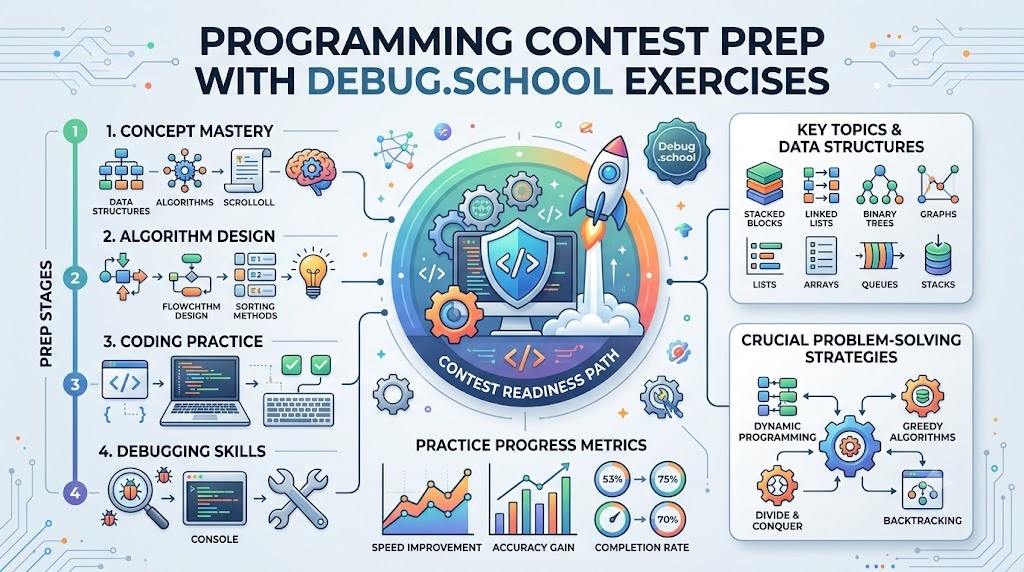
Coding contests are fast, fun math games where you write computer code to solve tricky puzzles. You race against a ticking clock to submit answers before other players finish. Many beginners feel stuck when their code breaks during a tense contest. You can build speed and confidence by solving fun problems on debug.school. This learning platform breaks large puzzles into tiny steps, making tough coding concepts simple and exciting for everyone.
Contest problems test your thinking skills and your speed. When your computer program runs into an error, you must spot the mistake quickly. Practicing on easy puzzles trains your brain to find sneaky bugs without panic. You learn to write clean solutions that run fast and never freeze.
Good preparation turns scary challenges into an exciting video game. You learn how to organize your ideas before typing a single line. Regular practice helps you climb the leaderboard and win shiny virtual badges. Anyone can master these contests with steady practice, simple habits, and a cheerful attitude.
Understand How Computers Solve Puzzles
Computers need super clear instructions to solve any problem. If you skip one small detail, the program gets confused and stops. You must tell the machine where to start and where to finish.
Think of a computer program like a baking recipe. You cannot bake the cake before you mix the flour and eggs. Good coders write down every step in plain words first. This smart planning makes the actual coding feel smooth and simple.
Find and Fix Code Bugs Fast
A bug is just a tiny mistake hidden inside your instructions. Sometimes you spell a word wrong or forget a tiny punctuation mark. Other times, your numbers do not add up correctly.
Fixing bugs feels just like playing a detective game. You inspect your code line by line to spot the odd clue. Once you find the mistake, you fix it and test the program again. Fixing errors quickly gives you a huge advantage during live contests.
Write Code That Runs Super Fast
In a coding race, slow programs lose points. Your program must solve the puzzle in less than one single second. If your instructions take too many loops, the computer runs out of time.
Smart coders choose short paths to find the right answer. Instead of checking every number one by one, they use clever shortcuts. Learning fast patterns helps your code zip across the finish line with ease.
Stay Calm Under Time Limits
Contest clocks tick down fast while you work. It is very easy to feel rushed and make silly typos. Top coders take a slow, deep breath before they start typing.
When you practice often, the ticking clock stops feeling scary. You trust your training and focus on one puzzle at a time. Staying relaxed keeps your mind sharp, creative, and ready to win.
Key Operational Concepts You Must Know
The Magic of Step-by-Step Logic
Every winning program follows a strict recipe called an algorithm. An algorithm tells the machine how to move from a raw question to the right answer. You must keep these steps short, simple, and neat.
When you plan your logic clearly, you avoid messy dead ends. You can test your plan on paper using simple sketches. This quick paper check saves you lots of valuable contest time.
Smart Ways to Hold Your Data
Computers need tidy digital boxes to store numbers, words, and game scores. Programmers call these organized storage bins data structures. Choosing the right bin makes finding your data super fast.
If you put your toys in random piles, finding your favorite toy takes forever. But if you sort toys into labeled cubbies, you grab them in one second. Tidy code bins work the exact same way during a contest.
Looking at Extreme Edge Cases
A puzzle might give you normal numbers, but it can also hand you tricky surprises. What happens if the input is zero, an odd negative number, or a gigantic value? Sneaky test questions always hide these rare traps.
Careful coders check their programs against these wild situations before submitting. You must test your work against empty lists, giant lists, and duplicate numbers. Catching these hidden tricks protects your hard-earned points.
Tracking Computer Memory Limits
Computers have a set amount of temporary memory space for each task. If your program builds giant lists without deleting old data, it crashes. Contest servers stop greedy programs that use too much space.
You must design solutions that pack data into small, tidy shapes. Clean code leaves plenty of empty room for the machine to breathe. Efficient memory use ensures that your solution runs smoothly every time.
Platform Implementation vs. Culture — What's the Real Difference?
Tools Only Help When You Practice
Some kids collect fancy mechanical keyboards, three monitors, and cool desktop themes. However, having fancy equipment does not make you a faster typist or a better thinker. A regular laptop works just as well for solving contest problems.
Tools only do what you tell them to do. If your base plan is broken, a fast machine simply makes mistakes faster. Real mastery comes from practicing tough problems with your own brain.
Building Daily Problem Solving Habits
A great coder practices solving small puzzles every single day. They do not cram for ten hours right before a big event. Instead, they solve two quick brain teasers every afternoon after school.
This steady habit keeps your mind fresh and ready for anything. You start seeing patterns in problems without even trying hard. Daily practice builds quiet confidence that carries you through tough contest rounds.
| Feature | Fancy Platform Tools | Daily Practice Habit |
|---|---|---|
| Main Focus | Buying gadgets and downloading shiny apps. | Training your brain with fun coding puzzles. |
| Skill Growth | Gives quick comfort but zero real skill gains. | Builds deep problem-solving strength over time. |
| Contest Impact | Looks nice on your desk but adds zero points. | Helps you solve tricky tasks with high speed. |
| Long-Term Value | Tools get old and need constant replacement. | Smart thinking habits stay with you forever. |
Real-World Use Cases of Modern Operations
Delivering Packages on Fastest City Routes
Delivery trucks must bring thousands of parcels to homes across crowded cities every single day. Companies use contest-style pathfinding algorithms to pick the shortest roads. These clever instructions dodge traffic jams and save gasoline.
Without these smart math rules, delivery drivers would wander around in circles. Fast path calculations help packages arrive at your front door right on time. Coding contest tricks power these massive shipping systems every single morning.
- Main Goal: Find the fastest route between hundreds of neighborhood homes.
- Smart Trick: Use graph paths to skip traffic jams and closed roads.
- Big Result: Delivery trucks use less fuel and deliver packages faster.
Sorting Songs on Music Streaming Apps
Music apps store millions of songs on giant computer servers. When you search for your favorite band, the app finds the track in a split second. Contest sorting methods arrange these giant libraries so searches never lag.
These algorithms scan vast lists of titles and artist names instantly. They filter out wrong songs and show your favorites at the top of the screen. Fast search code keeps music fans dancing without annoying pauses.
- Main Goal: Pick the exact song a listener wants from a huge music catalog.
- Smart Trick: Use quick binary searches across sorted lists of track titles.
- Big Result: Songs start playing instantly without buffering delays.
Ranking High Scores in Online Games
Online multiplayer games track scores for millions of competitive players across the globe. The game server updates a massive live leaderboard every time a match ends. Clever heap algorithms update player ranks without slowing down the game.
The system places winners at the top of the ladder within milliseconds. Gamers see their rank rise immediately after a great victory. Clean, fast contest algorithms make these giant gaming leaderboards possible.
- Main Goal: Keep live rankings updated for millions of players at once.
- Smart Trick: Insert new high scores into ordered trees instantly.
- Big Result: Players see their true ladder rank update the moment a match ends.
Common Mistakes in Operations Engineering
Writing Code Before Reading the Full Story
Eager coders often read the first two sentences of a problem and start typing right away. They miss tiny secret rules hidden at the bottom of the page. Then, their program fails the hidden tests, and they waste time guessing why.
Always read every single word of the problem statement twice. Underline important rules, number ranges, and special conditions. Understanding the whole story first saves you from rewriting broken code later.
Forgetting to Test Simple Sample Cases
Many students click the big submit button without testing their work even once. They assume their code is perfect on the very first try. Then, they get hit with a quick error message that costs them points.
Always run your program against the provided example inputs first. Make up three silly test cases of your own to see what happens. Catching your own mistakes takes less time than waiting for server test results.
Panicking Over Red Error Screens
Seeing a bright red error message can make you feel sad or upset. Some students give up completely after their first failed attempt. However, red errors are just helpful clues showing you where to look next.
Great problem solvers smile when they see a bug. They know each fixed mistake brings them one step closer to the correct answer. Stay curious, read the error hint, and try a fresh idea.
How to Become an Operations Expert — Career Roadmap
Step 1: Learn the ABCs of Coding
Start your journey by picking one beginner-friendly coding language. Practice writing simple loops, basic math checks, and small text games. Get comfortable telling the computer how to print words and read numbers.
- Action Item: Write a tiny game that asks the user to guess a hidden secret number.
- Time Target: Spend four weeks building small fun projects on your computer.
- Core Goal: Feel happy and comfortable typing out basic programming instructions.
Step 2: Solve Beginner Math Puzzles
Next, start solving bite-sized math puzzles on interactive practice websites. Focus on problems that ask you to reverse words or count repeated numbers. Learn how to break big questions into two smaller, easier tasks.
- Action Item: Solve five tiny logic puzzles every single weekend morning.
- Time Target: Practice these simple puzzles for two to three months straight.
- Core Goal: Learn how to turn plain English instructions into clean code lines.
Step 3: Master Data Bins and Sorting Rules
Now you can learn advanced ways to store and organize lots of data. Study how to sort lists from smallest to largest in quick ways. Practice using maps and hash sets to find items in a flash.
- Action Item: Build a program that sorts a list of one thousand names alphabetically.
- Time Target: Dedicate three months to practicing these core sorting patterns.
- Core Goal: Understand why some sorting methods run faster than others.
Step 4: Join Your First Live Contest
Jump into your very first timed online competition with an open mind. Do not worry about your final rank or winning a trophy right away. Focus entirely on solving just one single puzzle correctly before the clock expires.
- Action Item: Register for a beginner weekend contest and give it your best shot.
- Time Target: Enter one fun contest every month to build your racing muscles.
- Core Goal: Learn how to stay calm and have fun while the contest clock ticks.
FAQ Section
- What age is best to start competitive coding? You can start as early as eight or nine years old! If you enjoy solving jigsaw puzzles and playing math games, you can learn to code easily.
- Which coding language should a beginner pick first? Python is a wonderful first choice because it looks like plain English. Many contest runners also love C++ because it runs super fast on the scoring servers.
- Do I need to be a math genius to win contests? No, you only need basic arithmetic, clear logic, and patience. Most beginner puzzles test your creative thinking rather than fancy classroom math formulas.
- How long does a standard coding contest last? Most beginner contests last between two and three hours. You usually get three to six fun puzzles to solve during that time window.
- What should I do when I get completely stuck on a puzzle? Step away from the screen, grab a glass of water, and draw the puzzle on paper. Looking at the steps visually often reveals the simple answer right away.
Final Summary
Competitive coding is a super fun way to turn computer programming into an exciting sport. It teaches you how to think clearly, solve big puzzles, and bounce back from silly mistakes. Platforms like debug.school make this learning path fun, smooth, and easy for everyone. You do not need expensive computers or genius math tricks to do well on the leaderboard. All you need is regular practice, an eye for sneaky bugs, and a cheerful attitude. Start by solving one tiny puzzle today, keep your code simple, and watch your skills grow week after week!



Top comments (0)