
Introduction
Modern applications rarely stay static. What starts as a clean relational schema slowly faces real-world pressure: new requirements, optional fields, integrations, role-based data, and UI-specific preferences. Teams then struggle between two extremes — strict normalization versus dumping everything into JSON.
Both approaches have strengths, but both fail when used alone.
This is where Hybrid Database Design comes in — a practical, production-proven approach that combines normalized tables, meta (key-value) fields, and JSON columns, each used intentionally for what they are best at.
This article explains:
What hybrid database design is
Why neither pure normalization nor pure JSON works alone
When to use tables, meta fields, and JSON
Real-life examples with clean structure`s
A repeatable decision framework for long-term systems
Why Pure Normalization Is Not Enough
Traditional relational design promotes:
`
Fixed schemas
Strong relationships
Strict constraints
`
This works perfectly when:
`
Fields are well-defined
Requirements are stable
Reporting needs are known upfront
`
The problem
In real applications:
`
Different users need different fields
New attributes are added frequently
Integrations introduce unpredictable data
UI preferences don’t belong in schema migrations
`
Result:
You either keep altering tables endlessly, or developers start misusing existing columns.
Why Pure JSON Is Also a Bad Idea
JSON columns offer flexibility:
`
No schema changes
Easy to store nested data
Perfect for variable structures
`
The problem
When JSON is overused:
`
Important business fields become invisible to SQL
Indexing becomes limited
Queries become slow and complex
Data integrity is enforced only in application code
Partial updates are risky
`
JSON becomes a dumping ground, not a design choice.
What Is Hybrid Database Design?
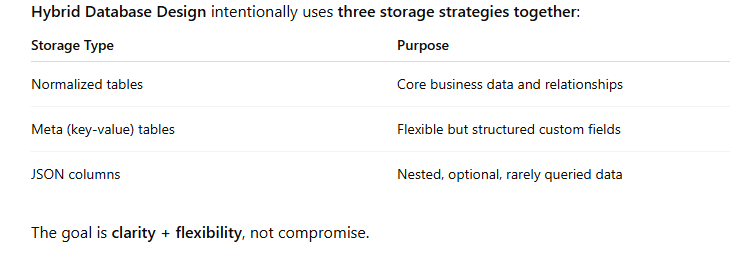
Normalized Tables (The Backbone)
What belongs here
`
Core fields
Frequently queried data
Relationships (one-to-many, many-to-many)
Anything used in filtering, sorting, reporting
`
Example: Orders (Core Data)
orders
`
id
user_id
status
total_amount
created_at
`
order_items
`
id
order_id
product_id
quantity
unit_price
`
Why this stays normalized
`
Reports depend on it
Queries must be fast
Data integrity matters
Relationships are fundamental
`
Meta Tables (Flexible but Controlled)
Meta tables store key-value pairs linked to a parent entity.
When meta fields make sense
`
Optional attributes
Custom fields
Fields that differ by role or type
Values that may evolve over time
Fields you might query occasionally by key
`
Example: Order Meta
order_meta
`
id
order_id
meta_key
meta_value
value_type
`
Stored values
`
gst_no
payment_reference
invoice_required
partner_code
`
Why meta is better than JSON here
You can update one key without rewriting everything
You can enforce uniqueness per key
You can index by meta_key if needed
Data stays structured
JSON Columns (Flexible and Nested)
JSON columns are ideal for nested, rarely queried, non-relational data.
When JSON makes sense
`
Settings
Configuration
UI preferences
Third-party API payloads
Audit snapshots
Feature flags
`
Example: User UI Preferences
users
`
id
name
email
`
ui_preferences (JSON)
`
{
"theme": "dark",
"sidebar": "collapsed",
"dashboard_widgets": ["orders", "revenue"],
"table_density": "compact"
}
`
Why JSON is perfect here
UI data changes frequently
No reporting needed
Structure may evolve
Read and written as a whole
Real-Life Hybrid Example: Vehicle Management System
Tables Used
vehicles (core)
id
owner_id
status
base_price
additional_config (JSON)
vehicle_images (child)
id
vehicle_id
role (admin / partner)
path
sort_order
is_primary
vehicle_meta (meta)
id
vehicle_id
meta_key
meta_value



Top comments (0)