
Concepts Covered
Your actual Project 0 focus is
Recommended learning ratio
Step 1 — Transformer
What is a Transformer?
Why was the Transformer needed?
Transformer does not simply understand words independently
Encoder vs Decoder
Encoder + Decoder
How does a Transformer process text?
What does “contextual representation” mean?
Why can Transformers understand context?
Transformer vs Attention
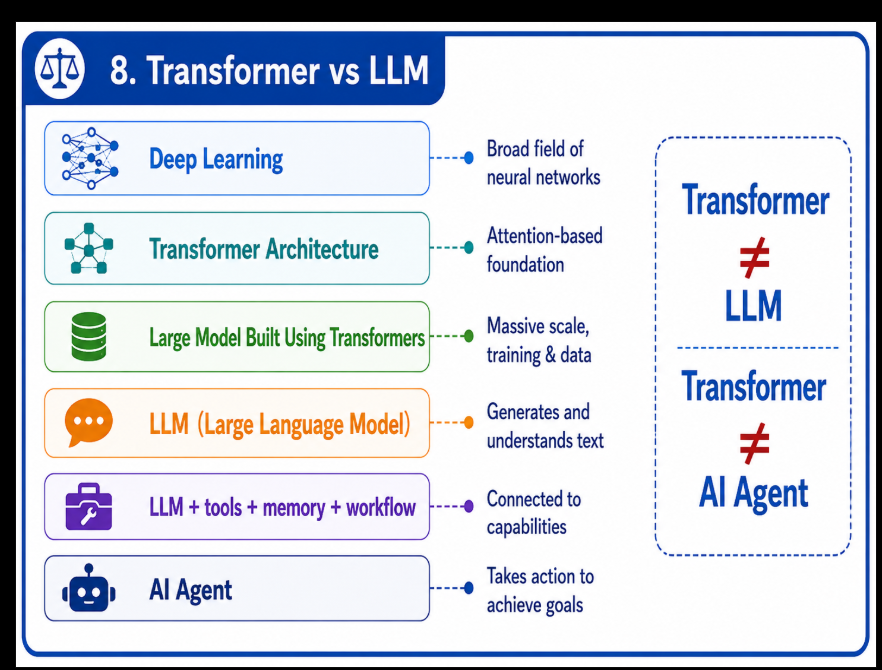
Transformer vs LLM
Transformer vs LLM vs AI Agent
One complete example
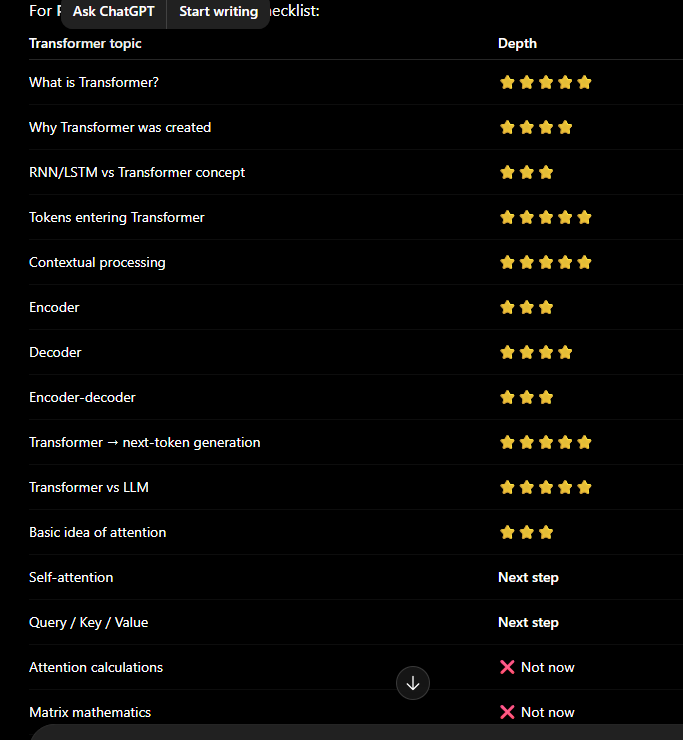
What you SHOULD learn in Transformer theory
What should you NOT learn now?
What should you be able to explain after Step 1?
Concepts Covered
Learn them in this order:
Minimum background
      ↓
Neural Network
      ↓
Deep Learning
      ↓
Transformer
      ↓
Attention
      ↓
Tokens / Tokenization
      ↓
Embeddings
      ↓
LLM
Your actual Project 0 focus is
:
1. Transformer
      ↓
2. Attention
      ↓
3. Tokens / Tokenization
      ↓
4. Embeddings
This is exactly the sequence defined in your roadmap.
Recommended learning ratio
Work    Percentage
Theory  30%
Experiments / practical 50%
Debugging + comparison + explaining 20%
Do not try to become an ML researcher here. Your goal is to understand LLM behavior well enough to build Agentic AI applications.
Step 1 — Transformer
For Step 1, concentrate on only these six questions:
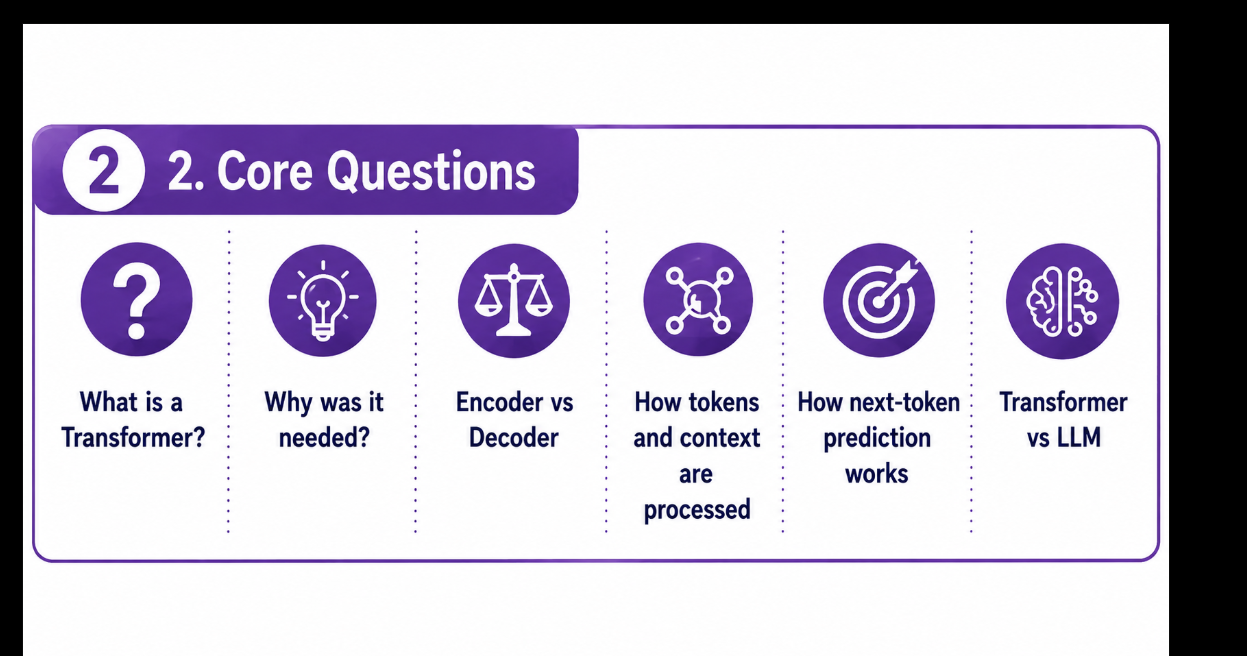
What is a Transformer?
Why was the Transformer needed?
Why did Transformers improve on older sequence architectures?
What are Encoder and Decoder?
How does a Transformer process tokens and context?
What is the relationship between a Transformer and an LLM?
These are also the exact high-level Transformer topics recommended in the roadmap.
1. What is a Transformer?
A Transformer is a deep-learning architecture designed to process sequences of information, such as text, while learning relationships between different parts of that sequence.
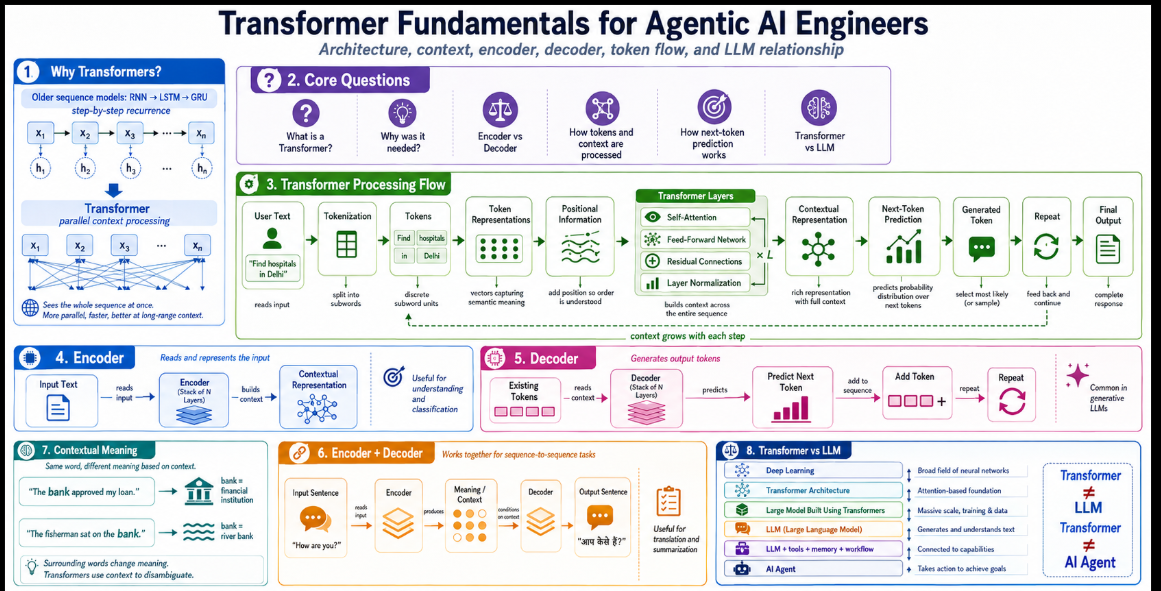
Simple mental model:
Sentence
   ↓
Break sentence into tokens
   ↓
Transformer
   ↓
Look at relationships between tokens
   ↓
Understand context
   ↓
Produce useful representation
   ↓
Predict/generate output
The original Transformer architecture was introduced in the 2017 paper “Attention Is All You Need.” It replaced recurrence with an architecture built around attention mechanisms, which also made computation more parallelizable than common recurrent approaches of the time.
Very simple definition
Transformer = an architecture that lets an AI model understand relationships between tokens in context.
Don't confuse:
Transformer ≠ ChatGPT
Transformer ≠ LLM
Transformer ≠ AI Agent
Instead:
Deep Learning
     ↓
Transformer architecture
     ↓
Large model built using Transformers
     ↓
LLM
     ↓
LLM + tools + memory + workflow
     ↓
AI Agent
Why was the Transformer needed?
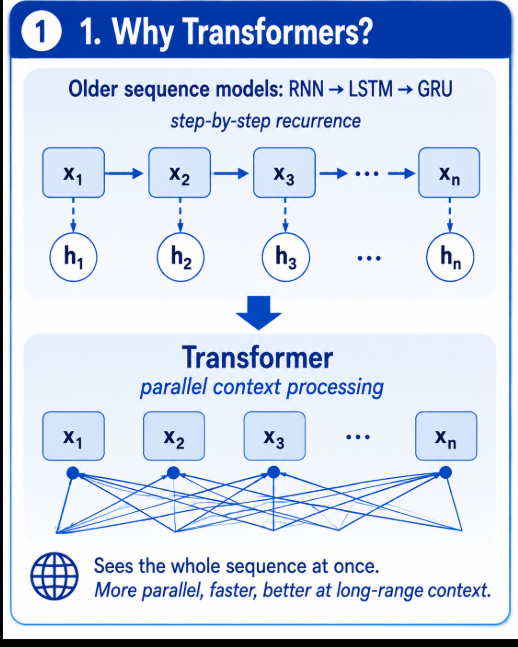
Before Transformers, sequence models commonly relied on architectures such as:
RNN
 ↓
LSTM
 ↓
GRU
These process sequential information using recurrence.
Imagine:
"Ashwani is a developer and he builds AI applications."
An older recurrent-style mental model is roughly:
Ashwani
   ↓
is
   ↓
a
   ↓
developer
   ↓
and
   ↓
he
   ↓
builds...
Information moves through the sequence step by step.
Transformers changed the approach by using attention to directly model relationships between positions in a sequence, while avoiding recurrence. The original paper emphasized that this design offered substantially greater parallelization during training.
Simplified Transformer view:
Ashwani ─────────────→ he
   │
   └───────────────→ developer


developer ──────────→ builds
AI ─────────────────→ applications
The important idea is:
Tokens can use information from other relevant tokens to build contextual representations.
You'll understand exactly how that happens in Step 2: Attention.
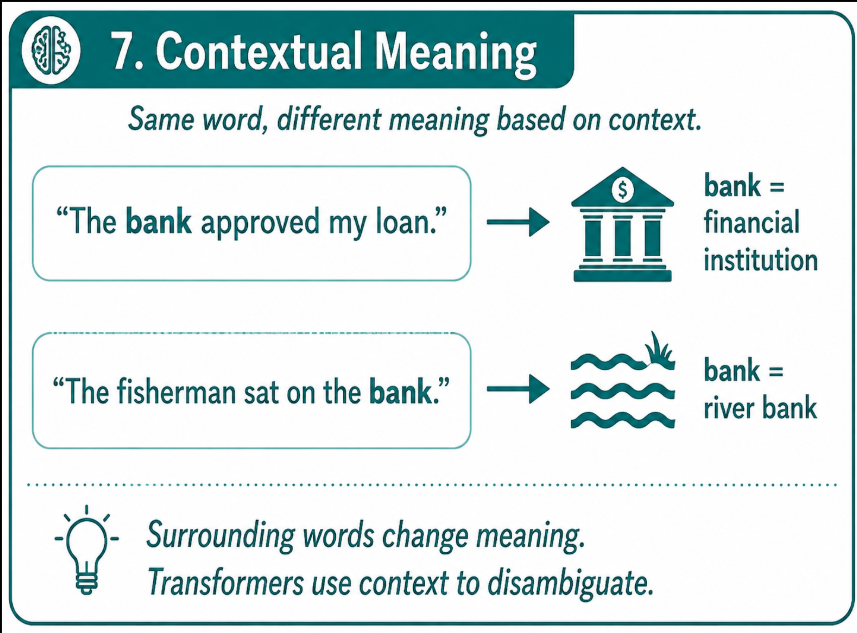
Transformer does not simply understand words independently
Consider:
The bank approved my loan.
and:
The fisherman sat on the bank.
Same word:
bank
but different meanings.
The surrounding context matters:
bank + loan
       ↓
financial institution
versus:
bank + fisherman
       ↓
river bank
A Transformer produces contextual representations in which a token's representation can depend on surrounding tokens.
This is one of the most important ideas you need before learning attention.
Encoder vs Decoder
At this stage, don't study their internal mathematics.
Understand their jobs.
Encoder
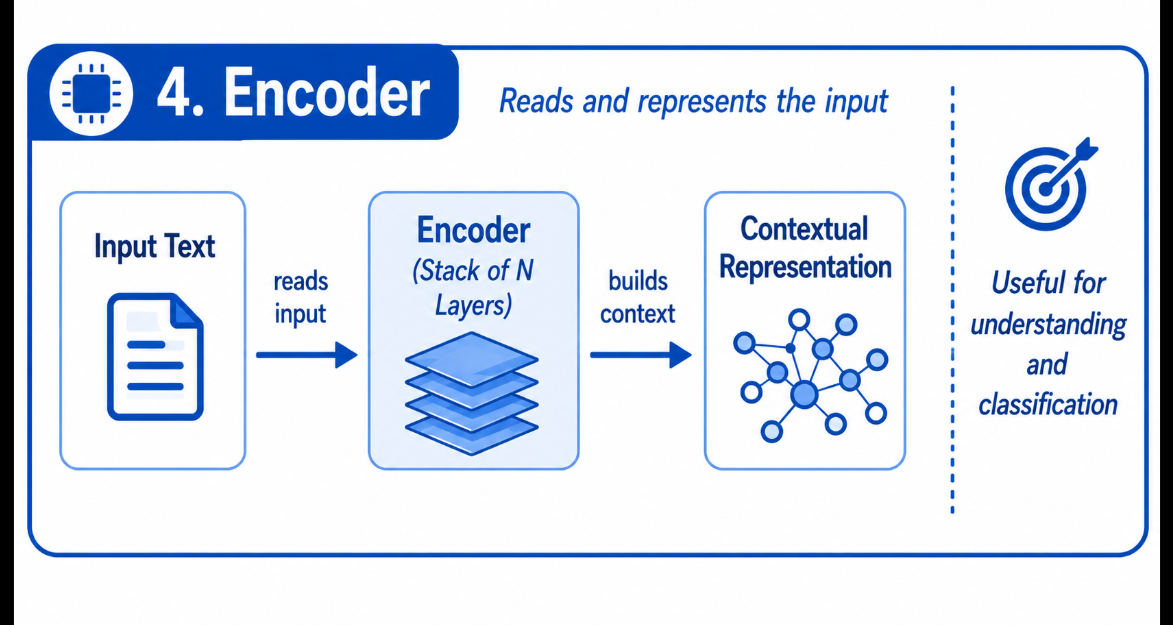
Think:
Encoder = reads/represents the input.
Example:
Input:
"The hospital provides cardiac surgery."


             ↓


           Encoder


             ↓


Contextual representation
of the input
Encoder-oriented architectures are especially useful for understanding/classification-style tasks.
For example:
Text
 ↓
Encoder
 ↓
Classification
Positive / Negative
Hugging Face's official LLM course categorizes Transformer models into encoder-only, decoder-only, and encoder-decoder architectures.
Decoder
Think:
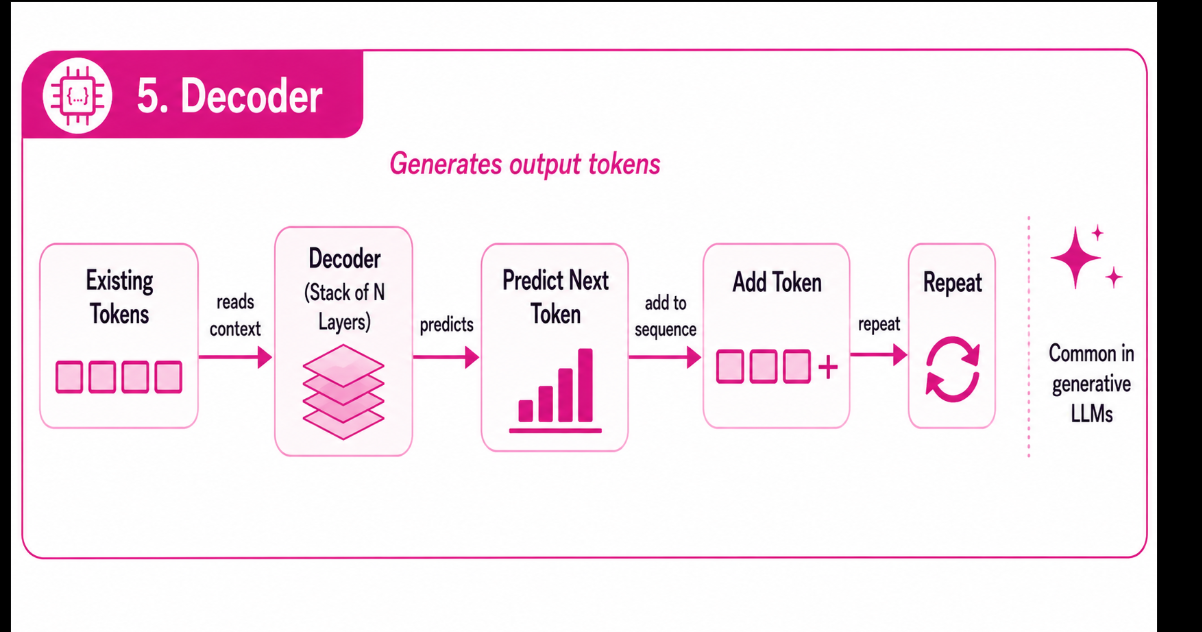
Decoder = generates output tokens.
Example:
Prompt:
"Artificial intelligence is"


             ↓


          Decoder


             ↓


Next token:
"transforming"


             ↓


Next token:
"software"


             ↓
This is particularly important for generative LLMs.
Simplified:
Existing tokens
      ↓
Transformer Decoder
      ↓
Predict next token
      ↓
Add predicted token
      ↓
Repeat
Decoder-only Transformer models are widely used for text-generation tasks.
Encoder + Decoder
The original Transformer had both.
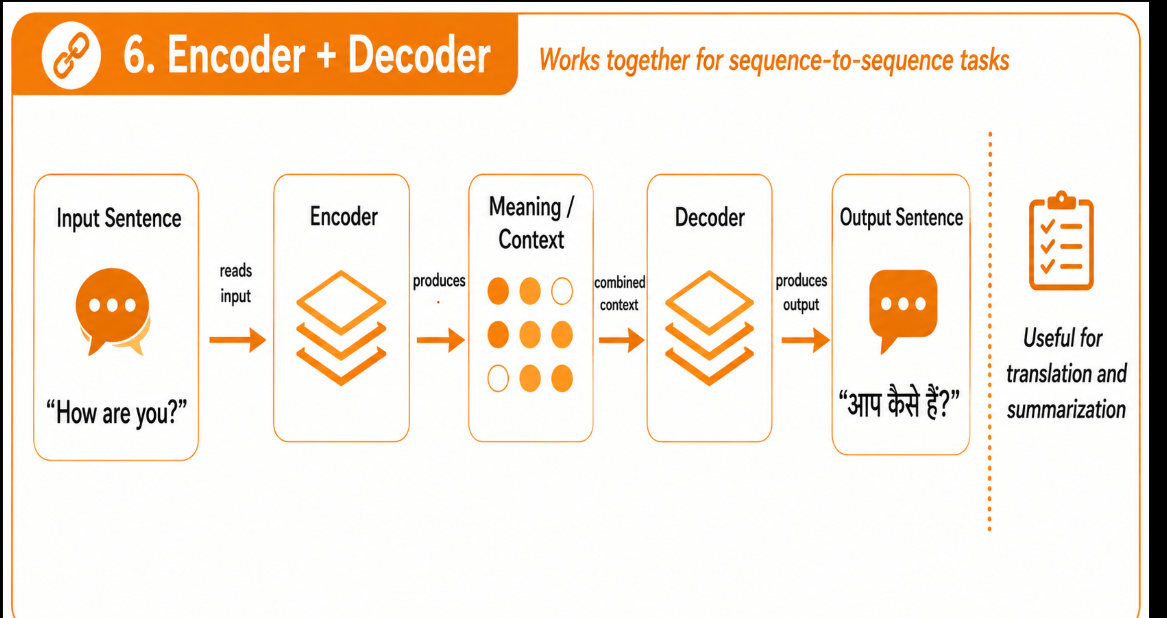
Mental model:
Input sentence
      ↓
    Encoder
      ↓
Input representation
      ↓
    Decoder
      ↓
Output sentence
Example:
English:


"How are you?"


      ↓
Encoder
      ↓
Meaning/context
      ↓
Decoder
      ↓


Hindi:
"आप कैसे हैं?"
Encoder-decoder architectures remain suitable for sequence-to-sequence tasks such as translation and summarization.
For your current Agentic AI roadmap, knowing this distinction conceptually is enough.
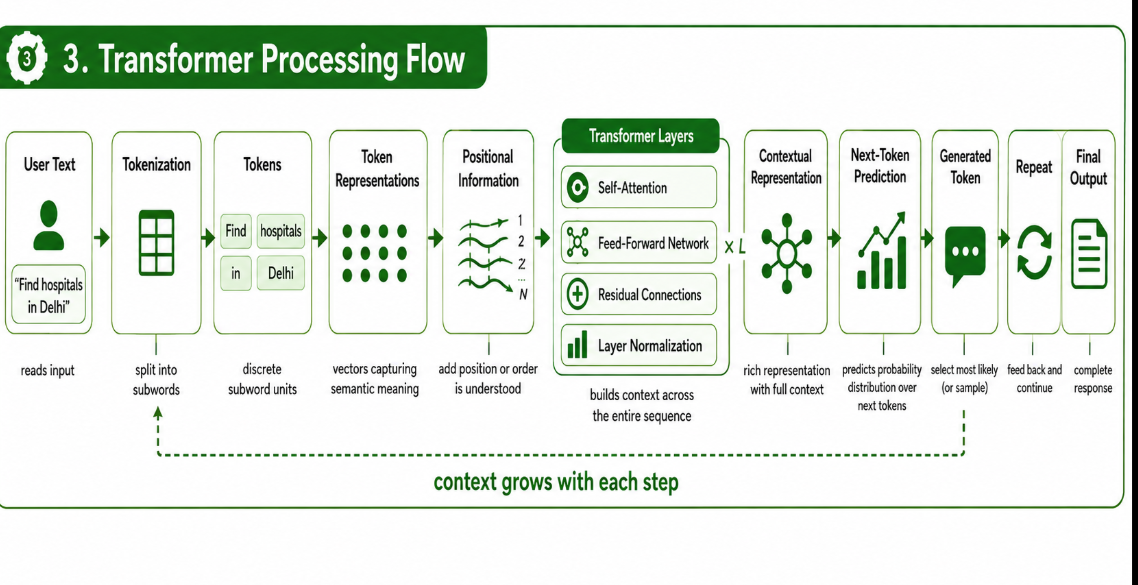
How does a Transformer process text?
This is the most important flow to remember.
Suppose the user writes:
"Find hospitals in Delhi"
Conceptually:
User Text
"Find hospitals in Delhi"


        ↓


Tokenization


        ↓


Tokens


"Find"
"hospitals"
"in"
"Delhi"


        ↓


Token representations


        ↓


Transformer layers


        ↓


Attention / contextual processing


        ↓


Contextual representation


        ↓


Next-token prediction


        ↓


Generated token


        ↓


Repeat


        ↓


Final response
Your blog summarizes the essential flow as:
Text
 ↓
Tokens
 ↓
Transformer
 ↓
Contextual representation
 ↓
Next-token prediction
 ↓
Output
This diagram is worth memorizing.
What does “contextual representation” mean?
This term initially sounds difficult, but the concept is simple.
Take:
Apple released a new phone.
The token:
Apple
starts as a token representation.
After contextual processing, the model can represent it in relation to:
released
new
phone
So the representation becomes more like:
Apple
+
information from surrounding relevant tokens
=
Apple-the-company in this context
Compare:
I ate an apple after lunch.
Now surrounding tokens include:
ate
after
lunch
So:
apple
+
different context
=
fruit
That is the intuition behind contextual representation.
Why can Transformers understand context?
This brings us directly to the next concept:
Attention
The simple mental model is:
Current token
       ↓
Looks at relevant surrounding tokens
       ↓
Determines which ones matter
       ↓
Combines useful information
       ↓
Gets contextual meaning
Example:
"The animal didn't cross the street because it was tired."
To interpret:
it
the model needs information from other parts of the sentence, especially:
animal
Your blog deliberately separates this into Step 2 — Attention, including self-attention, Query/Key/Value at a high level, attention weights, and context dependence.
So don't go deep into attention yet.
For Step 1 just remember:
Transformer is the architecture; attention is one of its central mechanisms for contextual processing.
Transformer vs Attention
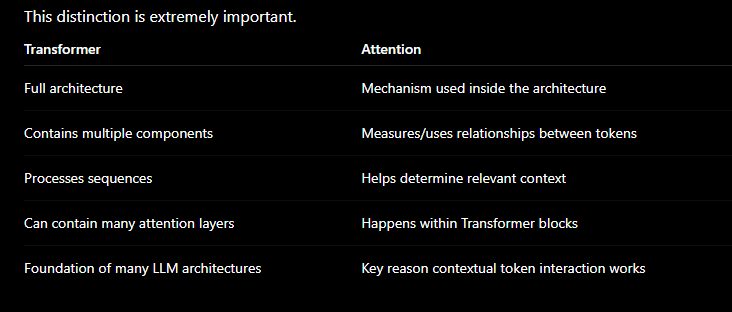
Mental model:
Transformer
│
├── Attention
│
├── Feed-forward network
│
├── Normalization
│
├── Residual connections
│
└── Position information
Do not think:
Transformer = Attention
Instead:
Attention
   ↓
important mechanism within
   ↓
Transformer
The original Transformer uses attention extensively, but Transformer blocks also contain other components such as position-wise feed-forward networks.
Transformer vs LLM
This is probably the single most important distinction for your roadmap.
Transformer

An architecture.

Think:

Blueprint
LLM
A large language model built/trained using a model architecture, with modern generative LLMs commonly based on Transformer variants.

Think:

Actual trained system
Mental analogy:
Transformer = Architecture/design
LLM = Large trained model built from that architecture
Or software analogy:
Architecture pattern
       ↓
Implementation
       ↓
Large application

For your learning flow:

Transformer
      ↓
Attention
      ↓
Tokens
      ↓
Embeddings
      ↓
LLM behavior
Transformer vs LLM vs AI Agent
Since your final objective is Agentic AI, keep this hierarchy clear from Day 1.
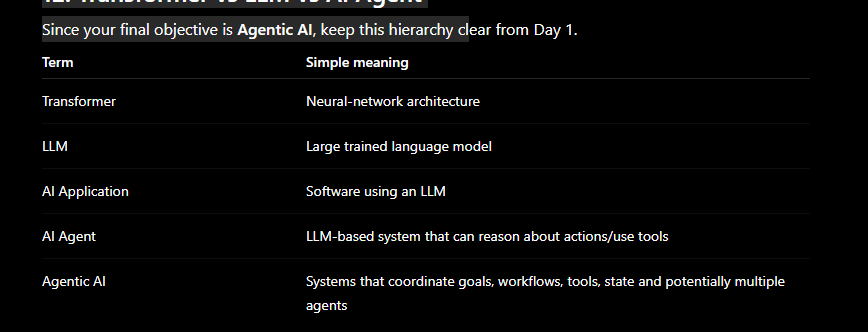
Conceptually:
Transformer
     ↓
LLM
     ↓
Prompt + LLM API
     ↓
LLM Application
     ↓
LLM + Tools
     ↓
AI Agent
     ↓
Tools + State + Memory + Planning + Workflow
     ↓
Agentic AI System
One complete example
Suppose later you build:
Hospital Booking Agent
User asks:
"Find a cardiologist in Delhi available tomorrow."
At the very bottom:
User sentence
      ↓
Tokens
      ↓
Transformer processing
      ↓
Contextual token representations
      ↓
LLM generates/decides output
Then your application layer might add:
LLM
 ↓
Recognize that hospital search is needed
 ↓
Call hospital_search()
 ↓
API
 ↓
Hospital data
 ↓
LLM
 ↓
Answer user
Later:
LLM
+
Tools
+
Memory
+
State
+
Workflow
+
Guardrails
       ↓
Agentic AI
Therefore:
Understanding Transformers does not mean you need to implement Transformers. You need enough knowledge to understand what the LLM sitting inside your agent is doing.
What you SHOULD learn in Transformer theory
What should you NOT learn now?
Your roadmap explicitly says not to begin with:
❌ Detailed matrix mathematics
❌ Gradient derivations
❌ Backpropagation equations
❌ Transformer training from scratch
❌ GPU optimization
❌ PyTorch Transformer implementation
I agree with that scope for your goal.
You are learning to become an:
Agentic AI Engineer
not initially a:
Transformer researcher
So don't spend two weeks deriving:
Q × Kᵀ
softmax
gradient calculations
matrix multiplication
You will learn Q/K/V conceptually in Step 2, but calculations are unnecessary at this stage.
- Transformer — one-page mental model
Memorize this:
        USER TEXT
            │
            ↓
      TOKENIZATION
            │
            ↓
          TOKENS
            │
            ↓
    TOKEN REPRESENTATIONS
            │
            ↓
    ┌─────────────────┐
    │   TRANSFORMER   │
    │                 │
    │   Attention     │
    │      +          │
    │ Contextual      │
    │ Processing      │
    └─────────────────┘
            │
            ↓
 CONTEXTUAL REPRESENTATION
            │
            ↓
   NEXT TOKEN PREDICTION
            │
            ↓
    GENERATED TOKEN
            │
            └───────────┐
                        │
                        ↓
                     Repeat
                        │
                        ↓
                 FINAL RESPONSE
- Step 1 practical experiment
Because Project 0 should be experiment-heavy, don't only read theory.
Use a simple LLM and test these sentences:
Experiment A
The bank approved my loan.
Ask:
What does "bank" mean here?
What words helped you determine the meaning?
Then:
The fisherman sat on the bank.
Ask the same questions.
Expected understanding:
Same token
+
different surrounding context
↓
different contextual meaning
Experiment B
Try:
John told David that he had been selected.
Ask:
Who might "he" refer to?
Why is the sentence ambiguous?
This teaches you that:
Transformer
≠
perfect human understanding
Context can itself be ambiguous.
This will become important later when you learn:
Hallucination
Prompt Engineering
RAG
Agents
Evaluation
What should you be able to explain after Step 1?
Don't move to Attention until you can answer these without notes:
What is a Transformer?
Why were Transformers important compared with recurrent sequence models?
What is an Encoder?
What is a Decoder?
What is an encoder-decoder Transformer?
How does text reach a Transformer?
What are contextual representations?
Why does context change the meaning of a token?
What is next-token prediction?
What is the difference between Transformer and LLM?
What is the difference between Transformer and Attention?
Why don't Agentic AI developers normally implement Transformers from scratch?
If you can explain those in simple words, Step 1 is complete.
PROMPT
read and anlayze blog https://www.debug.school/rakeshdevcotocus_468/roadmap-to-become-an-expert-agentic-ai-engineer-skills-frameworks-tools-and-learning-path-1k4k i would like to start from New Project 0 — LLM Foundations Experiment Lab this topic pls answer me Concepts covered ,What theory should you learn? Step 1 — Transformer



Top comments (0)