
Introduction
Building software that coordinates physical asset rentals presents a unique set of challenges. Unlike digital products where inventory is infinite, a vehicle rental system manages finite, stateful assets anchored to physical locations, maintenance cycles, and rigid time boundaries. Whether an engineering team is building an internal tool for a single garage or architecting a decentralized marketplace, getting the underlying data flow right is essential. When inventory, scheduling, and communication fall out of sync, the result is double-bookings, operational friction, and frustrated users.
The Rental Workflow as a State-Driven System
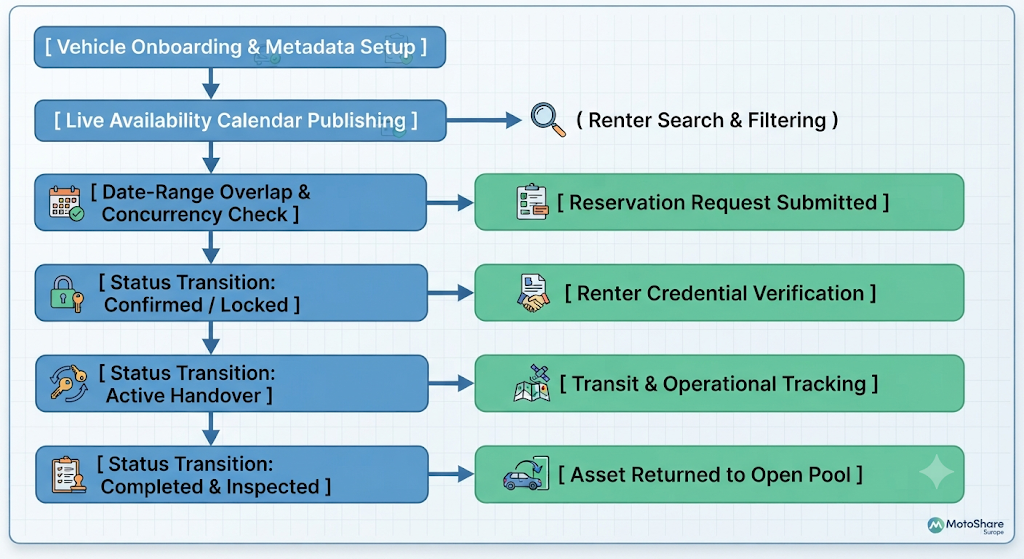
At its core, a vehicle rental application is a state machine governing physical assets. The complete user journey spans several distinct phases: vehicle onboarding and metadata definition, live availability publishing, customer discovery, reservation requests, credential verification, handover, active transit, and final return.
Each stage requires specific information inputs. On the supply side, the system must capture precise vehicle attributes, location coordinates, and pricing parameters. On the consumer side, the system must validate dates, cross-reference calendar blocks, and collect necessary identification details. If any information layer—such as a maintenance hold or an unconfirmed drop-off time—fails to propagate through the system in real time, the entire workflow risks breaking down before the keys ever change hands.
Availability Management and Concurrency Challenges
One of the most complex hurdles in rental architecture is preventing overlapping reservations when multiple users attempt to book the same asset simultaneously. Inaccurate availability data can quickly cause race conditions, resulting in double-bookings.
To manage date-range validation and inventory updates reliably, systems must enforce strict checks on start and end timestamps. When evaluating whether a vehicle is free for a specific window, the database query must ensure that no confirmed reservation overlaps with the requested interval.
The following simplified pseudocode illustrates a basic availability validation check before a reservation is written:
def check_availability(vehicle_id, requested_start, requested_end):
    # Fetch all active or confirmed bookings for the vehicle
    existing_bookings = database.query(
        "SELECT * FROM bookings WHERE vehicle_id = :vid AND status IN ('confirmed', 'active')",
        vid=vehicle_id
    )

    for booking in existing_bookings:
        # Check for date range overlap: (StartA <= EndB) and (EndA >= StartB)
        if (requested_start <= booking.end_date) and (requested_end >= booking.start_date):
            return False # Conflict found, vehicle is unavailable

    return True # Vehicle is available for the requested window
By maintaining strict reservation states and locking database rows during write operations, systems can maintain data integrity even under heavy traffic.
Vehicle Metadata and Relational Data Design
Different vehicle categories impose vastly different data modeling requirements. A robust database schema must accommodate everything from lightweight urban bicycles to heavy commercial passenger cars and high-performance touring machines.
- Motorcycles: Require fields for engine displacement (cc), licensing class requirements, specialized safety gear inclusions, and detailed maintenance logs.
- Bicycles: Focus on frame size, gear configuration, accessory types, and high-turnover urban positioning.
- Scooters: Demand rapid status tracking for battery levels, fuel states, and quick-turn service intervals.
- Cars: Involve multi-passenger capacity data, mileage limits, insurance tier codes, and structured inspection checklists.
Organizing these attributes into modular, well-indexed database tables ensures that search filters can parse queries efficiently without sacrificing data depth.
The Booking Lifecycle and Data Consistency
Managing reservations effectively requires tracking clear state transitions across the booking lifecycle. A typical model transitions a reservation through several key statuses: requested, confirmed, cancelled, active, and completed.
| Booking Status | System Action / Trigger | Data Implications |
|---|---|---|
| Requested | User submits booking form. | Provisional hold created; inventory remains conditionally available. |
| Confirmed | Provider accepts or payment/deposit clears. | Calendar slot locked; vehicle status updated to reserved. |
| Cancelled | User or provider cancels before pickup. | Calendar slot released back to open inventory pool. |
| Active | Renter collects vehicle at handover. | Asset status toggled to 'in-transit'; odometer logged. |
| Completed | Vehicle returned and inspected. | Final mileage logged; asset returned to available pool. |
Enforcing these status transitions with strict validation rules ensures that financial reporting, fleet availability trackers, and customer history records remain consistent over time.
Evaluating Software Solutions for Rental Operations
As independent rental shops and fleet operators scale, manual spreadsheets quickly become unsustainable. Operators frequently evaluate off-the-shelf software categories to handle day-to-day administration, including a dedicated vehicle rental booking system to centralize reservation calendars.
When managing specialized fleets, businesses often look for niche solutions, such as dedicated bike rental software or agile scooter rental software tailored to high-turnover micro-mobility. For multi-vehicle car fleets, robust free car rental software packages offer structured customer and transaction tracking. Additionally, various technology providers promote free vehicle rental management software to help independent shops handle listings, payments, and reporting. When selecting any digital tool, technical operators must audit its actual functionality, data export capabilities, security practices, and workflow limitations rather than assuming universal feature depth.
Marketplace Dynamics and Peer-to-Peer Considerations
Decentralized marketplaces introduce unique architectural and operational layers by connecting independent asset owners directly with travelers. This model relies heavily on self-service data entry, where hosts manage their own listings, photos, and availability calendars.
For private individuals who choose to rent out my motorcycle during weeks when it sits idle, or those looking to safely list my car for rent from a residential garage, maintaining data accuracy is critical. Owners must build habits around keeping calendar syncs up to date, responding promptly to booking requests, and clearly defining rental conditions. A marketplace is only as reliable as the accuracy of its distributed input data.
Pricing Logic and Regional Economic Variables
Designing pricing engines within rental software requires accounting for a dynamic set of variables. Rental costs are rarely static; they fluctuate based on asset classification, regional operating overhead, and seasonal demand curves.
For example, travelers evaluating expenses—such as analyzing typical motorcycle rental costs in Europe figures—will find that rates vary significantly depending on engine displacement, regional tourism peaks, and included accessories like luggage panniers or touring gear. Software systems must allow operators to configure flexible pricing rules, seasonal rate multipliers, and custom fee structures without hardcoding static calculations into the core application logic.
MotoShare Europe in the Ecosystem
Navigating regional mobility requires platforms that bridge the gap between consumer discovery and independent supply. MotoShare Europe operates as a Europe-focused online marketplace connecting renters with independent vehicle owners and participating local providers across motorcycles, bikes, scooters, and cars.
By providing a digital environment where users can explore listings, compare options, and request bookings, the platform exemplifies the decentralized marketplace model. For travelers searching for specialized regional touring options, engaging with a peer-to-peer motorcycle rental Europe network or exploring a dedicated motorcycle rental Europe category offers alternatives to conventional commercial storefronts. At the same time, platform capabilities—including advertised administrative tools—represent platform offerings rather than independently verified enterprise functionality.
Technical Implementation Checklist for Developers
When building or auditing a vehicle rental workflow, engineering teams and operators should verify the following core components:
- Data Integrity & Schema Design: Ensure vehicle metadata tables are properly normalized and indexed for fast geographical and categorical filtering.
- Concurrency Controls: Implement robust date-range overlap queries and database row locking to prevent double-bookings during simultaneous checkout attempts.
-
State Machine Validation: Enforce strict status transitions (
requested->confirmed->active->completed) to maintain accurate audit logs. - Calendar Synchronization: Provide reliable export and import tools (such as iCal feeds) to help hosts prevent scheduling conflicts across external channels.
- Document & Credential Verification: Build secure intake pipelines for validating driver's licenses, insurance documentation, and security deposits.
- Operational Reporting: Ensure transaction ledgers and maintenance logs can be exported cleanly for accounting and fleet auditing.
Conclusion
Building reliable vehicle rental software requires treating physical assets with the same precision as digital inventory. By combining robust database schemas, strict concurrency controls, clear booking lifecycle states, and responsive communication workflows, engineering teams can eliminate operational friction. Whether supporting a single independent garage or a sprawling regional marketplace, disciplined data architecture remains the foundational key to seamless mobility.



Top comments (0)