
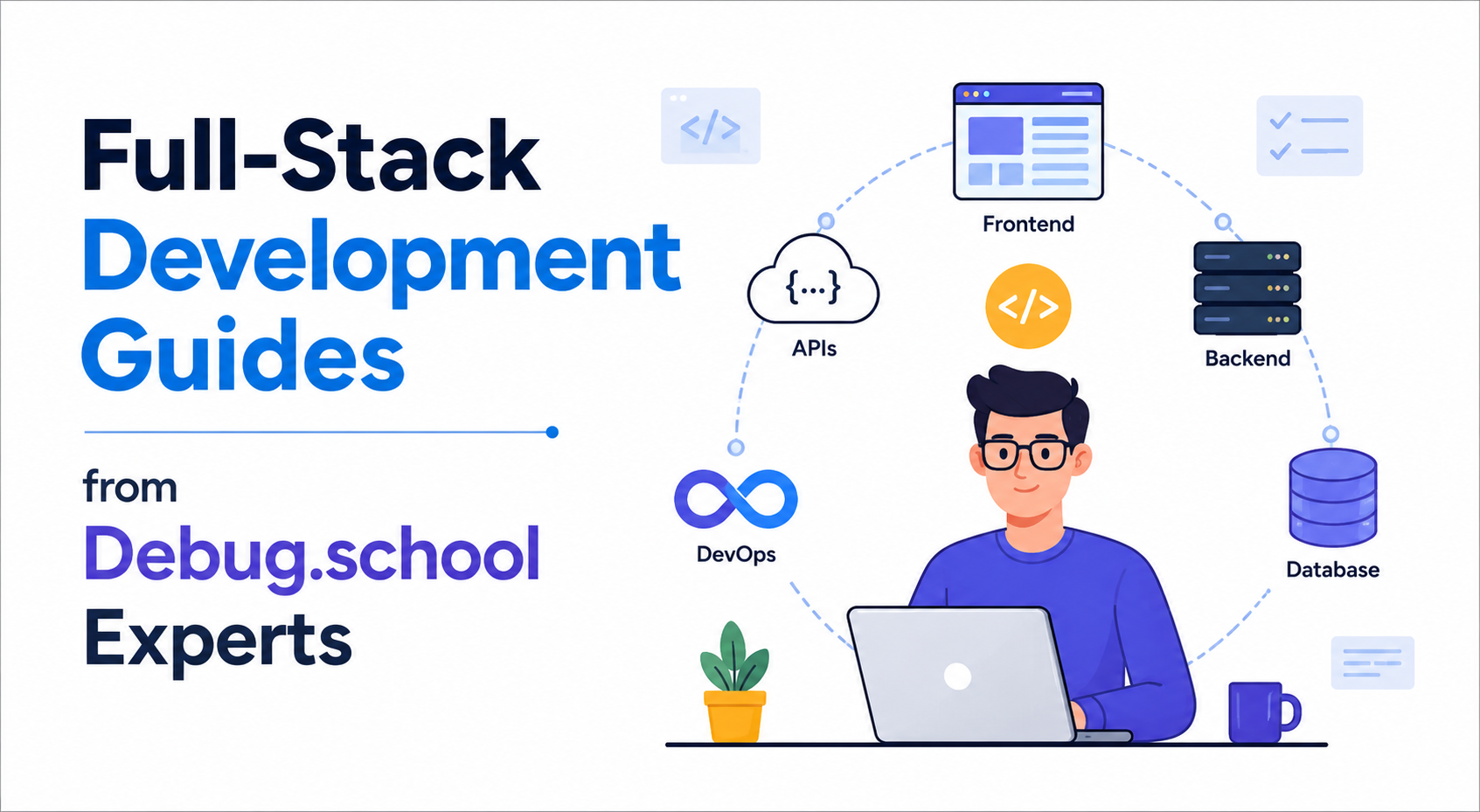
Modern software applications require much more than basic coding knowledge. Today, organizations need professionals who can build complete applications that handle user interfaces, business logic, databases, APIs, security, deployment, and maintenance. This demand has made full-stack development one of the most valuable skills in the technology industry. A full-stack developer understands how different layers of an application work together and can contribute across the entire development lifecycle.
Learning full-stack development can seem overwhelming because it combines multiple technologies, frameworks, and operational practices. However, with the right guidance, structured learning, and practical experience, developers can build strong expertise and create high-quality applications. Experts from Debug.school emphasize that successful full-stack development is not only about writing code. It also involves understanding architecture, collaboration, deployment processes, scalability, security, and operational excellence. This comprehensive guide explores the essential concepts, practices, challenges, and career pathways that every aspiring and experienced full-stack developer should understand.
Key Operational Concepts You Must Know
Full-stack development extends beyond creating web pages and connecting databases. Developers must understand operational concepts that ensure applications run reliably in real-world environments. These concepts help teams deliver stable software while reducing downtime and improving user satisfaction. When developers understand operational principles early, they create systems that are easier to maintain, troubleshoot, and scale.
One of the most important concepts is application architecture. Architecture defines how different components interact within a system. Frontend interfaces communicate with backend services, which in turn access databases and external resources. A well-designed architecture reduces complexity and improves maintainability. Developers who understand architecture make better design decisions because they can anticipate future growth and operational challenges.
Another critical concept is scalability. Applications often start with a small user base, but successful products attract increasing traffic. Scalability ensures systems can handle growing workloads without performance degradation. Developers must learn techniques such as load balancing, caching, database optimization, and distributed computing. These approaches help maintain consistent performance as demand increases.
Reliability also plays a major role in operational success. Users expect applications to function consistently without interruptions. Reliability involves monitoring system health, managing failures, implementing redundancy, and creating recovery mechanisms. Developers who understand reliability principles can build systems that continue operating even when unexpected issues occur.
Security represents another operational pillar. Every application handles valuable information, making security a critical responsibility. Full-stack developers must understand authentication, authorization, encryption, secure coding practices, and vulnerability management. Strong security practices protect users while reducing organizational risk.
Performance optimization is equally important. Users quickly abandon slow applications, making speed a competitive advantage. Developers need skills in frontend optimization, backend efficiency, database tuning, and network performance improvements. Small performance enhancements can significantly improve user experience and operational efficiency.
Observability has become increasingly valuable in modern software environments. Observability includes monitoring, logging, and tracing capabilities that help teams understand system behavior. When issues occur, observability tools provide visibility into application performance and enable faster troubleshooting. Full-stack professionals who understand observability contribute to smoother operations and improved reliability.
Automation is another foundational concept. Manual processes often introduce delays and errors. Automation streamlines development, testing, deployment, and infrastructure management. Teams that automate repetitive tasks can focus more on innovation and less on routine maintenance. This improves both productivity and operational consistency.
Finally, developers must understand collaboration. Modern applications require contributions from multiple teams, including developers, testers, security professionals, operations engineers, and business stakeholders. Effective communication and teamwork ensure smooth project execution and successful software delivery.
Platform Implementation vs. Culture — What's the Real Difference?
Many organizations invest heavily in platforms, tools, and technologies to improve development efficiency. While these investments are important, technical platforms alone do not guarantee success. Organizational culture often determines whether teams fully realize the benefits of their technology investments. Understanding the distinction between platform implementation and culture helps developers appreciate the broader factors that influence project outcomes.
Platform implementation focuses on technology. Organizations deploy frameworks, development environments, cloud services, monitoring systems, version control platforms, and automation tools. These resources provide the technical foundation required for building and managing software. Well-designed platforms simplify development workflows and improve operational consistency.
However, technology alone cannot solve communication problems, collaboration challenges, or organizational resistance. This is where culture becomes critical. Culture influences how teams share knowledge, respond to feedback, approach problem-solving, and support continuous improvement. A positive culture encourages learning, experimentation, and innovation.
For example, an organization may provide advanced deployment tools that enable rapid software releases. Yet if team members fear making mistakes or receiving criticism, they may avoid frequent deployments. In this situation, the platform exists, but the culture prevents effective utilization. Conversely, a collaborative culture can often overcome technical limitations through creativity and teamwork.
Culture also impacts knowledge sharing. Full-stack development involves many disciplines, including frontend engineering, backend systems, databases, security, and infrastructure. Developers who freely exchange ideas learn faster and solve problems more effectively. Organizations that encourage collaboration often achieve higher productivity and better software quality.
Another distinction involves ownership. Platform implementation provides technical capabilities, while culture determines accountability. Teams with strong ownership take responsibility for application quality, performance, and user satisfaction. They proactively address issues and continuously seek improvements. Ownership creates a sense of commitment that technology alone cannot deliver.
Continuous learning represents another cultural factor. Technology evolves rapidly, making ongoing education essential. Organizations that promote learning help developers stay current with emerging tools, frameworks, and practices. This adaptability supports long-term operational success.
Trust is equally important. High-performing teams trust each other's expertise and intentions. Trust enables faster decision-making, more effective collaboration, and greater innovation. Without trust, even the best platforms may fail to deliver expected results.
Ultimately, successful full-stack development requires both strong platforms and supportive culture. Technology provides the necessary capabilities, while culture determines how effectively teams use those capabilities. Organizations that balance these elements create environments where developers can thrive and deliver exceptional software solutions.
Real-World Use Cases of Modern Operations
Modern operations practices influence nearly every digital service people use daily. Full-stack developers benefit from understanding how operational principles support real-world applications across various industries. These examples demonstrate why operational excellence matters and how it contributes to business success.
E-commerce platforms provide a strong example. Online stores must handle fluctuating traffic, especially during promotional events and holiday shopping periods. Operational practices such as load balancing, auto-scaling, monitoring, and database optimization ensure smooth customer experiences. Full-stack developers contribute by creating efficient application architectures that support high transaction volumes.
Financial services organizations rely heavily on operational excellence. Banking applications process sensitive transactions and personal information. Security, reliability, and compliance requirements are extremely strict. Developers implement secure authentication systems, encrypted communications, and robust monitoring capabilities to protect users and maintain trust.
Healthcare systems represent another important use case. Medical applications manage critical patient information and support healthcare professionals in delivering care. Operational reliability becomes essential because service disruptions can affect patient outcomes. Developers build resilient systems that prioritize availability, security, and data integrity.
Educational technology platforms have experienced significant growth. Online learning environments support millions of students and educators worldwide. These systems require scalable infrastructure, reliable content delivery, and strong performance optimization. Full-stack professionals play a key role in ensuring these platforms remain accessible and responsive.
Social media applications demonstrate the importance of scalability and performance. Users expect instant interactions, real-time notifications, and seamless content delivery. Operational teams implement distributed architectures, caching strategies, and monitoring systems to maintain user satisfaction. Developers contribute by optimizing application code and designing efficient data models.
Software-as-a-Service platforms also highlight operational excellence. These businesses depend on consistent availability and customer satisfaction. Downtime directly impacts revenue and reputation. Developers build applications with resilience, observability, and automation in mind, enabling reliable service delivery.
Manufacturing organizations increasingly use digital systems for production monitoring, inventory management, and supply chain coordination. Operational reliability ensures these systems support efficient business operations. Developers create integrated solutions that connect multiple systems while maintaining performance and security.
Transportation and logistics companies rely on real-time tracking, route optimization, and communication systems. Operational practices ensure these applications remain available and accurate. Full-stack developers design systems capable of processing large volumes of data while supporting real-time decision-making.
These examples demonstrate that operational excellence directly impacts business outcomes. Developers who understand operational principles create applications that perform effectively under real-world conditions and support organizational goals.
Common Mistakes in Operations Engineering
Operations engineering involves many moving parts, and mistakes can lead to performance issues, security vulnerabilities, and service disruptions. Understanding common pitfalls helps developers avoid costly problems and build more reliable systems.
One frequent mistake is ignoring monitoring until problems occur. Some teams focus exclusively on feature development and postpone observability implementation. Without proper monitoring, identifying issues becomes difficult and time-consuming. Developers should integrate monitoring, logging, and alerting from the beginning of a project.
Another common mistake involves inadequate documentation. Complex systems require clear documentation to support maintenance, troubleshooting, and onboarding. Poor documentation increases dependency on individual team members and slows operational response during incidents. Comprehensive documentation improves efficiency and knowledge sharing.
Security neglect remains a significant challenge. Some developers treat security as a final step rather than an ongoing responsibility. This approach often results in vulnerabilities that could have been prevented through secure design practices. Security considerations should be integrated throughout the development lifecycle.
Overcomplicating architecture also creates problems. Developers sometimes introduce unnecessary complexity in pursuit of flexibility or scalability. While advanced architectures may offer benefits, excessive complexity increases maintenance requirements and operational risk. Simplicity often leads to more reliable systems.
Insufficient testing represents another major issue. Applications require thorough testing across multiple scenarios, including functionality, performance, security, and failure conditions. Limited testing increases the likelihood of production incidents. Developers should implement comprehensive testing strategies that validate application behavior under various circumstances.
Failure to plan for scalability can create future challenges. Applications that perform well with small user bases may struggle as demand grows. Developers should consider scalability requirements early and design systems capable of accommodating growth.
Poor incident response preparation also affects operational effectiveness. Teams sometimes assume problems will not occur, resulting in inadequate response procedures. Clear incident management processes enable faster resolution and minimize business impact when issues arise.
Lack of automation remains a common operational weakness. Manual processes increase the risk of errors and slow software delivery. Developers should automate repetitive tasks whenever possible to improve consistency and efficiency.
Communication failures can undermine technical excellence. Operations often involve multiple teams working together under pressure. Clear communication practices help coordinate efforts, reduce misunderstandings, and improve outcomes during critical situations.
Learning from these mistakes helps developers strengthen their operational capabilities and contribute more effectively to successful software delivery.
How to Become an Operations Expert — Career Roadmap
Building expertise in operations requires a combination of technical knowledge, practical experience, and continuous learning. While the journey varies for each individual, a structured roadmap can help aspiring professionals develop the skills needed for long-term success.
The first step involves building strong technical foundations. Developers should understand programming fundamentals, databases, networking concepts, operating systems, and web technologies. These core skills provide the knowledge required to understand how applications function within larger environments.
Next, aspiring professionals should gain hands-on experience with full-stack development. Building real applications helps developers understand frontend interfaces, backend services, APIs, databases, and deployment processes. Practical experience reinforces theoretical knowledge and develops problem-solving abilities.
Cloud computing knowledge has become increasingly important. Modern applications frequently operate on cloud platforms that provide scalable infrastructure and managed services. Developers should understand cloud architecture, resource management, and deployment strategies.
Automation skills represent another critical milestone. Professionals should learn tools and practices that streamline development and operational workflows. Automation improves efficiency while reducing manual effort and operational risk.
Observability expertise also plays an important role. Understanding monitoring, logging, tracing, and alerting enables developers to maintain application reliability and troubleshoot issues effectively. These skills become increasingly valuable as systems grow in complexity.
Security knowledge is essential throughout the career journey. Developers should learn secure coding practices, identity management, vulnerability assessment, and risk mitigation strategies. Security awareness strengthens overall operational effectiveness.
Communication and leadership skills become increasingly important as professionals advance. Technical expertise alone may not be sufficient for senior roles. Effective communication supports collaboration, mentoring, and decision-making across teams.
Recommended learning progression:
| Career Stage | Primary Focus |
|---|---|
| Beginner | Programming, databases, web development |
| Junior Developer | Full-stack projects, APIs, testing |
| Mid-Level Developer | Cloud platforms, automation, monitoring |
| Senior Developer | Architecture, scalability, security |
| Operations Specialist | Reliability, observability, optimization |
| Technical Leader | Strategy, mentoring, organizational improvement |
Additional practices that accelerate growth include:
- Building personal projects
- Contributing to collaborative development efforts
- Studying system design concepts
- Learning deployment automation techniques
- Practicing troubleshooting scenarios
- Exploring performance optimization methods
- Developing security awareness
- Participating in technical communities
Continuous learning remains the most important factor. Technology evolves rapidly, and successful professionals consistently expand their knowledge while adapting to new challenges.
FAQ Section
What is full-stack development?
Full-stack development involves building both frontend and backend components of an application, including user interfaces, servers, databases, APIs, and deployment processes.
Why are operational skills important for full-stack developers?
Operational skills help developers create reliable, secure, scalable, and maintainable applications that perform effectively in production environments.
Which programming languages should a full-stack developer learn?
Developers commonly learn JavaScript, TypeScript, Python, Java, PHP, or C#. The best choice depends on project requirements and career goals.
How important is cloud computing knowledge?
Cloud computing knowledge is highly valuable because many modern applications operate on cloud infrastructure that supports scalability and operational efficiency.
What role does automation play in modern development?
Automation reduces manual effort, improves consistency, accelerates delivery, and minimizes operational errors throughout the software lifecycle.
Is security part of full-stack development?
Yes. Security is a core responsibility that includes authentication, authorization, encryption, secure coding, and vulnerability management.
How can beginners gain practical experience?
Beginners can build personal projects, contribute to collaborative initiatives, participate in coding challenges, and create portfolio applications.
What are the biggest challenges in operations engineering?
Common challenges include scalability management, incident response, security maintenance, performance optimization, and coordinating complex systems.
Do full-stack developers need monitoring knowledge?
Yes. Monitoring helps developers understand application behavior, identify issues, and maintain reliability in production environments.
Can full-stack development lead to leadership roles?
Yes. Experienced professionals often advance into architecture, engineering management, technical leadership, and operational strategy positions.
Final Summary
Full-stack development combines technical versatility with operational awareness, making it one of the most valuable skill sets in modern technology environments. While coding remains an essential component, successful developers also understand architecture, scalability, reliability, security, performance optimization, observability, and automation. These operational concepts enable teams to deliver software that performs effectively under real-world conditions.
Organizations achieve the greatest success when they balance strong technical platforms with supportive cultures that encourage collaboration, learning, ownership, and continuous improvement. Real-world applications across industries demonstrate the importance of operational excellence in maintaining reliability, protecting users, and supporting business growth.
Developers who avoid common operational mistakes, invest in continuous learning, and build practical experience can progress from beginner roles to advanced technical leadership positions. By combining full-stack expertise with operational knowledge, professionals create solutions that deliver lasting value while supporting long-term organizational success.



Top comments (0)