
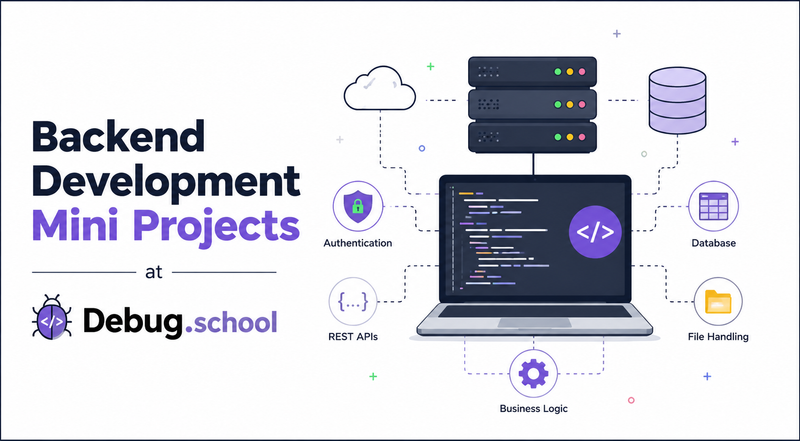
Backend development forms the foundation of every modern application. While users interact with interfaces on websites and mobile applications, backend systems handle data processing, authentication, business logic, security, storage, and communication between different services. Without a strong backend, even the most attractive frontend cannot function effectively.
For aspiring developers, mini projects provide one of the best ways to learn backend development because they combine theory with practical implementation. Through real project work, learners understand APIs, databases, authentication systems, server management, data validation, and application architecture. Organizations also value candidates who can demonstrate practical project experience rather than only theoretical knowledge.
One platform that focuses on practical technology learning is Debug.school. The platform encourages learners to build hands-on backend development mini projects that strengthen technical skills and prepare them for real-world software engineering challenges. Through project-based learning, developers gain confidence in creating scalable, secure, and maintainable backend systems.
Backend development mini projects help learners understand how professional applications work behind the scenes. Whether creating user authentication systems, inventory management applications, chat platforms, task managers, or REST APIs, each project contributes to a deeper understanding of backend engineering principles. As developers progress through increasingly complex projects, they develop problem-solving abilities that become valuable throughout their careers.
Understanding Backend Development Mini Projects
Backend development mini projects are small-scale applications designed to teach essential server-side programming concepts. These projects focus on the logic that powers applications, including database operations, authentication, authorization, API creation, caching, file handling, and system integration.
Unlike large enterprise systems, mini projects remain manageable for beginners and intermediate developers. They allow learners to focus on specific backend concepts without becoming overwhelmed by complexity. As a result, developers can quickly apply theoretical knowledge while seeing immediate results from their work.
A typical backend mini project may involve creating a user registration system, managing customer information, building a product catalog API, developing a blogging platform backend, or implementing a notification service. Although these projects are smaller in scope, they closely resemble components used in professional software systems.
Moreover, mini projects help developers understand software architecture. They learn how requests travel through applications, how data moves between databases and servers, and how business rules influence application behavior. This practical experience builds confidence and prepares learners for larger development projects.
Why Backend Mini Projects Matter for Learning
Practical implementation accelerates learning because developers encounter real problems and solve them independently. Reading documentation provides theoretical understanding, but building projects develops technical intuition and troubleshooting skills.
Backend mini projects expose developers to common challenges such as database optimization, API design, input validation, error handling, security implementation, and performance improvement. These challenges encourage critical thinking and strengthen problem-solving capabilities.
Furthermore, project work improves coding discipline. Developers learn how to structure applications, organize files, write maintainable code, and document their work. These habits become increasingly important as projects grow in size and complexity.
Employers also appreciate candidates who can demonstrate completed projects. A portfolio containing practical backend applications often carries more weight than theoretical knowledge alone. Therefore, mini projects serve both educational and career-development purposes.
Popular Backend Development Mini Project Ideas
Several mini project categories provide excellent learning opportunities for backend developers.
User Authentication System
Authentication projects teach login functionality, password encryption, user registration, role management, and session handling. Developers learn important security concepts while building systems used in almost every modern application.
Task Management Application
Task management systems introduce CRUD operations, database design, user relationships, and project organization. These projects help developers understand application workflows and business logic implementation.
Blogging Platform Backend
A blogging backend includes content creation, editing, publishing, categorization, and user management. Such projects demonstrate how content-driven applications operate behind the scenes.
Inventory Management System
Inventory applications involve product tracking, stock management, supplier information, and reporting functionality. Developers learn complex data relationships and business process automation.
Chat Application Backend
Messaging systems teach real-time communication, event processing, user interactions, and scalable architecture concepts. These projects introduce advanced backend development techniques.
Key Operational Concepts You Must Know
Operations concepts play a crucial role in backend development because applications must remain reliable, secure, and available after deployment. Building software represents only one part of the process. Maintaining and operating software effectively requires additional operational knowledge.
One important concept is monitoring. Monitoring helps teams track application health, resource utilization, response times, and system availability. Through monitoring, engineers identify issues before users experience significant disruptions. Effective monitoring also supports performance optimization and capacity planning.
Another essential concept is logging. Logs provide detailed records of application activities, errors, user actions, and system events. When issues occur, logs become valuable resources for troubleshooting and root cause analysis. Developers who understand logging can diagnose problems more efficiently and improve application reliability.
Configuration management represents another critical operational practice. Applications often run in multiple environments, including development, testing, staging, and production. Managing configuration settings consistently reduces deployment errors and simplifies maintenance. Understanding operational concepts enables backend developers to build systems that perform reliably under real-world conditions.
Infrastructure Awareness for Backend Developers
Modern backend developers benefit from understanding infrastructure fundamentals. Although infrastructure specialists may manage production environments, backend engineers frequently collaborate with operations teams.
Servers, containers, cloud services, storage systems, networking components, and load balancers all influence application behavior. Developers who understand these technologies can design applications that perform efficiently within operational environments.
For example, knowing how load balancing works helps developers create stateless applications that scale effectively. Similarly, understanding database replication supports better decisions regarding data consistency and availability.
Infrastructure awareness also improves deployment planning. Developers can anticipate resource requirements, identify performance bottlenecks, and optimize application architecture. Consequently, backend systems become more reliable and scalable.
This operational perspective transforms developers from code writers into solution architects capable of considering the complete software lifecycle.
Platform Implementation vs. Culture — What's the Real Difference?
Many organizations invest heavily in technology platforms but overlook the cultural aspects of operational excellence. Understanding the distinction between platform implementation and organizational culture helps developers appreciate how successful software teams operate.
Platform implementation focuses on technical systems. It includes deployment pipelines, monitoring tools, infrastructure automation, security controls, databases, cloud services, and operational frameworks. These tools improve efficiency, consistency, and scalability across development environments.
Culture, however, focuses on people, collaboration, communication, accountability, and continuous improvement. Teams with strong operational cultures share knowledge, learn from failures, prioritize reliability, and actively support one another. Culture influences how technology gets used and maintained over time.
A company may deploy advanced operational platforms yet still struggle if teams lack communication and ownership. Conversely, strong teams often achieve impressive results even with limited tooling because they collaborate effectively and continuously improve their processes.
The most successful organizations combine robust platforms with healthy operational cultures. Technology provides the foundation, while culture determines how effectively teams leverage those capabilities. Backend developers who understand both dimensions contribute more effectively to long-term organizational success.
The Role of Automation in Modern Backend Operations
Automation has become a cornerstone of modern backend engineering. Manual processes often introduce delays, inconsistencies, and human errors. Therefore, organizations increasingly automate repetitive operational tasks.
Automated testing validates code quality before deployment. Continuous integration systems execute tests whenever developers submit changes. This approach helps identify defects early and reduces production risks.
Deployment automation accelerates software delivery while maintaining consistency across environments. Instead of manually configuring servers, teams use automated pipelines to package, test, and deploy applications. This process improves reliability and reduces operational overhead.
Infrastructure automation further enhances efficiency by enabling teams to provision resources programmatically. Servers, networks, databases, and security configurations can be managed through code rather than manual intervention.
Backend developers who understand automation principles can build systems that integrate seamlessly with modern operational workflows. As organizations continue embracing automation, these skills become increasingly valuable.
Real-World Use Cases of Modern Operations
Modern operations practices support countless applications across industries. Understanding real-world use cases helps developers appreciate the importance of operational excellence.
E-Commerce Platforms
Online stores process thousands of customer transactions daily. Operations teams ensure application availability, monitor payment systems, manage database performance, and handle traffic spikes during promotional events. Reliable backend operations directly influence customer satisfaction and revenue generation.
Financial Services
Banks and financial institutions require highly secure and reliable systems. Operations teams monitor transactions, manage compliance requirements, maintain service availability, and protect sensitive customer data. Even brief outages can have significant consequences.
Healthcare Applications
Healthcare platforms manage patient records, appointment scheduling, diagnostic information, and communication systems. Operational reliability becomes essential because system failures may affect patient care and clinical decision-making.
Educational Platforms
Learning management systems support online courses, assessments, content delivery, and student collaboration. Operations teams maintain platform availability and ensure consistent performance during periods of high user activity.
Software-as-a-Service Solutions
SaaS providers serve customers globally. Operations teams manage infrastructure scaling, performance optimization, security monitoring, and service reliability. Effective operations enable organizations to deliver consistent user experiences regardless of location or demand fluctuations.
These examples demonstrate how backend development and operational excellence work together to support critical business functions across multiple industries.
Building Production-Ready Backend Applications
Creating production-ready applications requires more than implementing basic functionality. Developers must consider reliability, scalability, maintainability, and security from the beginning of the development process.
Error handling represents a key requirement. Applications should respond gracefully to failures rather than crashing unexpectedly. Effective error management improves user experience and simplifies troubleshooting.
Security also demands significant attention. Developers must validate user input, protect sensitive information, implement authentication controls, and prevent common vulnerabilities. Security-conscious development reduces organizational risk and strengthens customer trust.
Performance optimization becomes increasingly important as applications grow. Efficient database queries, caching strategies, asynchronous processing, and resource management contribute to better application responsiveness.
Documentation further improves maintainability. Clear documentation helps future developers understand system behavior, architecture decisions, and operational procedures. Well-documented applications support long-term success and easier collaboration.
By incorporating these practices into mini projects, developers build habits that translate directly into professional software development environments.
Common Mistakes in Operations Engineering
Many developers encounter operational challenges when transitioning from development environments to production systems. Understanding common mistakes helps prevent costly issues and improves system reliability.
One frequent mistake involves insufficient monitoring. Without adequate visibility, teams struggle to identify problems quickly. As a result, issues may persist longer and impact more users before resolution begins.
Another common error involves poor logging practices. Applications that generate incomplete or inconsistent logs make troubleshooting difficult. Engineers spend additional time investigating incidents and identifying root causes.
Configuration mismanagement also creates operational challenges. Inconsistent settings across environments often lead to unexpected behavior during deployment. Proper configuration management reduces these risks significantly.
Many teams underestimate security requirements. Weak authentication mechanisms, improper access controls, and inadequate validation can expose applications to serious vulnerabilities. Security should remain a continuous priority throughout development and operations.
Capacity planning mistakes represent another recurring challenge. Applications may perform well under normal conditions but struggle during traffic spikes. Proactive planning helps organizations maintain service quality during periods of increased demand.
Avoiding these mistakes requires continuous learning, operational awareness, and disciplined engineering practices.
Skills Required for Backend Operations Excellence
Backend professionals benefit from developing both technical and operational competencies. Technical expertise alone often proves insufficient when managing production systems.
Important technical skills include:
- API development
- Database management
- Server-side programming
- Authentication systems
- Security implementation
- Cloud platform knowledge
- Performance optimization
- Testing methodologies
Operational skills include:
- Monitoring and observability
- Incident response
- Troubleshooting
- Configuration management
- Deployment strategies
- Infrastructure understanding
- Risk assessment
- Documentation practices
Soft skills also contribute significantly to success. Communication, collaboration, problem-solving, adaptability, and continuous learning help professionals navigate complex operational environments effectively.
Combining these skill categories creates well-rounded backend engineers capable of delivering reliable software solutions.
How to Become an Operations Expert — Career Roadmap
Becoming an operations expert requires a structured learning approach that combines technical knowledge, practical experience, and continuous improvement. The journey typically progresses through several developmental stages.
Stage 1: Learn Backend Fundamentals
Begin by mastering programming languages, databases, APIs, authentication systems, and application architecture. Build multiple mini projects to strengthen practical understanding. Focus on creating functional applications that solve real problems.
Stage 2: Understand Deployment Processes
Learn how applications move from development environments into production systems. Explore deployment pipelines, version control workflows, containerization concepts, and environment management practices.
Stage 3: Study Infrastructure Concepts
Develop foundational knowledge of servers, networking, cloud platforms, storage systems, and scalability principles. Understanding infrastructure improves architectural decision-making and operational awareness.
Stage 4: Practice Monitoring and Troubleshooting
Learn how to identify performance issues, analyze logs, interpret metrics, and resolve operational incidents. Practical troubleshooting experience strengthens confidence and technical maturity.
Stage 5: Build Automation Skills
Study automation tools and workflows. Automate testing, deployments, configuration management, and operational tasks whenever possible. Automation expertise significantly increases productivity and reliability.
Stage 6: Focus on Security and Reliability
Develop expertise in application security, access control, vulnerability management, backup strategies, and disaster recovery planning. Reliable systems require proactive risk management.
Stage 7: Lead Operational Initiatives
As experience grows, contribute to architectural decisions, operational improvements, mentoring activities, and cross-functional collaboration. Leadership responsibilities often emerge naturally through demonstrated expertise.
Following this roadmap helps developers transition from entry-level backend engineers to highly capable operations professionals who can manage complex production environments effectively.
Benefits of Learning Backend Development Through Mini Projects
Mini projects offer numerous advantages compared to purely theoretical learning approaches. Most importantly, they provide practical experience that mirrors real development scenarios.
Developers gain confidence through hands-on implementation. Instead of memorizing concepts, they apply knowledge directly to functioning applications. This active learning process improves retention and understanding.
Projects also expose developers to debugging challenges. Solving real issues strengthens analytical thinking and encourages independent problem-solving. These experiences become valuable when working on larger systems.
Portfolio development represents another significant benefit. Completed projects showcase technical abilities and provide tangible evidence of competence. Employers often appreciate demonstrated experience more than theoretical knowledge alone.
Furthermore, mini projects encourage experimentation. Developers can explore new technologies, architectural approaches, and operational techniques without the risks associated with large production systems. This freedom supports innovation and continuous learning.
FAQ Section
What are backend development mini projects?
Backend development mini projects are small applications that help developers learn server-side programming, database management, API creation, authentication, and business logic implementation through practical experience.
Why should beginners start with mini projects?
Mini projects simplify learning by focusing on manageable tasks. They allow beginners to apply theoretical concepts, solve real problems, and build confidence before working on larger applications.
Which technologies are commonly used in backend projects?
Developers often use programming languages, databases, APIs, authentication frameworks, web servers, and cloud services depending on project requirements and learning objectives.
How many mini projects should a beginner build?
A beginner should build multiple projects covering different concepts such as authentication, CRUD operations, database relationships, APIs, and deployment workflows to develop well-rounded skills.
Do backend developers need operational knowledge?
Yes. Understanding monitoring, logging, deployment, security, and infrastructure helps developers build reliable applications that perform effectively in production environments.
Can mini projects help with job opportunities?
Yes. Mini projects demonstrate practical skills, problem-solving abilities, and technical competence. They also strengthen portfolios and improve interview discussions.
What is the biggest benefit of project-based learning?
Project-based learning provides hands-on experience that transforms theoretical knowledge into practical expertise. Developers learn faster because they actively solve real-world challenges.
How long does it take to become proficient in backend development?
The timeline varies based on learning consistency, project experience, and technical background. Regular practice through mini projects significantly accelerates skill development.
Final Summary
Backend Development Mini Projects at Debug.school provide an effective pathway for learning practical software engineering skills. Through project-based learning, developers gain hands-on experience with APIs, databases, authentication systems, business logic, security implementation, and application architecture. These projects bridge the gap between theoretical concepts and real-world software development practices.
In addition, understanding operational concepts enhances a developer's ability to create reliable and scalable applications. Monitoring, logging, automation, infrastructure awareness, and security all contribute to successful backend systems. Modern organizations depend on these operational capabilities to maintain application performance and service availability.
Developers who combine backend expertise with operational knowledge become valuable contributors to software teams. By building mini projects, practicing deployment workflows, studying infrastructure concepts, and continuously improving technical skills, aspiring professionals can establish a strong foundation for long-term career growth. The journey begins with small projects, yet those projects often become the stepping stones toward advanced backend engineering and operations excellence.



Top comments (0)