
Imagine a massive digital checkout system crashing during a global flash sale because a single database query took thirty seconds to execute instead of three milliseconds. This exact operational bottleneck halts corporate revenue instantly and leaves engineering teams scrambling in absolute chaos. To prevent these catastrophic system disruptions, modern technical teams rely heavily on structured data management and optimized querying mechanics.
Students must master structured query language to navigate these complex environments. This foundational skill allows future engineers to interact with massive relational data repositories seamlessly. Understanding data architecture helps teams scale application frameworks, optimize cloud resource consumption, and ensure high availability across global networks.
This comprehensive guide covers everything from historical infrastructure bottlenecks to modern database optimization methodologies. Readers will explore core operational principles, critical performance metrics, and tactical career roadmaps designed for deep technical mastery. Aspiring database experts can accelerate their journey by exploring structured educational paths at Debug.school, where interactive practical labs transform foundational theory into production-ready engineering expertise.
The Origin of Systems Infrastructure
The Early Industrial Bottlenecks
Traditional enterprise environments frequently suffered from massive operational inefficiencies due to isolated functional divisions. Software developers wrote application code independently, while system administrators managed physical hardware servers in separate silos. Consequently, deploying a simple database update required complex manual handoffs, lengthy email threads, and frequent configuration mismatches.
Because these teams worked in isolation, debugging database errors during live deployments took hours or even days. Software developers did not understand physical storage limitations, and system administrators lacked visibility into application logic. This severe operational disconnect created unstable production environments and slowed corporate product release cycles to a crawl.
Moving Toward Unified Workflow Automation
As internet applications grew exponentially, corporate enterprises realized that manual deployment processes could no longer sustain market demands. Organizations began breaking down functional silos to unify software development and infrastructure operations into a single continuous pipeline. This cultural and technological shift allowed engineering teams to automate repetitive server configurations and database provisioning tasks.
By treating infrastructure as code, teams successfully eliminated human error from the deployment cycle. Database migrations became automated steps within continuous integration pipelines, ensuring consistent environments across development, testing, and production. This unified workflow drastically reduced deployment failures and accelerated software delivery speeds across global industries.
Global Expansion Across Commercial Ecosystems
The rapid rise of cloud computing platforms accelerated the global adoption of automated operational frameworks across major commercial sectors. E-commerce platforms, financial institutions, and massive social networks required scalable systems capable of handling billions of concurrent data transactions. Consequently, traditional system administration evolved into a highly specialized engineering discipline focused on system reliability and data persistence.
Today, large-scale tech enterprises view database optimization and automated infrastructure management as core competitive advantages. Organizations that master these automated workflows can scale their digital services instantly to meet fluctuating consumer demands. As a result, global demand for technical professionals who understand both application databases and automated infrastructure continues to skyrocket.
Defining Strategic Operations Management
The Core Operational Structure
The foundational architecture of modern data operations centers on creating highly resilient, scalable, and predictable information flows. Data must move seamlessly from user-facing applications into distributed relational databases without introducing latency or corruption. To achieve this consistency, systems employ load balancers, caching layers, and database clusters working in perfect harmony.
[User Request] -> [Load Balancer] -> [Application Server] -> [Caching Layer] -> [SQL Database Cluster]
This structural architecture relies on automated health checks and self-healing mechanisms to maintain constant system availability. When a primary database node experiences a hardware fault, automated failover systems instantly route traffic to a secondary replica. This sophisticated architectural design minimizes data loss and ensures that consumer applications remain fully operational during infrastructure disruptions.
Daily Tasks of Systems Coordinators
Database infrastructure specialists execute a wide variety of tactical engineering tasks every single day to ensure maximum performance. These experts spend their mornings analyzing slow-query logs to identify database bottlenecks that could degrade user experiences. They actively rewrite inefficient queries, build strategic indexes, and optimize database schemas to minimize storage engine overhead.
In the afternoon, these coordinators focus on engineering automated backup systems, testing disaster recovery protocols, and configuring alert thresholds. They write automated scripts to monitor tablespace utilization and predict future storage requirements before capacity issues affect production. Additionally, they collaborate with software developers to review database migration scripts prior to production deployments.
Localized Control vs. Broad System Architecture
Managing individual database components requires a vastly different approach than overseeing a massive, multi-system cloud infrastructure. Localized control focuses on fine-tuning specific database variables, optimizing individual table structures, and managing local connection pools. This granular optimization ensures that a single database instance operates at peak performance.
Conversely, broad system architecture requires a holistic view of how hundreds of interconnected microservices interact with distributed data layers. Engineers must design global data replication strategies, manage cross-region network latencies, and orchestrate complex data synchronization workflows. Balancing localized database performance with broad system architectural stability remains a critical requirement for modern technology enterprises.
The Efficiency Mindset
Transitioning into a senior operations role requires a profound cultural shift from firefighting system outages to engineering long-term stability. Instead of repeatedly fixing the same database crash manually, engineers must investigate the underlying root cause of the failure. They build automated self-healing scripts that detect and resolve the issue without requiring human intervention.
This efficiency mindset prioritizes structural reliability, thorough documentation, and continuous automation over manual operational effort. Engineers constantly evaluate system performance metrics to uncover hidden architectural weaknesses before they manifest as critical production outages. By emphasizing proactive engineering, organizations create highly predictable, resilient systems that require minimal manual maintenance.
The 7 Core Principles of Modern Data Operations
| Principle | Core Objective | Primary Tactical Benefit |
|---|---|---|
| Risk Management | Accept imperfection and manage budgets | Balances rapid innovation with baseline safety |
| SLO Establishment | Define clear, measurable success metrics | Aligns engineering priorities with user expectations |
| Toil Elimination | Engineer away repetitive manual tasks | Frees up engineering capacity for structural work |
| Observability | Maintain full pipeline visibility | Detects hidden architectural anomalies early |
| Automation | Scale workflows using smart software | Eliminates human execution errors from pipelines |
| Release Stability | Deliver consistent, safe deployments | Reduces production deployment failure rates |
| Simplicity | Keep network architectures minimal | Directly minimizes potential system failure surfaces |
1. Embracing Risk and Managing Variability
In large-scale cloud environments, achieving absolute 100% system uptime remains a statistical impossibility due to hardware and network variables. Modern operations teams accept this reality by treating risk as a manageable metric rather than a failure condition. They calculate exactly how much downtime their business can tolerate without negatively affecting the consumer experience.
By quantifying acceptable risk, engineering teams can make informed decisions regarding feature release velocities and infrastructure investments. If a system maintains high stability, developers can accelerate product updates and deploy experimental features more aggressively. This balanced approach to risk management allows organizations to innovate rapidly while maintaining baseline systemic safety.
2. Establishing Service Level Objectives (SLOs)
Teams must establish precise, measurable targets for systemic success to ensure that operations align directly with user requirements. These service level objectives define the exact performance thresholds a system must maintain over a specific period. For example, a team might state that 99% of database queries must return results within 200 milliseconds.
Setting realistic objectives prevents engineering teams from over-engineering systems for unnecessary perfection, which wastes valuable corporate resources. These metrics provide a clear, data-driven framework for making critical operational decisions across organization branches. When a system misses its performance targets, teams temporarily pause new feature deployments to focus exclusively on stability engineering.
3. Eliminating Toil and Manual Processes
Toil represents repetitive, manual, operational tasks that lack long-term strategic value and can be scaled linearly with system size. Examples include manually running database backup scripts, resetting user permissions via commands, or adding disk space to servers during capacity drops. Left unchecked, excessive toil drains engineering morale and consumes valuable time that teams should spend on innovation.
[Identify Repetitive Task] -> [Analyze Steps] -> [Write Script/Playbook] -> [Integrate into Pipeline] -> [Zero Manual Effort]
Modern infrastructure specialists actively identify these repetitive activities and write software scripts to automate them entirely. If a task must be performed more than twice, it becomes a prime candidate for programmatic automation. Eliminating toil ensures that engineering teams remain small, highly efficient, and focused on building long-term structural improvements.
4. Monitoring & Observability Across the Pipeline
Maintaining deep visibility across the entire data delivery pipeline remains essential for preventing blind spots and hidden system degradations. Traditional monitoring simply alerts teams when a database server crashes or stops responding to network pings entirely. Modern observability goes much deeper by collecting granular metrics, structured logs, and distributed request traces from every system component.
This rich telemetry allows engineers to track exactly how a single user request moves through complex microservice architectures. They can pinpoint the exact database query causing latency issues deep within the data persistence layer. Comprehensive observability enables teams to diagnose complex, intermittent system anomalies before consumers notice any performance degradation.
5. Automation Over Manual Coordination
Scaling modern, massive corporate infrastructures requires a strict reliance on software automation rather than human coordination and checklists. When a system needs to scale up to handle sudden traffic surges, software algorithms must provision new database replicas instantly. Relying on manual human intervention to configure servers during a live traffic spike leads to catastrophic delays.
Engineers build intelligent automation frameworks that monitor system resource consumption and dynamically adjust infrastructure capacity in real time. These automated workflows handle complex database provisioning, user access control, and routine software updates seamlessly. Replacing manual coordination with robust code ensures that infrastructure scales predictably, safely, and infinitely.
6. Release Engineering and Deployment Stability
Release engineering focuses on building consistent, predictable, and fully automated strategies for delivering software and database updates to production. Teams utilize continuous deployment pipelines to run comprehensive automated tests on every single database schema change before deployment. This rigorous verification process catches syntax errors and optimization flaws early in the cycle.
[Code Commit] -> [Automated Syntax Check] -> [Query Optimization Test] -> [Staging Deployment] -> [Production Rollout]
Furthermore, modern release strategies utilize canary deployments to roll out updates to a tiny fraction of users initially. Engineers monitor system health metrics closely during this phase to ensure the update does not introduce performance issues. If the canary deployment remains stable, the system automatically rolls out the update to the remaining global infrastructure.
7. Simplicity in Network Architecture
As systems expand, software architectures naturally tend to become increasingly complex, intertwined, and difficult for engineering teams to maintain. Modern operations principles explicitly prioritize simplicity in network design and database configurations to directly minimize potential failure surfaces. A clean, minimal system design remains far easier to monitor, secure, debug, and scale efficiently over time.
Engineers systematically eliminate redundant data paths, unnecessary software dependencies, and overly complex database joins from their application frameworks. They utilize clear, standardized architectural patterns that allow new team members to understand data flows quickly. Maintaining extreme simplicity ensures that systems remain highly reliable and resilient against unexpected operational anomalies.
Key Operational Concepts You Must Know
SLA vs. SLO vs. SLI — Explained Simply
Understanding the distinction between these three core metrics remains vital for managing infrastructure performance and setting clear organizational expectations:
- Service Level Agreement (SLA): A formal commitment made directly to external customers outlining system availability guarantees, carrying financial or legal penalties if missed.
- Service Level Objective (SLO): An internal target metric that engineering teams strive to achieve to keep customers satisfied, always set stricter than the official SLA.
- Service Level Indicator (SLI): A precise, real-time measurement of system performance, representing the specific data points used to determine if the team meets its SLO.
Error Budgets — The Game Changer for Operational Risk
An error budget represents the exact amount of systemic instability an organization can tolerate over a specific timeframe before users complain. Calculated mathematically as $1 - \text{SLO}$, this metric provides a shared framework for balancing innovation speed with infrastructure safety. For instance, a 99% uptime objective leaves a 1% error budget for system updates and experimentation.
When a development team maintains a completely full error budget, they can roll out innovative features and architectural changes rapidly. However, if unexpected production outages completely deplete the budget, the organization halts all feature releases immediately. The entire engineering department pivots to focus exclusively on fixing bugs, optimizing queries, and stabilizing infrastructure.
Toil — The Silent Productivity Killer in Infrastructure
Toil manifests as operational work that provides no permanent engineering improvement and scales directly with the size of the infrastructure. If managing ten database servers requires two hours of manual work daily, managing one hundred servers would require twenty hours. This linear scalability model quickly overwhelms engineering departments and halts product development velocity completely.
Organizations calculate their total percentage of toil by tracking daily engineering activities and categorizing manual, repetitive tasks. Leaders aim to cap total operational toil at less than 50% of an engineering team's total working capacity. The remaining time must be strictly reserved for engineering permanent automation solutions that eliminate those manual tasks forever.
Incident Management & Postmortems
When critical production outages inevitably occur, organizations must execute a highly structured, calm, and efficient incident management process. Teams assign clear roles, including an incident commander who coordinates debugging efforts and a communications lead who updates external customers. This organized structure prevents chaotic, overlapping remediation attempts and speeds up overall system recovery times.
[System Outage] -> [Assemble Incident Team] -> [Isolate Failure Node] -> [Restore Service] -> [Blameless Postmortem]
Following service restoration, teams conduct a comprehensive, blameless postmortem to analyze the root cause of the operational failure. The discussion focuses entirely on identifying systemic weaknesses and architectural flaws rather than assigning blame to individual engineers. This transparent process results in actionable engineering tasks designed to ensure that specific failure mode never occurs again.
Capacity Planning
Capacity planning involves forecasting future business growth and preparing infrastructure resources well ahead of actual consumer demand shifts. Engineers analyze historical database growth trends, seasonal traffic patterns, and marketing roadmaps to predict hardware requirements accurately. This proactive forecasting prevents sudden resource exhaustion events that cause performance drops or system crashes.
Through regular load testing, teams simulate extreme user traffic spikes against their staging environments to discover hidden resource limitations. They determine exactly when database CPU usage or storage tablespace allocations will cross critical operational safety thresholds. Armed with this data, organizations can provision additional cloud resources efficiently without overspending on unnecessary infrastructure.
The Four Golden Signals of Pipeline Performance
To maintain absolute visibility into system health, engineers monitor four critical baseline operational performance metrics:
- Latency: The precise time taken to process a specific request, such as a database query returning data to a user.
- Traffic: A direct measurement of total system demand, tracking concurrent user requests or database transactions per second.
- Errors: The rate of incoming requests that fail explicitly, such as SQL database connection dropouts or timeout errors.
- Saturation: A metric tracking fraction of total resources consumed, highlighting memory bottlenecks, CPU constraints, or disk IOPS limits.
Platform Implementation vs. Culture — What's the Real Difference?
The Philosophy Difference
Many technology organizations frequently confuse high-level operational cultural frameworks with concrete, platform-specific technical implementations. Cultural frameworks focus heavily on organizational philosophy, communication channels, and breaking down traditional barriers between distinct engineering departments. This philosophy encourages shared responsibility, collaborative continuous improvement, and an organizational acceptance of managed risk.
Conversely, platform implementation focuses on building the actual software engines, internal tools, and infrastructure environments that enable automation. This discipline applies core engineering principles directly to infrastructure design, creating scalable software systems that manage operations automatically. While culture establishes the collaborative mindset, platform engineering provides the technical tooling to execute that vision.
Roles & Responsibilities Compared
Understanding the distinct differences in daily duties helps organizations structure their engineering departments for maximum productivity:
- Cultural Advocates:
- Focus on optimizing cross-team communication channels and accelerating overall software delivery lifecycles.
- Promote collaborative deployment workflows and shared ownership of production code stability across branches.
Measure overall organizational agility, deployment frequencies, and lead times for major feature changes.
Platform Engineers:
Focus on building self-service developer platforms, automated pipelines, and robust database clustering architectures.
Write clean software code to automate infrastructure provisioning, configuration management, and alerting engines.
Measure specific infrastructure performance metrics, database query latencies, and global resource utilization rates.
Can You Have Both Disciplines?
Modern, highly mature technology enterprises do not view these two operational paradigms as mutually exclusive engineering choices. Instead, they successfully combine cultural principles with platform engineering practices to build incredibly resilient development ecosystems. The cultural philosophy guides how teams collaborate, while platform engineering delivers the robust technical tools required to execute automated tasks.
When both disciplines coexist, software developers can provision fully optimized database environments instantly via self-service internal portals. They follow automated testing protocols established by the culture while utilizing cloud platforms built by platform engineers. This powerful combination maximizes organizational development velocity while maintaining ironclad system stability and data integrity.
Which One Should Your Team Adopt?
Choosing the optimal operational strategy depends heavily on an organization's current engineering size, technical maturity, and scaling requirements. Early-stage startups with small development teams should prioritize adopting a collaborative, agile culture before building complex internal platforms. This initial focus ensures rapid product iteration without introducing massive technical infrastructure overhead too early.
As an organization grows past dozens of engineers, managing individual cloud configurations manually becomes a massive bottleneck. At this stage, teams must invest heavily in platform engineering to build standardized internal developer ecosystems. This transition prevents architectural fragmentation, enforces database security guardrails automatically, and allows the organization to scale its infrastructure efficiently.
Real-World Use Cases of Modern Operations
How Tech Leaders Use Operational Metrics
Major global software enterprises utilize real-time database performance metrics to optimize user experiences and minimize cloud computing costs. These industry leaders process billions of data transactions daily across highly distributed, multi-region cloud database clusters. They deploy advanced telemetry frameworks that continuously track SQL execution times, index utilization, and connection pool behavior.
By analyzing this data, automated scheduling algorithms dynamically relocate data workloads to regions with lower operational costs or higher compute availability. If a specific database table experiences a massive spike in read operations, the system automatically spins up read replicas. This data-driven approach to infrastructure management ensures flawless application performance during unpredictable traffic events.
Chaos Engineering Approaches to Resilient Systems
To guarantee absolute reliability, forward-thinking tech firms do not wait for hardware failures to test their production systems. They practice chaos engineering, which involves intentionally introducing controlled infrastructure failures directly into live production environments. Automated software utilities randomly terminate database instances, inject network latency, or simulate disk failures during regular working hours.
These intentional disruptions allow engineers to verify that their automated self-healing mechanisms and database failover protocols work correctly. If a primary SQL node terminates, the system must promote a secondary node instantly without dropping consumer connections. Outages uncover hidden structural flaws, allowing teams to remediate vulnerabilities before they cause catastrophic real-world downtime.
Handling Reliability at Massive Scale
Massive digital entertainment and social networking platforms handle hundreds of millions of active users concurrent connections every single second. These extreme scales require highly specialized database architectures that partition massive tables across thousands of independent physical servers. This sharding technique ensures that no single database instance becomes a performance bottleneck or a single point of failure.
Engineers implement advanced caching layers ahead of the database layer to absorb massive bursts of repetitive read traffic. They utilize eventual consistency models for non-critical data while reserving strict transactional SQL parameters for core user state operations. This tiered data architecture allows global applications to maintain lightning-fast response times even during historic, unprecedented consumer traffic events.
High-Availability in Fintech Operations
Financial technology and digital payment processing networks operate within zero-tolerance parameters for data loss, latency, or system downtime. A single database synchronization failure could result in incorrect account balances, duplicate transactions, or massive compliance penalties. Consequently, fintech infrastructure utilizes synchronous multi-region database replication architectures to ensure absolute transactional integrity.
Every single SQL transaction must write successfully to multiple geographically isolated data centers before receiving a success confirmation code. Engineers implement real-time fraud detection algorithms directly within the data pipeline, processing security metrics in microseconds. Continuous, automated audit logging tracks every schema modification and access request, guaranteeing complete visibility for regulatory compliance bodies.
Scaled-Down but Essential Systems for Startups
Early-stage technology startups lack the massive budgets and engineering headcount of global tech giants, yet reliability remains critical. These small teams apply core operational principles efficiently by utilizing managed cloud database services and serverless infrastructure frameworks. By outsourcing physical database administration to cloud providers, startups can focus their limited engineering capacity entirely on product development.
They set up basic, automated alerting thresholds for critical metrics like database CPU usage, storage capacity, and connection errors. They write simple script playbooks to automate routine database backups and schema migrations through their deployment pipelines. This lean approach to operations provides essential system stability and data protection guardrails without overwhelming the startup with complex infrastructure management.
Common Mistakes in Operations Engineering
Mistake 1 — Confusing System Management with Just Being On-Call
Many organizations mistakenly believe that establishing an operational engineering discipline simply means assigning developers to an on-call rotation shift. This reactive approach forces engineers to spend their valuable time manually responding to alerts, restarting crashed services, and fixing symptoms. It transforms highly skilled software engineers into manual system firefighters, completely stalling long-term technological innovation.
True operational engineering focuses heavily on proactive system design, robust software automation, and building long-term architectural stability. Teams must dedicate a substantial portion of their weekly schedule to writing code that eliminates operational vulnerabilities permanently. If an engineer receives an alert, their ultimate goal is to automate the remediation so that specific alert never triggers again.
Mistake 2 — Setting Unrealistic SLOs
Inexperienced product managers and engineering teams frequently demand perfect 100% system uptime objectives for their newly launched applications. This unrealistic expectation creates massive operational bottlenecks because achieving extreme stability requires incredibly complex, redundant, and expensive infrastructure. Furthermore, demanding perfect availability completely halts software development velocity since every minor update introduces statistical risk to that budget.
[Unrealistic 100% SLO] -> [Extreme Infrastructure Cost] -> [Zero Feature Velocity] -> [Engineer Burnout]
Organizations must understand that minor system fluctuations and brief maintenance windows are entirely acceptable to the average digital consumer. Teams should set realistic, data-driven service objectives that accurately balance user satisfaction with financial infrastructure costs. Embracing a manageable error budget allows developers to release innovative features rapidly while maintaining a highly reliable system.
Mistake 3 — Ignoring Toil Until It's Too Late
When fast-growing technology companies ignore manual toil, operational debt accumulates quietly deep within their infrastructure management workflows. As the product scales, engineers spend increasing amounts of time manually approving user permissions, running ad-hoc scripts, and cleaning disks. Eventually, manual operational tasks consume 100% of the team's capacity, leaving zero time for engineering upgrades.
This operational stagnation burns out talented engineers, slows software delivery to a crawl, and introduces severe human execution errors. Organizations must track, quantify, and aggressively limit manual toil from the very first day of system development. Leadership must empower teams to pause feature work to build automated software tools whenever toil crosses acceptable limits.
Mistake 4 — Skipping Blameless Postmortems
When a major production database crash occurs, unhealthy corporate cultures focus heavily on finding a human scapegoat to blame. This punitive approach causes engineers to hide system mistakes, cover up critical architectural flaws, and avoid taking innovative risks. Consequently, the underlying structural vulnerabilities remain completely unaddressed, ensuring that identical system outages will occur repeatedly.
Modern technology teams must insist on conducting completely blameless postmortems following every single production infrastructure incident. The investigation focuses entirely on understanding why the automated guardrails, deployment pipelines, and testing frameworks failed to catch the error. This constructive environment encourages transparent engineering analysis, resulting in robust system improvements that protect the entire organization.
Mistake 5 — Monitoring Without Actionable Alerts
Setting up overly sensitive monitoring configurations causes notification channels to flood engineers with hundreds of non-critical system alerts daily. Engineers quickly develop severe alert fatigue, leading them to ignore notifications or mute critical infrastructure warning alarms entirely. When a genuine, catastrophic database failure finally occurs, the critical alert gets lost in a sea of irrelevant noise.
[Over-Sensitive Monitoring] -> [Hundreds of Non-Critical Alerts] -> [Severe Alert Fatigue] -> [Missed Production Outage]
Organizations must enforce a strict policy that every single automated alert must require immediate, definitive human action. If an alert triggers but can wait until the next morning to be resolved, it must be downgraded to a log. If an alert can be fixed by running a standard terminal command, teams should automate that script completely.
Mistake 6 — Not Involving Operational Engineers in the Design Phase
Software development teams frequently design complex application architectures and database schemas in complete isolation from operational infrastructure specialists. They hand over the finished application code to the operations team at the last second, demanding an immediate production rollout. This disconnect leads to severe performance issues, deployment failures, and security vulnerabilities because the architecture lacks infrastructure optimization.
To build highly resilient services, operational database experts must participate actively in software architectural design from day one. They provide critical guidance on database sharding strategies, connection pool sizing, index optimization, and high-availability replication topologies. Integrating operational expertise early in the development lifecycle prevents costly architectural re-engineering efforts down the road.
Essential Infrastructure Tools & Technologies
| Category | Primary Industry Tools | Key Operational Benefit |
|---|---|---|
| Observability | Prometheus, Grafana, Datadog, New Relic | Real-time metric collection and performance visualization |
| Incident Response | PagerDuty, Opsgenie, VictorOps | Automated engineer alerting and incident coordination |
| Continuous Delivery | Jenkins, Spinnaker, Argo CD | Fully automated application and database rollouts |
| Chaos Engineering | Chaos Monkey, Gremlin, LitmusChaos | Controlled failure injection to test self-healing systems |
| SLO Management | Nobl9, Pyrra, Sloth | Accurate error budget tracking against user thresholds |
Monitoring & Observability
Engineers utilize industry-standard monitoring engines like Prometheus to collect granular, time-series performance metrics from every database cluster. They pair these data collectors with powerful visualization dashboards like Grafana to build real-time infrastructure health command centers. These dashboards allow teams to visualize query latencies, memory utilization trends, and network traffic spikes instantly.
For comprehensive enterprise observability, organizations deploy full-stack telemetry platforms like Datadog and New Relic across their global networks. These advanced tools trace individual application requests deep into relational database tables, pinpointing the exact lines of SQL causing performance lag. Maintaining this deep visibility allows engineering departments to optimize resource allocations and remediate hidden bugs rapidly.
Incident Management
When critical infrastructure anomalies trigger automated alerts, teams rely on robust incident response platforms like PagerDuty to coordinate remediation. These intelligent systems route critical notifications to the specific on-call database engineer based on predefined team schedules. If the primary responder does not acknowledge the alert within minutes, the platform automatically escalates to senior management.
Modern incident response management platforms integrate directly with team communication channels like Slack and Microsoft Teams to streamline collaboration. They automatically spin up dedicated war-rooms, compile relevant system performance charts, and attach historical postmortem remediation guides. This rapid, organized coordination minimizes total service restoration times and keeps engineering teams aligned during high-stress outages.
CI/CD & Release Engineering
To automate the testing and deployment of software updates, organizations build robust pipelines using automation engines like Jenkins. These continuous integration servers compile code, run comprehensive unit tests, and verify database migration syntax automatically on every commit. This rigorous automated gatekeeping ensures that broken queries or non-optimized schemas never make it to production environments.
[Code Repository] -> [Jenkins Test Gate] -> [Spinnaker Canary Run] -> [Argo CD Cluster Sync]
For safe infrastructure delivery, teams leverage advanced continuous deployment CD platforms like Spinnaker and Argo CD. These sophisticated tools manage complex deployment strategies, such as automated canary testing and blue-green environmental rollouts. If the deployment platform detects a spike in error rates during rollout, it automatically executes an instantaneous rollback.
Chaos Engineering
Engineers inject controlled operational disruptions into production environments using specialized chaos engineering utilities like Chaos Monkey. Developed originally by pioneer cloud entertainment enterprises, this automated tool randomly terminates virtual server instances during active working hours. This aggressive testing protocol forces engineering teams to design highly resilient, redundant systems that survive hardware drops automatically.
For comprehensive, targeted vulnerability testing, modern organizations utilize sophisticated chaos platforms like Gremlin and LitmusChaos. These tools allow engineers to simulate specific infrastructure failures, such as network latency spikes, disk saturation events, or database synchronization dropouts. Running regular, controlled chaos experiments validates system self-healing capabilities and ensures production reliability.
SLO Management
Tracking error budgets and managing service level objectives accurately requires specialized platform tools like Nobl9. This dedicated reliability platform integrates seamlessly with existing monitoring tools to continuously analyze system availability performance metrics. It provides real-time visualizations of remaining error budgets, helping teams balance feature development speed with baseline infrastructure safety.
Open-source SLO management utilities like Pyrra and Sloth allow engineers to define reliability targets directly within code repositories using configuration files. These tools automatically generate complex Prometheus alerting rules and Grafana dashboards based on those simple definitions. Standardizing objective tracking within continuous pipelines ensures that reliability metrics remain consistent across every microservice.
How to Become an Operations Expert — Career Roadmap
Skills Every Specialist Must Have
Building a successful career in database operations requires a powerful combination of systems programming knowledge and core infrastructure skills. Aspiring experts must master foundational operating system mechanics, including deep familiarity with Linux terminal navigation and shell scripting languages. They must write automated scripts proficiently using robust languages like Python or Go to eliminate repetitive manual tasks.
Furthermore, technical professionals must possess an absolute, comprehensive understanding of relational database design and advanced SQL optimization techniques. They must master database indexing strategies, connection pool configurations, transaction isolation parameters, and distributed data replication models. Understanding how cloud computing networks manage storage virtualization and container routing remains equally critical for modern engineering roles.
The Professional Learning Path
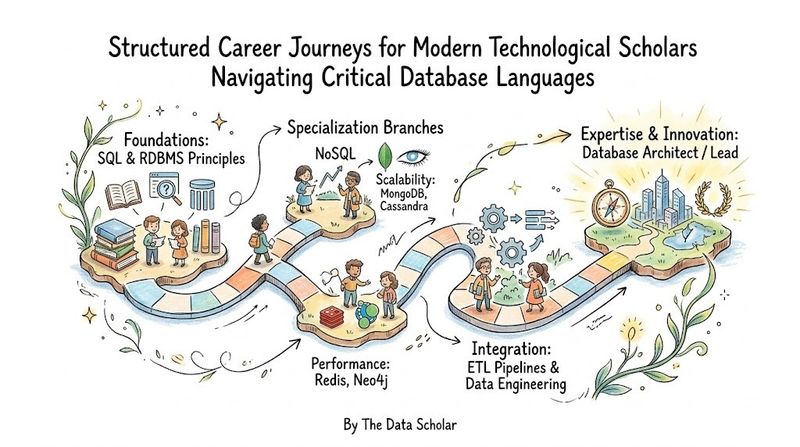
The educational progression into a senior infrastructure role begins with mastering local database administration on a single system. Students learn to write clean SQL code, normalize database tables properly, and analyze query execution paths using terminal commands. This basic understanding provides the core foundations necessary for managing complex, multi-tiered application data environments.
Once local administration is mastered, learners advance to studying automated cloud infrastructure orchestration, containerization frameworks, and microservice architectures. They build distributed database clusters, configure automated failover mechanisms, and practice writing infrastructure configurations as code. Finally, senior architects master high-level system reliability philosophies, comprehensive telemetry pipeline design, and corporate capacity forecasting models.
Certifications Worth Pursuing
Earning respected, industry-recognized technical credentials helps validate an individual's database optimization and infrastructure engineering expertise to global employers. Professionals should target foundational cloud architecture credentials offered by major global cloud providers like Amazon Web Services, Google Cloud, and Microsoft Azure. These comprehensive examinations verify deep knowledge of scalable cloud networking, distributed storage configurations, and system security management.
Additionally, pursuing specialized credentials like the Certified Kubernetes Administrator (CKA) demonstrates strong proficiency in managing containerized microservice workloads. Industry validations focused specifically on database administration and systems reliability engineering provide significant competitive advantages in competitive global job markets. These rigorous technical certifications prove that an engineer possesses the practical skills necessary to manage high-availability enterprise production systems.
Educational Resources with Debug.school
Navigating the vast landscape of database engineering and infrastructure management can feel incredibly overwhelming for students working in isolation. Aspiring technology professionals can streamline their learning experience significantly by leveraging the structured, mentor-led courses at Debug.school. The educational platform provides a step-by-step curriculum designed to guide learners from basic syntax to advanced architecture.
Students gain invaluable real-world experience by working inside interactive, hands-on cloud laboratory environments that simulate production scenarios. They practice optimizing slow queries, configuring automated replication pipelines, and debugging simulated infrastructure failures directly within the learning browser. This highly practical, engineering-focused educational approach ensures that graduates develop the actual production-ready skills demanded by top global tech firms.
The Future of Systems Management
AI and Automation in System Optimization
The integration of advanced artificial intelligence and machine learning algorithms is completely revolutionizing modern database infrastructure optimization workflows. Future system operations will move away from static, human-configured alerting rules toward predictive, self-tuning telemetry frameworks. Intelligent software agents continuously analyze system metrics in real time to detect subtle performance anomalies long before they trigger outages.
These autonomous systems can identify inefficient query patterns, recommend optimal index placements, and adjust database memory allocations automatically. When a machine learning model predicts an impending storage saturation event, it provisions additional cloud tablespace instantly without human intervention. This AI-driven operational paradigm eliminates routine maintenance tasks, allowing human engineers to focus entirely on broad system architecture.
Platform Engineering — The Evolution of Infrastructure
Platform engineering is rapidly emerging as the dominant architectural evolution for managing complex cloud infrastructure environments at scale. Instead of forcing software developers to configure complex cloud resources manually, organizations build internal developer platforms (IDPs). These self-service internal portals encapsulate complex infrastructure templates, compliance parameters, and security guardrails into simple automated menus.
[Developer Request] -> [Internal Developer Platform] -> [Automated Compliant SQL Cluster Provisioned]
Software developers can spin up fully compliant, pre-optimized database clusters instantly with a single button click inside the portal. The internal platform automatically configures standard backups, registers telemetry paths, and applies corporate data encryption standards. This modern approach eliminates configuration bottlenecks, accelerates development lifecycles, and maintains ironclad organizational infrastructure standards.
Management in Cloud-Native & Kubernetes Environments
As global commercial enterprises rapidly migrate their monolithic legacy applications toward cloud-native architectures, managing containerized databases presents unique orchestration challenges. Modern operations teams utilize advanced Kubernetes orchestration engines to deploy, scale, and manage dynamic container clusters across global cloud networks. They leverage cloud-native database operators to automate complex lifecycle tasks like software patching, vertical scaling, and multi-datacenter data replication.
These dynamic, containerized environments require engineers to design robust storage persistence layers that remain resilient when individual cloud nodes terminate. They build sophisticated service mesh architectures to manage secure microservice network communications, encrypt data paths, and balance traffic loads. Mastering cloud-native database orchestration remains an absolute prerequisite for technical experts aiming to lead modern, high-scale engineering initiatives.
Operational Skills That Will Matter Most
The rapidly evolving technological landscape will continuously demand new specializations and priorities from tomorrow's database infrastructure engineering experts. One critical priority emerging across global tech sectors is cloud financial optimization, which requires engineers to maximize database performance while minimizing computing costs. Professionals must write incredibly optimized SQL code and configure precise resource scaling policies to prevent wasteful corporate over-provisioning.
Additionally, mastering deep data observability across decentralized edge-computing networks and hybrid cloud environments will become a highly sought-after capability. Engineers must design secure, low-latency data ingestion pipelines capable of processing telemetry streams from billions of global devices simultaneously. Cultivating a continuous learning mindset and mastering data architecture fundamentals will ensure that technical experts remain indispensable throughout their careers.
FAQ Section
- What is the typical entry-level salary for a database operations specialist? Entry-level technical professionals entering the database infrastructure and systems operations field can expect highly competitive initial compensation packages globally. Salaries vary based on geographic location and industry, but junior engineers routinely secure starting compensation ranging from seventy thousand to one hundred thousand dollars annually.
- How does database operations engineering differ from traditional database administration? Traditional database administration focuses heavily on manual upkeep tasks like installing database software, configuring backups, and modifying user tables schemas. Conversely, operations engineering treats database management as a software engineering problem, writing automated scripts and building self-healing platforms to handle those tasks infinitely.
- Which programming languages are most critical for infrastructure automation? Aspiring automation experts must prioritize learning robust systems languages like Python and Go to write custom infrastructure management tools. Additionally, mastering bash shell scripting remains vital for navigating Linux terminal environments, while understanding SQL is mandatory for managing relational data layers.
- Can a student transition directly into a systems reliability role without experience? While reliability engineering roles traditionally required years of production systems experience, students can transition directly by demonstrating deep practical knowledge. Building public portfolios of cloud automation projects, earning advanced technical certifications, and completing comprehensive lab courses at Debug.school validates readiness effectively.
- What are the most common metrics tracked to measure database health? Engineers continuously monitor specific baseline telemetry signals including active database connection pool numbers, slow query execution times, and disk read-write IOPS limits. Additionally, tracking overall database CPU utilization, memory cache hit ratios, and network replication lag times ensures early detection of systemic degradation.
- How often should an organization conduct chaos engineering experiments? Mature tech firms integrate automated chaos engineering tests continuously directly into their daily production deployment pipelines and staging environment workflows. For teams starting out, conducting scheduled monthly fire-drills to manually test database failover protocols provides essential validation without introducing excessive risk.
Final Summary
Maintaining optimal database health and systemic infrastructure reliability requires a profound commitment to continuous automation, rigorous observability, and proactive software engineering. Organizations must systematically eliminate manual toil, establish realistic performance objectives, and foster completely blameless analytical cultures to survive modern digital scaling demands. By treating infrastructure management as a software discipline, engineering teams can build highly resilient, predictable data pipelines that drive long-term commercial innovation. Aspiring technological scholars can master these complex structural paradigms and accelerate their professional engineering careers by exploring the comprehensive, practical curriculum at Debug.school.



Top comments (0)