
An AI agent is an application that can use a language model to work toward a goal, choose from permitted tools, use information, and decide what to do next. A useful agent needs more than a good prompt: it needs reliable data, controlled access to tools, checks on its output, and a way to measure whether it completed the task.
The screenshot presents eight stages, from prompt engineering through system design and career development. Here is a practical explanation of each stage.
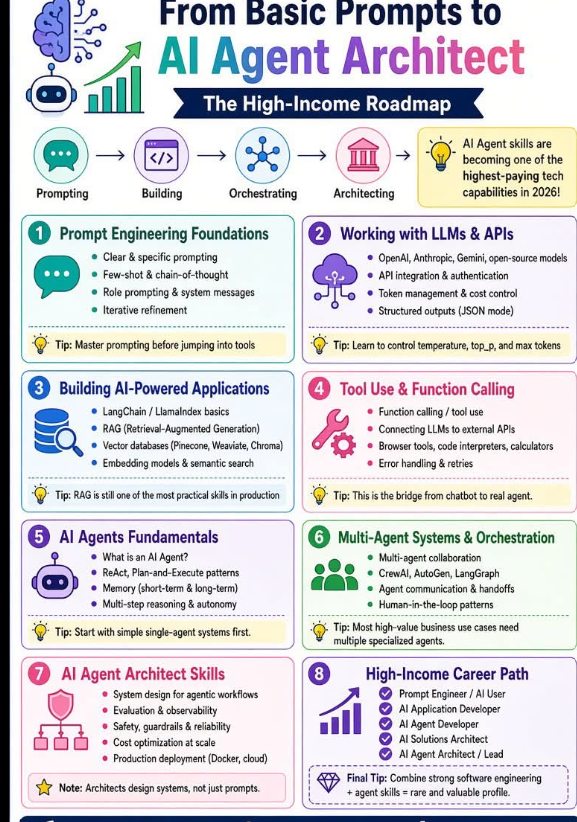
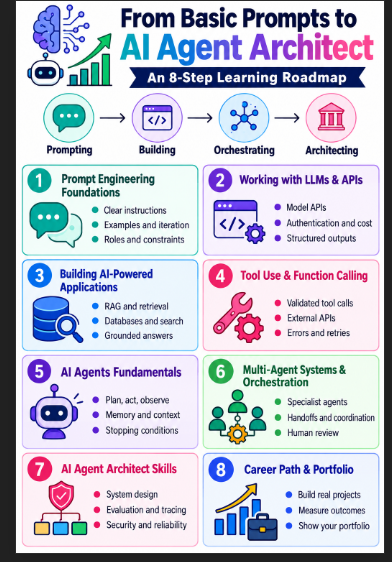
Prompt Engineering Foundations
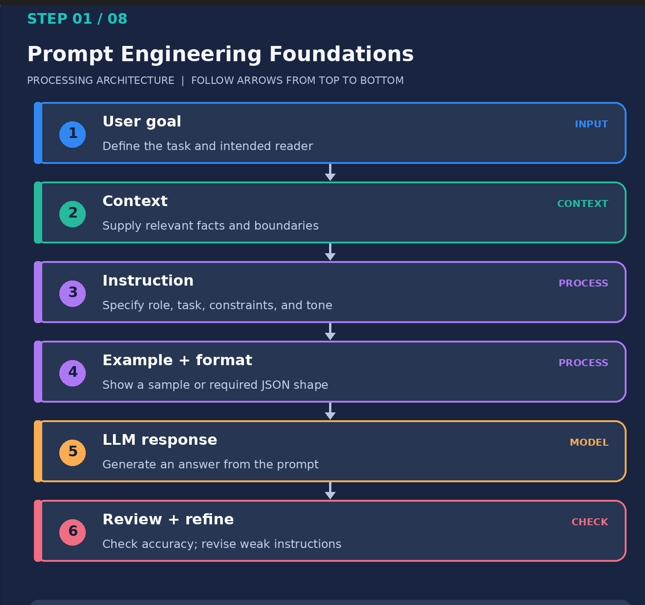
A prompt tells the model what task to perform and what a useful answer looks like. Start by stating the goal, giving relevant context, defining constraints, and specifying the output format.
For example, “Summarize this order” is vague. A stronger instruction is: “Summarize this order for a delivery manager in three bullets: current status, delay reason, and next action. Use only the supplied order data.”
Learn how to write clear instructions, supply a few examples when helpful, and revise a prompt after examining its failures. A system message can set application behavior, while the user message supplies the current task. Prompting is the first skill, but it cannot compensate for missing data or an unreliable workflow.
Working with LLMs and APIs
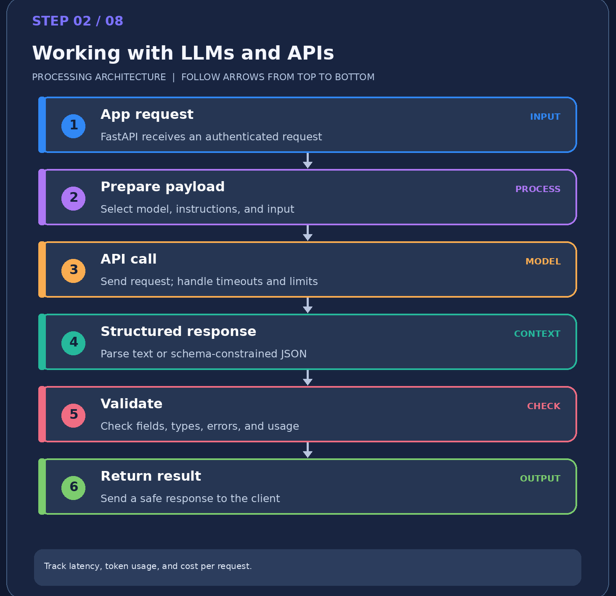
The next step is calling a model from your application. Your FastAPI backend might receive a request, send the relevant information to a model API, validate the response, and return it to the frontend.
Learn API authentication, request and response handling, timeouts, rate limits, token usage, and cost tracking. When your application needs a predictable response, use a defined JSON schema or structured output and validate the result before saving it or showing it to a user. Function calling and structured outputs are supported patterns for connecting model responses to application code.
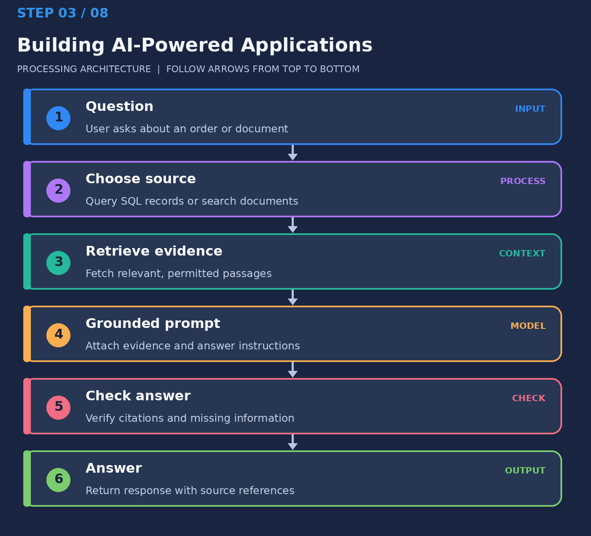
Building AI-Powered Applications
At this stage, the model becomes one part of a working product. Suppose you build a support assistant for HolidayLandmark. The user asks, “What is the cancellation policy for my trip?” The app must identify the relevant trip, retrieve the applicable policy, and produce an answer grounded in those records.
Retrieval-augmented generation (RAG) is useful when answers depend on documents or records that are not reliably contained in the model itself. A typical flow is: store searchable content, retrieve relevant passages for the question, and provide those passages to the model. Evaluate whether retrieval found the right material before judging the final answer.
A vector database is one possible retrieval component, not a requirement for every AI application. For a small, structured dataset, ordinary database queries may be simpler and more accurate.
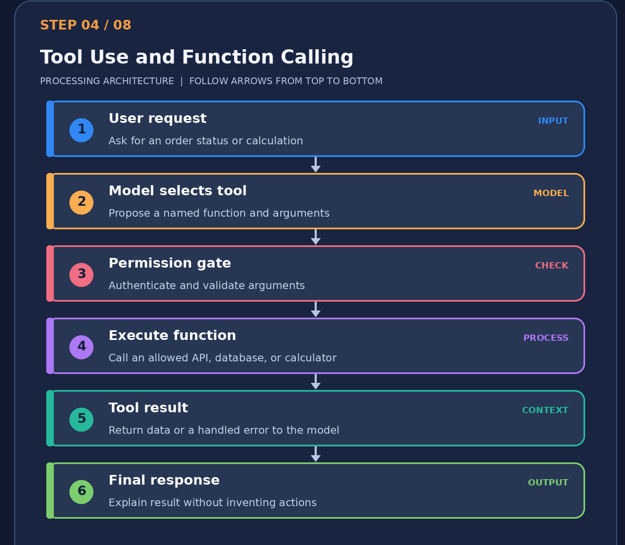
Tool Use and Function Calling
Tools let the agent interact with application functions. Examples include get_order_status(order_id), search_trip_policy(query), or calculate_refund(booking_id).
The model can request a tool call, but your application executes the function. The application should validate its arguments, check the user’s permissions, handle failures, and return the result to the model. Start with read-only tools; add actions such as changing a booking only when the workflow needs them.
This is where a conversational assistant can begin doing useful work. It is also where permissions become critical: an agent should receive only the tools and access needed for its task. OWASP identifies excessive agent authority as a security risk.
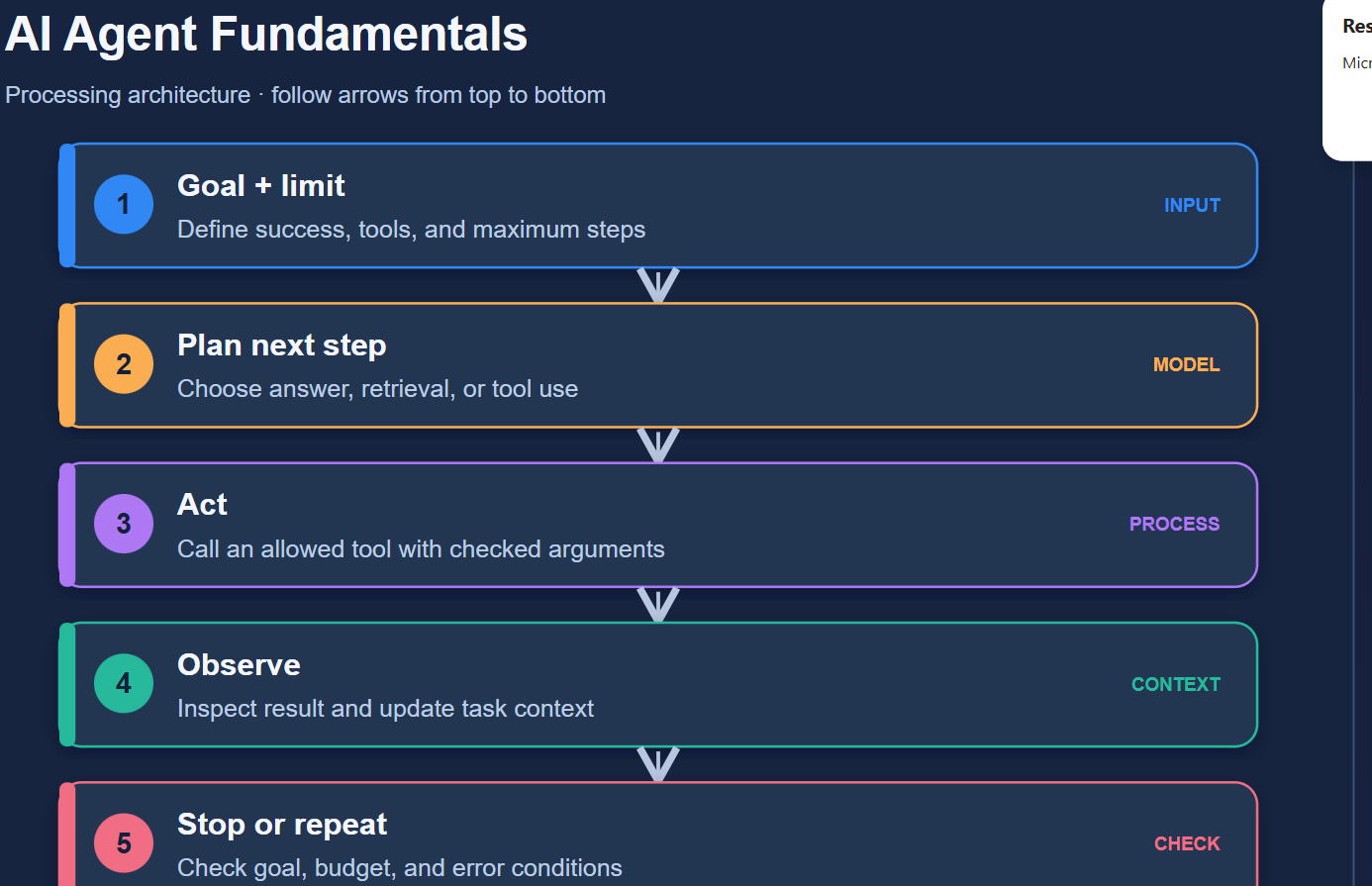
AI Agent Fundamentals
A basic agent follows a loop:
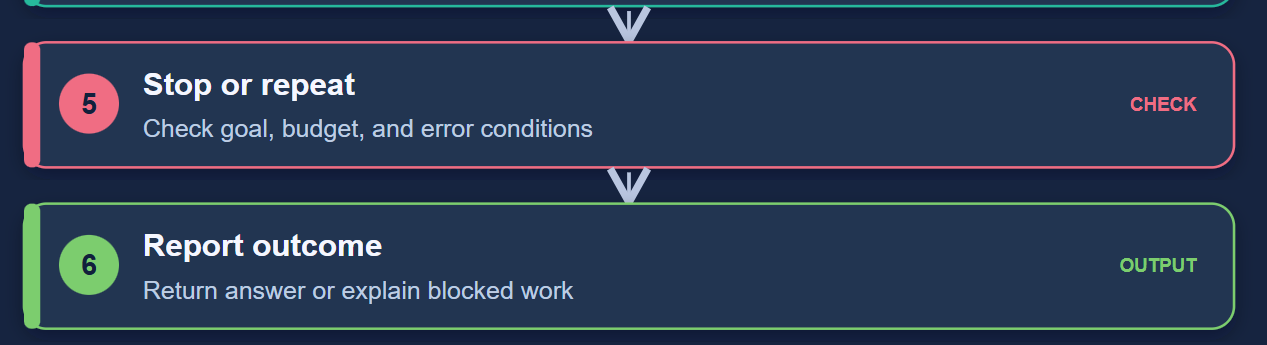
Understand the goal → choose an action → use a tool → inspect the result → respond or continue.
For example, an order-support agent might read an order, check the latest delivery event, consult a delay policy, then explain the next step. It may need several tool calls, but each should serve the original request.
Learn to set stopping conditions, limit tool calls, handle errors, and preserve only the context needed for the task. Distinguish conversation history from durable memory: saving a user preference or fact for future use requires an explicit design decision. Build and evaluate one capable agent before adding more agents.
Multi-Agent Systems and Orchestration
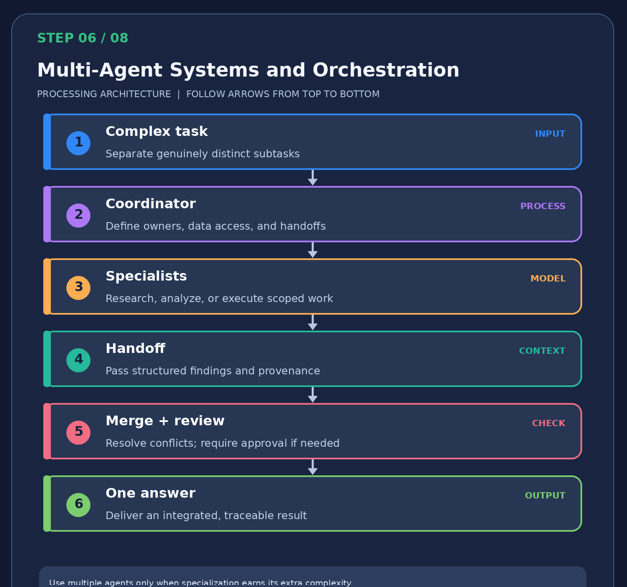
A multi-agent system divides work between specialized agents. One might retrieve facts, another analyze them, and a coordinator combine their results. Orchestration defines who receives each task, what information they can access, and how the final answer is produced.
This helps when tasks are genuinely independent or require different tools. It also introduces handoff errors, additional cost, and more decisions to inspect. Use multiple agents when a single agent with well-defined tools becomes difficult to manage or evaluate, not simply because the task has several steps.
For consequential actions, an orchestration flow can pause for human review before an agent writes to a database, sends a message, or changes a booking.
AI Agent Architect Skills
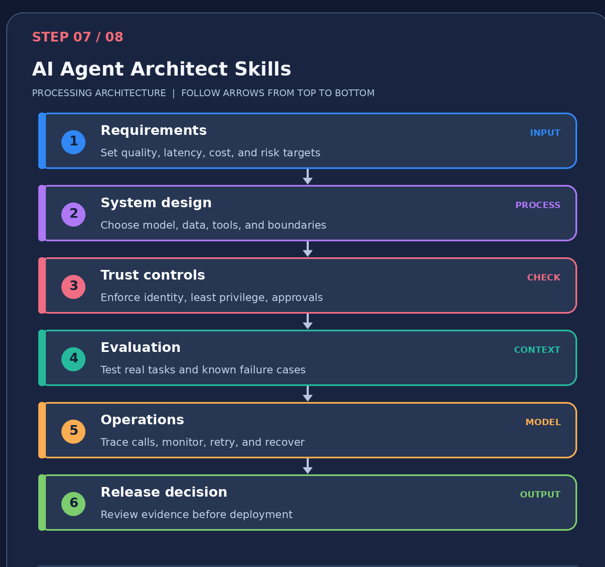
An architect designs the complete system around the model. That includes choosing where data comes from, deciding which operations the agent may perform, defining approval points, and planning for failures.
A production design should answer concrete questions:
- What happens when retrieval returns the wrong document?
- Can a tool change data without checking the user’s identity?
- What happens when the model API times out?
- How will you trace a wrong answer back to its inputs and tool calls?
- How will you test accuracy, latency, cost, and safety before release?
Prompt injection and excessive agency are documented risks, so the design must treat retrieved pages, documents, and tool results as potentially untrusted input.
Career Path: Build Evidence Through Projects
The screenshot suggests a progression from prompting to application development, agent development, solutions architecture, and technical leadership. Treat these as areas of responsibility, not guaranteed job titles or salary steps.
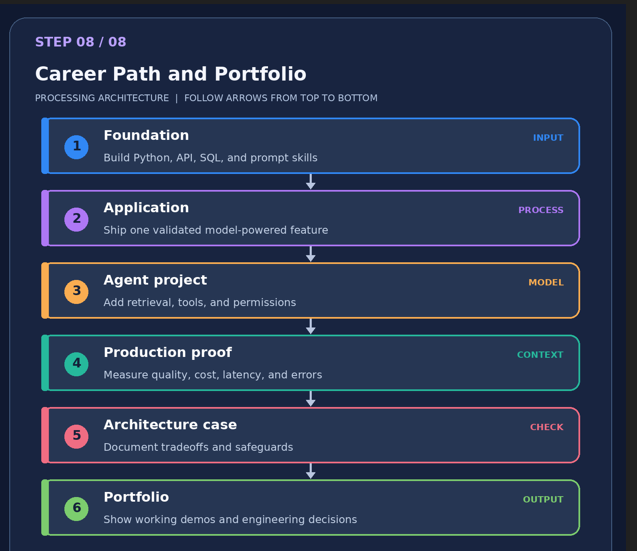
A strong portfolio would show increasing scope:
- A prompt-driven feature with measured output quality.
- A FastAPI application that calls a model and validates responses.
- A document or database assistant that retrieves and cites its source data.
- A tool-using agent with authentication, error handling, and traceable actions.
- A production design explaining permissions, evaluation, monitoring, cost, and failure recovery.
Your existing FastAPI and backend experience gives you a practical starting point: connect an agent to a narrow feature in a product you understand, then measure whether it solves that feature’s real user problem.
Colorful architecture: how a production agent works
The diagram shows a possible single-agent application. The colored groups separate user interaction, application control, AI decisions, data access, and operational checks.



Top comments (0)