
ONE LINE DEFINATION
TABULAR DIFFERENCE
LLM Architecture
Use LLM architecture when
RAG Architecture
The biggest difference
When should you use only an LLM?
When should you use RAG?
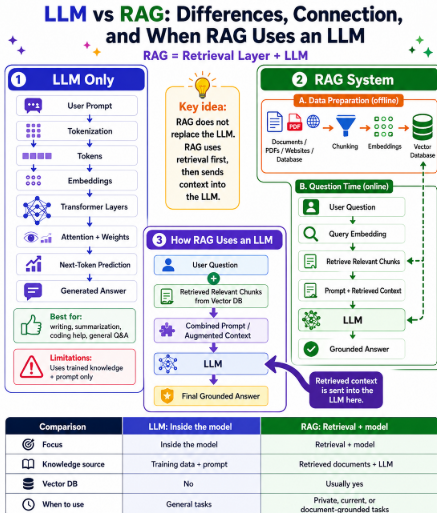
Very important: RAG does not replace the LLM
One real-world example
Best rule to remember
ONE LINE DEFINATION
LLM Architecture = how the language model itself works.
RAG Architecture = how we connect an LLM with external knowledge before generating an answer.
TABULAR DIFFERENCE
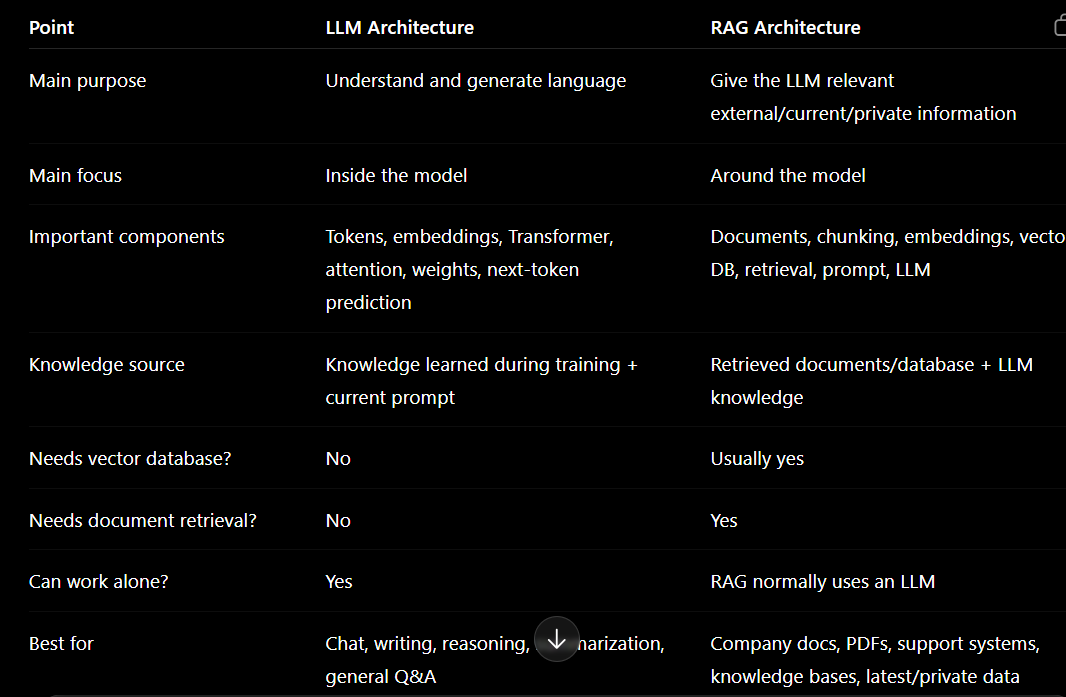
LLM Architecture
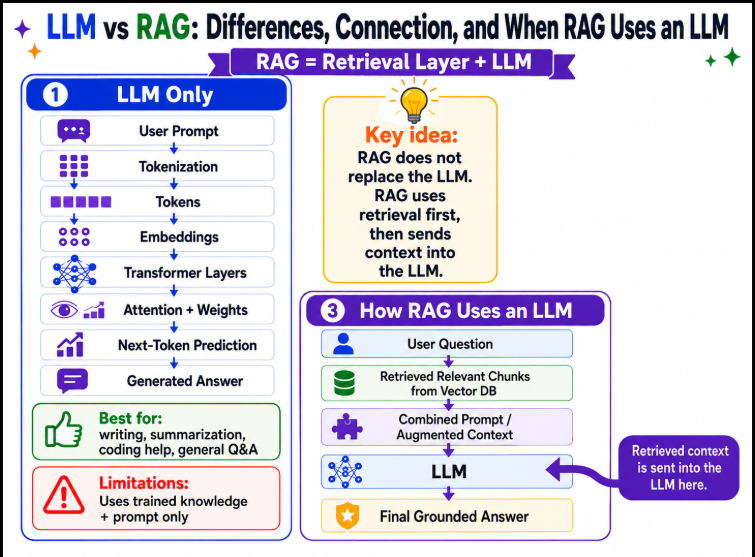
An LLM architecture explains what happens when text enters the model.
A simplified flow is:
User Prompt
   ↓
Tokenization
   ↓
Tokens
   ↓
Embeddings
   ↓
Transformer Layers
   ├── Attention
   ├── Learned Weights
   └── Feed-Forward Processing
   ↓
Next-Token Probabilities
   ↓
Temperature / Top-P
   ↓
Next Token
   ↓
Repeat
   ↓
Answer
Example:
User:
"Write a leave application."


        ↓


LLM processes the prompt


        ↓


Generated leave application
Here, you don't need to search any database or PDF. The LLM can generate the answer from the prompt and what it learned during training.
Use LLM architecture when
You want to understand or build systems involving:
chatbot generation
text summarization
translation
content generation
classification
reasoning
prompt engineering
fine-tuning
understanding Transformers, attention, tokens and embeddings
RAG Architecture
RAG means:
Retrieval-Augmented Generation
It means:
Before asking the LLM to answer, find relevant information from your own data and give that information to the LLM.
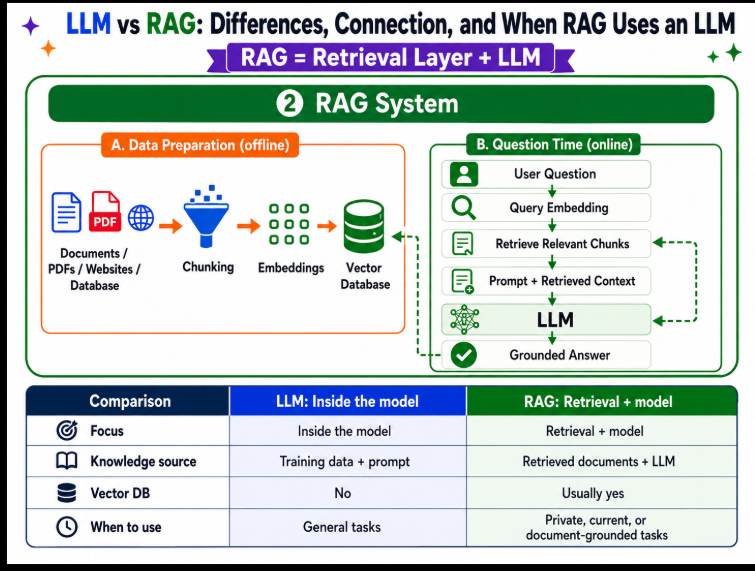
Typical flow:
             KNOWLEDGE PREPARATION


PDF / Website / Database / Docs
              ↓
           Loading
              ↓
          Chunking
              ↓
         Embeddings
              ↓
         Vector DB


                 QUESTION TIME


User Question
      ↓
Question Embedding
      ↓
Vector Search
      ↓
Relevant Chunks
      ↓
Question + Retrieved Context
      ↓
            LLM
             ↓
           Answer
Example:
Suppose your company has:
employee-policy.pdf
and someone asks:
"How many casual leaves do employees get?"
A normal LLM may not know your company's policy.
With RAG:
Question
   ↓
Search company documents
   ↓
Find:
"Employees receive 12 casual leaves..."
   ↓
Send this information to LLM
   ↓
Answer:
"According to your company policy,
employees receive 12 casual leaves."
This is where RAG is useful.
The biggest difference
Think of an LLM as a brain and RAG as giving that brain a library/search system.
LLM
        Brain
          ↓
Uses what it learned
during training
while RAG is:
Library / Database
                    ↓
                 Search
                    ↓
User Question → Relevant Information
                    ↓
                   LLM
                    ↓
                  Answer
So:
RAG
 ├── Retrieval System
 ├── Vector Database
 ├── Embedding Model
 └── LLM
        ↓
   Transformer
   Attention
   Weights
   Next-token prediction
In other words:
The LLM is one component inside a RAG application
.
When should you use only an LLM?
Use only an LLM when the answer does not depend on your private or frequently changing data.
For example:
Explain Docker.


Write Python code.


Summarize this paragraph.


Create an email.


Explain machine learning.


Generate interview questions.
Architecture:
User
 ↓
LLM
 ↓
Answer
When should you use RAG?
Use RAG when the answer must come from specific external information.
For example:
Company Knowledge Bot
Company Documents
      ↓
Vector DB
      ↓
Employee Question
      ↓
Retrieval
      ↓
LLM
      ↓
Answer
Hospital system
Suppose you have:
Hospital information
Doctor information
Treatment information
Policies
FAQs
A patient asks:
"Which hospitals have cardiologists in Ranchi?"
RAG can search your actual hospital data before the LLM answers.
E-commerce
Customer asks:
"Which laptop under ₹70,000 has 16 GB RAM?"
RAG/search can retrieve current products.
Product DB
   ↓
Retrieve matching products
   ↓
LLM
   ↓
Natural-language recommendation
Developer documentation
Laravel Docs
Project Docs
API Docs
GitHub documentation
        ↓
      RAG
        ↓
Developer asks question
        ↓
Accurate project-specific answer
Very important: RAG does not replace the LLM
This is a common misunderstanding.
It is not:
LLM vs RAG
as if you must choose one.
It is usually:
   RAG Application
                    │
        ┌───────────┴───────────┐
        ↓                       ↓
 Retrieval System             LLM
        ↓                       ↓
 Vector Database         Transformer
 Embeddings              Attention
 Documents               Parameters
                          Generation
RAG adds retrieval capability to an LLM application.
One real-world example
Suppose you build a MyHospitalNow AI Assistant.
Using only an LLM
User asks:
"What is angioplasty?"
User
 ↓
LLM
 ↓
General explanation
Good use of a normal LLM.
But if the user asks:
"Which hospitals registered on MyHospitalNow offer angioplasty under ₹2 lakh?"
The LLM alone doesn't reliably know your live hospital database.
Now use RAG/search:
User Question
       ↓
MyHospitalNow Data
       ↓
Retrieve matching hospitals
       ↓
Relevant Hospital Records
       ↓
LLM
       ↓
Readable Recommendation
That's a RAG-type use case.
Best rule to remember
Need general language intelligence?
            ↓
           LLM


Need answers from your own documents/data?
            ↓
        RAG + LLM


Need both?
            ↓
Almost always RAG application containing an LLM
And architecturally:
RAG Architecture
       ↓
contains an
       ↓
LLM
       ↓
whose internal architecture contains
       ↓
Transformer
       ↓
Attention + Parameters
       ↓
Next-Token Generation
So learn LLM architecture first, then RAG architecture. Once you understand tokens → embeddings → Transformer → attention → next-token generation, RAG becomes much easier to understand.



Top comments (0)