
Which programming language is the most secure: PHP, Python, Node.js, Rust, or Go?
All five can be used to build secure applications. Their built-in protections differ, but none automatically protects your login system, database queries, uploads, or server configuration.
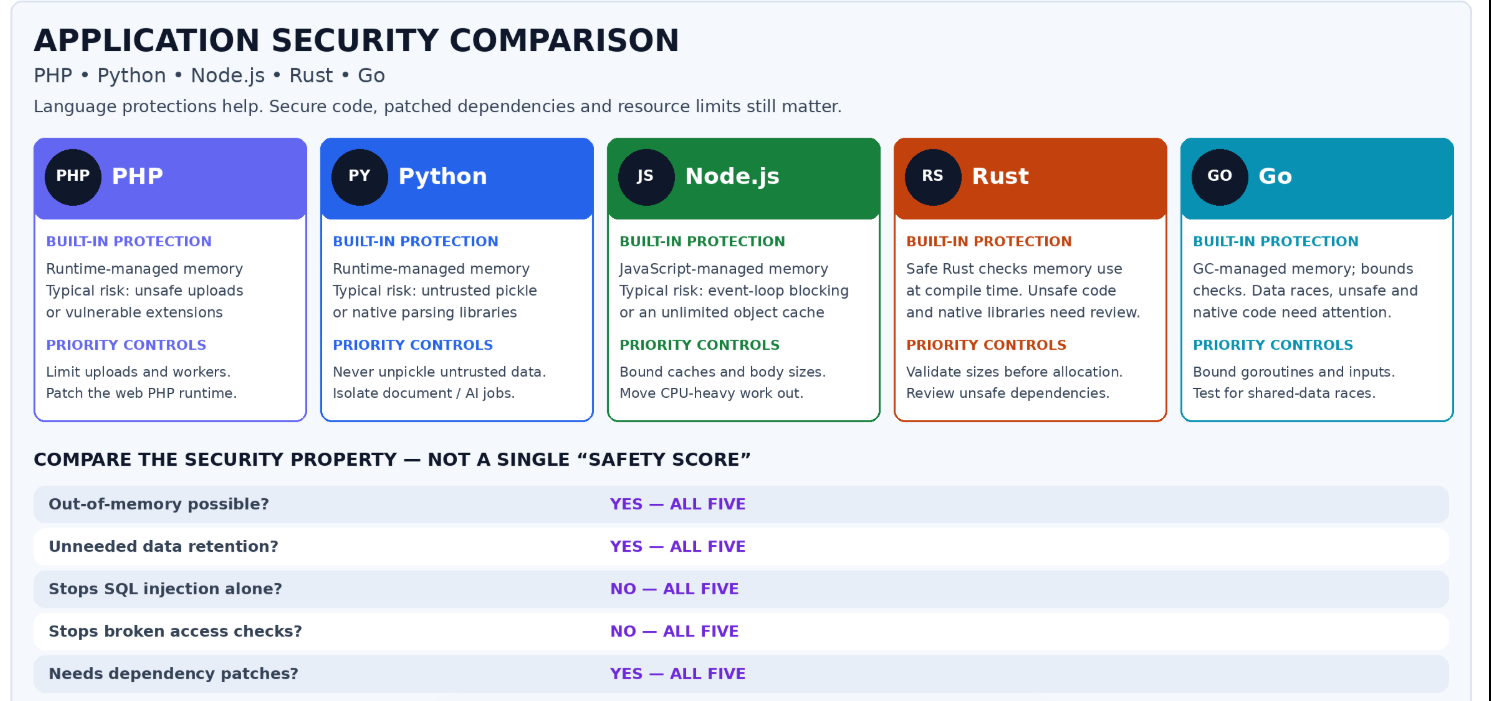
Rust offers strong compile-time memory protections in safe code. Go provides automatic memory management and bounds checking. PHP, Python, and JavaScript also manage memory for ordinary application code, while their runtimes and native dependencies remain part of the security picture.
The useful question is: Which mistakes does the language help prevent, and which protections must we implement ourselves?
Node.js is a JavaScript runtime. Go and Golang refer to the same language. The examples below are illustrative scenarios, not reports of named security incidents or claims of current vulnerabilities.
1. Understand Three Different Parts of Security
| Part | Simple meaning | Example |
|---|---|---|
| Language protections | Rules that help prevent certain programming mistakes | Safe Rust prevents many invalid memory accesses |
| Runtime and dependency security | Security of the engine and libraries running your code | A PDF parser needs security updates |
| Application and deployment security | Rules your application and infrastructure enforce | A patient must not access another patient's report |
Strong language protections do not fix a missing permission check. A patched PDF library does not make unlimited processing safe. Each part needs attention.
2. PHP vs Python vs Node.js vs Rust vs Go: Security Comparison Table
| Security area | PHP | Python | Node.js | Rust | Go |
|---|---|---|---|---|---|
| Memory handling | Runtime-managed | Runtime-managed | JavaScript engine-managed | Ownership and borrowing; no required garbage collector | Runtime-managed with garbage collection |
| Invalid memory access in ordinary application code | Direct raw-pointer access is generally absent | Direct raw-pointer access is generally absent | Ordinary JavaScript does not expose raw pointers | Safe Rust prevents many invalid accesses at compile time | Normal Go uses memory protections and bounds checks |
| Important memory-safety caveat | Runtime, extensions, and native integrations can have bugs | Interpreter, native extensions, and native integrations can have bugs | Engine, native addons, and native integrations can have bugs | Unsound unsafe code, native integrations, and compiler/library bugs can break guarantees | Data races, unsafe code, native integrations, and runtime bugs need attention |
| Can run out of RAM? | Yes | Yes | Yes | Yes | Yes |
| Can retain unnecessary memory? | Yes | Yes | Yes | Yes | Yes |
| Automatically prevents SQL injection? | No | No | No | No | No |
| Automatically checks user permissions? | No | No | No | No | No |
| Automatically makes uploads safe? | No | No | No | No | No |
| Needs dependency review and updates? | Yes | Yes | Yes | Yes | Yes |
| Needs request and concurrency limits? | Yes | Yes | Yes | Yes | Yes |
Memory safety means protection against certain invalid memory operations. It does not mean unlimited RAM or correct business rules.
For example, Rust can reject an invalid reference at compile time. It cannot automatically know whether a logged-in doctor is allowed to download a particular patient's file.
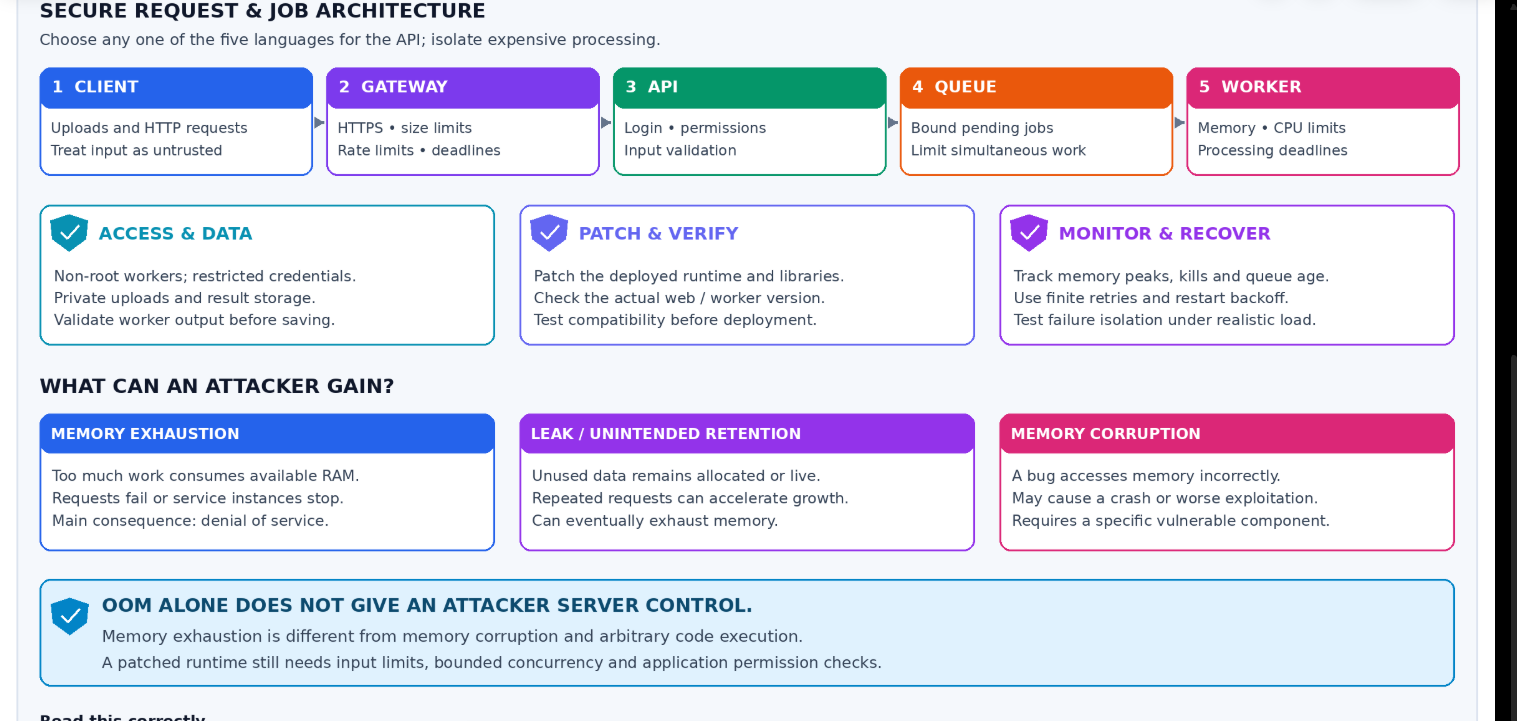
3. Memory Exhaustion, Memory Leaks, and Memory Corruption
| Problem | Simple explanation | Possible attacker benefit |
|---|---|---|
| Memory exhaustion | The program cannot obtain more memory or reaches an enforced limit | Interrupt requests or make the service unavailable |
| Memory leak or unintended retention | Memory remains allocated or reachable longer than intended | Repeated requests may accelerate memory growth |
| Memory corruption | A bug accesses or changes memory incorrectly | Cause a crash or potentially more serious exploitation, depending on the specific bug |
A growing global cache is often unintended retention. Garbage collection cannot remove objects the application still references.
Running out of memory does not automatically give an attacker server control. Code execution requires a separate exploitable vulnerability or another execution path.
A simple analogy
Memory exhaustion is like flooding a restaurant with more orders than the kitchen can handle. Real customers cannot get served.
Memory corruption is like a defect that causes the kitchen's equipment to operate incorrectly. Whether that defect can be exploited depends on the particular failure.
These are different problems, although a particular vulnerability can connect them.
4. PHP and Laravel Security: Strengths, Risks, and Examples
PHP handles memory for normal application code. Laravel provides useful tools for validation, authentication, authorization, database queries, and other web application tasks. Developers must use and configure them correctly.
Example: an unsafe upload location
A website saves user uploads in a directory where the web server permits PHP execution. If an executable file passes validation and can be requested directly, this can become a code-execution path.
The problem is the upload and execution configuration, not the existence of a PHP form.
| Risk | Practical protection |
|---|---|
| Executable uploads | Store uploads in non-executable private storage; validate content and allowed types |
| Huge database result | Select only required columns and process bounded batches |
| Many expensive requests | Limit worker concurrency, request rate, size, and duration |
| Vulnerable engine or extension | Patch the actual runtime serving the website and its extensions |
For a large read-only Laravel job, process batches rather than loading every model together:
$count = 0;

User::select('id', 'email')->chunkById(500, function ($users) use (&$count) {
    foreach ($users as $user) {
        // Process without retaining all batches.
        $count++;
    }
});

echo "Processed $count users";
Example output:
Processed 25000 users
This requires an existing Laravel application and User model. Batch size 500 is illustrative; measure with your data.
5. Python Security: Strengths, Risks, and Examples
Python manages memory automatically, but unsafe APIs and native processing libraries still need careful use.
Example: untrusted pickle data
Python's pickle format can cause code execution during deserialization. It must not be used to load untrusted files or request data.
For ordinary structured input, an appropriate alternative may be JSON:
import json

payload = '{"name": "Ashwani", "role": "doctor"}'
data = json.loads(payload)

print(data["name"])
Expected output:
Ashwani
JSON parsing does not establish trust. Validate the schema and sizes, and never grant permissions merely because the client sent "role": "doctor".
| Risk | Practical protection |
|---|---|
| Untrusted deserialization | Never unpickle untrusted input |
| Expensive PDF or AI processing | Separate bounded workers from the API |
| Dangerous shell invocation | Avoid constructing shell commands from untrusted strings |
| Vulnerable native extension | Update the extension and its underlying native libraries |
6. Node.js Security: Strengths, Risks, and Examples
Node.js manages JavaScript memory, but a process can still become overloaded or retain too much data.
Example: a request history that grows forever
const history = [];

function rememberRequest(body) {
  history.push(body);
}
If called repeatedly without removal, this retains more and more data. Garbage collection cannot discard the referenced entries.
A small bounded example:
const history = [];
const MAX_ENTRIES = 100;

function rememberSummary(summary) {
  if (history.length >= MAX_ENTRIES) history.shift();
  history.push(summary);
}

for (let i = 0; i < 150; i++) {
  rememberSummary(`Request ${i}`);
}

console.log(history.length);
Expected output:
100
Also bound entry size. A count limit alone cannot prevent 100 enormous values from exhausting memory. This example is a basic bounded list, not a production cache implementation.
| Risk | Practical protection |
|---|---|
| Event loop blocked by expensive synchronous work | Move heavy work into bounded workers |
| Growing cache | Limit entries, total bytes, and retention time |
| Large or slow requests | Configure body limits, deadlines, and connection controls |
| Vulnerable dependencies | Review and update packages and native addons |
7. Rust Security: Strengths, Risks, and Examples
Safe Rust's ownership and borrowing rules prevent many invalid memory accesses and data races before the program runs. Soundness of underlying unsafe implementations remains important.
Example: excessive user-requested allocation
An application can still accept a request for more memory than the machine can supply.
Validate the size before allocating:
fn main() {
    let requested_bytes: usize = 20 * 1024 * 1024;
    let allowed_bytes: usize = 5 * 1024 * 1024;

    if requested_bytes > allowed_bytes {
        println!("Rejected: exceeds the 5 MiB limit");
        return;
    }

    let mut buffer: Vec<u8> = Vec::new();
    match buffer.try_reserve(requested_bytes) {
        Ok(()) => println!("Capacity reserved"),
        Err(_) => println!("Cannot reserve capacity"),
    }
}
Expected output for these values:
Rejected: exceeds the 5 MiB limit
In a real upload endpoint, enforce actual bytes received rather than trusting the claimed size. try_reserve can report capacity overflow or an allocator-reported failure; it cannot prevent an external OS kill.
| Risk | Practical protection |
|---|---|
| Unbounded allocation | Validate sizes and bound accepted work |
| Unsound unsafe code | Minimize and carefully review unsafe implementations |
| Vulnerable native library | Patch and isolate the integration |
| Missing authorization | Check permissions for each protected operation |
8. Go Security: Strengths, Risks, and Examples
Go provides garbage collection and bounds checking in normal code. Its concurrency features are useful, but work must still be bounded and shared data must be synchronized.
Example: unlimited goroutines
An endpoint starts a new goroutine for every expensive job. Enough accepted jobs can exhaust memory, connections, or CPU.
More goroutines do not create more resources.
A worker pool with a bounded queue can keep only a limited number of jobs active. When capacity is reached, the application must apply backpressure or reject further work according to a defined policy.
| Risk | Practical protection |
|---|---|
| Unlimited goroutines | Use bounded worker pools and admission limits |
| Shared-data races | Synchronize access and run race-detection tests |
| Unbounded body reads | Enforce a maximum while reading |
| Growing collections | Bound retained data and expire unused entries |
The Go race detector can be run with:
go test -race ./...
It detects races exercised during the test run. A clean result does not prove that every possible execution is race-free.
9. How Memory Failure Affects Users
| Language | Possible failure behavior | Possible user impact |
|---|---|---|
| PHP | Script memory-limit fatal error; other failures can stop a worker | Failed request or job; other workers may continue |
| Python |
MemoryError or external process termination |
Failed job or interrupted API requests |
| Node.js | Fatal V8 heap exhaustion can terminate the process | Requests handled by that instance are interrupted |
| Rust | Ordinary allocation failure commonly aborts; fallible APIs can return an error | Failed operation or stopped instance |
| Go | Fatal runtime OOM or external process termination | Interrupted requests and jobs |
An operating-system kill can bypass application error handling in all five. Exact behavior depends on the failure, runtime, and deployment.
10. Which Language Should You Choose?
This is an engineering assessment, not an overall security ranking.
| Your goal | Practical choice to evaluate | Security focus |
|---|---|---|
| Strong compile-time memory and data-race protections | Rust | Keep unsafe boundaries sound; still enforce authorization and resource limits |
| Network services with straightforward concurrency | Go | Bound concurrency and synchronize shared data |
| AI, data, and document processing | Python | Isolate expensive work and inspect native dependencies |
| JavaScript APIs and real-time features | Node.js | Protect the event loop and bound retained data |
| Maintain an existing Laravel application | PHP / Laravel | Patch the deployed stack; secure uploads, permissions, and workers |
A language rewrite does not automatically fix weak passwords, exposed credentials, SQL injection, or missing permission checks.
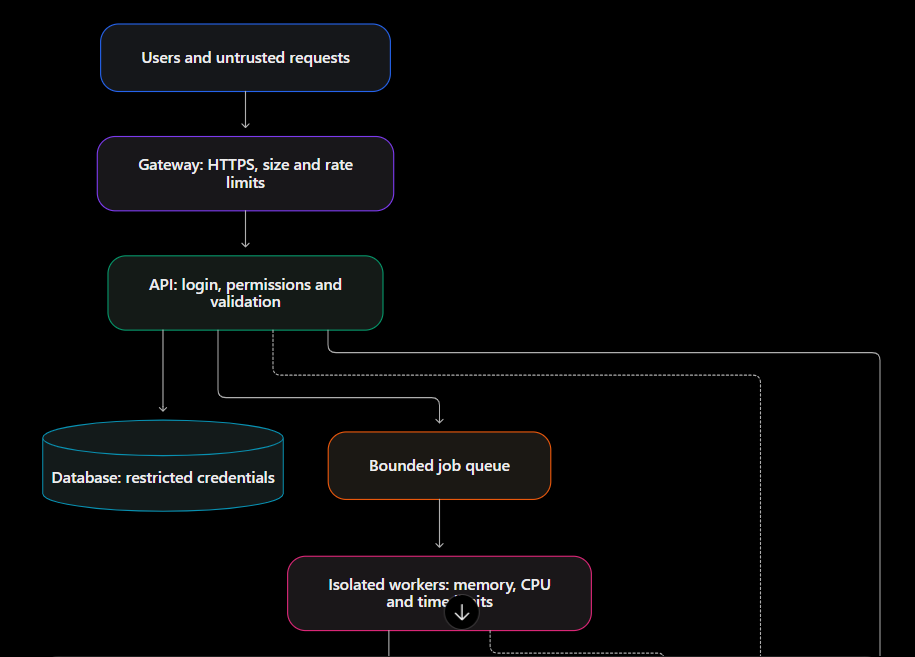
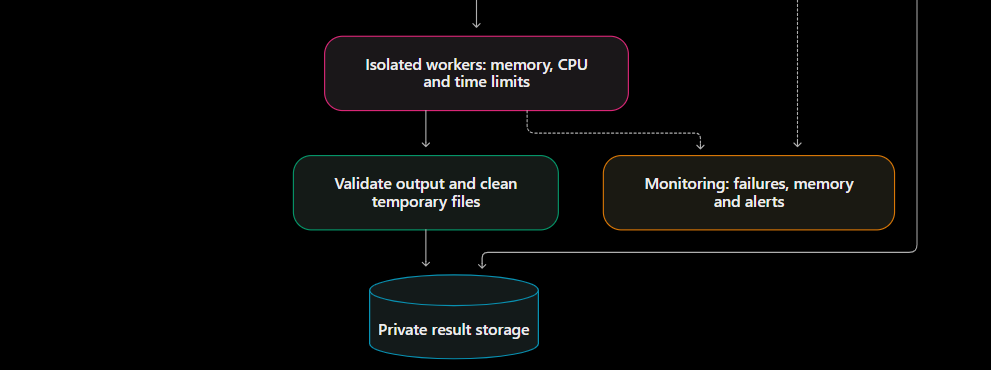
11. Security Controls Needed in Every Language
| Layer | Example control | Purpose |
|---|---|---|
| Gateway | HTTPS, body limits, connection deadlines, rate limits | Restrict incoming work |
| Application | Authentication, authorization, schema validation | Decide who may do what |
| Database | Parameterized queries and restricted credentials | Reduce injection and excessive access |
| Queue | Bounded backlog and admission policy | Avoid unlimited pending work |
| Worker | Memory, CPU, time, and concurrency limits | Contain expensive processing |
| Storage | Private non-executable uploads; retention limits | Restrict file access and storage growth |
| Maintenance | Runtime and dependency updates | Fix known vulnerabilities |
| Monitoring | Memory peaks, kills, failures, restart frequency | Detect and investigate problems |
12. Frequently Asked Questions
Is PHP automatically less secure than Go or Rust?
No overall security conclusion follows from the language alone. Safe Rust offers stronger compile-time protections against certain memory errors, but an application in any language can expose data through a missing permission check.
Can garbage collection stop every memory leak?
No. It cannot discard objects that remain reachable. An unlimited cache can grow in Python, Node.js, or Go.
Does compiled code automatically prevent hacking?
No. Compiled applications can still contain injection flaws, broken authorization, vulnerable dependencies, and resource-exhaustion problems.
Does an OOM error mean someone gained access?
No. It means a memory allocation or resource boundary failed. Investigate whether the cause was legitimate load, a bug, a configuration issue, or deliberate abuse.
What should I improve first in an existing Laravel service?
Identify and patch the runtime actually serving requests. Then review authentication and authorization, upload storage, database access, expensive jobs, dependency security, and resource limits.
Official References
- PHP security manual
- Laravel authorization
- Python security considerations
- Python pickle security warning
- Node.js security best practices
- Rust unsafe code and memory guarantees
- Go security best practices
- Go race detector
13. Colourful Security Comparison and Architecture
The diagram compares language protections and shows a shared architecture: gateway, validated API, bounded queue, isolated workers, restricted data access, and monitoring.
Publishing instruction: upload the supplied PNG using your blog editor and replace the relative image path above with the uploaded image URL. The badges are illustrative language icons, not official logos.



Top comments (0)