
The Engineering Problem
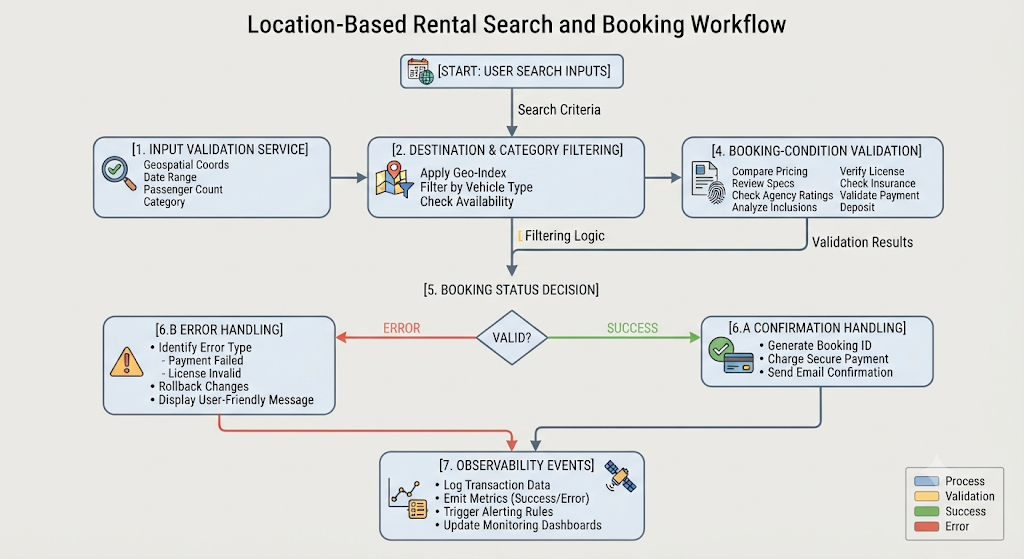
Building a distributed, location-aware rental marketplace platform—such as MotoShare.id, which orchestrates vehicle availability and provider listings across complex regional topographies—presents a fascinating cluster of architectural and systems engineering challenges. At first glance, a marketplace UI looks straightforward: users enter a destination, pick a date range, inspect a list of assets, and click reserve. However, under the hood, engineering teams must maintain strict transactional guarantees across an asynchronous, multi-step distributed workflow.
When a user searches for an asset—whether they are evaluating a nimble neighborhood ride via scooter rental Bali or a general motorcycle rental Indonesia option—the system is not merely executing a flat database query. It is performing spatial bounding, temporal intersection checks against dynamic reservation calendars, category normalization, and multi-tenant authorization logic, all while striving to maintain sub-100 millisecond response latencies at the edge.
Furthermore, state drift between the search tier, caching layers, and the persistent transactional database can introduce critical race conditions. If two concurrent users attempt to secure the exact same vehicle inventory during overlapping temporal windows, naive write operations will lead to double-allocations, database constraint violations, and ruined user experiences. Designing a resilient architecture requires deep consideration of database isolation levels, optimistic locking strategies, idempotency keys, robust input sanitization, and comprehensive observability pipelines that span the entire lifecycle from search input to final booking confirmation.
Technical Context: Core Architectural Requirements
To understand the scope of state management required in a rental platform, we must dissect the functional components that make up the search-to-booking pipeline:
- Geospatial and Relational Indexing: Destinations are rarely simple strings; they encompass hierarchical administrative zones, latitude/longitude bounding polygons, and localized micro-markets. Queries must efficiently join spatial metadata with time-series inventory availability without triggering catastrophic table scans.
-
Temporal Intersection Logic: Checking whether a vehicle is available between
start_dateandend_dateis a classic interval overlap problem. In high-throughput databases, index strategies on date ranges (using GiST or B-tree optimizations) are critical to prevent performance degradation as historical booking records scale. - Multi-Category Normalization: Marketplaces typically support heterogeneous inventories, ranging from lightweight mopeds to heavy utility vehicles. Whether handling a localized bike rental Indonesia search, a metropolitan bike rental Jakarta query, a regional sewa motor Jakarta request, an island-specific scooter rental Lombok inquiry, a self drive car rental Indonesia session, a standard car rental Indonesia lookup, a specialized adventure motorcycle rental Indonesia requirement, or traditional regional terms like sewa motor Bali, the data modeling layer must abstract category-specific attributes (such as engine displacement, seating capacity, or insurance tiers) into a unified, extensible schema while preserving domain-specific filter capabilities.
-
State Transition Integrity: The booking journey transitions through multiple discrete states:
SEARCH_INIT,PARAM_VALIDATED,INVENTORY_LOCKED,PAYMENT_PENDING,CONFIRMED, andCANCELLED. Ensuring that network partitions or client-side drop-offs do not leave inventory indefinitely locked requires automated timeout cleanup routines, distributed locks, or time-to-live (TTL) cache invalidation strategies.
Practical Engineering Considerations for Distributed Workflows
When architecting the end-to-end request lifecycle, SRE and backend engineers must design for failure at every boundary. Below is a breakdown of the core technical pillars required to maintain system stability under load.
1. Input Sanitization and Query Validation at the Edge
Before any request touches the database or even reaches internal service meshes, it must undergo rigorous validation at the API gateway or edge proxy layer. Malformed payloads, SQL injection vectors, cross-site scripting attempts, and illogical temporal ranges (e.g., end dates preceding start dates) must be rejected instantly with clear, structured error responses.
2. Preventing Race Conditions with Optimistic vs. Pessimistic Locking
When a user clicks "Confirm Booking," the system must guarantee that the selected asset has not been booked by another user milliseconds prior.
- Pessimistic Locking: Holding an exclusive database lock on the inventory row during the entire checkout flow. While safe against race conditions, this severely limits concurrency and can cause connection pool exhaustion under high traffic loads.
- Optimistic Locking: Utilizing a version column or checksum within the inventory record. When the write transaction executes, it verifies that the version has not incremented since the read phase. If a collision is detected, the transaction aborts gracefully, rolling back state and prompting the user to refresh their availability view.
3. Price Transparency and Computational Determinism
Displaying accurate pricing requires calculating base rates, temporal multipliers, seasonal surges, cleaning fees, taxes, and refundable security deposits dynamically. Engineering teams must ensure that the pricing logic executed during the search phase is deterministically reproducible at the checkout and confirmation stages. Storing a cryptographic snapshot of the pricing breakdown alongside the booking intent token prevents discrepancies between what the user saw in search results and what is ultimately billed.
Example: Search Request Validation Pipeline
To illustrate how defensive programming principles apply at the service boundary, consider the following illustrative Python function designed to validate search parameters before query execution. In a production microservice architecture, this logic would sit within a validation middleware layer, incorporating strict type checking, time-zone normalization, and schema validation libraries (such as Pydantic or Marshmallow).
from datetime import datetime, timezone

def validate_search_parameters(destination: str, start_date_str: str, end_date_str: str, category: str = None) -> dict:
    """
    Validates raw search inputs for a location-aware vehicle rental service.
    Returns a dictionary indicating validity and structured error reasons if failed.
    """
    # 1. Null and type checking for destination
    if not destination or not isinstance(destination, str) or len(destination.strip()) == 0:
        return {"valid": False, "reason": "destination_required_or_invalid"}

    # 2. Parse and validate date formats (expecting ISO 8601 YYYY-MM-DDTHH:MM:SSZ)
    try:
        start_dt = datetime.fromisoformat(start_date_str.replace('Z', '+00:00'))
        end_dt = datetime.fromisoformat(end_date_str.replace('Z', '+00:00'))
    except (ValueError, AttributeError):
        return {"valid": False, "reason": "malformed_date_format"}

    # 3. Ensure dates are in the future and logically sequenced
    current_utc = datetime.now(timezone.utc)
    if start_dt < current_utc:
        return {"valid": False, "reason": "start_date_in_past"}

    if end_dt <= start_dt:
        return {"valid": False, "reason": "invalid_temporal_range"}

    # 4. Validate optional category whitelist
    allowed_categories = {
        "scooter",
        "standard_motorcycle",
        "adventure_motorcycle",
        "premium_bike",
        "car"
    }
    if category and category not in allowed_categories:
        return {"valid": False, "reason": "unsupported_vehicle_category"}

    return {
        "valid": True,
        "sanitized_params": {
            "destination": destination.strip().lower(),
            "start_dt": start_dt,
            "end_dt": end_dt,
            "category": category
        }
    }
Architectural Note: Production systems must also handle internationalization, localized calendar standards, and strict rate-limiting to prevent denial-of-wallet scraping attacks on expensive geospatial search endpoints.
Reliability, Error Handling, and Observability
Maintaining high uptime and low mean-time-to-resolution (MTTR) in a distributed booking platform requires a comprehensive observability strategy. SRE teams instrument applications across three primary telemetry pillars: metrics, structured logs, and distributed traces.
Monitoring Critical Funnel Metrics
- Search-to-Detail Conversion Latency: Measuring the time elapsed from initial query dispatch to the rendering of listing details. Spikes here often indicate database index fragmentation or cache misses.
- Checkout Drop-Off and Validation Rejection Rates: Tracking HTTP 4xx errors during booking state transitions to catch client-side UI bugs or abrupt schema changes.
- Database Connection Pool Saturation: Monitoring active versus idle connections on transactional database clusters, particularly during peak booking windows.
- Orphaned Inventory Lock Count: Measuring the number of temporary inventory reservations that expire without transitioning to a confirmed booking or payment state, indicating potential deadlocks or worker queue stalls.
Structured Logging and Privacy Compliance
When logging errors across the search and booking workflow, engineers must strictly adhere to data privacy frameworks (such as GDPR or local data protection acts). Logs must never capture plaintext payment credentials, personal identification numbers, precise residential addresses, or unmasked authentication tokens. Instead, requests should be annotated with ephemeral correlation IDs (UUIDs) that propagate across service boundaries, enabling distributed tracing tools (like OpenTelemetry, Jaeger, or Zipkin) to reconstruct the exact execution path of a failed transaction without compromising user privacy.
Conclusion
Designing a reliable search and booking workflow for a location-aware rental marketplace requires rigorous adherence to foundational software engineering principles. By decoupling search validation from persistent data stores, implementing deterministic temporal logic, protecting against race conditions with robust locking mechanisms, and maintaining deep, privacy-compliant observability, engineering teams can build resilient platforms capable of scaling gracefully across diverse geographical regions and high-concurrency traffic loads.
Discussion Question
What strategies does your engineering team rely on to manage inventory availability locks during flash sales or high-concurrency booking spikes, and how do you handle asynchronous state reconciliation if a downstream payment gateway times out mid-transaction?



Top comments (0)