
Introduction
Writing software for restaurant reservations appears deceptively simple at the surface level: store a guest name, contact details, timestamp, and party size in a database. In engineering practice, however, hospitality platforms manage a classic finite-resource allocation problem. Unlike compute containers or digital storage that scale horizontally, physical dining rooms operate with fixed physical constraints: discrete seat counts, structural layouts, variable dining durations, and asynchronous real-world events such as walk-in traffic and no-shows.
Treating reservation software as a standard calendar event scheduler inevitably creates operational failures during service. A reliable system must coordinate incoming demand with physical room capacity by modeling dining floors as state-driven distributed resources.
Modeling Resources and Their Lifecycles
In software design, a restaurant's capacity cannot be modeled as a single scalar integer representing open chairs. A room with forty chairs cannot accommodate ten four-person parties if the space consists entirely of isolated two-top tables.
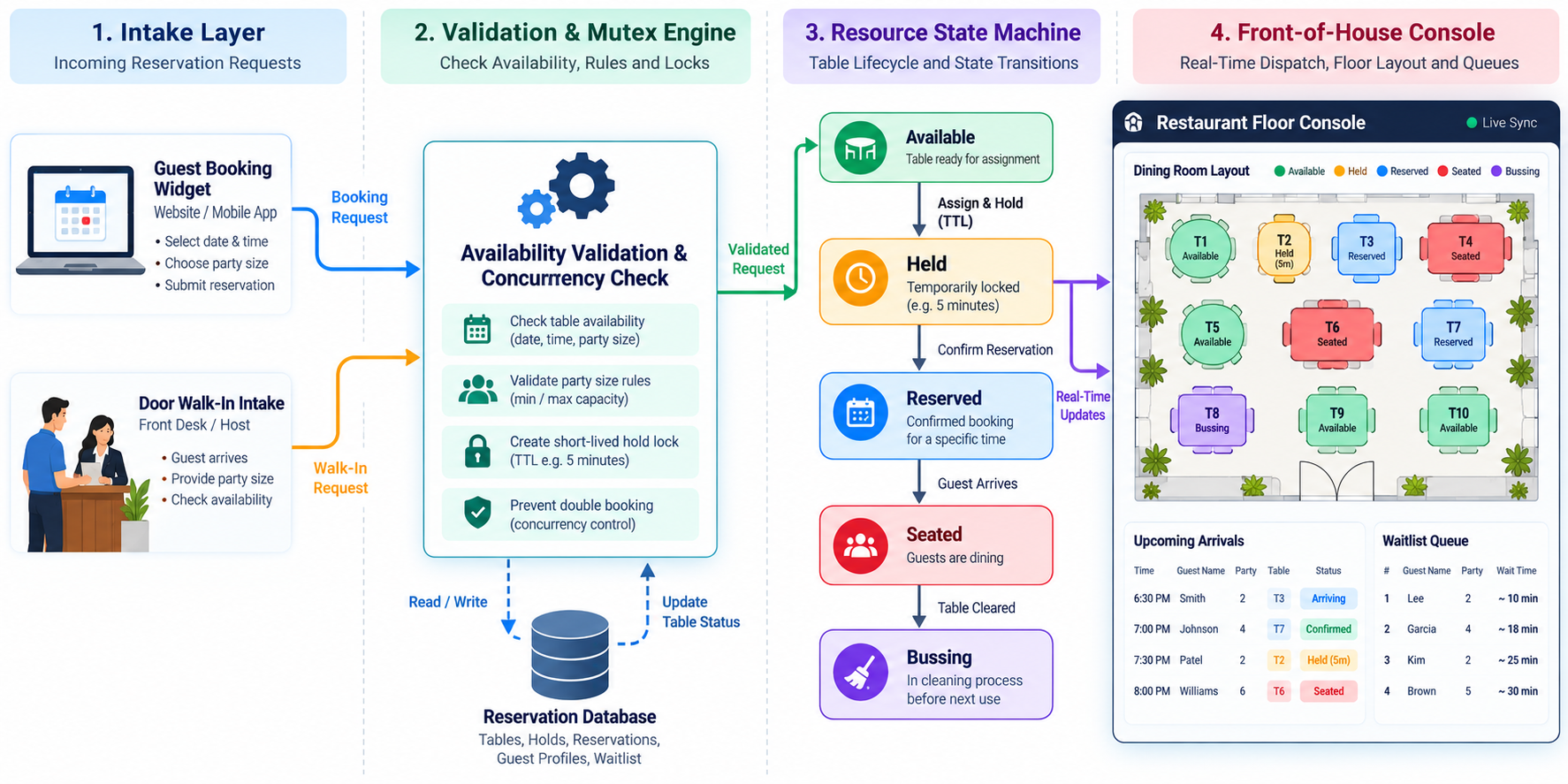
Physical tables are discrete resources with explicit attributes: minimum capacity, maximum capacity, spatial zone, and combinability with adjacent units. To maintain system consistency, tables and bookings should move through well-defined lifecycle states:
- Available: The table has no overlapping holds or active seatings during the target service window.
- Held: A transient state applied during an active checkout sequence, guarded by a short time-to-live (TTL) counter.
- Reserved: A confirmed commitment mapped to an upcoming service slot.
- Seated / Occupied: The party has physically arrived and is dining.
- Bussing / Reset: A transitional buffer period allowing staff to clean and prepare the station for the next allocation.
Establishing explicit state transitions ensures that downstream processes—such as host allocations and guest notifications—react to verified operational states rather than optimistic assumptions.
Preventing Conflicting Table Allocations
When multiple users attempt to reserve the same popular Friday evening table simultaneously, systems face concurrency challenges. Without defensive design, simultaneous write operations lead to double bookings.
Engineers generally resolve these race conditions through clear transactional boundaries:
- Pre-Allocation Validation: The scheduling service queries available inventory using composite constraints and verifies that no conflicting reservation overlaps within the requested turnaround window.
- Atomic Hold Transitions: When a guest initiates checkout, candidate tables transition to a Held state within an atomic transaction. If the session expires or the user drops off, the hold times out and returns the inventory to the active pool.
- Composite Table Dependencies: If Table 1 and Table 2 can be combined into a virtual large-format station, an active booking on Table 1 must atomically invalidate availability for the combined entity.
While concurrency controls mitigate digital collisions, physical dining introduces human timing variance. Meal lengths fluctuate based on kitchen cadence and dining pacing. Systems must therefore enforce configurable turnaround buffers rather than assuming rigid, uniform departure times.
Connecting Bookings With the Live Service Workflow
An intake interface is only the first step in a reservation lifecycle. Once a booking is created, the system must bridge the digital record with physical operations at the venue.
Integrating an Online Restaurant Booking System ensures that consumer-facing scheduling forms interact directly with backend shift rules, party thresholds, and availability matrices. When independent restaurants implement a Direct Restaurant Booking System on their own websites, they establish direct communication channels with their guests. Diners receive unique confirmation codes and secure, tokenized self-service links that allow them to modify or cancel their reservations independently, ensuring the central database reflects cancellations promptly without requiring manual staff updates.
Managing Tables and Floor Plans
Representing physical layouts accurately requires spatial data modeling. In modern Restaurant Table Management Software, tables are managed both as independent database entities and as nodes within a physical floor plan.
Pairing this logic with interactive Restaurant Floor Plan Software gives staff an intuitive representation of the dining room. When hosts need to reseat a party dynamically during service, the underlying software evaluates layout dependencies in real time, preventing reassignment to stations earmarked for incoming reservations.
Including Waitlists and Walk-Ins as Core Workflows
Decoupling walk-in traffic and waitlists from the central booking engine creates severe data synchronization issues. In live service, walk-ins and pre-booked guests compete for the identical pool of physical chairs.
Deploying Restaurant Waitlist Management Software allows venues to capture overflow demand when scheduled allocations are fully committed. The waitlist engine generates rolling wait-time estimates based on active dining durations and approaching booking arrival windows. Because dining speeds vary naturally, these estimates should always be surfaced as operational approximations rather than guaranteed commitments.
Concurrently, utilizing Restaurant Walk-In Management Software ensures that unannounced guests seated at the door immediately update real-time room occupancy. This instant state change prevents front-of-house staff from assigning an open table that has already been allocated to an incoming online reservation.
Building a Clear Host-Stand Interface
The user interface at the front desk serves as the operational control panel during a busy shift. Frontline staff make continuous, high-stress decisions that require rapid situational awareness.
Effective Restaurant Host Stand Software minimizes cognitive overhead by organizing data around immediate operational decisions:
- Which reservations are arriving within the next 15, 30, and 60 minutes?
- Which tables have exceeded their estimated turnover window?
- Which stations are currently cleared and ready for seating?
- What is the current queue length of waiting walk-in guests?
Presenting clear visual status tags and low-friction inputs ensures that staff update table states promptly, keeping digital records aligned with physical reality.
Adapting Systems for Different Venues
Architectural requirements scale with venue complexity. A boutique neighborhood cafe with ten tables has different requirements than a multi-level dining hall managing hundreds of covers daily.
Adopting specialized Restaurant Reservation Software for Small Restaurants provides essential floor mapping, walk-in tracking, and direct booking capabilities without the operational overhead of enterprise configurations. Systems should be designed around modular primitives that allow smaller operators to run lean while offering growing venues deeper role-based permissions and zone management.
Practical Implementation: The DineGlobe Platform
Connecting these architectural requirements into an integrated workflow is the primary design focus behind DineGlobe. Built for independent restaurants and growing hospitality businesses, DineGlobe unites online scheduling, floor allocation, waitlists, and host-stand tools into a single platform.
As an integrated Restaurant Reservation Software platform, DineGlobe combines direct online booking pages with availability validation, visual floor plans, seating buffers, combined-table handling, and walk-in guest management. Front-of-house staff track arrivals and occupied tables through a centralized host dashboard, while guests receive confirmation codes and direct self-service links. The platform also includes role-based access permissions, operational reporting, and native multilingual support across English, Japanese, and Arabic.
To assist operators in evaluating these operational tools, DineGlobe currently offers a Free Restaurant Reservation System pilot program, providing direct access to its core booking, waitlist, and table-management capabilities.
Conclusion
Building reliable reservation systems requires moving beyond basic data persistence and addressing the real-world constraints of physical spaces. Operational stability depends on modeling explicit table states, managing transactional locks against concurrent requests, integrating walk-ins with pre-booked demand, and delivering focused interfaces for front-of-house staff. When software aligns digital workflows with physical dining room dynamics, it creates a dependable foundation that supports smooth, predictable hospitality service.



Top comments (0)