
Introduction
Vehicle rental platforms have to coordinate more than customer requests. They must manage vehicle availability, rental periods, provider information, booking confirmations, payments and operational updates without creating confusion or double bookings. As the number of customers and rental providers grows, these responsibilities become increasingly challenging.
This is particularly relevant in a market such as the UAE, where residents, tourists and business travelers may be looking for everything from everyday cars to premium vehicles and motorcycles. A digital marketplace can make vehicle discovery easier, but its underlying booking and management workflows must be reliable.
This article explores the technical and operational principles behind a dependable vehicle rental platform, including inventory management, booking consistency, provider coordination and rental management software.
Why Vehicle Availability Is More Complicated Than It Looks
A basic vehicle listing might display a model, location, rental price and a few photographs. However, displaying a vehicle is not the same as confirming that it is available.
Consider a motorcycle listed by a rental provider in Dubai. Two customers might search for the same motorcycle and request overlapping rental periods within seconds of each other. If the system checks availability independently for both requests without protecting the inventory, it could accept two reservations for one vehicle.
A reliable platform needs to consider several factors:
- Vehicle availability for specific dates and times.
- Existing confirmed reservations.
- Pending booking requests and temporary holds.
- Maintenance periods and provider-blocked dates.
- Pickup and return scheduling.
- Booking cancellation and modification rules.
The availability check should happen close to the reservation operation, not simply when a customer first opens a listing.
Designing a Booking Workflow That Prevents Double Reservations
One of the most important technical challenges is handling simultaneous booking requests.
A typical workflow can follow these stages:
- The customer selects a vehicle and rental period.
- The backend validates the requested dates.
- The system checks existing reservations and blocked periods.
- A temporary reservation hold is created.
- The customer completes the required payment or confirmation process.
- The booking changes to confirmed after successful validation.
- If the process expires or fails, the temporary hold is released.
The critical part is ensuring that availability validation and reservation creation cannot conflict with another request.
For a relational database, transactions and appropriate locking strategies can help protect inventory updates. Depending on the database, exclusion constraints or carefully designed unique constraints may also prevent overlapping reservations.
For example, a simplified reservation table might contain:
| Field | Purpose |
|---|---|
| reservation_id | Unique reservation reference |
| vehicle_id | Identifies the rented vehicle |
| customer_id | Identifies the customer |
| start_time | Rental start date and time |
| end_time | Rental return date and time |
| status | Pending, confirmed, cancelled or expired |
| hold_expires_at | Expiration time for temporary holds |
The application should also use idempotency keys for payment and booking operations. If a customer retries a request because of a network interruption, the system should not accidentally create duplicate reservations or charge the customer twice.
Making Vehicle Search More Useful Through Structured Data
A rental marketplace becomes easier to use when listings follow a consistent data structure.
Customers searching for motorcycle rental Dubai may have different requirements from someone looking for car rental Dubai. Similarly, a person interested in luxury car rental Abu Dhabi may want information about vehicle specifications, rental conditions and provider requirements before making a decision.
A useful listing structure should include:
- Vehicle category and model.
- Pickup location and service area.
- Rental period options.
- Availability information.
- Pricing details and additional charges, where applicable.
- Mileage or usage conditions.
- Deposit and documentation requirements.
- Provider information and rental policies.
Search filters should be based on reliable listing attributes rather than loosely written descriptions. Location, vehicle category, rental dates and price range are practical starting points.
A marketplace may also support more specific searches such as motorcycle rental Abu Dhabi, car rental Abu Dhabi, Ducati motorcycle rental Dubai, sports bike rental Abu Dhabi and luxury car rental Dubai. These categories should only return listings that genuinely match the customer's selected location and requirements.
For a peer-to-peer model, peer-to-peer car rental UAE also introduces additional considerations. The platform may need to distinguish independent vehicle owners from professional rental providers and communicate the relevant booking conditions clearly.
Coordinating Customers, Vehicle Owners and Rental Businesses
A multi-provider marketplace has several different user roles. Customers need a straightforward booking experience, while vehicle owners and rental businesses need tools to manage their inventory and reservations.
A customer-facing workflow should make it easy to:
- Discover suitable vehicles.
- Compare relevant listing information.
- Review rental conditions.
- Submit a booking request.
- Receive booking updates.
- Access reservation details.
Providers need a separate operational workflow that allows them to:
- Add and update vehicle listings.
- Manage availability calendars.
- Review booking requests.
- Confirm or decline requests according to platform rules.
- Update vehicle status.
- Track upcoming pickups and returns.
The platform should maintain a clear distinction between a booking request, a temporary reservation and a confirmed booking. This prevents customers and providers from interpreting an unconfirmed request as a completed reservation.
Notifications can support this process through email, SMS or in-platform messages, depending on the system's capabilities. Important events include booking submission, confirmation, cancellation, payment updates and upcoming returns.
The Role of Rental Management Software
As rental businesses expand, managing reservations through spreadsheets, messages and manual calendars can become difficult. Information may be duplicated, availability may not be updated consistently, and staff may struggle to track upcoming returns.
This is where free vehicle rental management software UAE becomes a relevant consideration for rental operators evaluating digital tools.
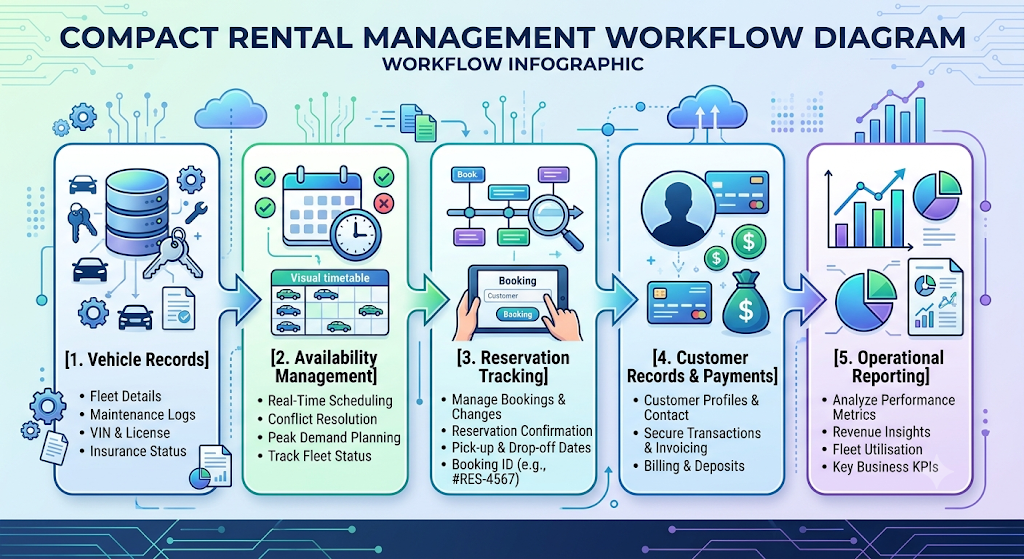
A useful rental management system may bring several operational activities into one place:
- Vehicle and fleet records.
- Reservation calendars.
- Customer information.
- Booking status tracking.
- Payment records.
- Vehicle maintenance schedules.
- Operational reports.
However, software capabilities vary. Rental businesses should evaluate whether a solution supports their actual workflow, number of vehicles, staff responsibilities and reporting requirements before adopting it.
For marketplace operators, the challenge is broader than maintaining one company's fleet. The platform must coordinate information across multiple providers while keeping each provider's records and permissions appropriately separated.
A well-designed system should also maintain an audit trail of important changes, such as booking status updates, availability modifications, and payment-related events. This helps teams investigate disputes and understand what happened during a reservation.
Security, Reliability, and Data Consistency
A rental platform handles customer details, booking records, and potentially sensitive payment-related information. Security should therefore be considered during system design rather than added as a final step.
Important engineering practices include:
Role-based access control: Customers, vehicle owners, rental staff and administrators should only access the information and actions required for their roles.
Secure payment handling: Payment processing should use appropriate payment providers and avoid storing sensitive card details unnecessarily.
Data validation: Rental dates, vehicle identifiers, customer details and booking status transitions should be validated on the server.
Monitoring and logging: Failed booking attempts, payment errors, unusual activity, and system failures should be recorded for investigation.
Backup and recovery: Important booking and inventory records should be protected through a tested backup and recovery strategy.
Reliability also depends on how the application handles temporary failures. For example, if a payment provider responds slowly, the platform should not immediately assume that the payment failed and release a reservation without checking its actual status.
These safeguards help create a more predictable experience for customers and providers.
A Practical Architecture for a Growing Rental Marketplace
A scalable rental platform does not necessarily need a complicated architecture from the beginning. It needs clearly separated responsibilities and a reliable way for its components to exchange information.
A possible high-level architecture could include:
| Component | Responsibility |
|---|---|
| Web or mobile interface | Vehicle discovery and customer interactions |
| Authentication service | User identity and access control |
| Listing service | Vehicle information and provider listings |
| Availability service | Rental calendars and inventory checks |
| Booking service | Reservation creation and status management |
| Payment integration | Payment requests and transaction updates |
| Notification service | Booking and operational notifications |
| Management dashboard | Provider and administrative workflows |
| Database | Persistent user, vehicle and reservation records |
A modular application can be a sensible starting point for a smaller marketplace. As traffic and operational requirements grow, individual components can be separated where there is a measurable technical reason to do so.
The important principle is to maintain consistent booking rules, clear service boundaries and reliable data ownership.
Applying These Principles to the UAE Rental Market
The UAE offers a useful example of why vehicle rental platforms need flexible search and dependable booking processes. Customers may be comparing different vehicle categories, rental periods and pickup locations depending on their travel or daily mobility needs.
A traveler researching motorcycle rental Dubai may prioritize a convenient pickup location and clear rental requirements. Another customer considering luxury car rental Abu Dhabi may focus more on vehicle specifications, provider policies and the total rental cost.
A marketplace such as MotoShare Gulf provides a relevant example of the digital marketplace model: connecting customers with vehicle owners and rental providers while helping them discover and compare available rental options.
The same operational principles apply regardless of vehicle category: accurate listings, transparent rental conditions, dependable availability information and clear communication between customers and providers.
For platform developers, the key lesson is that location-based discovery must be supported by accurate provider data and reservation logic. A polished search interface cannot compensate for unreliable inventory information.
Conclusion
Building a dependable vehicle rental marketplace requires more than publishing vehicle listings online. The platform must coordinate availability, reservations, provider operations, customer communication and payment-related processes through consistent workflows.
Preventing double bookings, structuring vehicle data, maintaining clear reservation states and providing useful management tools are all important parts of that foundation.
As digital rental services continue to develop, platforms that prioritize accurate information and reliable operations will be better positioned to support both customers and rental businesses. For developers, focusing on these fundamentals provides a practical path toward building a marketplace that can grow without sacrificing the quality of its booking experience.
Suggested Discussion for Developers
When building a multi-provider rental platform, which approach would you choose to prevent overlapping reservations: database-level constraints, transaction-based locking, or a combination of both? Share your reasoning and any implementation challenges you have encountered.



Top comments (0)