
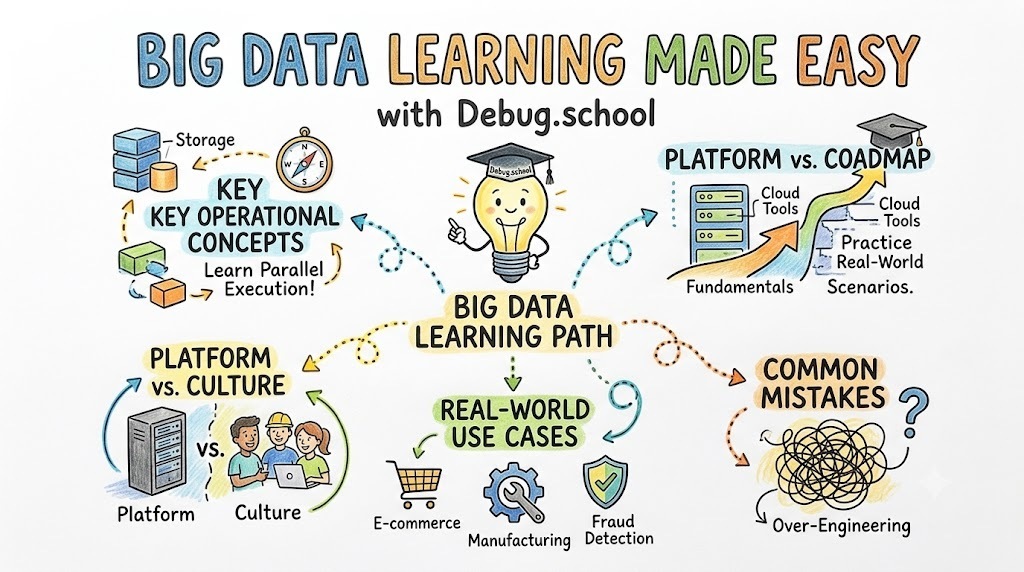
Big Data often feels like an overwhelming mountain of complex frameworks, massive data streams, and confusing architectural designs. However, mastering these distributed systems becomes remarkably straightforward when you have access to structured, hands-on guidance. Aspiring engineers can easily break down these complex processing concepts through the comprehensive curriculum offered by debug.school. This educational platform simplifies massive data processing by turning abstract infrastructure concepts into practical, bite-sized engineering lessons. Consequently, data professionals can rapidly learn how to store, process, and analyze petabyte-scale datasets without getting lost in theoretical jargon.
Key Operational Concepts You Must Know
Distributed Storage Mechanics
Distributed storage forms the absolute bedrock of any massive data infrastructure. Instead of relying on a single massive machine, distributed systems break large files into smaller chunks and spread them across a cluster of standard computers. This strategy ensures that your system can handle massive growth simply by adding more standard hardware over time.
Furthermore, these systems continuously replicate data chunks across multiple physical machines to prevent data loss when a computer inevitably fails. Because the system automatically tracks where every chunk lives, applications can read different parts of a file simultaneously. This parallel access dramatically increases overall read and write speeds across the entire network.
Consequently, understanding data replication, block placement policies, and fault tolerance is essential for building resilient storage layers. When you master these fundamental mechanics, managing petabytes of information feels just as simple as handling a local file system.
Parallel Execution Frameworks
Processing immense datasets requires a fundamental shift from sequential execution to massive parallel processing frameworks. Parallel execution engines break down a massive computational task into hundreds of smaller, independent operations that run simultaneously across different cluster nodes. This methodology ensures that processing times scale down efficiently as you introduce more computational power to the cluster.
Initially, early frameworks used a disk-based batch model that saved intermediate results directly to storage hardware. While this approach was incredibly reliable for massive datasets, it introduced significant disk input and output bottlenecks during complex multi-step computations.
Subsequently, modern execution frameworks shifted processing entirely into system memory, which eliminated slow disk read and write cycles. By keeping data in random access memory throughout the execution pipeline, these modern frameworks process complex analytical queries significantly faster than older distributed engines.
Stream vs Batch Processing
Engineers must constantly choose between processing data in real-time streams or analyzing it in accumulated historical batches. Batch processing handles large volumes of static data collected over a specific period, making it ideal for deep historical analysis and complex reporting. Because the data is complete, batch jobs can optimize resource utilization and run highly complex calculations over the entire dataset.
Conversely, stream processing handles continuous, infinite flows of data in near real-time as events occur. This immediate approach is crucial for time-sensitive applications like fraud detection, live system monitoring, and instant recommendation engines.
Ultimately, modern architectures frequently combine both approaches into a unified hybrid pipeline to achieve comprehensive data visibility. This combination allows organizations to react instantly to live events while still maintaining a deeply accurate historical record for long-term strategic planning.
Resource Orchestration and Management
A massive data cluster requires a dedicated operating system layer to manage CPU and memory allocation across hundreds of machines. Resource orchestrators act as central coordinators that dynamically assign hardware resources to competing processing jobs. Without this central coordination, long-running analytical queries could easily starve critical real-time streaming applications of necessary system memory.
Moreover, modern resource managers isolate workloads by creating secure, logical boundaries around running applications. This isolation prevents a single poorly written processing script from crashing other vital services running on the same shared cluster.
As a result, mastering resource allocation, queue scheduling, and cluster multi-tenancy is vital for maintaining optimal infrastructure performance. Efficient orchestration guarantees that every operational workload gets exactly what it needs without wasting expensive cloud hardware.
Platform Implementation vs. Culture — What's the Real Difference?
The Technology Trap in Engineering
Many organizations mistakenly believe that purchasing expensive software licenses or deploying advanced cloud tools will automatically solve their data challenges. This narrow focus on tools creates a dangerous technology trap where teams implement complex platforms without understanding their underlying architectural principles. Consequently, companies end up with fragile, over-engineered pipelines that are incredibly difficult to maintain and troubleshoot.
In reality, a platform is merely an enabler, not a complete solution to complex business problems. When engineers focus solely on tool configurations rather than architectural patterns, system performance inevitably degrades.
Therefore, true engineering mastery requires a deep focus on foundational concepts rather than the specific syntax of a fleeting technology trend. Learning how systems scale fundamentally prevents you from falling into the trap of fixing symptoms instead of solving root infrastructure design flaws.
Fostering a Data-Driven Engineering Culture
A robust data culture focuses heavily on collaboration, continuous learning, and shared engineering ownership across different functional teams. In this environment, teams treat data pipelines as living products that require rigorous testing, clear documentation, and continuous monitoring. This cultural mindset ensures that pipelines remain reliable, scalable, and adaptable as business requirements change over time.
Additionally, a healthy culture encourages engineers to experiment safely, share technical failures openly, and learn from operational mistakes. This collaborative approach removes the fear of failure and accelerates the development of innovative data processing solutions.
When an organization successfully balances technical platform implementation with a supportive engineering culture, data quality increases dramatically. Engineers stop fighting their tools and start focusing on delivering clean, trustworthy data to downstream business applications.
| Aspect | Platform Implementation | Culture & Mindset |
|---|---|---|
| Primary Focus | Deploying software, configuring clusters, and setting up cloud environments. | Establishing shared ownership, standardizing data practices, and fostering continuous learning. |
| Longevity | Short-term focus that changes frequently as new technology tools emerge. | Long-term foundation that remains stable across different technology cycles. |
| Success Metric | Cluster uptime, deployment speed, and successful tool integration. | Data trust, pipeline reliability, and cross-team collaboration efficiency. |
| Core Value | Provides the raw infrastructure and computational power for data tasks. | Drives the engineering standards, data quality, and innovative problem-solving. |
Real-World Use Cases of Modern Operations
Fraud Detection in Financial Ecosystems
Modern financial institutions process millions of transactions every second, requiring instantaneous analysis to block fraudulent activity. To achieve this speed, banking platforms ingest live transaction streams and run them through complex rule engines and machine learning models within milliseconds. This real-time processing allows banks to identify suspicious patterns and freeze compromised accounts before any financial loss occurs.
Simultaneously, historical batch systems analyze months of older transaction records to uncover subtle, long-term fraud trends. These historical insights are then used to update the real-time streaming models, creating a continuously improving security loop.
- Key Requirements: Sub-second latency, high availability, and strict data consistency across all processing nodes.
- Core Benefit: Protects customer financial assets while minimizing false positives that frustrate legitimate users.
- Data Scale: Handles terabytes of transactional log data daily across highly secure distributed networks.
Predictive Maintenance in Industrial Manufacturing
Industrial manufacturing facilities use thousands of internet-connected sensors to monitor the health of heavy factory machinery. These sensors continuously stream temperature, vibration, and pressure readings into centralized data stores for real-time analysis. By analyzing these streams, operational systems can accurately predict exactly when a machine component is likely to fail.
Furthermore, scheduling maintenance based on actual machine health rather than arbitrary calendars saves companies millions in operational costs. This predictive approach keeps factories running efficiently and completely eliminates unexpected, catastrophic equipment failures on the production floor.
- Data Types: High-frequency time-series data, sensor logs, and historical maintenance records.
- Operational Goal: Eliminate unexpected machine downtime and maximize the lifespan of expensive factory equipment.
- Analysis Method: Combines real-time anomaly detection with historical pattern matching across cluster nodes.
Personalization Engines in E-Commerce Platforms
E-commerce platforms rely heavily on real-time personalization to display relevant products to shoppers as they browse online stores. As a user clicks through pages, a streaming pipeline instantly captures their clickstream behavior and updates their preference profile. This immediate processing allows the recommendation engine to alter the homepage layout and showcase matching items instantly.
Meanwhile, massive batch jobs run nightly to analyze millions of user journeys, uncovering deeper purchasing trends and correlation patterns. This dual-layer processing ensures that recommendations are both instantly relevant to the current session and aligned with long-term customer trends.
- Target Outcomes: Higher conversion rates, increased average order value, and improved user engagement metrics.
- Pipeline Structure: Fast-moving streaming layers combined with deep-dive historical analytical stores.
- Scale Challenge: Managing highly volatile traffic spikes during massive holiday sales events without dropping user events.
Common Mistakes in Operations Engineering
Over-Engineering Simple Data Architectures
A frequent mistake among engineers is building overly complex architectures for relatively small datasets that could run on a single machine. Drawn by technology hype, teams often deploy massive distributed clusters when a simple relational database would work perfectly fine. This over-engineering introduces unnecessary networking latency, high cloud costs, and immense maintenance overhead for the engineering team.
Consequently, development velocity slows to a crawl because the team spends more time managing infrastructure than writing business logic. Simplicity should always be the primary goal when designing data collection and processing systems.
Therefore, you should only introduce distributed systems when your data volume, velocity, or variety genuinely outgrows traditional storage systems. Keeping your architecture lean ensures easy maintenance, lower operational costs, and higher system reliability over time.
Neglecting Data Quality and Schema Governance
Launching data pipelines without strict schema enforcement and quality validation rules always leads to major operational headaches down the line. When upstream applications change data formats without warning, downstream processing jobs instantly break, corrupting reporting dashboards. Without automated quality checks, dirty or malformed data quietly pollutes your storage layers, destroying user trust in your analytics.
To prevent this issue, engineering teams must implement strict schema registries and automated data profiling tools at the ingestion gate. These tools automatically catch and isolate bad data in a dead-letter queue before it enters the core pipeline.
Ultimately, maintaining clean data requires continuous monitoring, clear data ownership definitions, and automated alerting systems. Prioritizing data governance early prevents costly data clean-up projects and keeps your production pipelines running smoothly.
Ignoring Resource Optimization and Cost Controls
It is incredibly easy to overspend on cloud resources when running unoptimized, poorly written distributed processing queries. Beginners often spin up massive clusters to brute-force poorly written code, resulting in massive cloud bills at the end of the month. Common culprits include reading entire datasets instead of filtering early, and causing massive network bottlenecks by moving data unnecessarily between machines.
Moreover, failing to configure proper resource allocation limits allows a single unoptimized query to consume an entire cluster's memory. This lack of cost control and resource boundaries can easily bankrupt a small project or severely disrupt other critical team operations.
As a result, engineers must learn to analyze execution plans, build efficient storage layouts, and optimize data partitioning strategies. Writing resource-conscious code keeps cloud bills low and guarantees that your applications run efficiently on minimal hardware footprints.
How to Become an Operations Expert — Career Roadmap
Step 1: Mastering Fundamentals
Begin your educational journey by establishing an incredibly strong foundation in core computer science principles and programming languages. You must become completely comfortable with Linux system administration, command-line operations, and shell scripting for automation tasks. Additionally, focus heavily on mastering advanced structured query language patterns, data normalization concepts, and relational database indexing strategies.
- Core Focus: Learn a foundational language like Python, master core Linux commands, and understand basic network protocols.
- Learning Resources: Interactive coding platforms, foundational systems books, and structured introductory data engineering courses.
- Estimated Time: Spend your first few months building this baseline before touching any distributed tools.
Step 2: Understanding Distributed Core
Once you master the basics, move on to learning the architectural concepts behind distributed data storage and parallel processing frameworks. Study how distributed file systems manage data blocks, handle node failures, and maintain consistency across a network. Work on setting up small local clusters on your own machine to observe how data moves between master and worker nodes.
- Core Focus: Master data replication concepts, understand map-reduce patterns, and practice writing basic batch processing applications.
- Practical Projects: Build a local multi-node cluster using container tools to simulate network partitions and node failures.
- Key Concept: Focus entirely on understanding how data is divided and processed in parallel across multiple machines.
Step 3: Mastering Advanced Frameworks
Transition your skills into the modern ecosystem by mastering in-memory processing frameworks and real-time streaming technologies. Learn how to optimize execution graphs, manage system memory explicitly, and handle complex data joins efficiently. Additionally, dive deep into event-driven architectures, understanding message offsets, data partitioning, and stream windowing concepts.
- Core Focus: Write highly optimized analytical queries and build robust real-time event streaming pipelines.
- Design Skills: Learn to choose the right storage file formats based on specific application access patterns.
- Optimization Goal: Focus heavily on minimizing network overhead and avoiding memory management errors in production code.
Step 4: Enterprise Orchestration and Cloud Deployment
Round out your expertise by learning how to deploy, manage, and monitor data applications inside enterprise cloud environments. Master containerization tools, automated deployment workflows, and modern infrastructure-as-code practices to build repeatable data environments. Finally, learn how to configure centralized logging tools and metric dashboards to monitor pipeline health and optimize cloud costs.
- Core Focus: Use orchestrators to manage complex job dependencies and monitor overall cluster resource utilization.
- Career Growth: Transition from a junior developer into an infrastructure architect capable of leading massive platform migrations.
- Final Goal: Build completely automated, self-healing data pipelines that scale effortlessly based on live processing workloads.
FAQ Section
- What is the difference between data engineering and data science? Data engineering focuses on building the infrastructure, pipelines, and storage systems that move and clean massive datasets. Data scientists then use that clean infrastructure to run complex statistical models, run experiments, and uncover predictive insights.
- Why do distributed systems need specialized resource managers? Distributed systems require resource managers to prevent competing processing jobs from stealing hardware resources from one another. The manager coordinates CPU and memory allocation across hundreds of physical machines to ensure optimal performance.
- How does stream processing handle data that arrives late? Stream processing frameworks use specialized windowing mechanisms and watermarks to track time across a distributed network. These features allow the system to wait a specific period for delayed data before finalizing real-time calculations.
- Can I learn big data concepts without a powerful computer? Yes, you can absolutely master these concepts using cloud-based learning environments or by running lightweight containerized clusters locally. Educational platforms provide pre-configured environments that let you practice complex operations without needing expensive local hardware.
- Why is data partitioning so critical for cluster performance? Data partitioning ensures that large datasets are evenly distributed across all available nodes in a cluster. Proper partitioning prevents data skews where a single machine gets overwhelmed with work while other nodes sit completely idle.
Final Summary
Mastering massive data infrastructure does not require exceptional talent, but it absolutely demands a structured approach to learning foundational architectural patterns. By breaking down complex processing mechanics into manageable pieces, engineers can confidently design systems that scale effortlessly. Educational platforms like debug.school provide the hands-on practice, clear explanations, and guided career roadmaps needed to navigate this complex technological landscape. Avoid the trap of focusing purely on trendy tools; instead, focus your energy on understanding distributed storage, execution optimization, and robust data governance. Ultimately, blending strong technical skills with a collaborative engineering culture allows you to build reliable, cost-effective data pipelines that deliver real business value.



Top comments (0)