
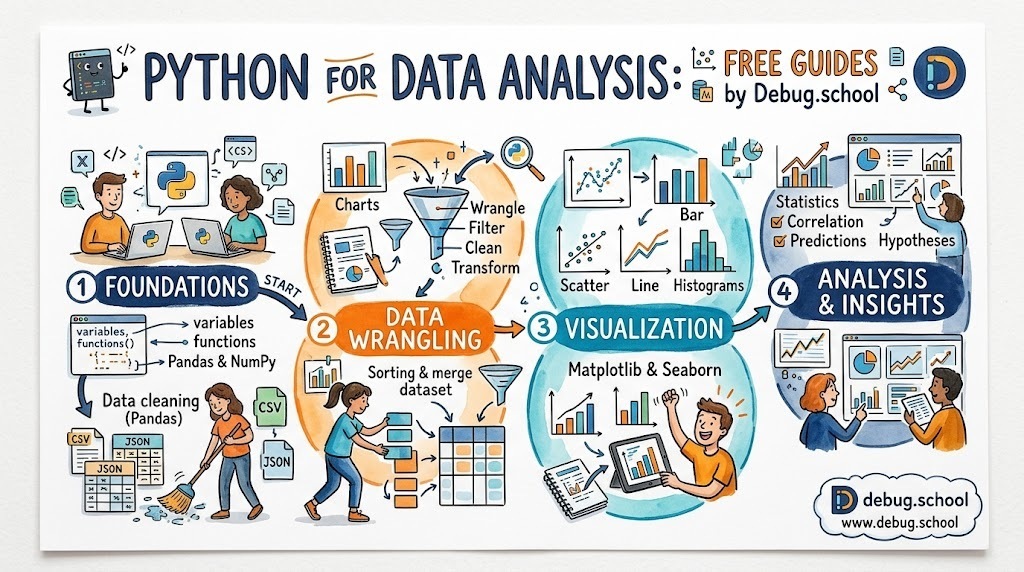
Python has transformed data science by offering readable syntax and a massive ecosystem of libraries. Consequently, modern professionals rely heavily on it to clean, transform, visualize, and model massive datasets across various industries. To help learners master these critical data skills, debug.school provides clear, structured, and accessible learning resources. Their comprehensive free guides remove traditional learning friction and enable students, developers, and engineers to build a strong foundation in programmatic data manipulation without financial barriers.
Data processing demands robust, reproducible methods rather than manual spreadsheet management. Therefore, choosing a structured learning pathway allows you to transition smoothly from basic syntax to advanced exploratory data analysis. These free instructional resources emphasize hands-on coding, real-world datasets, and production-ready techniques. By working through guided exercises, you can acquire the practical confidence needed to manage chaotic data pipelines and deliver clear, actionable business intelligence.
Key Operational Concepts You Must Know
Understanding Data Pipelines and Structuring Raw Inputs
Data pipelines serve as the backbone of any analytical architecture. Initially, raw data arrives in highly unstructured, chaotic formats, requiring structured ingest strategies. Data analysts must therefore write resilient ingestion routines that can handle inconsistent schemas, missing files, and variable network latency without breaking. Because structural integrity underpins all subsequent modeling efforts, you should always treat early-stage ingestion as a critical checkpoint.
Once raw inputs enter the pipeline, they must undergo strict schema validation and normalization. Consequently, using specialized programmatic frameworks allows engineers to enforce data types and filter out corrupt records early on. This initial preparation ensures that downstream applications receive clean, reliable structures. Ultimately, designing structured inputs minimizes engineering debt and prevents analytical errors from corrupting your business intelligence dashboards.
Mastering Exploratory Data Analysis and Statistical Verification
Exploratory data analysis helps you understand the underlying patterns, anomalies, and distributions within a newly acquired dataset. Analysts utilize descriptive statistics, such as mean, median, variance, and standard deviation, to quickly map out the boundaries of their information. Furthermore, plotting distributions allows teams to identify structural irregularities that might bias mathematical models later. Therefore, dedicated exploration should always precede any complex algorithmic development.
Statistical verification guarantees that the patterns you discover during exploration are genuinely meaningful rather than mere random noise. By applying hypothesis testing, correlation matrices, and confidence intervals, you can validate your initial assumptions with mathematical certainty. Consequently, this step prevents organizations from making expensive strategic pivots based on superficial trends or misleading outliers. Thorough verification bridges the gap between casual observation and true scientific discovery.
Platform Implementation vs. Culture — What's the Real Difference?
| Operational Aspect | Platform Implementation | Culture and Mindset |
|---|---|---|
| Primary Focus | Tool deployment, environment setup, and pipeline automation. | Collaboration, data-driven decisions, and continuous learning. |
| Core Execution | Writing scripts, managing packages, and running workflows. | Shared responsibility, code reviews, and architectural alignment. |
| Error Handling | Executing try-catch blocks and automated log collection. | Conducting blameless post-mortems and improving systems. |
| Long-Term Goal | Building scalable, highly efficient technical infrastructure. | Fostering team agility, trust, and shared analytical goals. |
Technical Environments and Tooling Infrastructure
Setting up a robust technical environment requires deliberate planning, package management, and infrastructure configuration. Developers deploy isolated virtual environments, install essential analytical packages, and configure computational runtimes to ensure predictable execution. Consequently, this mechanical layer provides the physical computation power and software tools necessary to process massive data arrays. Without a stable technical foundation, even the most elegant analytical scripts will fail to run reliably.
However, relying solely on sophisticated tooling will not guarantee organizational success. If your infrastructure is overly complex or poorly documented, team members will struggle to collaborate effectively. Therefore, platform implementation must focus on simplicity, repeatability, and seamless integration across your software stack. When you build clean, predictable technical environments, you allow engineers to focus entirely on solving complex analytical problems.
Fostering a Data-Driven Collaborative Philosophy
A healthy analytical culture encourages open collaboration, continuous knowledge sharing, and data-informed decision making across all organizational levels. Teams must feel empowered to challenge assumptions, share intermediate findings, and critique methodologies through constructive peer code reviews. This collaborative mindset shifts the organizational focus away from individual achievements toward collective system improvements. Thus, a strong data culture ensures that insights serve the entire business rather than isolated departments.
When you blend solid infrastructure with an inclusive collaborative philosophy, your engineering teams can innovate rapidly. A supportive environment removes the fear of making mistakes, which inspires developers to experiment with novel analytical methodologies. Furthermore, cross-functional communication ensures that data scientists remain fully aligned with high-level business realities. Ultimately, nurturing a data-driven culture transforms raw technical capability into sustainable, long-term operational success.
Real-World Use Cases of Modern Operations
Automated Financial Auditing and Risk Mitigation
Modern financial institutions process millions of complex transactions daily, making manual oversight completely impossible. To solve this issue, engineering teams deploy automated data pipelines that scan transaction feeds for fraudulent behavior in real time. These programmatic systems apply statistical thresholds and outlier detection algorithms to flag suspicious accounts instantly. Consequently, automation protects financial assets and ensures strict compliance with volatile global regulatory standards.
[Raw Transaction Feed] ➔ [Automated Data Pipeline] ➔ [Statistical Threshold Check] ➔ [Flag Suspicious Activity]
Beyond immediate fraud detection, automated pipelines streamline the generation of comprehensive quarterly financial risk reports. Algorithms ingest diverse market data, compute risk metrics, and compile structured summaries without human intervention. This automated approach eliminates manual spreadsheet errors and saves hundreds of hours for compliance teams. As a result, financial organizations can make rapid, data-backed decisions during sudden periods of market instability.
Scalable E-Commerce Inventory Optimization
E-commerce businesses operate in highly competitive environments where maintaining optimal inventory levels determines profitability. By utilizing programmatic analysis, retailers can evaluate historical sales trends, seasonal fluctuations, and supplier delays simultaneously. This deep logistical insight allows companies to forecast demand accurately and maintain perfect stock levels across multiple distribution hubs. Consequently, organizations can avoid costly overstock scenarios while preventing sudden inventory shortages.
- Supply Chain Coordinators: Utilize automated forecasting models to schedule inventory shipments, optimize warehouse space, and minimize global transport costs.
- Pricing Analysts: Monitor competitor pricing dynamics, evaluate consumer demand elasticity, and adjust retail prices programmatically to protect profit margins.
- Marketing Strategists: Analyze customer purchase histories to design highly targeted promotional campaigns that efficiently clear out slow-moving inventory items.
Common Mistakes in Operations Engineering
Neglecting Code Quality and Omitting Technical Documentation
Data analysts frequently write messy, unorganized code when rushing to meet tight project deadlines. They neglect clear variable naming conventions, omit helpful comments, and skip modular function design entirely. While these chaotic scripts might work initially, they quickly become impossible to maintain or scale. Therefore, maintaining strict coding standards is essential, even during the early, fast-paced exploratory phases of a project.
Moreover, failing to write clear documentation creates massive knowledge silos within your engineering team. When the author of a complex pipeline leaves the organization, remaining team members struggle to fix system failures. Consequently, omitting assembly instructions, setup guides, and schema definitions increases operational risk. Prioritizing clean code and writing comprehensive documentation ensures that your data infrastructure remains maintainable for years to come.
Overlooking Data Validation and Ignoring Processing Exceptions
Skipping thorough input validation represents one of the most dangerous mistakes an engineer can make. When pipelines blindly accept external data feeds without checking for missing values or incorrect data types, systems fail unpredictably. These unverified inputs pollute downstream databases and break analytical models silently. Thus, you must always implement strict validation rules at every entry point of your data infrastructure.
[Incoming Data Feed] ➔ [Validation Layer: Check Types/Nulls] ➔ (Passes?)
                                 |
                        +--------+--------+
                        | Yes             | No
                        ▼                 ▼
             [Process Data Safely]   [Log & Isolate Exception]
Similarly, ignoring runtime exceptions and failing to log processing errors leaves your team completely blind to systemic failures. Corrupt records can slip through unnoticed, distorting your final business reports and leading to poor corporate decisions. Implementing comprehensive error handling, try-catch blocks, and automated alerts ensures that your team identifies and isolates bugs immediately. Protecting your system against unexpected data variations preserves the long-term integrity of your analytics.
How to Become an Operations Expert — Career Roadmap
Mastering Fundamental Core Scripting and Object Architecture
To build a successful career in data analysis, you must first master foundational scripting concepts and programming logic. Focus on learning core data structures, including lists, dictionaries, tuples, and control flow loops. Developing a deep understanding of these elements allows you to manipulate data arrays efficiently. Dedicating ample time to mastering these basics provides the necessary foundation for working with advanced data science libraries.
After mastering basic syntax, focus on learning clean object-oriented programming and modular software design. Practice breaking down large, complex problems into reusable functions and well-structured classes. This architectural approach improves your code's readability and makes testing and debugging much easier. By writing clean, modular scripts, you ensure your data workflows can scale effortlessly as your datasets grow.
Embracing Advanced Package Eco-Systems and Specialized Automation
Once you master basic programming, you should learn to use specialized data libraries designed for high-performance manipulation. Master the use of dataframes to clean messy datasets, handle missing values, and merge diverse data sources. Additionally, learn to use vectorized operations to process massive matrices quickly and efficiently. Moving beyond basic loops to specialized libraries allows you to handle large-scale enterprise data challenges with ease.
- Junior Data Analyst: Focuses on cleaning raw datasets, generating basic descriptive statistics, and building clear internal tracking reports.
- Data Infrastructure Engineer: Designs scalable pipelines, optimizes database storage engines, and automates complex data transformation workflows.
- Lead Analytics Architect: Oversees the entire data strategy, selects core enterprise technologies, and aligns analytical systems with business goals.
FAQ Section
- What makes Python the preferred language for modern data analysis tasks?
Python features a remarkably clean syntax that mimics natural language, making it highly accessible to beginners and seasoned professionals alike. Furthermore, its massive ecosystem of open-source libraries simplifies complex statistical modeling, data cleaning, and visualization workflows.
- How do the free guides from debug.school help beginners learn data analysis?
The free guides break down complex programming concepts into practical, bite-sized lessons with hands-on exercises and real-world examples. This structured approach allows students to build real programming confidence without facing upfront financial barriers or overwhelming academic jargon.
- Why should data professionals focus on building automated data pipelines?
Automated pipelines eliminate manual data entry errors, reduce processing delays, and ensure business dashboards update consistently in real time. This automation frees analysts from repetitive cleaning tasks, allowing them to focus on discovering deep strategic insights.
- What are the consequences of ignoring code documentation in data projects?
Omitting clear documentation creates dangerous knowledge silos, making it incredibly difficult for teams to update or debug legacy scripts. Over time, poorly documented code increases operational costs and elevates the risk of catastrophic pipeline failures during system migrations.
- How does statistical verification protect businesses from making costly mistakes?
Statistical verification confirms that the trends discovered during exploration are mathematically valid rather than mere random coincidences. By confirming these insights, companies can make major strategic moves with confidence, avoiding expensive errors based on flawed data.
Final Summary
Embracing programmatic data analysis allows organizations and individual developers to convert chaotic, unstructured information into clear, actionable business strategies. By mastering essential tools, validation strategies, and clean coding habits, you can build reliable data pipelines that scale effortlessly. This technical expertise protects your systems from common operational mistakes and ensures long-term analytical accuracy. As businesses generate more information every day, the demand for skilled data professionals will continue to grow rapidly across every major industry.
Using high-quality, structured learning platforms remains the most effective way to master these advanced data engineering concepts. The comprehensive free resources offered by debug.school give learners a practical, step-by-step pathway to master essential programming skills and data frameworks. Dedicating time to hands-on practice, peer code reviews, and continuous system optimization will help you build a successful technical career. Ultimately, mixing strong programmatic principles with a data-driven mindset lets you solve complex business challenges with total confidence.



Top comments (0)