
Imagine an online registration system crashing during peak course enrollment because a database query timed out under heavy load. This operational bottleneck completely paralyzes student registration and frustrates thousands of users simultaneously. Modern engineering teams depend heavily on relational database optimization to maintain system performance and eliminate such structural failures entirely.
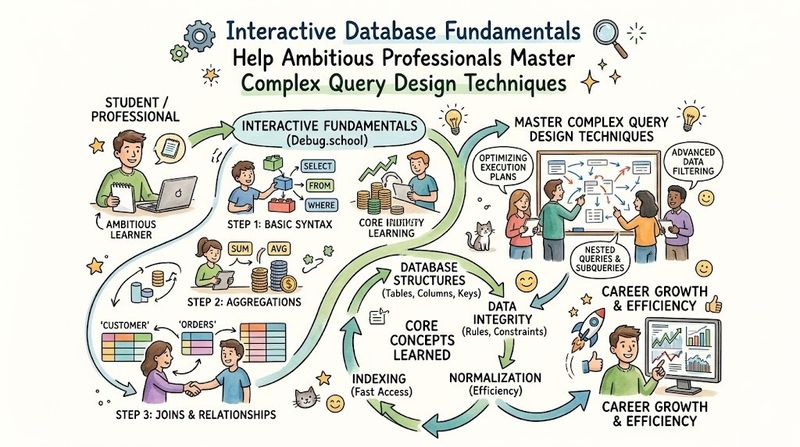
Step-by-Step SQL Learning for Students on Debug.school provides an educational framework designed to teach students how to manage, query, and optimize relational databases systematically. This guide covers foundational syntax rules, query optimization strategies, advanced join operations, and production-level database management principles.
Furthermore, you will learn how to design clean database schemas and handle complex data pipelines efficiently. Aspiring data professionals can build these essential production skills by exploring the structured curriculum available at Debug.school.
The Origin of Systems Infrastructure
The Early Industrial Bottlenecks
Traditional operations teams struggled significantly because they isolated data management from software development workflows. This fragmentation meant developers wrote application code without understanding how databases executed queries in production environments.
Consequently, unexpected system slowdowns occurred frequently because unoptimized database interactions blocked server threads. Siloed communication patterns delayed issue resolution and increased system downtime across enterprise platforms.
Moving Toward Unified Workflow Automation
As organizations recognized these structural inefficiencies, engineering teams shifted toward unified workflow automation to streamline operations. This transition bridged the operational gap between application developers and database administrators.
By automating database schema migrations and testing queries during early development cycles, companies reduced production bugs significantly. This cultural integration allowed software teams to deliver updates faster while maintaining data consistency.
Global Expansion Across Commercial Ecosystems
Modern large-scale tech enterprises rapidly adopted automated infrastructure workflows to manage massive data volumes globally. Distributed commercial ecosystems required continuous availability and automated data replication across multiple geographic zones.
As a result, data engineering principles expanded from niche web applications to global retail, healthcare, and logistics networks. Reliable data architectures now form the backbone of all modern digital services.
Defining Strategic Operations Management
The Core Operational Structure
The foundational architecture of database operations depends on a continuous flow of structured transaction information. Data moves from application endpoints into indexing pipelines where structural rules organize information for fast retrieval.
[Application Client] ---> [Query Parser] ---> [Execution Plan] ---> [Storage Engine]
This structural flow minimizes processing overhead and ensures immediate data availability for analytical systems. Proper architectural design prevents data corruption and balances computing resource consumption across clusters.
Daily Tasks of Systems Coordinators
- Analyzing slow-running queries to optimize execution paths and reduce server resource usage.
- Automating schema updates across development, staging, and production database environments.
- Monitoring database connection pools to prevent application servers from overwhelming storage nodes.
- Implementing automated backup verification procedures to secure business data against corruption.
Localized Control vs. Broad System Architecture
Managing granular components involves tuning individual table indexes, modifying specific column types, and auditing local query execution plans. Conversely, managing broad system architecture focuses on coordinating multi-region replication groups, data sharding strategies, and failover automation parameters.
Engineers must balance local performance tuning with macro-level infrastructure scaling to keep global systems responsive. Both perspectives are essential for maintaining comprehensive system health.
The Efficiency Mindset
Prioritizing long-term stability requires a shift from reactive troubleshooting to proactive software engineering practices. Teams must treat operational challenges as engineering problems by building automated validation systems instead of manually fixing recurring database issues.
This proactive approach eliminates systemic risks and allows engineers to focus on building resilient data infrastructure. Long-term reliability serves as the primary metric for architectural success.
The 7 Core Principles of Step-by-Step SQL Learning for Students on Debug.school
1. Embracing Risk and Managing Variability
Absolute system perfection remains impossible because hardware components fail, network latencies fluctuate, and software bugs occur. Data professionals manage this inevitable variability by designing database architectures that tolerate partial failures without losing information.
By defining acceptable boundaries for query latency and transient errors, teams maintain operational stability without over-engineering systems. Accepting structured risk allows organizations to innovate rapidly while preserving baseline system performance.
2. Establishing Service Level Objectives (SLOs)
Engineering groups define measurable targets for data availability and query performance to align operational realities with user expectations. These precise objectives ensure that database clusters meet specific uptime thresholds and transaction speed benchmarks.
By tracking performance metrics continuously, teams can identify degradation trends before users experience system errors. Clear performance targets guide infrastructure investment decisions and prioritize maintenance tasks effectively.
3. Eliminating Toil and Manual Processes
Repetitive, manual operations slow down engineering velocity and introduce human errors into production data systems. Teams systematically identify tasks like manual user permission updates or repetitive index rebuilds and write automation code to handle them.
Engineering away these routine operational burdens frees up valuable time for strategic architectural improvements. Minimizing human intervention directly improves the consistency and security of database infrastructure.
4. Monitoring & Observability Across the Pipeline
Comprehensive visibility across the entire data pipeline prevents hidden performance bottlenecks from disrupting downstream application workflows. Engineers collect detailed metrics, execution logs, and transaction traces from every database node in real time.
This deep observability allows teams to pinpoint the exact source of query delays, whether from lock contention or disk I/O limitations. Early detection of resource constraints prevents minor system anomalies from escalating into widespread outages.
5. Automation Over Manual Coordination
Scaling modern database operations requires software solutions to manage cluster state changes automatically instead of relying on human coordination. Automated systems handle node provisioning, traffic routing during database failovers, and horizontal scaling tasks seamlessly.
Using code to manage infrastructure guarantees that every database environment mirrors approved security and performance configurations. Programmable automation allows small engineering teams to manage massive, distributed database systems efficiently.
6. Release Engineering and Deployment Stability
Safe database evolution requires predictable, repeatable deployment strategies for schema changes and data migrations. Teams utilize automated testing frameworks to validate structural database updates against production-sized datasets before actual deployment.
Using version-controlled migration scripts ensures that infrastructure changes can roll back safely if unexpected errors arise. Stable release engineering minimizes application downtime and protects data integrity during software upgrades.
7. Simplicity in Network Architecture
Minimalist database environments naturally reduce the overall failure surface and simplify system debugging procedures. Engineers avoid overly complex clustering patterns or redundant data isolation layers that add administrative overhead without clear performance gains.
Keeping network paths and data schemas clean makes system behavior predictable during high-traffic events. Straightforward architectures are inherently easier to secure, monitor, and scale over long operational lifecycles.
Key Operational Concepts You Must Know
SLA vs. SLO vs. SLI — Explained Simply
- Service Level Agreement (SLA): The formal commitment made to external clients regarding overall platform availability, often involving financial or legal penalties if broken.
- Service Level Objective (SLO): The internal target metric that engineering teams aim for to maintain system health and keep customers satisfied.
- Service Level Indicator (SLI): The actual real-time measurement of a specific system metric, such as the exact percentage of successful database queries over a specific timeframe.
Error Budgets — The Game Changer for Operational Risk
An error budget represents the total allowable downtime or percentage of failed transactions that a system can experience over a given period. For example, a 99.9% availability objective leaves a 0.1% error budget for experimental updates, schema migrations, and feature testing.
If a team consumes their entire error budget due to frequent database failures, production deployments halt completely until stability returns. This mechanism balances the velocity of software innovation with baseline operational safety requirements.
Toil — The Silent Productivity Killer in Infrastructure
Toil encompasses administrative, repetitive tasks that lack long-term engineering value and scale linearly as system size increases. Examples include manually running clean-up scripts, resetting database user passwords, and manually pulling historical usage reports for business teams.
Organizations calculate toil by tracking engineering hours spent on operational maintenance versus strategic development projects. Eliminating toil through smart scripting and self-service portals is essential for maintaining engineering velocity.
Incident Management & Postmortems
When unexpected database failures occur, structured incident response frameworks guide teams to restore normal service operations quickly. Afterward, teams conduct blameless postmortems to analyze root causes without pointing fingers at individual engineers.
Focusing on systemic vulnerabilities rather than human errors encourages transparent reporting and drives permanent structural fixes. Documenting these lessons prevents identical system failures from repeating across the enterprise.
Capacity Planning
Data teams forecast future storage, memory, and computing requirements by analyzing historical usage trends alongside upcoming business growth projections. This strategic preparation ensures that database clusters receive timely hardware upgrades before resource utilization hits critical thresholds.
Anticipating demand spikes prevents performance degradation during major marketing events or seasonal traffic surges. Proactive scaling protects corporate platforms from suffering sudden resource exhaustion failures.
The Four Golden Signals of Pipeline Performance
| Metric | Focus Area | Operational Impact |
|---|---|---|
| Latency | Time taken to execute a database query | High latency directly degrades the end-user application experience. |
| Traffic | Total demand placed on the database engine | Tracking concurrent requests helps teams scale connection pools. |
| Errors | Rate of requests that fail explicitly | High error rates indicate schema mismatches or resource limits. |
| Saturation | Utilization level of system resources | Monitoring CPU and memory ceilings signals when to upgrade nodes. |
Platform Implementation vs. Culture — What's the Real Difference?
The Philosophy Difference
Platform implementation focuses on concrete technological mechanisms like configuring replica nodes, tuning caching layers, and deploying query optimization tools. In contrast, operational culture centers on organizational shared responsibility, engineering transparency, and a continuous desire to automate manual tasks.
While technical tools provide the infrastructure framework, a healthy operational culture ensures that teams use those systems effectively to maintain reliability. True operational excellence requires balancing both technological capability and organizational mindset.
Roles & Responsibilities Compared
- Platform Engineers: Focus on building reusable internal deployment tools, provisioning base cloud infrastructure, and maintaining shared communication pipelines.
- Database Operations Specialists: Concentrate on fine-tuning database indexing structures, optimizing specific transaction queries, and validating data integrity policies across clusters.
- Application Developers: Focus on writing business features, designing local query paths, and implementing application-level data caching mechanisms.
- Site Reliability Engineers: Monitor macro-level service availability, manage overall error budgets, and orchestrate global system failover strategies during large outages.
Can You Have Both Disciplines?
Modern technology enterprises successfully combine technical platform engineering with proactive operational cultures to achieve high delivery velocities. Software platforms provide the automated infrastructure guardrails that empower teams to test and deploy schema updates safely.
Concurrently, a shared culture of reliability prevents developers from launching unoptimized code that could compromise core storage systems. Merging these disciplines eliminates operational bottlenecks and fosters shared accountability across engineering teams.
Which One Should Your Team Adopt?
| Organization Size | Recommended Focus | Implementation Strategy |
|---|---|---|
| Early-Stage Startups | Cultural Core Foundations | Prioritize shared operational habits, simple single-instance databases, and fast manual review cycles. |
| Mid-Sized Enterprises | Hybrid Strategy Integration | Implement automated deployment pipelines while formalizing internal SLO tracking across core database clusters. |
| Global Corporations | Dedicated Platform Frameworks | Deploy advanced self-service database platforms managed by specialized reliability teams across business units. |
Real-World Use Cases of Modern Operations
How Tech Leaders Use Operational Metrics
Large software organizations analyze millions of query executions daily to find micro-level regressions in their production data layers. By tracking execution time percentiles rather than simple averages, engineers discover specific queries that cause periodic slowdowns for minor user groups.
These granular insights allow teams to fix indexing gaps before performance issues spread to broader infrastructure systems. Data-driven monitoring ensures that application response times remain predictable under varied operational conditions.
Chaos Engineering Approaches to Resilient Systems
Engineers purposefully introduce controlled disruptions into live database clusters to evaluate system recovery mechanisms under stress. For instance, a team might simulate a sudden network disconnection on a primary storage node to verify that secondary nodes assume traffic smoothly.
[Healthy Cluster] ---> [Inject Primary Node Failure] ---> [Automated Failover] ---> [Recovery Verified]
Uncovering hidden infrastructure architectural weaknesses during scheduled experiments prevents catastrophic real-world failures when actual hardware drops offline unexpectedly. Testing resilience proactively hardens production data systems against unpredictable failures.
Handling Reliability at Massive Scale
Distributed web services manage heavy write traffic by implementing data sharding strategies that split massive datasets across multiple independent database nodes. This architecture prevents any single storage machine from becoming a central bottleneck during high-volume events.
Additionally, intelligent query routing layers direct read requests to geographically close read replicas, reducing global latency metrics significantly. Distributed structures allow platforms to handle millions of simultaneous queries without performance degradation.
High-Availability in Fintech Operations
Financial transaction networks demand absolute data consistency and zero tolerance for data loss during hardware failures. These platforms utilize synchronous replication models across multiple distinct data centers to ensure every ledger entry records safely in multiple locations before confirmation.
Advanced consensus algorithms manage cluster state changes automatically to prevent conflicting account balances during sudden network partitions. Strict validation loops guarantee financial compliance and protect corporate transactional integrity around the clock.
Scaled-Down but Essential Systems for Startups
Early-stage companies apply core reliability principles efficiently by using managed cloud database services that automate fundamental backup and scaling workflows. This choice allows lean engineering teams to focus on perfecting their application query logic without spending valuable hours managing physical server hardware.
Startups protect their early growth by setting up basic, clear alerting thresholds on critical metrics like disk space and CPU saturation. Establishing these simple guardrails early prevents common resource exhaustion bugs from knocking new services offline.
Common Mistakes in Operations Engineering
Mistake 1 — Confusing System Management with Just Being On-Call
Many organizations mistakenly view operations as a reactive task centered entirely on responding to page alerts when infrastructure breaks down. This narrow approach leaves engineers trapped in a continuous cycle of firefighting, preventing them from addressing the underlying root causes of system instability.
True engineering operations requires dedicating significant time to writing automation scripts, optimizing database architecture, and building preventative system guardrails. Shift focus toward proactive software engineering to break the cycle of constant operational emergencies.
Mistake 2 — Setting Unrealistic SLOs
Demanding perfect uptime limits feature innovation because achieving absolute reliability requires freeze periods and complex, slow validation procedures. Teams that set unrealistic performance targets consume their error budgets instantly, causing unnecessary deployment delays and engineering frustration.
Instead, establish attainable objectives based on actual user satisfaction levels and realistic business requirements. This balance allows software development teams to iterate quickly while maintaining a stable user experience.
Mistake 3 — Ignoring Toil Until It's Late
Accumulating operational debt by ignoring manual, repetitive tasks eventually stalls engineering velocity completely as the underlying infrastructure grows. When engineers spend their entire working day manually running data fixes and adjusting server settings, strategic development work stops.
Organizations must treat toil as a systemic risk and actively mandate that teams automate routine activities before they overwhelm schedules. Keeping operational overhead low preserves engineering capacity for building scalable system architectures.
Mistake 4 — Skipping Blameless Postmortems
When teams assign individual blame after critical database outages, engineers naturally hide system mistakes to protect their careers. This culture of fear prevents organizations from identifying the deep architectural flaws that allowed human errors to disrupt operations.
Failing to analyze incidents thoroughly guarantees that identical system failures will happen again in the future. Embrace transparent, blameless reviews to transform operational failures into clear opportunities for infrastructural improvement.
Mistake 5 — Monitoring Without Actionable Alerts
Flooding engineering teams with notifications for minor system fluctuations that require no immediate intervention causes severe alert fatigue. Over time, exhausted engineers ignore notification channels entirely, leading them to miss critical warnings right before major database crashes occur.
Every alert configured in an observability pipeline must point to a well-defined, urgent problem that requires human intervention to solve. Cleaning up noisy telemetry monitors preserves team responsiveness for genuine system emergencies.
Mistake 6 — Not Involving Operational Engineers in the Design Phase
Developing complex data schemas and application architectures without operational input results in production systems that are incredibly difficult to monitor and scale. Software teams often launch features that perform well locally but fail under realistic enterprise workloads due to unoptimized lock patterns.
Bringing operational perspective into early architectural design phases ensures that systems are built for long-term production stability. Early collaboration eliminates costly redesign efforts late in the development lifecycle.
Essential Infrastructure Tools & Technologies
Monitoring & Observability
Engineers track relational database health metrics using comprehensive logging frameworks and performance tracing systems. These specialized tools capture detailed query statistics, engine internal events, and active connection metrics continuously.
Visual dashboards aggregate this raw telemetry, helping teams identify slow execution patterns and resource consumption anomalies quickly. Maintaining clear system visibility is the foundational step for resolving complex production performance bottlenecks.
Incident Management
Modern engineering teams coordinate their emergency outage responses using structured communication platforms that route alerts based on shifts and technical expertise. These systems integrate directly with monitoring infrastructure to dispatch critical pages when database metrics breach safe operating limits.
Centralized incident portals help teams track remediation steps, share live debugging notes, and manage stakeholder updates transparently during critical events. Organized response workflows reduce system downtime and streamline post-incident analysis.
CI/CD & Release Engineering
Automated deployment engines handle the execution of database schema modifications and configuration updates across enterprise environments seamlessly. These continuous integration tools validate migration scripts against staging databases to catch syntax errors and lock conflicts before production release.
Version-controlling structural database definitions ensures that every environment stays synchronized and reduces deployment variability. Repeatable release pipelines protect data availability during complex application upgrades.
Chaos Engineering
Specialized testing frameworks allow systems engineers to safely inject fault conditions into production environments to evaluate infrastructure resilience. These automated engines simulate server crashes, drop network packets, and exhaust computing resources according to strict experimental parameters.
Observing how database clusters adapt to live disruptions helps teams verify that automated failover mechanisms operate correctly. Proactive failure injection builds confidence in system self-healing capabilities under unexpected stress.
SLO Management
Dedicated reliability dashboards track real-time performance indicators against established compliance thresholds over rolling operational windows. These platforms calculate precise error budget consumption rates, warning engineering groups when systems approach safety limits.
Quantifying reliability helps technical leadership make informed trade-offs between launching new software features and investing in infrastructure maintenance. Objective metric tracking aligns business priorities with actual system capabilities.
How to Become an Operations Expert — Career Roadmap
Skills Every Specialist Must Have
- Advanced Terminal Command Fluency: Mastering shell scripting and navigation utilities to diagnose server issues directly on host machines.
- Database Query Optimization: Understanding execution plans, indexing strategies, and transaction isolation levels inside storage engines.
- Infrastructure as Code (IaC): Writing reproducible configuration files to provision and manage cloud storage nodes programmatically.
- Basic Application Programming: Developing foundational scripts in languages like Python or Go to automate routine administrative tasks.
The Professional Learning Path
Begin your educational journey by mastering basic relational database query syntax and learning how to structure normal schemas on local development machines. Next, progress to studying single-instance server configurations, backup automation routines, and basic performance tuning concepts.
Once comfortable with single nodes, expand your focus to distributed systems architecture, replication patterns, and automated failover orchestration. Finally, master advanced microservices integration patterns, horizontal sharding models, and enterprise-wide financial resource optimization strategies.
Certifications Worth Pursuing
Validating your database management capabilities through industry-recognized technical credentials helps advance your engineering career significantly. Leading cloud providers offer specific certifications focused on managing large-scale data systems, distributed architectural design, and automated operations.
Earning these credentials demonstrates a verified understanding of modern security practices, data replication models, and performance tuning methodologies. Professional certifications complement practical experience and highlight your technical commitment to prospective employers.
Educational Resources with Debug.school
Aspiring data professionals can build deep production skills by engaging with the structured, hands-on labs available on Debug.school. The interactive educational platform provides comprehensive step-by-step tracks designed specifically to guide students through real-world operational scenarios.
By practicing query optimization and schema design inside live, browser-based environments, you develop genuine troubleshooting confidence. Explore the specialized curriculum on Debug.school to accelerate your journey toward mastering modern database infrastructure management.
The Future of Systems Management
AI and Automation in System Optimization
Machine intelligence integrations are transforming traditional database administration by automating complex query indexing choices and forecasting resource requirements dynamically. Automated models analyze historical query logs continuously to detect subtle performance regressions without requiring constant human oversight.
These smart observability engines speed up root cause analysis during critical outages by isolating anomalous log lines instantly. Shifting routine diagnostic tasks to intelligent systems allows engineers to focus on high-level architectural innovation.
Platform Engineering — The Evolution of Infrastructure
The rise of dedicated internal developer platforms allows software teams to provision secure, pre-configured database environments independently without filing manual infrastructure requests. These self-service portals embed corporate security policies and scaling guardrails directly into the automation code automatically.
This model accelerates software delivery velocity while ensuring that all newly deployed storage nodes meet strict operational standards. Platform engineering reduces operational friction and standardizes architecture across large organizations.
Management in Cloud-Native & Kubernetes Environments
Orchestrated container clusters present unique challenges for stateful data storage, requiring specialized operators to manage database life cycles within dynamic cloud environments. Engineers utilize software controllers to automate backup schedules, scale storage volumes, and coordinate node reboots safely across distributed systems.
Managing databases as cloud-native microservices ensures that storage infrastructure scales dynamically alongside application computing layers. Embracing containerized storage patterns simplifies resource management across hybrid cloud networks.
Operational Skills That Will Matter Most
Future systems professionals must expand their expertise beyond basic infrastructure configuration toward managing cloud financial operations and auditing complex data supply chains. As cloud storage architectures grow more complex, optimizing resource costs while maintaining performance targets becomes a critical corporate priority.
Additionally, mastering deep telemetry analysis across disparate data sources is essential for diagnosing transient errors in distributed environments. Developing a multidisciplinary skillset ensures long-term career relevance in an evolving technological landscape.
FAQ Section
- What is the difference between a traditional database administrator and a modern reliability engineer? Traditional database administrators focus on manual server maintenance, user permission management, and direct query tuning tasks for isolated database instances. Modern reliability engineers treat operations as a software problem, writing automation code to manage infrastructure scale, monitor SLOs, and eliminate manual tasks systematically.
- How does an error budget help software development teams move faster safely? An error budget provides a clear, quantitative metric that defines exactly how much systemic risk a development group can take with new feature releases. As long as the database performance remains within safe compliance boundaries, developers can deploy updates independently without requiring slow manual operational reviews.
- Why are blameless postmortems critical for building reliable enterprise systems? Blameless postmortems encourage engineering teams to share technical details honestly after major production outages without fear of career punishment. This transparency allows organizations to identify deep structural vulnerabilities and implement permanent automated fixes that prevent identical system failures from repeating.
- What are the four golden signals used to monitor production database performance? The four critical metrics are latency (query execution speed), traffic (total volume of incoming requests), errors (rate of failing transactions), and saturation (utilization level of server resources like CPU and memory). Tracking these signals continuously helps teams detect performance degradation trends before users experience system issues.
- Can a small early-stage startup apply complex reliability engineering principles efficiently? Yes, startups apply these core principles by utilizing managed cloud database services that automate fundamental backup routines and infrastructure scaling tasks. By establishing simple alerting guardrails on critical resource metrics early, lean teams prevent common resource exhaustion bugs without incurring massive operational overhead.
- Which programming languages are most valuable for automation engineers to learn? Python and Go are highly valued because they feature powerful libraries for interacting with cloud provider APIs, managing system files, and writing performance tools. Additionally, mastering foundational shell scripting languages allows engineers to build quick diagnostic utilities directly on production terminal environments.
Final Summary
Maintaining reliable database systems requires a continuous commitment to clear metric observability, automated infrastructure management, and a transparent operational culture. By establishing objective performance targets and systematically engineering away manual maintenance toil, organizations protect their data platforms from unexpected production downtime. Resilient architectures adapt smoothly to shifting traffic patterns and provide a stable foundation for software feature innovation. Aspiring database experts can build these essential production tuning capabilities by engaging with the comprehensive tracks provided by Debug.school.



Top comments (0)