
What are we trying to understand?
Machine Learning
Deep Learning
Neural Networks
Generative AI
Large Language Model (LLM)
Transformer
Attention
Tokens and Tokenization
Context Window
Inference
Temperature
Top-p and Sampling
Deterministic vs Probabilistic Software
Embeddings
Hallucination
Pretraining
Prompting
Fine-tuning
RAG
Prompting vs RAG vs Fine-tuning
The complete LLM request lifecycle
Main Difference Between All the Concepts
What are we trying to understand?
As a traditional developer, you're accustomed to this:
Input
  ↓
Your Code
  ↓
Business Rules
  ↓
Database/API
  ↓
Predictable Output
For example:
if age >= 18:
    return "Adult"
else:
    return "Minor"
Same input → same logic → same output.
An LLM application behaves differently:
User Input
    ↓
Prompt / Instructions
    ↓
Tokenization
    ↓
LLM
    ↓
Probabilistic Generation
    ↓
Validation
    ↓
Application
Understanding why that middle part behaves differently is the purpose of Week 1.
Machine Learning
Definition
Machine Learning (ML) is a way of creating software where the system learns patterns from data instead of you manually programming every decision rule.
Traditional programming:
Rules + Data
     ↓
 Program
     ↓
 Output
Machine learning:
Historical Data + Expected Outputs
              ↓
           Training
              ↓
            Model
              ↓
        New Data → Prediction
Example
Suppose MotoShare wants to predict whether a booking is potentially fraudulent.
Traditional approach:
if booking_amount > 100000:
    suspicious = True
But fraud can depend on:
booking amount
user history
vehicle
location
booking frequency
payment behavior
account age
device
ML learns patterns among these features.
Purpose
Learn ML because LLMs themselves are machine-learning models.
You don't need to become a classical ML expert first, but you should understand:
data
training
model
prediction/inference
features
evaluation
Deep Learning
Definition
Deep learning is a branch of machine learning that uses multi-layer neural networks to learn complicated patterns from large amounts of data.
Artificial Intelligence
        │
        └── Machine Learning
                │
                └── Deep Learning
                        │
                        └── Generative AI
                                │
                                └── LLMs
Why do we need it?
Traditional ML can work very well for structured problems such as:
Price prediction
Fraud detection
Spam detection
Customer churn
Deep learning is particularly powerful for unstructured/high-dimensional information:
Text
Images
Audio
Video
Language
Backend analogy
Think of ML as an application and a neural network as one possible implementation engine.
You don't need to understand every transistor inside your CPU to write Laravel/Python applications.
Likewise, you don't initially need the mathematics behind every neural-network operation to build LLM systems.
Neural Networks
Definition
A neural network is a collection of connected mathematical units that transforms inputs through learned parameters called weights.
Very simplified:
INPUT
  ↓
Layer
  ↓
Layer
  ↓
Layer
  ↓
OUTPUT
During training:
Input
 ↓
Prediction
 ↓
Compare with expected result
 ↓
Calculate error
 ↓
Adjust weights
 ↓
Repeat millions/billions of times
Backend analogy
Imagine an enormous configurable function:
output = model(input, billions_of_learned_parameters)
Except developers didn't manually write all those parameters.
They were learned during training.
Why learn this?
Because terms such as:
7B model
70B model
parameters
weights
training
fine-tuning
will otherwise be confusing later.
Generative AI
Definition
Generative AI produces new content based on patterns learned during training.
It can generate:
Text
Code
Images
Audio
Video
Structured data
Traditional ML vs Generative AI
Traditional ML might answer:
Input:
"This vehicle is excellent."

Output:
Positive
Generative AI could answer:
"Write a professional description
for this vehicle."

→

"Experience comfortable city travel
with this well-maintained..."
The second system generates content.
Purpose
Agentic AI is primarily built around generative models that can reason over instructions, produce responses and increasingly invoke tools.
Large Language Model (LLM)
Definition
An LLM is a large neural network trained on huge amounts of text to predict and generate sequences of tokens.
One crucial mental model:
An LLM is fundamentally predicting what token should come next.
Suppose the input is:
The capital of India is
Possible next tokens could have probabilities resembling:
Delhi       0.91
Mumbai      0.03
India       0.02
Kolkata     0.01
The generation process continues:
Input
 ↓
Predict next token
 ↓
Append token
 ↓
Predict next token
 ↓
Append token
 ↓
Why learn this?
This explains many things you'll encounter:
temperature
hallucination
tokens
context windows
prompt engineering
sampling
Transformer
This is one of the most important Week 1 concepts.
Definition
A Transformer is a neural-network architecture designed to process sequences while determining relationships between different parts of the input.
Modern LLMs are largely built using transformer architectures.
Why was it important?
Consider:
Ashwani deposited ₹10,000 into the bank.
He withdrew ₹2,000 the next day.
How much money remains?
The model needs relationships among:
Ashwani
He
₹10,000
₹2,000
bank
withdraw
Transformers help model those relationships.
Simplified architecture
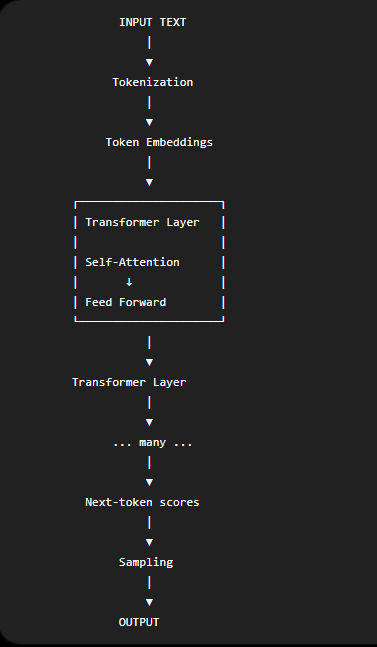
For Week 1, remember:
Transformer = architecture;
LLM = a language model commonly built using transformer architecture.
Attention
Definition
Attention allows the model to determine which parts of the available context are relevant when processing another part.
Consider:
Raj put his laptop inside his bag
because he was traveling.

What was inside the bag?
For answering the question, important relationships include:
bag ← laptop
Less important information may include:
traveling
Conceptually:
          "bag"

               │
       Attention relationships
        ↙      ↓       ↘
     Raj    laptop   traveling
             ↑
         highly relevant
Backend analogy
Think of attention loosely as dynamic relevance selection.
A backend developer might explicitly select:
SELECT relevant_columns
FROM data
WHERE condition = ...
Attention learns which parts of context matter instead of using your manually written SQL condition.
Why learn it?
Later it helps you understand:
context
RAG
long documents
prompt placement
agent memory
Tokens and Tokenization
This is extremely important for production AI.
Definition
LLMs don't directly process text as human-readable words.
Text is converted into tokens.
"AI is powerful"

       ↓ Tokenizer

[token1, token2, token3, ...]
A token might represent:
a word
part of a word
punctuation
whitespace-related units
So:
Characters ≠ Words ≠ Tokens
Why do tokens matter?
Because they affect:
API cost
context limits
latency
maximum output
Conceptually:
Cost ≈
(input tokens × input price)
+
(output tokens × output price)
Backend analogy
Tokens are somewhat like payload size.
You already care about:
HTTP request size
memory
DB query size
response size
With LLMs you additionally care about:
token budget
Context Window
Definition
The context window is the amount of tokenized information a model can consider within a request/conversation context.
It can contain more than just the latest user message.
Context Window
│
├── System instructions
├── Developer instructions
├── Conversation history
├── User message
├── Retrieved RAG documents
├── Tool results
└── Generated tokens
Important misconception
Context is not permanent memory.
If you have:
Message 1
Message 2
Message 3
...
Message 5000
you cannot assume the model permanently remembers everything.
Applications often manage this using:
truncation
summarization
RAG
external memory
sliding windows
databases
Why learn it?
Agents often maintain long-running conversations and tool results.
Bad context management produces:
high cost
high latency
lost information
context overflow
poor responses
Inference
Definition
Training teaches the model.
Inference uses the trained model.
TRAINING
Huge dataset
    ↓
Training process
    ↓
Learn weights
    ↓
Trained model
INFERENCE
Your prompt
    ↓
Trained model
    ↓
Generated response
When your FastAPI application calls an LLM API, you're normally performing inference, not training.
Backend analogy
Think:
Training ≈ building/compiling/preparing the capability

Inference ≈ executing that capability for a request
It's not a perfect analogy, but useful initially.
Temperature
Definition
Temperature controls how much variation is allowed during token selection.
Conceptually:
Temperature ↓
More predictable

Temperature ↑
More variation
Example:
Prompt:
Give me a slogan for MotoShare.
Low temperature might repeatedly produce similar direct answers.
Higher temperature may produce more diverse alternatives.
When should you use low temperature?
Tasks requiring consistency:
classification
data extraction
structured output
business decisions
API workflows
Higher temperature?
Creative tasks:
marketing copy
brainstorming
story ideas
slogans
But temperature does not magically turn the model into a truth engine.
Top-p and Sampling
The model may assign probabilities to candidate next tokens.
Example:
Delhi       70%
Mumbai      10%
Kolkata      7%
Chennai      5%
Sampling determines how the next token is selected from that probability distribution.
Temperature and top-p influence this selection.
For Week 1:
Temperature
    ↓
changes probability sharpness/variation

Top-p
    ↓
limits selection to a probability mass

Sampling
    ↓
select next token

Next token
You don't need the detailed mathematics yet.
Deterministic vs Probabilistic Software
This is a major mindset change for backend developers.
Traditional backend:
2 + 2
 ↓
4
You expect the same result every time.
LLM:
"Write a vehicle description."
             ↓
            LLM
       ↙      ↓       ↘
Response A Response B Response C
Therefore:
Traditional software

Input → Rules → Output


AI software

Input
 ↓
Prompt
 ↓
Probabilistic Model
 ↓
Possible Output
 ↓
VALIDATION
 ↓
Application
Why this matters for Agentic AI
An agent may decide:
Which tool?
What arguments?
Do I need another tool?
Is the task complete?
Therefore you cannot treat model output like trusted deterministic code.
Embeddings
This will become extremely important when you learn RAG.
Definition
An embedding converts information such as text into a numerical vector representing aspects of its semantic meaning.
"Rent a bike"
      ↓
Embedding model
      ↓
[0.13, -0.82, 0.44, ...]
Consider:
A = "I want to rent a car."

B = "I need a vehicle for hire."

C = "Python supports decorators."
Semantically:
Similarity(A, B) → HIGH
Similarity(A, C) → LOW
even though A and B don't contain exactly the same words.
Backend analogy
Traditional search:
WHERE description LIKE '%car rental%'
Semantic search:
Query
 ↓
Embedding
 ↓
Vector similarity search
 ↓
Semantically related documents
Where will you use this?
Later:
RAG
semantic search
recommendations
document retrieval
knowledge bases
similarity matching
Hallucination
Definition
Hallucination occurs when an LLM generates information that appears plausible but is unsupported, incorrect or fabricated.
Example:
User:
"What is the rental price of this vehicle?"

Context:
No price provided.

Bad model:
"The rental price is ₹1,500/day."
The model created information that wasn't available.
Why?
Remember:
LLM
 ≠
database

LLM
 ≠
truth engine

LLM
 =
probabilistic language model
Production solution
Never rely solely on:
"Please don't hallucinate."
Instead build:
User question
      ↓
Retrieve trusted data
      ↓
Provide context
      ↓
LLM
      ↓
Structured output
      ↓
Validation
      ↓
Business rules
This leads directly to RAG.
Pretraining
Definition
Pretraining is the large-scale initial training process through which an LLM learns language patterns and broad knowledge from huge datasets.
Massive dataset
      ↓
Pretraining
      ↓
General-purpose model
As an application developer, you usually do not pretrain an LLM yourself.
It's extremely expensive.
Prompting
You provide instructions and context at inference time without changing the model's underlying trained weights.
Existing Model
     +
Prompt
     +
Context
     ↓
Response
Example:
Classify this MotoShare enquiry into:
BOOKING
PAYMENT
CANCELLATION
OTHER
No model training required.
Start here first
For most application problems:
Prompting
   ↓
Structured Output
   ↓
RAG
   ↓
Fine-tuning if justified
Don't jump directly to fine-tuning.
Fine-tuning
Definition
Fine-tuning further trains an existing model using a specialized dataset to influence its behavior or capabilities for a particular task/domain.
Base Model
    ↓
Specialized training examples
    ↓
Fine-tuned Model
Don't confuse this with RAG
Fine-tuning
    ↓
changes model behavior/weights

RAG
    ↓
supplies external information at runtime
If the problem is:
"The AI doesn't know today's MotoShare vehicle inventory."
Fine-tuning is generally the wrong solution.
You want:
Database / Search
        ↓
Retrieve current vehicles
        ↓
LLM
RAG
RAG = Retrieval-Augmented Generation.
Definition
RAG retrieves relevant information from an external source and supplies that information to an LLM as context before generation.
User Question
      ↓
Create/Search representation
      ↓
Knowledge Base / Vector DB
      ↓
Relevant Documents
      ↓
Prompt + Documents
      ↓
LLM
      ↓
Answer
Why?
Your database may know:
Vehicle availability
Rental price
Booking policy
Cancellation policy
The LLM shouldn't invent these.
Retrieve them.
Then let the LLM reason/generate using them.
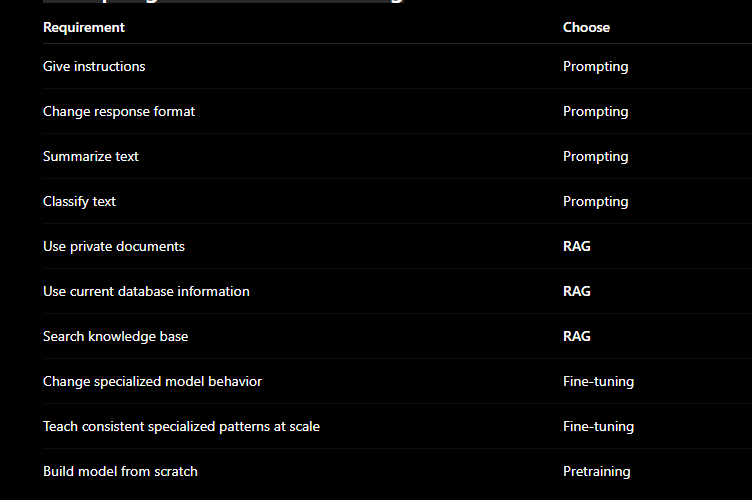
Prompting vs RAG vs Fine-tuning
The complete LLM request lifecycle
Here is the architecture you should remember:
                React Application
                          │
                          │ HTTP
                          ▼
                  ┌───────────────┐
                  │    FastAPI    │
                  └───────┬───────┘
                          │
                    Validate Input
                          │
                          ▼
                 Build Instructions
                          │
                          ▼
                System + User Prompt
                          │
                          ▼
                   TOKENIZATION
                          │
                          ▼
                ┌──────────────────┐
                │  Context Window  │
                │                  │
                │ System Prompt    │
                │ User Prompt      │
                │ History          │
                │ RAG Context      │
                │ Tool Results     │
                └────────┬─────────┘
                         │
                         ▼
                  Transformer / LLM
                         │
                  ┌──────┴──────┐
                  │ Attention   │
                  │ Neural Net  │
                  │ Parameters  │
                  └──────┬──────┘
                         │
                         ▼
                 Next-token scores
                         │
                         ▼
             Temperature / Sampling
                         │
                         ▼
                  Select Token
                         │
                         ▼
               Generate Next Token
                         │
                    repeat...
                         │
                         ▼
                   Model Output
                         │
                         ▼
                Pydantic Validation
                         │
                 ┌───────┴────────┐
                 │                │
              Valid            Invalid
                 │                │
                 ▼                ▼
           Business Logic    Retry / Reject
                 │
                 ▼
             FastAPI Response
                 │
                 ▼
                React
How everything connects
The entire Week 1 can be reduced to this mental model:
            AI
                     │
              Machine Learning
                     │
               Deep Learning
                     │
              Neural Networks
                     │
                Transformer
                     │
                    LLM
                     │
        ┌────────────┼─────────────┐
        │            │             │
      Tokens      Attention    Embeddings
        │            │             │
        └────────────┼─────────────┘
                     │
               Context Window
                     │
                   Prompt
                     │
                 Inference
                     │
        Temperature + Sampling
                     │
               Generated Output
                     │
              Possible Hallucination
                     │
                  Validation
                     │
             Production Application
What you need to know before moving forward
Don't memorize definitions. You should be able to explain these relationships:
ML → Deep Learning → Neural Network → Transformer → LLM
and:
Text → Tokens → Context → Transformer → probabilities → sampling → tokens → response → validation
and finally:
Prompting = give instructions

RAG = give external/current knowledge

Fine-tuning = modify model behavior through additional training

Pretraining = create the general model capability
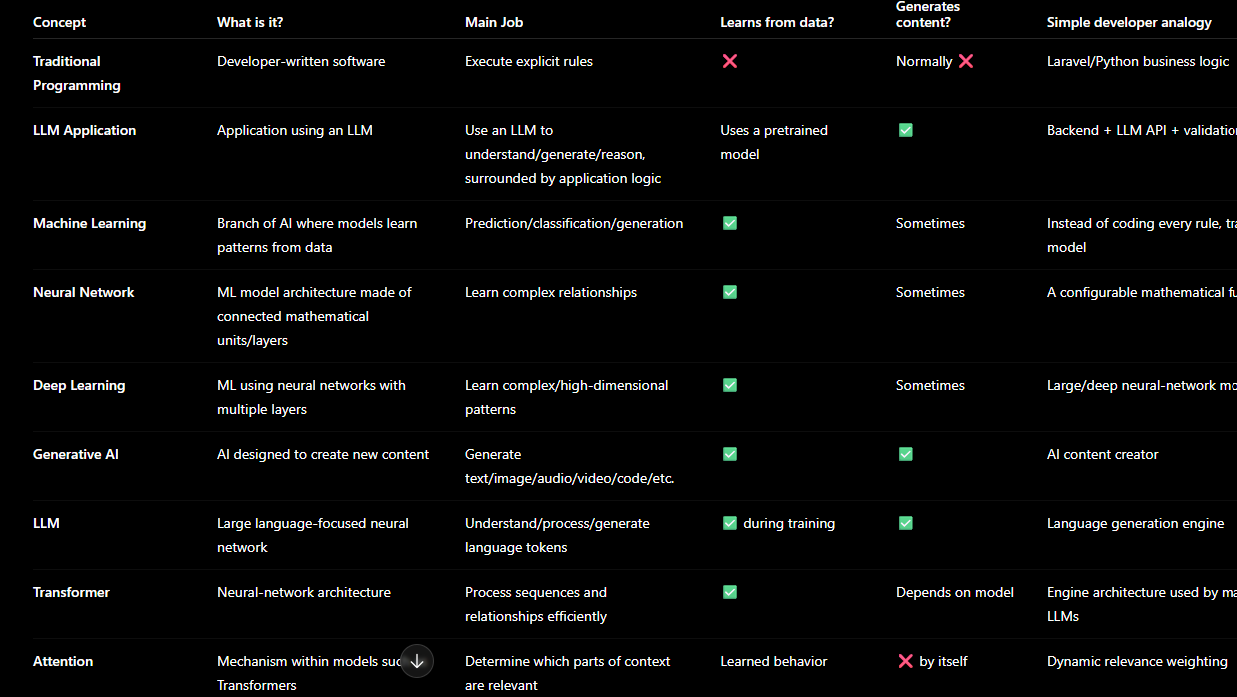
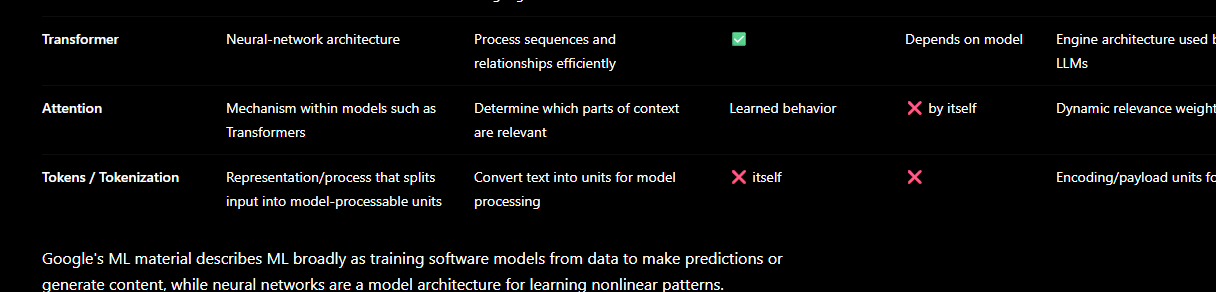
Main Difference Between All the Concepts



Top comments (0)