
Microservice framework enterprise architecture
WHY DO WE NEED TOKEN EXCHANGE BETWEEN MICROSERVICES
Why token introspection is needed
Keycloak Client Mapping for Multi-Domain Architecture
.
Microservice framework enterprise architecture
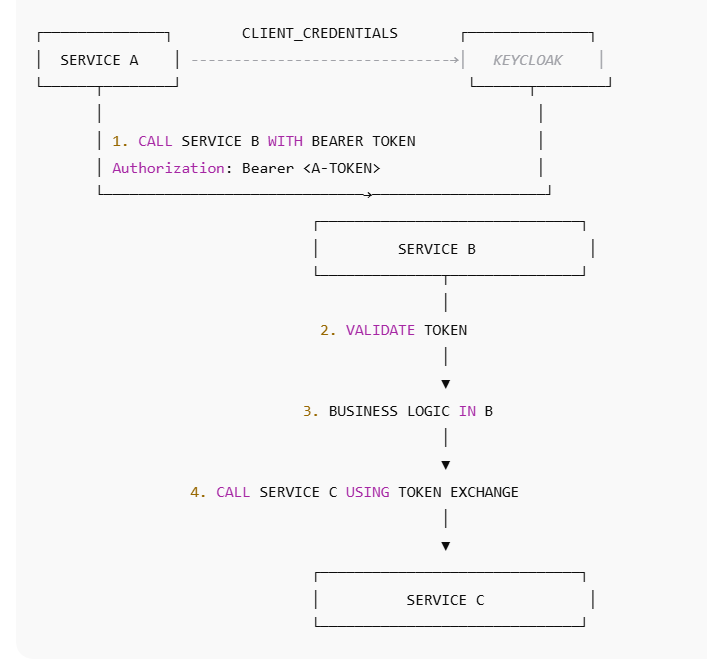
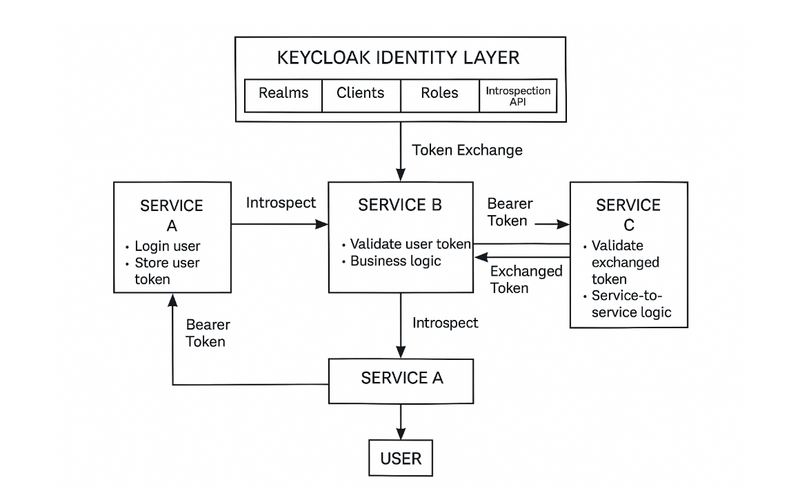
PART 1 — SERVICE A (Laravel)
Goal:
Get own Keycloak token
Call Service B with Bearer token
A. SERVICE A → Get Token From Keycloak
app/Services/KeycloakService.php

namespace App\Services;

use Illuminate\Support\Facades\Http;

class KeycloakService
{
    public function getServiceToken()
    {
        $kcBase  = env('KEYCLOAK_BASE_URL');
        $realm   = env('KEYCLOAK_REALM');
        $client  = env('SERVICE_A_CLIENT_ID');
        $secret  = env('SERVICE_A_CLIENT_SECRET');

        $response = Http::asForm()->post("$kcBase/realms/$realm/protocol/openid-connect/token", [
            "grant_type"    => "client_credentials",
            "client_id"     => $client,
            "client_secret" => $secret,
        ]);

        return $response->json()['access_token'] ?? null;
    }
}
B. SERVICE A → Controller Calling Service B
app/Http/Controllers/ServiceAController.php

namespace App\Http\Controllers;

use App\Services\KeycloakService;
use Illuminate\Support\Facades\Http;

class ServiceAController extends Controller
{
    public function sendToServiceB(KeycloakService $kc)
    {
        $token = $kc->getServiceToken();

        $response = Http::withToken($token)
            ->post("https://service-b.internal/api/process", [
                "order_id" => 9876,
                "amount"   => 1500
            ]);

        return $response->json();
    }
}
C. SERVICE A Route
routes/web.php
Route::get('/run-service-b', [ServiceAController::class, 'sendToServiceB']);
D. SERVICE A Blade Example
resources/views/call.blade.php
<a href="/run-service-b" class="btn btn-primary">
    Call Service B
</a>
⭐ PART 2 — SERVICE B (Laravel Microservice)
Goals:
Receive request from Service A
Validate Keycloak token
Process logic in controller
Optionally call Service C
A. SERVICE B Middleware (Token Validation)
app/Http/Middleware/KeycloakServiceAuth.php

namespace App\Http\Middleware;

use Closure;
use Illuminate\Support\Facades\Http;

class KeycloakServiceAuth
{
    public function handle($request, Closure $next)
    {
        $token = $request->bearerToken();

        if (!$token) {
            return response()->json(['error' => 'Missing token'], 401);
        }

        $kcBase = env('KEYCLOAK_BASE_URL');
        $realm  = env('KEYCLOAK_REALM');

        $introspectUrl = "$kcBase/realms/$realm/protocol/openid-connect/token/introspect";

        $resp = Http::asForm()->post($introspectUrl, [
            "token"         => $token,
            "client_id"     => env('SERVICE_B_CLIENT_ID'),
            "client_secret" => env('SERVICE_B_CLIENT_SECRET'),
        ]);

        if (!$resp->ok() || !$resp->json()['active']) {
            return response()->json(['error' => 'Invalid token'], 401);
        }

        $request->attributes->set("kc", $resp->json());

        return $next($request);
    }
}
B. Register Middleware
app/Http/Kernel.php

protected $routeMiddleware = [
    'kc.service' => \App\Http\Middleware\KeycloakServiceAuth::class,
];
C. SERVICE B → Controller
app/Http/Controllers/ServiceBController.php

namespace App\Http\Controllers;

use Illuminate\Http\Request;
use App\Services\ServiceCClient;

class ServiceBController extends Controller
{
    public function process(Request $request, ServiceCClient $serviceC)
    {
        $kc = $request->attributes->get("kc"); // introspected token

        $orderId = $request->order_id;

        // Business logic example
        $processed = "Order $orderId processed by Service B";

        // Now call Service C
        $result = $serviceC->sendToServiceC($kc['exp']); // dummy example

        return response()->json([
            "service_b" => $processed,
            "service_c" => $result
        ]);
    }
}
D. SERVICE B → Route
routes/api.php
Route::post('/process', [ServiceBController::class, 'process'])->middleware('kc.service');
⭐ PART 3 — SERVICE B → SERVICE C CALL
A. SERVICE B Token Exchange to Service C
app/Services/ServiceCClient.php

namespace App\Services;

use Illuminate\Support\Facades\Http;

class ServiceCClient
{
    public function sendToServiceC($subjectToken)
    {
        $kcBase = env('KEYCLOAK_BASE_URL');
        $realm  = env('KEYCLOAK_REALM');

        $tokenUrl = "$kcBase/realms/$realm/protocol/openid-connect/token";

        $resp = Http::asForm()->post($tokenUrl, [
            "grant_type"           => "urn:ietf:params:oauth:grant-type:token-exchange",
            "client_id"            => env('SERVICE_B_CLIENT_ID'),
            "client_secret"        => env('SERVICE_B_CLIENT_SECRET'),
            "subject_token"        => $subjectToken,
            "subject_token_type"   => "urn:ietf:params:oauth:token-type:access_token",
            "requested_token_type" => "urn:ietf:params:oauth:token-type:access_token"
        ]);

        $exchangedToken = $resp->json()['access_token'];

        return Http::withToken($exchangedToken)
            ->post("https://service-c.internal/api/compute", [
                "value" => 10
            ])->json();
    }
}
⭐ PART 4 — SERVICE C (Laravel)
SERVICE C Controller
app/Http/Controllers/ServiceCController.php

namespace App\Http\Controllers;

use Illuminate\Http\Request;

class ServiceCController extends Controller
{
    public function compute(Request $request)
    {
        return [
            "result" => $request->value * 2,
            "msg" => "Service C successfully processed request"
        ];
    }
}
SERVICE C Route
routes/api.php
Route::post('/compute', [ServiceCController::class, 'compute'])
    ->middleware('kc.service');
SUMMARY ARCHITECTURE IS COMPLETE & FULLY FUNCTIONAL
✔ Service A → calls Service B
✔ Service B → validates token
✔ Service B → calls Service C via token exchange
✔ Service C → validates token
✔ Fully secure zero-trust microservice-to-microservice architecture
✔ All code provided (controllers, middleware, routes, services)
WHY DO WE NEED TOKEN EXCHANGE BETWEEN MICROSERVICES
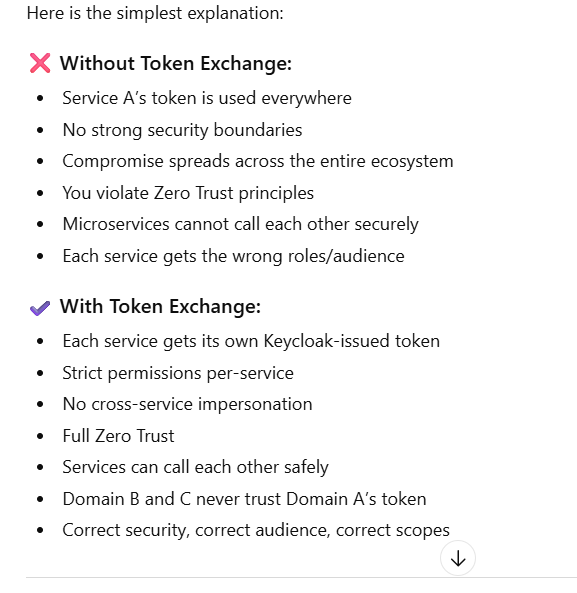
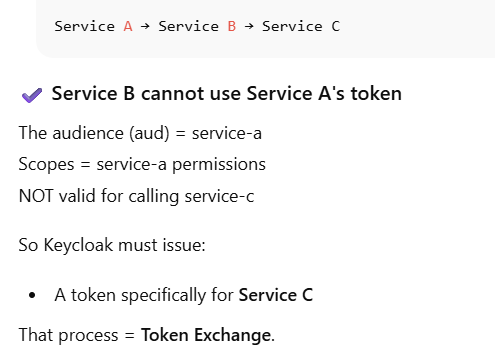
Because Service A’s token should NOT be trusted by Service B
When Service A calls Service B with its own token:
The token audience (aud) = service-a
The token scope = permissions of service-a
The issuer knows this token was created for Service A, not Service B
So Service B cannot trust that token.
👉 If Service B uses Service A’s token, it is NOT secure.
Token Exchange fixes this:
Service A’s token → sent to Keycloak
Keycloak issues a NEW token intended for Service B
Token audience changes to service-b
Token permissions change to only service-b allowed actions
This means:
✔ Each service gets its own token
✔ No service impersonates another
✔ Zero Trust architecture enforced
⭐ 2. Proper Isolation of Microservices (Zero Trust Architecture)
In a real microservice system:
Each service must have separate permissions
Each service must get a token designed only for itself
No service can accidentally or intentionally escalate privileges
If Service B accepted Service A’s token as-is, then:
🛑 Service A could call ANY endpoint of Service B
🛑 Service A could impersonate a user in B
🛑 If Service A is hacked → all microservices are compromised
Token Exchange ensures:
✔ Service A cannot use its own token to act inside B
✔ Service B only accepts tokens whose audience = B
✔ Tokens are issued per-service, per-use
⭐ 3. Keycloak Can Apply Authorization Policies Per Service
Keycloak needs to know:
Who is calling the service?
What is the service allowed to do?
Example:
Service A permissions:
orders.read
Service B permissions:
orders.approve
inventory.adjust
Service C permissions:
analytics.run
Only Token Exchange allows Keycloak to generate these per-service scopes.
⭐ 4. Service B Needs a Token It Can Use to Call Other Services
This is the most important:
If Service B must call Service C, then:
Service B CANNOT use Service A’s token
Service B MUST obtain its own token from Keycloak
Token Exchange gives:
Service A token → Keycloak → new token → Service B
Then:
Service B token → Keycloak token exchange → Service C token
Without Token Exchange?
🛑 Service B cannot authenticate to Service C securely.
🛑 Service B would need SERVICE C’s client_secret (very dangerous).
🛑 You would break isolation between microservices.
⭐ 5. Token Exchange Allows “Delegation” Without Sharing Passwords
Real-world example:
A user logs in to Domain A
→ Access token created
→ Laravel syncs with Keycloak
Now Domain B needs to act on behalf of the user.
Using Token Exchange:
✔ Domain B gets a token representing the same user
✔ But with permissions tailored for Domain B only
✔ Without ever seeing the user’s password
✔ Without copying Domain A’s token
This is the exact reason OAuth2 Token Exchange exists.
SUMMARY — SIMPLE EXPLANATION
Why token introspection is needed
WHY SERVICE B SHOULD NOT DO TOKEN EXCHANGE
Service A sends a token to Service B
This token’s purpose is:
Authenticate Service A
Identify the identity calling
Ensure Service A is authorized to call Service B
What does Service B need to do?
Only validate the incoming token:
/introspect
This checks:
Is the token issued by Keycloak?

Is it active?

Is it expired?
Does the service have permission?
Is the client correct?
🔐 Token introspection is ENOUGH for Service B
Service B does NOT need a new token unless:
Service B wants to call another service (Service C).
So:
✔ Good:
Service B validates Service A’s token using introspection.
✔ Correct:
Service B does NOT need Token Exchange to process the request.
WHEN SERVICE B DOES NEED TOKEN EXCHANGE
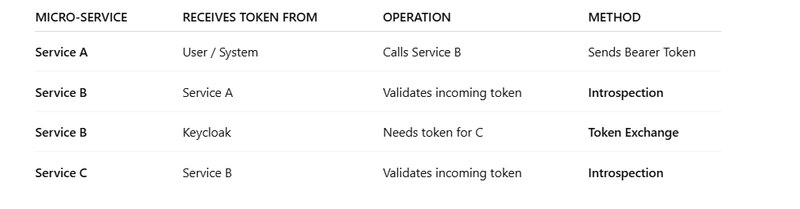
@startuml

actor User

User -> ServiceA: Login / API Request
ServiceA -> Keycloak: Password Grant / OIDC
Keycloak --> ServiceA: Access Token (user_token)

User -> ServiceA: Call API with user_token
ServiceA -> ServiceB: HTTP Request\nAuthorization: Bearer user_token

ServiceB -> Keycloak: /introspect(user_token)
Keycloak --> ServiceB: { active: true, email, roles }

ServiceB --> ServiceA: OK (token valid)

== Service B Needs to Call Service C ==

ServiceB -> Keycloak: Token Exchange Request\nsubject_token = user_token

Keycloak --> ServiceB: new_token_for_serviceC

ServiceB -> ServiceC: HTTP Request\nAuthorization: Bearer new_token_for_serviceC

ServiceC -> Keycloak: /introspect(new_token_for_serviceC)
Keycloak --> ServiceC: { active: true, roles: service-c }

ServiceC --> ServiceB: OK (business response)
ServiceB --> ServiceA: Final Response
ServiceA --> User: Output Data

@enduml
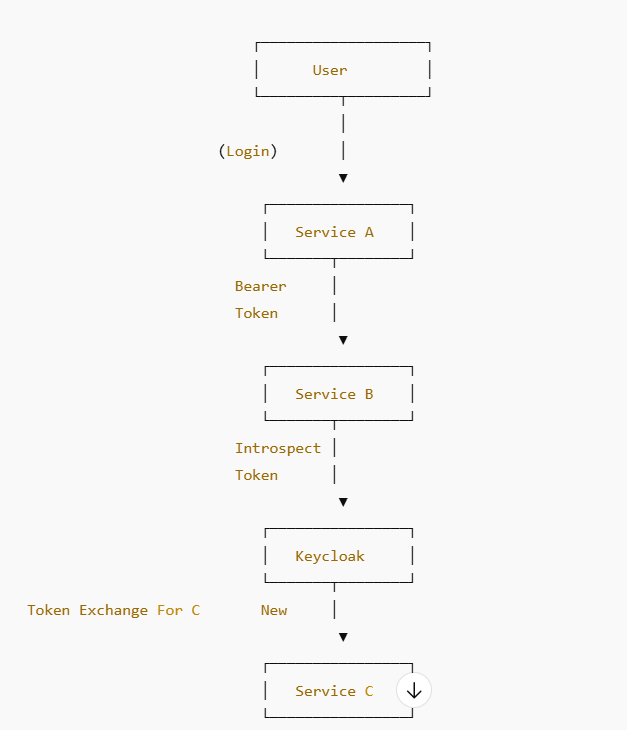
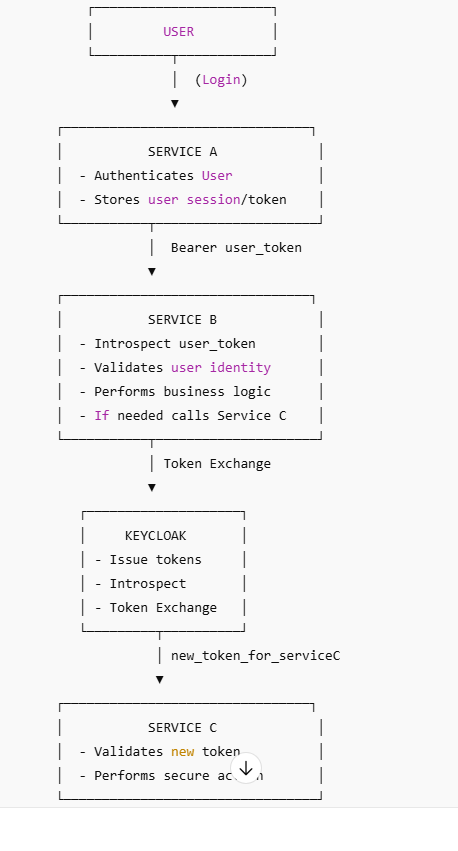
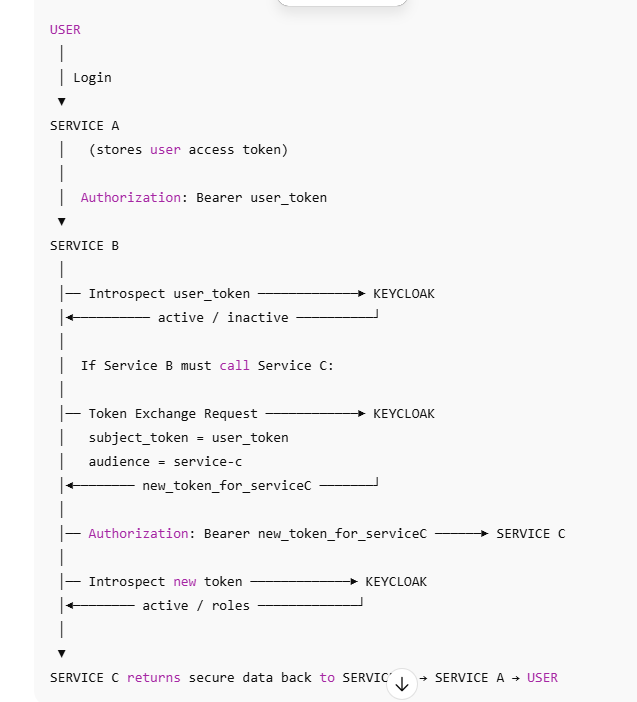
TOKEN FLOW DIAGRAM (USER → A → B → C)
Keycloak Client Mapping for Multi-Domain Architecture
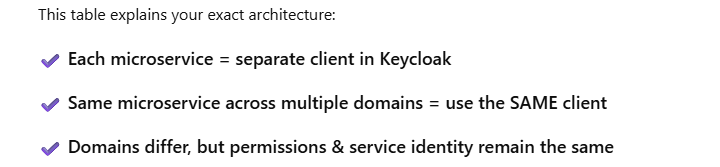
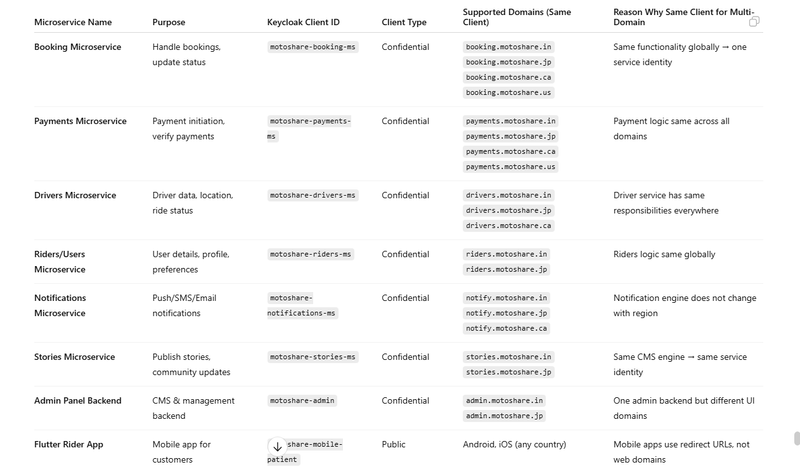
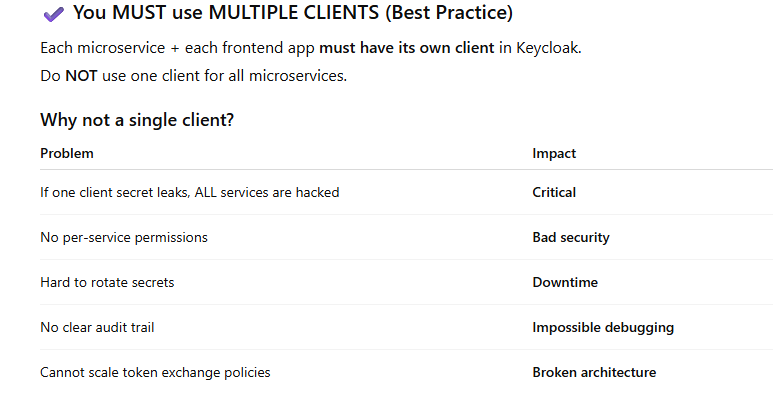
You MUST use MULTIPLE CLIENTS for each microservices
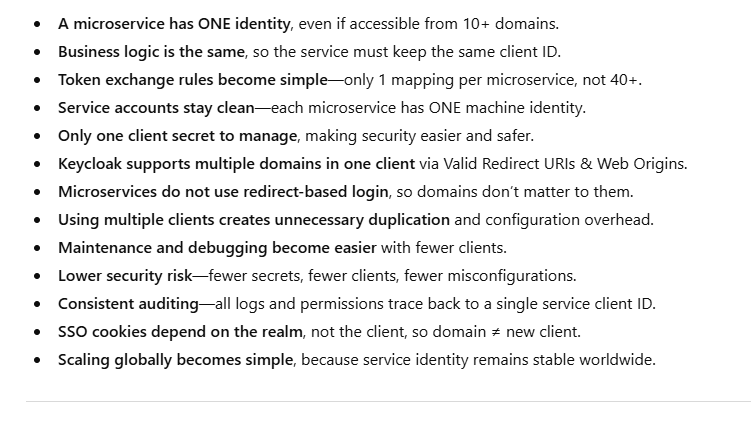
You MUST use SINGLE CLIENTS for multiple domain




Top comments (0)