
AI Engineer + Agentic AI Developer
Weeks 1–2: Python and AI foundations
Weeks 3–4: LLM application development
Weeks 5–6: Embeddings and RAG
Weeks 7–8: Agentic AI fundamentals
Week 9: MCP
Week 10: Multi-agent systems
Week 11: Evaluation, safety and observability
Week 12: Production deployment
Here's the strategy I would follow if I were in your position
The YouTube link you shared is currently titled “China’s New Education Policy” and discusses AI education in schools; it does not appear to be a developer roadmap for becoming an AI expert.
For a developer with 6 years of coding experience, you can become a strong AI application and Agentic AI engineer in 12 weeks. Becoming an AI researcher or model-training expert will take considerably longer.
Target role
Focus on becoming an:
AI Engineer + Agentic AI Developer
You should be able to build:
LLM-powered applications
RAG systems using company documents
Tool-calling agents
MCP servers
Multi-step agent workflows
Production-ready AI APIs
Evaluation, monitoring and security systems
Recommended technology stack
Use:
Python
FastAPI
OpenAI or another major LLM API
PostgreSQL + pgvector
Redis
Docker
LangGraph
MCP
Hugging Face
GitHub Actions
Continue using Laravel for your main applications, but create a separate Python AI microservice. Laravel can communicate with it through REST APIs or queues.
12-week AI and Agentic AI roadmap
Weeks 1–2: Python and AI foundations
Do not spend months learning mathematics first.
Learn:
Python syntax, classes and type hints
Virtual environments and package management
NumPy and Pandas basics
FastAPI
Async programming
REST APIs
JSON Schema and Pydantic
Understand these AI concepts:
Machine learning versus deep learning
Neural networks
Transformers
Tokens
Embeddings
Context windows
Temperature
Inference
Training versus fine-tuning
Project
Build a FastAPI service:
POST /summarize
POST /classify
POST /extract
POST /chat
Connect it to one of your Laravel applications.
Weeks 3–4: LLM application development
Learn:
System, user and assistant messages
Prompt engineering
Structured JSON output
Function and tool calling
Streaming responses
Conversation history
Token and cost management
Retry and fallback handling
Do not only practise prompts inside ChatGPT. Write actual API-based applications.
Project
Build an AI Trip Creation Assistant for HolidayLandmark:
User provides:
- Destination
- Number of days
- Budget
- Traveller type

AI generates:
- Title
- Summary
- Daily itinerary
- Highlights
- Pricing suggestion
- Required JSON data
Validate every response using Pydantic before storing it.
Weeks 5–6: Embeddings and RAG
Learn:
Document chunking
Embedding models
Vector databases
Semantic search
Metadata filtering
Hybrid search
Reranking
Citations
RAG evaluation
Project
Build a DevOpsSchool Knowledge Assistant that answers questions using:
Documentation
README files
Course information
Existing test cases
Troubleshooting guides
Store embeddings in PostgreSQL using pgvector.
The system should always return:
{
  "answer": "...",
  "sources": [],
  "confidence": 0.0
}
Weeks 7–8: Agentic AI fundamentals
An agent is not simply a chatbot. It receives a goal, chooses tools, performs actions, observes results and continues until it finishes or needs human approval.
Learn:
Agent loop
Tools and actions
Planning
State management
Short-term and long-term memory
Deterministic workflows versus autonomous agents
Human-in-the-loop approval
Error recovery
Idempotency
LangGraph is designed for long-running, stateful agent workflows and supports concepts such as shared state, nodes, persistence and memory.
Project
Build a Production Error Investigation Agent:
- Read Laravel logs
- Identify the likely error
- Search the relevant repository
- Check migrations and configuration
- Suggest a fix
- Generate tests
- Ask for approval
- Never modify production automatically
Start with a fixed workflow. Add autonomous decision-making only where it is genuinely necessary.
Week 9: MCP
MCP is an open standard that lets AI applications connect to external tools and data sources. MCP servers can expose resources, tools and reusable prompts.
Learn:
MCP host, client and server
Resources
Tools
Prompts
Tool schemas
Authentication
Permission boundaries
Local and remote MCP servers
Project
Create a MotoShare MCP server exposing safe tools:
get_vehicle
search_bookings
get_payment_status
read_application_logs
create_support_ticket
Do not expose dangerous tools such as unrestricted SQL execution or arbitrary shell commands.
Week 10: Multi-agent systems
Learn:
Supervisor and worker pattern
Router pattern
Planner and executor
Reviewer or critic pattern
Parallel workers
Agent handoffs
Shared state
When not to use multiple agents
Project
Build a Software QA Agent Team:
Requirement Agent
↓
Test Planner
↓
UI Test Generator
↓
API Test Generator
↓
Security Reviewer
↓
Final Test Report
Each agent should have a clearly limited responsibility. Avoid creating multiple agents merely because it looks advanced.
Week 11: Evaluation, safety and observability
This is what separates a demo developer from a professional AI engineer.
Learn:
Golden test datasets
Prompt regression testing
RAG evaluation
Tool-call accuracy
Hallucination checks
Latency and cost tracking
Prompt injection protection
Output validation
Rate limiting
Audit logging
Human approval for destructive actions
Create at least 50 test cases covering:
Normal request
Missing information
Incorrect information
Prompt injection
Tool failure
Timeout
Malformed output
Repeated execution
Unauthorized action
Very large input
Week 12: Production deployment
Learn:
Docker
Queue workers
Redis
Background jobs
Webhooks
Secrets management
API authentication
Logging and tracing
Model fallbacks
Caching
Cost limits
CI/CD
Horizontal scaling
Final project
Build one complete enterprise AI system:
AI Operations Assistant
It should:
Read GitHub repositories
Read Laravel logs
Read project documentation
Search known solutions
Create an investigation report
Suggest code changes
Generate test cases
Open a draft pull request
Require human approval
Maintain an audit trail
Daily routine
Study for 2–3 hours per day, six days per week:
30 minutes – Theory
60 minutes – Coding
30 minutes – Project work
30 minutes – Testing and documentation
Use this rule:
20% learning
70% building
10% publishing and explaining
Every week, publish:
One GitHub project
One README containing architecture and decisions
One demonstration video
One short technical article
Best learning order
Python and FastAPI
LLM APIs and structured output
Embeddings and RAG
Tool calling
Agent workflows
LangGraph
MCP
Evaluation and security
Deployment
Multi-agent systems
The free Hugging Face Agents Course covers agent theory, design and frameworks including smolagents, LlamaIndex and LangGraph. Its LLM course covers transformers, tokenizers, datasets and related foundations.
Important advice
Do not spend your first months on:
Training an LLM from scratch
Advanced mathematics without building anything
Learning five agent frameworks
Creating autonomous agents for every problem
Watching tutorials without completing projects
Depending entirely on generated code
Choose one stack, build four serious projects and learn how to evaluate them.
After 12 weeks, your realistic position should be:
Production-oriented AI and Agentic AI Developer, capable of adding reliable AI features and agents to Laravel, Python and enterprise applications.
You will not yet be an AI research scientist, but you can be employable and productive in applied AI.
Here's the strategy I would follow if I were in your position
The roadmap you shared is good because it focuses on AI Engineering + Agentic AI, not AI research. That's exactly the direction experienced developers should take. Similar roadmaps from AI engineering communities also emphasize building production systems rather than spending months on theory.
Here's the strategy I would follow if I were in your position
Documentation (20%)
Only for understanding APIs and frameworks.
Examples:
OpenAI API docs
Anthropic docs
LangGraph docs
MCP documentation
FastAPI docs
Documentation should answer:
How does this work?
What APIs are available?
Best practices?
Do not read documentation cover to cover.
ChatGPT / Claude (40%)
This should become your personal teacher.
Instead of searching YouTube:
❌ "LangGraph tutorial"
Ask:

Explain LangGraph assuming I'm a Laravel developer.

Then

Build a simple project.

Then

Why do we use StateGraph?

Then

Show production architecture.

Then

Give interview questions.
This reduces 10 hours of video into 1 hour.
Official Tutorial (20%)
Use only official quickstarts.
For example
OpenAI Quickstart
LangGraph Quickstart
MCP Quickstart
LlamaIndex Quickstart
Never watch a 5-hour playlist first.
YouTube (20%)
Use videos only when:
a concept is confusing
architecture needs visualization
you want to see implementation
Watch only:
Fireship
freeCodeCamp
IBM Technology
Microsoft Developer
Anthropic/OpenAI official videos
Avoid "100 videos on LangChain."
The learning cycle
For every topic:
Step 1
Ask ChatGPT

↓

Step 2
Read official documentation (20 minutes)

↓

Step 3
Build it

↓

Step 4
If stuck
Watch a 15-minute YouTube video

↓

Step 5
Build a better version
That is probably 5× faster than video-first learning.
Don't study. Build.
This is where most developers fail.
Instead of
Week 1

Prompt Engineering

Do

Build

AI Email Generator

Instead of

Week 2

RAG

Build

Company Knowledge Chatbot

Instead of

Week 3

MCP

Build

AI that controls your filesystem

Instead of

Week 4

Agents

Build


AI Travel Planner
Every topic should produce a GitHub repository.
Since you're already a Laravel developer
Your roadmap should be different from beginners.
Skip
Python basics
Variables
Loops
Functions
Git
HTTP
REST API
SQL
You already know these concepts.
Only learn Python syntax differences as needed.
Spend time here instead
LLMs
Prompt Engineering
Structured Outputs
Function Calling
Embeddings
Vector Databases
RAG
Memory
AI Agents
LangGraph
MCP
Multi-agent systems
Evaluation
AI Security
Production deployment
These are the skills that differentiate an AI engineer from a traditional backend developer.
My weekly schedule (15 hours/week)
Monday (2 hrs)
Learn one concept with ChatGPT
Read official docs
Tuesday (2 hrs)
Build a mini project
Wednesday (2 hrs)
Improve the project
Thursday (2 hrs)
Read architecture
Learn best practices
Friday (2 hrs)
Add new features
Saturday (4 hrs)
Build one complete project
Sunday (1 hr)
Write notes
The biggest shortcut
Don't create demo projects.
Create AI features for your own products.
For example:
MotoShare
AI vehicle description generator
AI pricing recommendation
AI support chatbot
AI fraud detection
AI booking assistant
MyHospitalNow
AI symptom assistant
AI treatment comparison
AI hospital recommendation
AI appointment scheduler
AI medical FAQ
HolidayLandmark
AI trip planner
AI itinerary generator
AI travel assistant
AI multilingual guide
AI review summarizer
These projects will immediately improve products you're already building and create a portfolio that demonstrates production experience.
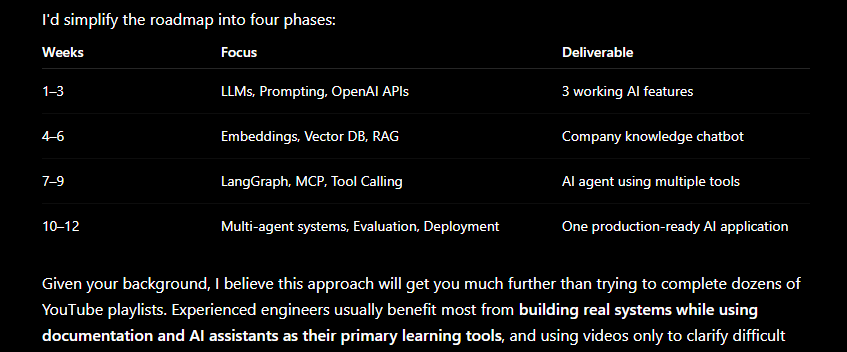
If your goal is to become an AI/Agentic AI developer in 12 weeks
I'd simplify the roadmap into four phases:
If your goal is to become an AI/Agentic AI developer in 12 weeks
Here's the strategy I would follow if I were in your position



Top comments (0)