
Basic Programming Coding example
Project-Level / Real-Time Validation Examples (with output)
Multiple conditions inside and_then
Using filter() (Cleaner & Recommended)
Using match with guard (Very Clean Rust Way)
Return different error messages per condition (Better for APIs)
Full Updated Payment Example (Multiple Conditions + Currency)
User Registration Validation (username + email + age)
Product Order Validation (price + quantity + stock)
Login Validation (username + password + role)
Booking Validation (start_time + end_time + seats)
Payment Validation (amount + currency + user_id + status)
Basic Programming Coding example
1) Validate username is not empty
fn main() {
    let input = "ashwani";

    let username = if input.trim().is_empty() { None } else { Some(input.trim()) };

    match username {
        Some(u) => println!("OK: username = {}", u),
        None => println!("ERR: username is required"),
    }
}
Output
OK: username = ashwani
2) Validate number is positive (parse + check)
fn main() {
    let raw = "12";

    let n = raw.parse::<i32>().ok().and_then(|v| if v > 0 { Some(v) } else { None });

    match n {
        Some(v) => println!("OK: positive number = {}", v),
        None => println!("ERR: invalid or not positive"),
    }
}
Output
OK: positive number = 12
3) Validate age >= 18
fn main() {
    let raw_age = "17";

    let age = raw_age.parse::<u8>().ok().and_then(|a| if a >= 18 { Some(a) } else { None });

    match age {
        Some(a) => println!("OK: allowed, age={}", a),
        None => println!("ERR: must be 18+"),
    }
}
Output
ERR: must be 18+
4) Validate email contains '@' and '.'
fn main() {
    let email_raw = "test@gmail.com";

    let email = {
        let e = email_raw.trim();
        if e.contains('@') && e.contains('.') { Some(e) } else { None }
    };

    match email {
        Some(e) => println!("OK: email={}", e),
        None => println!("ERR: invalid email"),
    }
}
Output
OK: email=test@gmail.com
5) Validate OTP length exactly 6 digits
fn main() {
    let otp_raw = "12345a";

    let otp = {
        let s = otp_raw.trim();
        if s.len() == 6 && s.chars().all(|c| c.is_ascii_digit()) { Some(s) } else { None }
    };

    match otp {
        Some(v) => println!("OK: otp={}", v),
        None => println!("ERR: OTP must be 6 digits"),
    }
}
Output
ERR: OTP must be 6 digits
6) Validate minimum password length (>= 8)
fn main() {
    let pass = "secret12";

    let valid = if pass.len() >= 8 { Some(pass) } else { None };

    match valid {
        Some(_) => println!("OK: password length valid"),
        None => println!("ERR: password too short"),
    }
}
Output
OK: password length valid
7) Validate allowed role using match
fn main() {
    let role_raw = "admin";

    let role = match role_raw {
        "admin" => Some("Admin"),
        "viewer" => Some("Viewer"),
        _ => None,
    };

    match role {
        Some(r) => println!("OK: role={}", r),
        None => println!("ERR: role not allowed"),
    }
}
Output
OK: role=Admin
8) Validate list is not empty
fn main() {
    let items: Vec<i32> = vec![];

    let non_empty = if items.is_empty() { None } else { Some(items.len()) };

    match non_empty {
        Some(n) => println!("OK: items count={}", n),
        None => println!("ERR: list cannot be empty"),
    }
}
Output
ERR: list cannot be empty
9) Validate string max length <= 10
fn main() {
    let city = "Dhanbad";

    let ok = if city.chars().count() <= 10 { Some(city) } else { None };

    match ok {
        Some(v) => println!("OK: city={}", v),
        None => println!("ERR: city too long"),
    }
}
Output
OK: city=Dhanbad
10) Validate two inputs together (both required)
fn main() {
    let u = "ashwani";
    let p = "";

    let username = if u.trim().is_empty() { None } else { Some(u.trim()) };
    let password = if p.trim().is_empty() { None } else { Some(p.trim()) };

    match (username, password) {
        (Some(u), Some(_)) => println!("OK: login inputs present, user={}", u),
        (None, _) => println!("ERR: username missing"),
        (_, None) => println!("ERR: password missing"),
    }
}
Output
ERR: password missing
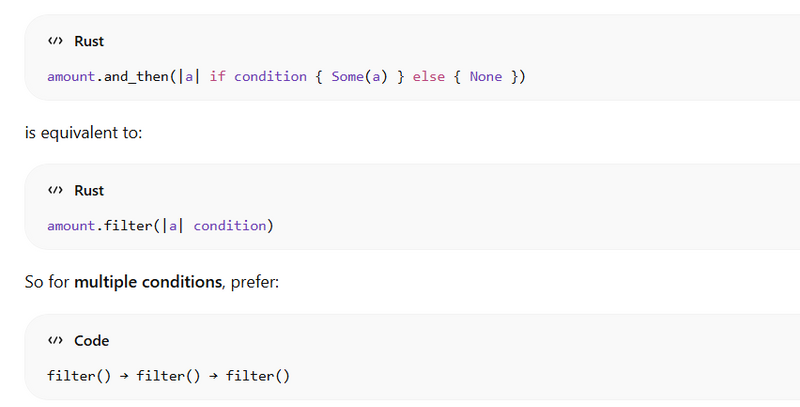
1️⃣ and_then ≡ filter
Syntax
amount.and_then(|a| if a > 0 { Some(a) } else { None })
Equivalent to:
amount.filter(|a| *a > 0)
Program
fn main() {
    let amount = Some(10);

    let result = amount.filter(|a| *a > 0);

    println!("{:?}", result);
}
Output
Some(10)
✅ 2️⃣ Multiple Conditions with and_then
Syntax
value.and_then(|v| {
    if cond1 && cond2 { Some(v) } else { None }
})
Equivalent to:
value.filter(|v| cond1 && cond2)
Program
fn main() {
    let num = Some(20);

    let result = num.filter(|n| *n > 10 && *n < 30);

    println!("{:?}", result);
}
Output
Some(20)
✅ 3️⃣ map vs and_then
Syntax
opt.map(|v| v * 2)
Used when returning value directly.
opt.and_then(|v| Some(v * 2))
Equivalent here.
Program
fn main() {
    let x = Some(5);

    let result = x.map(|v| v * 2);

    println!("{:?}", result);
}
Output
Some(10)
✅ 4️⃣ match vs if let
Syntax
match opt {
    Some(v) => println!("{}", v),
    None => println!("None"),
}
Equivalent to:
if let Some(v) = opt {
    println!("{}", v);
}
Program
fn main() {
    let val = Some(100);

    if let Some(v) = val {
        println!("Value: {}", v);
    }
}
Output
Value: 100
✅ 5️⃣ unwrap_or for Default
Syntax
opt.unwrap_or(default_value)
Program
fn main() {
    let val: Option<i32> = None;

    let result = val.unwrap_or(50);

    println!("{}", result);
}
Output
50
✅ 6️⃣ unwrap_or_else (Lazy Evaluation)
Syntax
opt.unwrap_or_else(|| compute())
Program
fn main() {
    let val: Option<i32> = None;

    let result = val.unwrap_or_else(|| 99);

    println!("{}", result);
}
Output
99
✅ 7️⃣ Combine Multiple Options in Match (Tuple Match)
Syntax
match (opt1, opt2) {
    (Some(a), Some(b)) => ...
    _ => ...
}
Program
fn main() {
    let a = Some(5);
    let b = Some(10);

    match (a, b) {
        (Some(x), Some(y)) => println!("Sum = {}", x + y),
        _ => println!("Missing value"),
    }
}
Output
Sum = 15
✅ 8️⃣ Using ? Operator (Shortcut for match)
Syntax
let v = opt?;
Equivalent to:
match opt {
    Some(v) => v,
    None => return None,
}
Program
fn double(opt: Option<i32>) -> Option<i32> {
    let v = opt?;
    Some(v * 2)
}

fn main() {
    println!("{:?}", double(Some(4)));
}
Output
Some(8)
✅ 9️⃣ ok_or Convert Option → Result
Syntax
opt.ok_or("error")
Program
fn main() {
    let val: Option<i32> = None;

    let result = val.ok_or("Value missing");

    println!("{:?}", result);
}
Output
Err("Value missing")
✅ 🔟 Chained Validation (Production Style)
Syntax
opt
  .filter(cond1)
  .filter(cond2)
  .map(transform)
Program
fn main() {
    let amount = Some(500.0);

    let result = amount
        .filter(|a| *a > 0.0)
        .filter(|a| *a <= 1000.0)
        .map(|a| a * 1.18);

    println!("{:?}", result);
}
Output
Some(590.0)
Project-Level / Real-Time Validation Examples (with output)
11) API: validate LoginForm fields before DB call
#[derive(Debug)]
struct LoginForm {
    username: String,
    password: String,
}

fn validate_login(form: &LoginForm) -> Option<&'static str> {
    match (form.username.trim().is_empty(), form.password.trim().is_empty()) {
        (true, _) => Some("username_required"),
        (_, true) => Some("password_required"),
        _ => None,
    }
}

fn main() {
    let form = LoginForm { username: "admin".into(), password: "".into() };

    match validate_login(&form) {
        None => println!("OK: proceed to DB check"),
        Some(err_code) => println!("ERR: {}", err_code),
    }
}
Output
ERR: password_required
12) Session validation: require user_id and role
fn ensure_session(user_id: Option<i64>, role: Option<String>) -> Option<&'static str> {
    match (user_id, role.as_deref()) {
        (Some(_), Some("admin" | "viewer")) => None,
        (None, _) => Some("missing_user_id"),
        (_, None) => Some("missing_role"),
        (_, Some(_)) => Some("invalid_role"),
    }
}

fn main() {
    let user_id = Some(101);
    let role = Some("guest".to_string());

    match ensure_session(user_id, role) {
        None => println!("OK: session valid"),
        Some(e) => println!("ERR: {}", e),
    }
}
Output
ERR: invalid_role
13) RBAC authorization check using match
fn can_access(route: &str, role: Option<&str>) -> Option<&'static str> {
    match (route, role) {
        ("/admin", Some("admin")) => None,
        ("/admin", Some(_)) => Some("forbidden"),
        ("/admin", None) => Some("unauthorized"),
        (_, Some(_)) => None,
        (_, None) => Some("unauthorized"),
    }
}

fn main() {
    let role = Some("viewer");
    match can_access("/admin", role) {
        None => println!("OK: access granted"),
        Some(e) => println!("ERR: {}", e),
    }
}
Output
ERR: forbidden
14) Validate pagination query params (page, limit)
fn validate_pagination(page: Option<i64>, limit: Option<i64>) -> Option<&'static str> {
    let p = page.and_then(|v| if v >= 1 { Some(v) } else { None });
    let l = limit.and_then(|v| if (1..=100).contains(&v) { Some(v) } else { None });

    match (p, l) {
        (Some(_), Some(_)) => None,
        (None, _) => Some("invalid_page"),
        (_, None) => Some("invalid_limit"),
    }
}

fn main() {
    match validate_pagination(Some(0), Some(20)) {
        None => println!("OK: pagination valid"),
        Some(e) => println!("ERR: {}", e),
    }
}
Output
ERR: invalid_page
15) Validate price and currency for checkout
fn validate_payment(amount: Option<f64>, currency: Option<&str>) -> Option<&'static str> {
    let amt = amount.and_then(|a| if a > 0.0 { Some(a) } else { None });

    match (amt, currency) {
        (Some(_), Some("INR" | "USD")) => None,
        (None, _) => Some("invalid_amount"),
        (_, None) => Some("currency_required"),
        (_, Some(_)) => Some("unsupported_currency"),
    }
}

fn main() {
    match validate_payment(Some(499.0), Some("EUR")) {
        None => println!("OK: payment request valid"),
        Some(e) => println!("ERR: {}", e),
    }
}
Output
ERR: unsupported_currency
16) Validate time-range for booking (start < end)
fn validate_time_range(start_min: Option<i32>, end_min: Option<i32>) -> Option<&'static str> {
    match (start_min, end_min) {
        (Some(s), Some(e)) if s < e => None,
        (Some(_), Some(_)) => Some("invalid_range"),
        (None, _) => Some("start_required"),
        (_, None) => Some("end_required"),
    }
}

fn main() {
    // 10:00 => 600, 09:30 => 570
    match validate_time_range(Some(600), Some(570)) {
        None => println!("OK: time range valid"),
        Some(e) => println!("ERR: {}", e),
    }
}
Output
ERR: invalid_range
17) Validate API key header (presence + length)
fn validate_api_key(key: Option<&str>) -> Option<&'static str> {
    match key {
        Some(k) if k.len() >= 20 => None,
        Some(_) => Some("api_key_too_short"),
        None => Some("api_key_missing"),
    }
}

fn main() {
    match validate_api_key(Some("short_key")) {
        None => println!("OK: api key valid"),
        Some(e) => println!("ERR: {}", e),
    }
}
Output
ERR: api_key_too_short
18) Validate JSON payload: required nested field (address.city)
#[derive(Debug)]
struct Address { city: Option<String> }

fn validate_address(addr: Option<Address>) -> Option<&'static str> {
    match addr {
        Some(a) => match a.city.as_deref() {
            Some(c) if !c.trim().is_empty() => None,
            _ => Some("city_required"),
        },
        None => Some("address_required"),
    }
}

fn main() {
    let addr = Some(Address { city: Some("".into()) });

    match validate_address(addr) {
        None => println!("OK: address valid"),
        Some(e) => println!("ERR: {}", e),
    }
}
Output
ERR: city_required
19) Validate file upload: allow only jpg/png (by extension)
fn validate_file(filename: Option<&str>) -> Option<&'static str> {
    match filename {
        Some(name) => {
            let ext = name.rsplit('.').next();
            match ext {
                Some("jpg" | "jpeg" | "png") => None,
                Some(_) => Some("unsupported_file_type"),
                None => Some("missing_extension"),
            }
        }
        None => Some("file_required"),
    }
}

fn main() {
    match validate_file(Some("avatar.webp")) {
        None => println!("OK: file allowed"),
        Some(e) => println!("ERR: {}", e),
    }
}
Output
ERR: unsupported_file_type
20) Validate DB result: user found + active + password match
#[derive(Clone)]
struct User {
    id: i64,
    username: String,
    password: String,
    active: bool,
}

fn validate_login_user(maybe_user: Option<User>, input_pass: &str) -> Option<&'static str> {
    match maybe_user {
        Some(u) => match (u.active, u.password == input_pass) {
            (true, true) => None,
            (false, _) => Some("user_inactive"),
            (_, false) => Some("wrong_password"),
        },
        None => Some("user_not_found"),
    }
}

fn main() {
    let user = Some(User {
        id: 1,
        username: "admin".into(),
        password: "1234".into(),
        active: true,
    });

    match validate_login_user(user, "9999") {
        None => println!("OK: login success"),
        Some(e) => println!("ERR: {}", e),
    }
}
Output
ERR: wrong_password
Multiple conditions inside and_then
let amt = amount.and_then(|a| {
    if a > 0.0 && a <= 10_000.0 && a.fract() == 0.0 {
        Some(a)
    } else {
        None
    }
});
✔ Conditions:
Must be > 0
Must be <= 10,000
Must not contain decimal value
Using filter() (Cleaner & Recommended)
let amt = amount
    .filter(|a| *a > 0.0)
    .filter(|a| *a <= 10_000.0)
    .filter(|a| a.fract() == 0.0);
Why better?
More readable

Each condition separated

Very production friendly
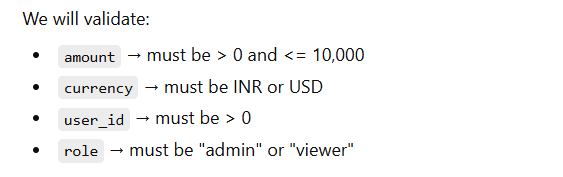
fn main() {
    let amount = Some(499.0);
    let curr = Some("USD");
    let user_id = Some(101);
    let role = Some("admin");

    // 1️⃣ Validate amount
    let amt = amount
        .filter(|a| *a > 0.0)
        .filter(|a| *a <= 10_000.0);

    // 2️⃣ Validate currency
    let currency = curr
        .filter(|c| *c == "INR" || *c == "USD");

    // 3️⃣ Validate user_id
    let uid = user_id
        .filter(|id| *id > 0);

    // 4️⃣ Validate role
    let valid_role = role
        .filter(|r| *r == "admin" || *r == "viewer");

    // 5️⃣ Match all 4 together
    match (amt, currency, uid, valid_role) {
        (Some(a), Some(c), Some(id), Some(r)) => {
            println!("OK: amount={} currency={} user_id={} role={}", a, c, id, r)
        }

        (None, _, _, _) => println!("ERR: invalid amount"),
        (_, None, _, _) => println!("ERR: invalid currency"),
        (_, _, None, _) => println!("ERR: invalid user_id"),
        (_, _, _, None) => println!("ERR: invalid role"),
    }
}
✅ Output (Valid Case)
OK: amount=499 currency=USD user_id=101 role=admin
Using match with guard (Very Clean Rust Way)
let amt = match amount {
    Some(a) if a > 0.0 && a <= 10_000.0 && a.fract() == 0.0 => Some(a),
    _ => None,
};
This is extremely readable and used often in real projects.
✅ 4.
Return different error messages per condition (Better for APIs)
If you want specific error reasons:
fn validate_amount(amount: Option<f64>) -> Option<&'static str> {
    match amount {
        None => Some("amount_required"),
        Some(a) if a <= 0.0 => Some("amount_must_be_positive"),
        Some(a) if a > 10_000.0 => Some("amount_too_large"),
        Some(a) if a.fract() != 0.0 => Some("no_decimal_allowed"),
        Some(_) => None,
    }
}
Output
match validate_amount(Some(20000.0)) {
    None => println!("OK"),
    Some(e) => println!("ERR: {}", e),
}
ERR: amount_too_large
This is real-world production style.
✅ 5.
Full Updated Payment Example (Multiple Conditions + Currency)
fn validate_payment(amount: Option<f64>, currency: Option<&str>) -> Option<&'static str> {
    match amount {
        None => return Some("amount_required"),
        Some(a) if a <= 0.0 => return Some("amount_must_be_positive"),
        Some(a) if a > 10_000.0 => return Some("amount_exceeds_limit"),
        _ => {}
    }

    match currency {
        None => Some("currency_required"),
        Some("INR" | "USD") => None,
        Some(_) => Some("unsupported_currency"),
    }
}

fn main() {
    match validate_payment(Some(499.0), Some("EUR")) {
        None => println!("OK: payment request valid"),
        Some(e) => println!("ERR: {}", e),
    }
}
Output
ERR: unsupported_currency
User Registration Validation (username + email + age)
fn main() {
    let username = Some("ashwani");
    let email = Some("test@gmail.com");
    let age = Some(22);

    let valid_username = username.filter(|u| u.len() >= 3);
    let valid_email = email.filter(|e| e.contains('@') && e.contains('.'));
    let valid_age = age.filter(|a| *a >= 18);

    match (valid_username, valid_email, valid_age) {
        (Some(u), Some(e), Some(a)) =>
            println!("OK: {} {} {}", u, e, a),
        (None, _, _) => println!("ERR: invalid username"),
        (_, None, _) => println!("ERR: invalid email"),
        (_, _, None) => println!("ERR: age must be 18+"),
    }
}
Output
OK: ashwani test@gmail.com 22
✅ 2️⃣
Product Order Validation (price + quantity + stock)
fn main() {
    let price = Some(1200.0);
    let quantity = Some(2);
    let stock = Some(5);

    let valid_price = price.filter(|p| *p > 0.0);
    let valid_quantity = quantity.filter(|q| *q > 0);
    let valid_stock = match (quantity, stock) {
        (Some(q), Some(s)) if q <= s => Some(s),
        _ => None,
    };

    match (valid_price, valid_quantity, valid_stock) {
        (Some(p), Some(q), Some(_)) =>
            println!("OK: order placed price={} qty={}", p, q),
        (None, _, _) => println!("ERR: invalid price"),
        (_, None, _) => println!("ERR: invalid quantity"),
        (_, _, None) => println!("ERR: not enough stock"),
    }
}
Output
OK: order placed price=1200 qty=2
✅ 3️⃣
Login Validation (username + password + role)
fn main() {
    let username = Some("admin");
    let password = Some("secret123");
    let role = Some("admin");

    let valid_user = username.filter(|u| !u.is_empty());
    let valid_pass = password.filter(|p| p.len() >= 8);
    let valid_role = role.filter(|r| *r == "admin" || *r == "viewer");

    match (valid_user, valid_pass, valid_role) {
        (Some(u), Some(_), Some(r)) =>
            println!("OK: login success {} {}", u, r),
        (None, _, _) => println!("ERR: username required"),
        (_, None, _) => println!("ERR: password too short"),
        (_, _, None) => println!("ERR: invalid role"),
    }
}
Output
OK: login success admin admin
✅ 4️⃣
Booking Validation (start_time + end_time + seats)
fn main() {
    let start_time = Some(600);  // 10:00 AM
    let end_time = Some(900);    // 3:00 PM
    let seats = Some(3);

    let valid_time = match (start_time, end_time) {
        (Some(s), Some(e)) if s < e => Some((s, e)),
        _ => None,
    };

    let valid_seats = seats.filter(|s| *s > 0 && *s <= 5);

    match (valid_time, valid_seats) {
        (Some((s, e)), Some(seat)) =>
            println!("OK: booking {}-{} seats={}", s, e, seat),
        (None, _) => println!("ERR: invalid time range"),
        (_, None) => println!("ERR: invalid seats"),
    }
}
Output
OK: booking 600-900 seats=3
✅ 5️⃣
Payment Validation (amount + currency + user_id + status)
fn main() {
    let amount = Some(499.0);
    let currency = Some("USD");
    let user_id = Some(101);
    let status = Some("active");

    let valid_amount = amount.filter(|a| *a > 0.0 && *a <= 10_000.0);
    let valid_currency = currency.filter(|c| *c == "INR" || *c == "USD");
    let valid_user = user_id.filter(|id| *id > 0);
    let valid_status = status.filter(|s| *s == "active");

    match (valid_amount, valid_currency, valid_user, valid_status) {
        (Some(a), Some(c), Some(id), Some(_)) =>
            println!("OK: payment {} {} user={}", a, c, id),
        (None, _, _, _) => println!("ERR: invalid amount"),
        (_, None, _, _) => println!("ERR: invalid currency"),
        (_, _, None, _) => println!("ERR: invalid user"),
        (_, _, _, None) => println!("ERR: account not active"),
    }
}
Output
OK: payment 499 USD user=101



Top comments (0)